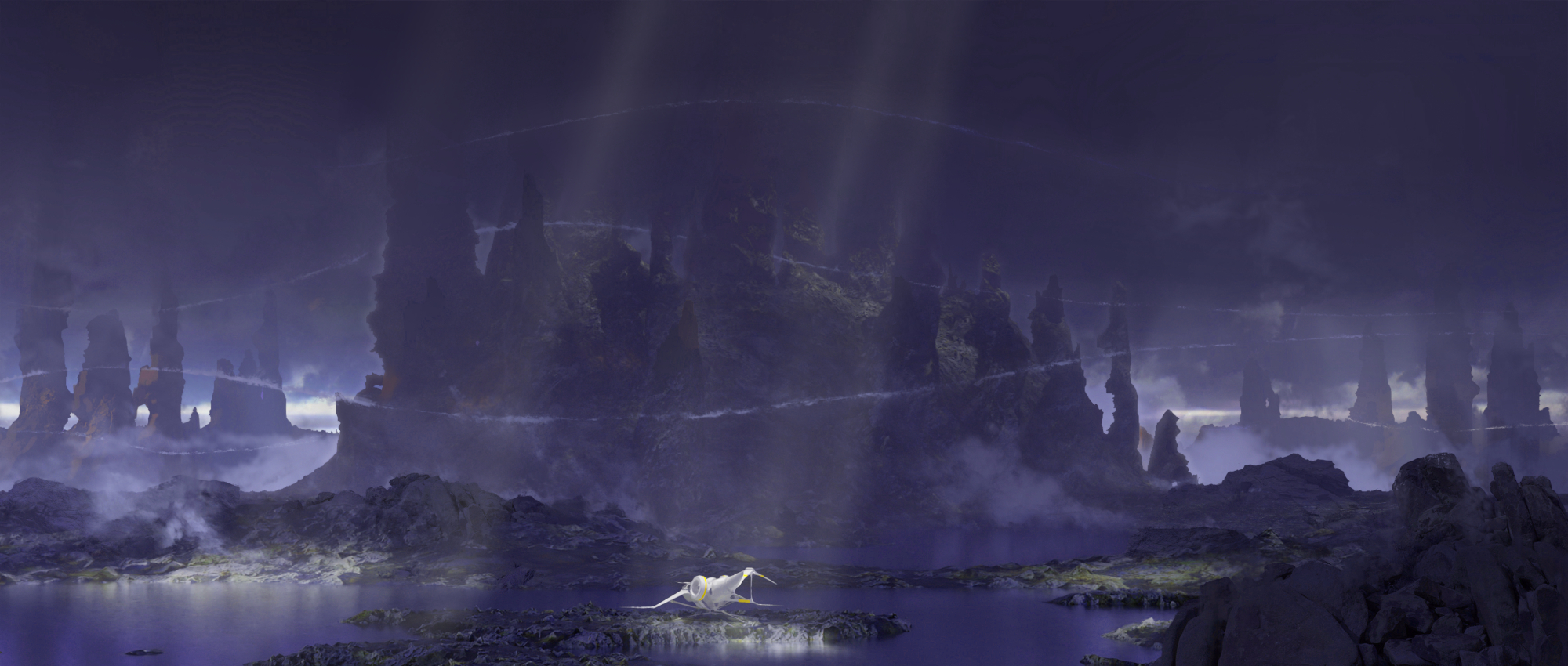
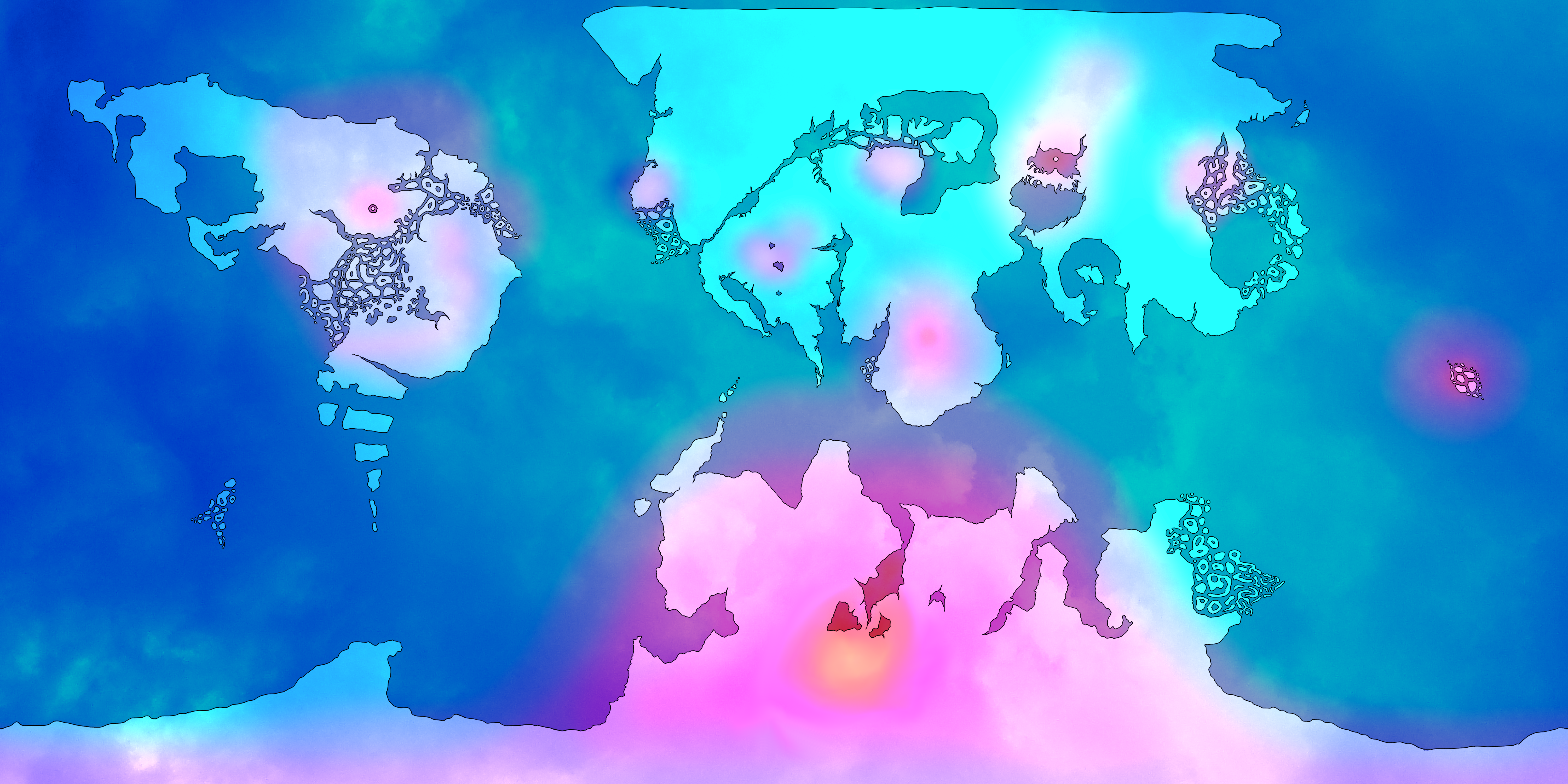
Jhoutai is the 2-mooned, ringed planet from which the Sazashi and Verin hail. Only an approximate 16% of the surface is land, with another 20% being Jhoutai Table Coral.
Cradle of Life
Like Eden, Jhoutai is a cradle of life. It is a rich, verdant world, replete with a massive menagerie of life even more varied than Eden both above and below the sea. It's a world that has not seen any extinction-level events, which means that the branches of the trees of evolution where never trimmed and so have only further exploded into increasingly strange expressions of life over time.
A Seed of Terraformation
With its many rich biomes Jhoutai is a rich basis by which to model many other worlds. Granted, drawing from Jhoutai certainly comes with its own risks and dangers—many of the creatures, bacteria, and flora within those ecosystems are less than friendly to Sophont life—but it's more important to settle a world before you concern yourself with thriving in it.
Sauluea
Introduction
Save for some outlying zones, Jhoutai is an extremely wet planet. While it would appear that 36% of the surface area of Jhoutai is solid landmass, the actual number is much closer to 16%; this is due to the presence of the most prolific life form on Jhoutai, Jhoutai Table Coral, which overlaps almost half of the landmass and extends it out by 20%.
This coral is the keystone of so many other species and ecosystems within the world. It is the basis of the Nege Trees, which run their roots through the corallums, as well as the Purpose Flower and countless more of the flora which Jhoutai is known for.
Civilization
Geology
Jhoutai's surface divided into 3 continental regions which subdivide into 64 georegions whose bounds are determined by the geoecological barriers—geography, climate, and coral growth.
Each ecoregion is a part of a larger tapestry. Bioprecipitation in the Nege-Tai Caldera may become Fog Floods in the Kajh-Tai deserts, and a hot day in the Khatoumay Steppes may make for a cold snap in the Valdutani Basin. It is all one system, one body.
Working from the left and moving clockwise, the 3 continents are: Verra, AmujnAlden, and FalguMer'rh. Verra is the cradle of life to the Verin, who created the Sazashi to help settle the other two. Today, the ValuSelu Pact owns all 3, but allows Verin to live on Verra as a reservation.
— From The Accounts of The AdventinesTrying to pin down an ecoregion schema is proving painful. It's a simple question, but our escort is a mix of four nations and by God there's a lot of politics buried in this topic.
I can see why, though. Jhoutai's coral covering doesn't exactly leave the surface replete with materials to mine. It sounds like that's what most of the border warring was about. They really got into it, too. There's a lot of ancient bad blood between Sazashi.
From its lofty peaks to its deep trenches, Jhoutai's topography is the weathered hide of a beast which has seen many battles. The surface is a shooting gallery for its asteroid belts, and extreme temperatures and tempestial storms have made erosion an art form.
Altough Jhoutai's landmass is mostly coral (detailed ahead), there is still an underlying foundation of planetary crust upon which that coral grows. In some places, crust punctures the coral, reaching up into severe crags and uneven plateaus.
Jhoutai’s topography is marked by several important mountain ranges: The Faur’rdar’rian Mountains, the Mar’rianiyan Spine, the Verra Highlands, the Valu Divide, the Aempian Skyreach and the Pillars of Kajh-Tai.
After a bloody revolution against the Ancient Haimarchy, the Sazashi nations drew their borders acording to georegional surveys conducted by the Haimarchy.
Millenia later, challenging the accuracy of the survey meant challenging a nation's claim to its land. This was finally settled in #### with an updated signing of the ValuSelu Pacts.
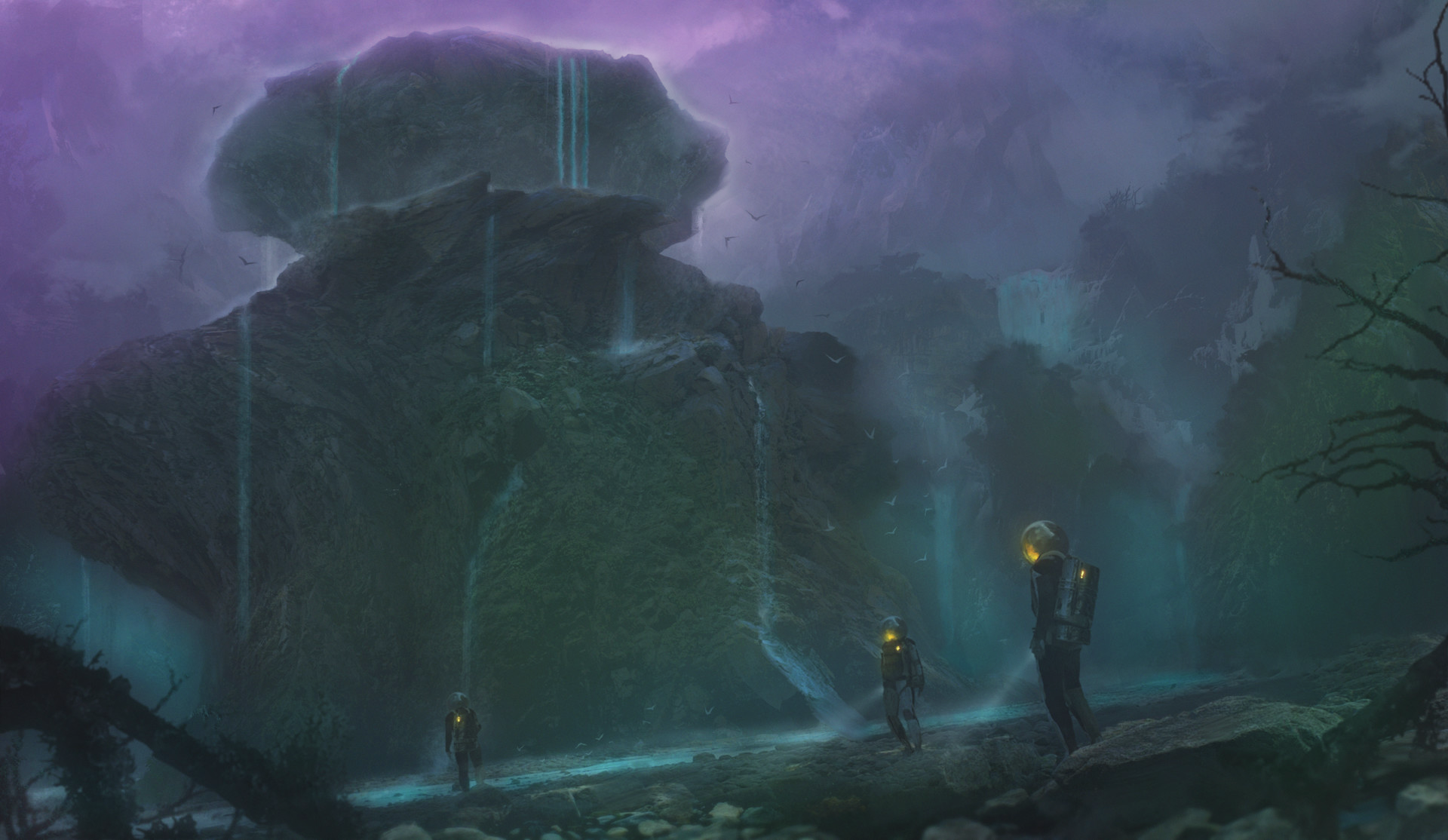
Ecology
Continental Coral
Jhoutai is host to many Communal Organisms and holobiont, collectively named "Gigaforms". These gigaforms are the keystones of the entire planet's ecosystem, and are each treated as their own natural force.
Gigaforms are the basis of many Terraformation methods, as they are naturally prescient at adapting minerals into dirt, and dirt into life.
These gigaforms would envelop Earth in years if they could survive our ecosystem.
They are natural wonders of the fertility nature of Jhoutai—a world of uncontrollable life.
Jhoutai is host to such alien and mighty organisms that to attempt to classify them as strictly flora or fauna, or to pin them with the 'mega-' prefix, does a disservice to their unique nature and gargantuan size.
These organisms, hereafter referred to as Gigaforms, shape every aspect of Jhoutai by their very presence. They may very well represent some of the oldest evolution patterns on the planet, and are considered key to understanding the origin of life on Jhoutai.
While there are many region-specific species and subspecies, the two Gigaforms which most deeply shape Jhoutai are Nege Trees and Jhoutaioan Coral.
Continental Variants
Jhoutaioan Coral is centerpiece to the Jhoutaioan ecosystem. Not only does it create the landscape upon which all other life subsists, but it is in eternal concert with that life—both as provider and consumer.
There are several subspecies of naturally occurring Jhoutaioan Coral, and several more which are derived from them and adapted to rapid growth for use in terraforming other worlds.
Without the coral serving as the bedrock of the world, most terrestrial life, including the Verin and Sazashi, may never have existed, let alone grown into Sophonce.
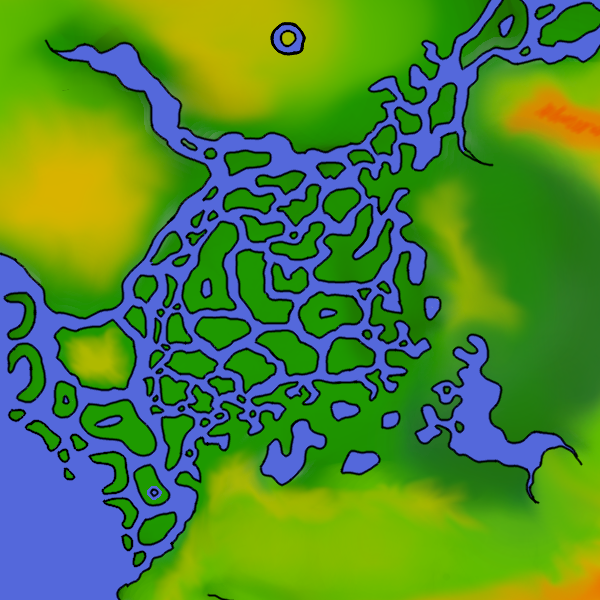
Grows into massive mounds. As these mounds age, hollow, and collapse, they leave behind ring-shaped craters miles wide.
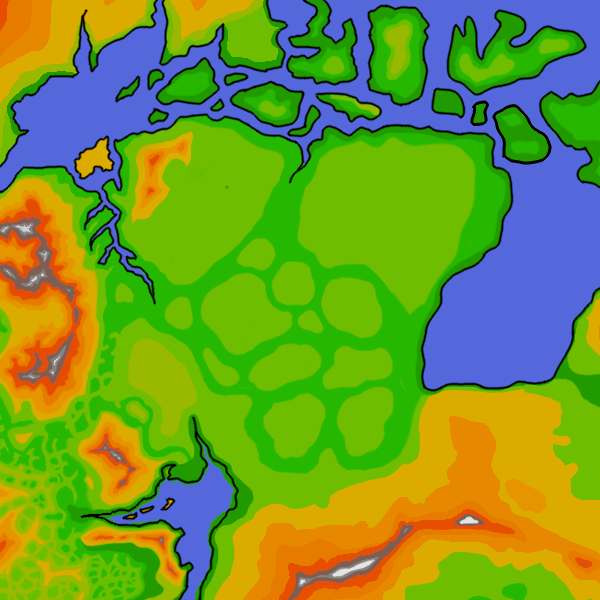
Spreads a wide base and then grows kilometers thick. 100s of kilometers of corralums, weave through them.
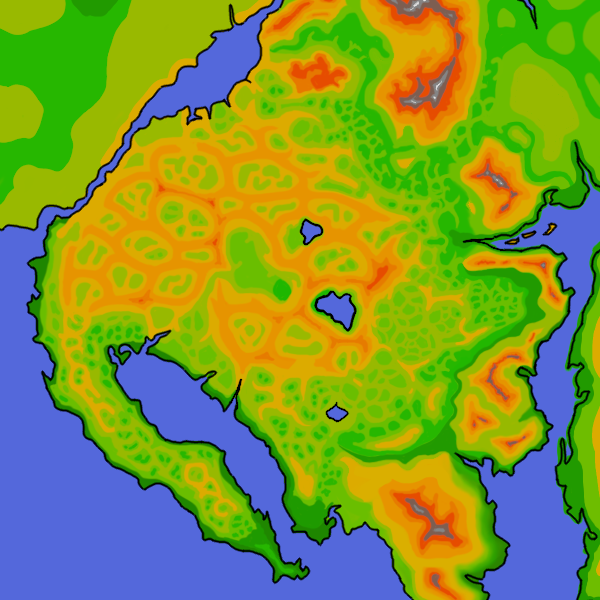
Spreads out in meandering, cellular patterns which grow up and over each other until they solidify into chambers.
Strata
Surface
Canopy
Understory
Abyssal
Nege Trees
Nege trees are colonial organisms comprised of many zooids. On top of being a part of an ecosystem, they are an ecosystem unto themselves. For all their dangers and disorientation, Nege trees can make for rich habitats. There's no shortage of resources within Nege forests.
From The Accounts of The AdventinesIt's very alien, being inside of another organism. You'd think it would be comparable to a forest, but no. At least in the deepest rainforests on Earth you can look up and see sky above the canopy. Inside of a Nege the only light is from biolume, and that comes from every which direction. It's like being in a city, at night, but everything is humid, and alive, and twisting.
I don't know how the natives live here, let alone thrive. I get motion sickness just looking around, yet they traverse up, down, and across the somacyst axons with ease.
Accounts of The AdventinesPutting these notes down before I forget them...
Nege trees are found above the aquifers and cisterns of the labyrinthine corralums. They begin as "whogs" probing their roots into the corralums in search of nutrients and water. If they find a good source, these hollow roots will grow in diameter to fill the entire tunnel, and will siphon water up. The natives call these "whog ways" and grow algae in them.
Where the sun strikes the outermost entanglement of somacysts, they form a bark-like skin and grow together into a shell around the entire system.
As the tree matures, the cysts diversify. Some become storage for water, while others secrete a digestive acid the natives call "slog", which is sticky and attracts insects and other small creatures to trap and digest. Tall vertical shoots develop fronds which capture and convert the solar energy.
There's a lot of ways they're not like trees, but they look close enough and so that's the name that stuck.
Slime Mold
Celestial Features
Moons
Asteroid Belt
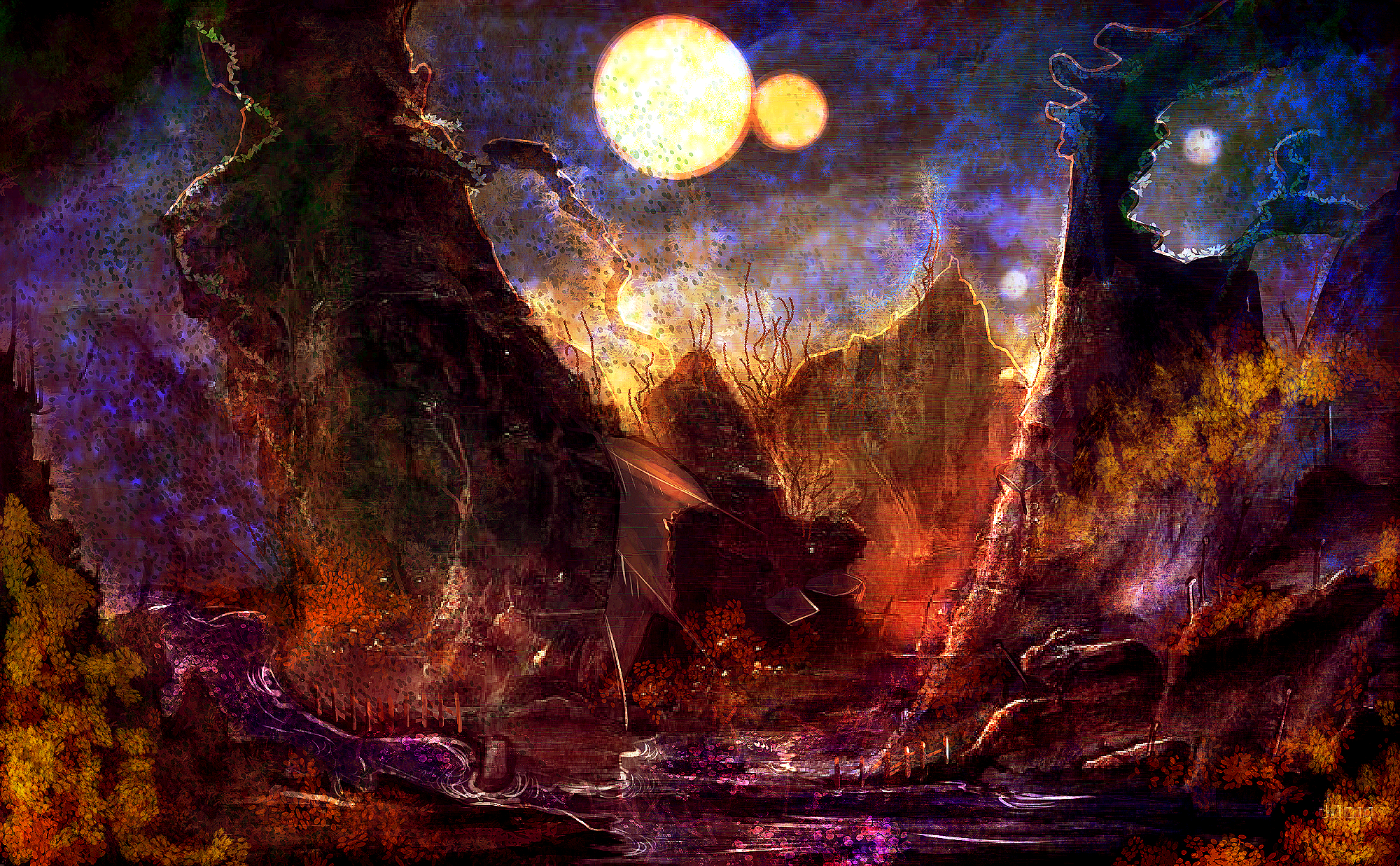
People once believed that the ring, a perfect circle to the naked eye, was evidence that The Wheel has chosen Jhoutai for a higher cause.
One of the most striking features about Jhoutai is the presence of an asteroid belt circling its equator. This influences its tides, temperature, and the ability for ships to take off and reach orbit—part of why the Verin had such difficulty originally visiting space.
Ancient peoples would use the shadow of the ring to determine the time of day, and determined early into their history, by the ring's shadow, the size and shape of the world.
Climate

Jhoutai's landmass appears equal-to or even greater-than that of Eden, yet is more wet. This is because most of the landmass is hollow coral.
Corralums are natural tunnels bored into the coral by bacteria, and are a critical part of the global ecosystem. They permit nutritious seawater and aquatic life to reach thousands of kilometers inland. Only an ~15% of the landmass is without water near to its surface, which keeps the planet extremly wet.
This coral, as well as similar organic gigaforms, the shadow of the planetary asteroid belts, bioprecipitation, and pollution factor into Jhoutai's tumultuous climate.
Contributing Factors
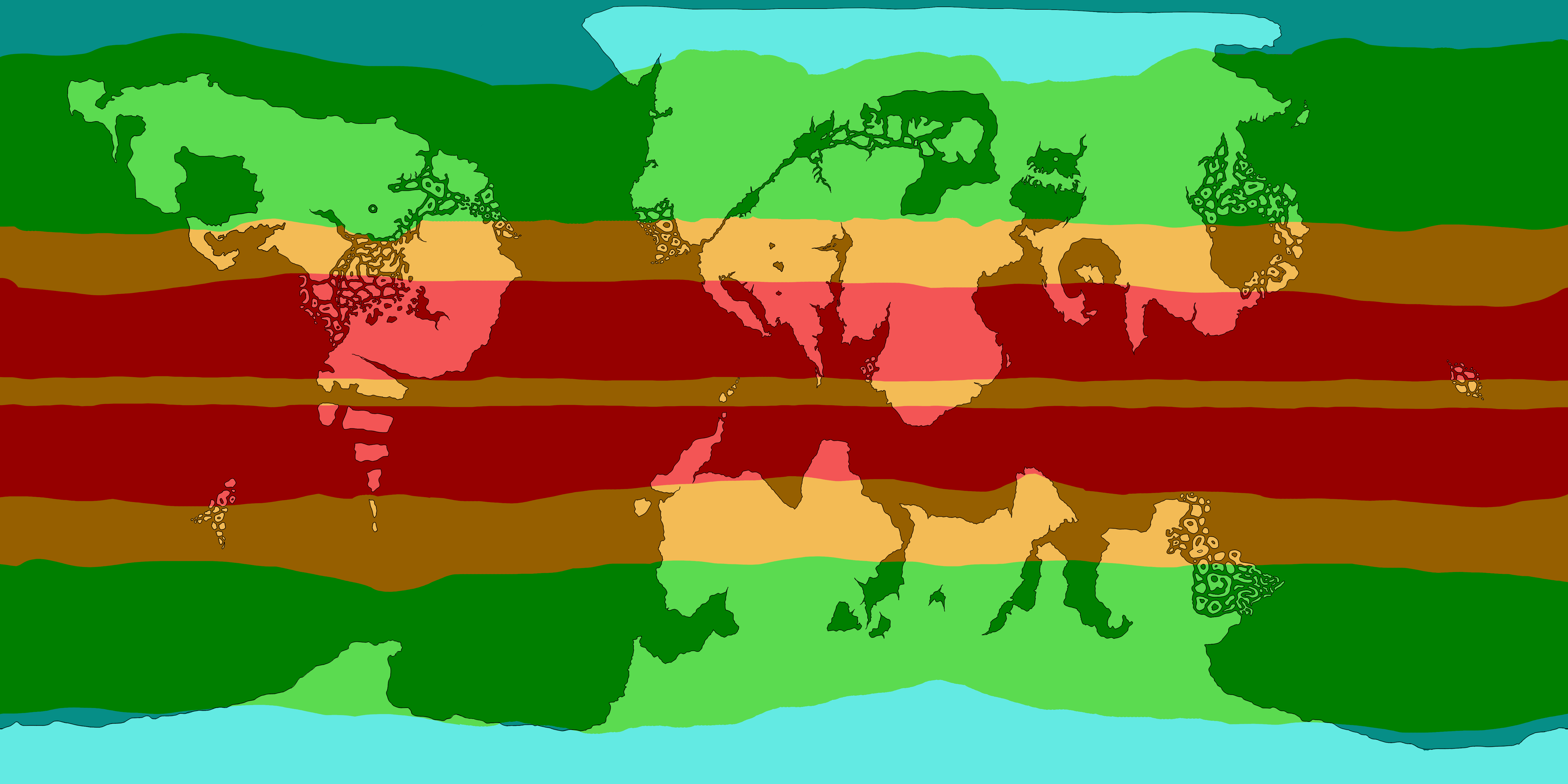
Looking solely at the record extremes of Jhoutai,-100°C to 60°C, doesn't do justice to understanding the variance and severity of climes across Jhoutai.
For example, it's harsher deserts reach 40-55°C range in summer, and the valleys and crevasses of the polar ranges average a frigid -45°C.
Jhoutaioan Coral and the Nege Trees are the primary source of bioprecipitation, and are responsible for seeding 70-80% of the rainfall on Jhoutai.
These forces are such an integral part of the Jhoutaioan ecosystem that they are considered an essential part of the ValuSelu Pact's terraforming toolkit.
Jhoutai is not without its wounds of battle or its industrial malaise. Pollution and war have taken their toll on the climate. Only in recent centuries has it seen repair.
There are many instances, but the chief one is a decrease in global rainfall and temperature after the Valuser'rh razed the Khatoumay Nege forest during a civil war.
Aside from their effect on bioprecipitation, the gigaform organisms of Jhoutai are so massive that they change the flow of the currents of the sky and the sea alike.
Nege forests, some over 800m high and reaching kilometers across, reshapes the sky while Jhoutaioan Coral pushes out against the sea incessantly.
Accounts of The Adventines
I write this hunkered down in the lobby of an upscale hotel provisoned to us by our generous host, Emporer Akotan.
I am grateful to him for the grant to study in his country. I've never slept in a more comfortable bed, and the food is so rich I feel guilty eating it, so I say this with only respect for him and his people:
Aempians, and I suspect all Jhoutaioans, are totally mad.
In all my years studying typhoons in Singapore I never saw storms like happen here. Aempis suspends its cities on a scaffolding of towers instead of building at ground level. I see why now. A lush forest grows between the towers; today only their tallest crowns crest a raging river.
With each roaring squall I fight the urge to run, screaming Mary, to higher ground. The Aempians enjoy my terror.
Notable Climate Features
Shaped by the extreme topography of the Nege and Coral, and perpetuated by the extreme temperatures, the pressure fronts of Jhoutai can sweep in suddenly, bringing temperature shifts of up to 40°C.
Life on Jhoutai must be well adapted for barometric shifts, lest a sudden shift in temperature kill them.
Tidal forces, displacement, and seismic activity periodically push freezing floods of water out of the corralums.
The freezing blast creates dense fog in warmer regions, veiling a flood of water and whatever pockets of poisonous gasses may have been dredged up by the flood.
Similar to fog floods, but vertical and less lethal. Fog Geysers are stunning to behold, as rainbows cascade in their wake.
These geysers, and the cisterns the spout from, are rare enough to be coveted by the wealthy and the spiritual.
This phenomenon, which means "Hell bridging earth and sky" is the perfect confluence of pressure systems, climes, and fog floods.
There are several kinds of hellstorm, each with their own features and terrors.
Accounts of The Adventines
I'm don't want to go home yet, but I'll have to anyway. I'm writing this in an infirmary, high on whatever pain meds they gave and reading the other ongoing accounts.
If any of you think you've got it bad, you should know that I just got pulled out of a flood of mud onset by nothing less than GLASS RAIN. Say it with me: GLASS. RAIN.
I owe my life to the guide. I was exploring a corralum when a fog flood swept me up. I broke some bones slamming into rocks and getting twisted in what was by now a mud flood. Our guide fished me out, but not before the storm flayed off a few layers of skin from my face and back.
This is going in the history books. I am so embarassed.
Metaphysical Perils
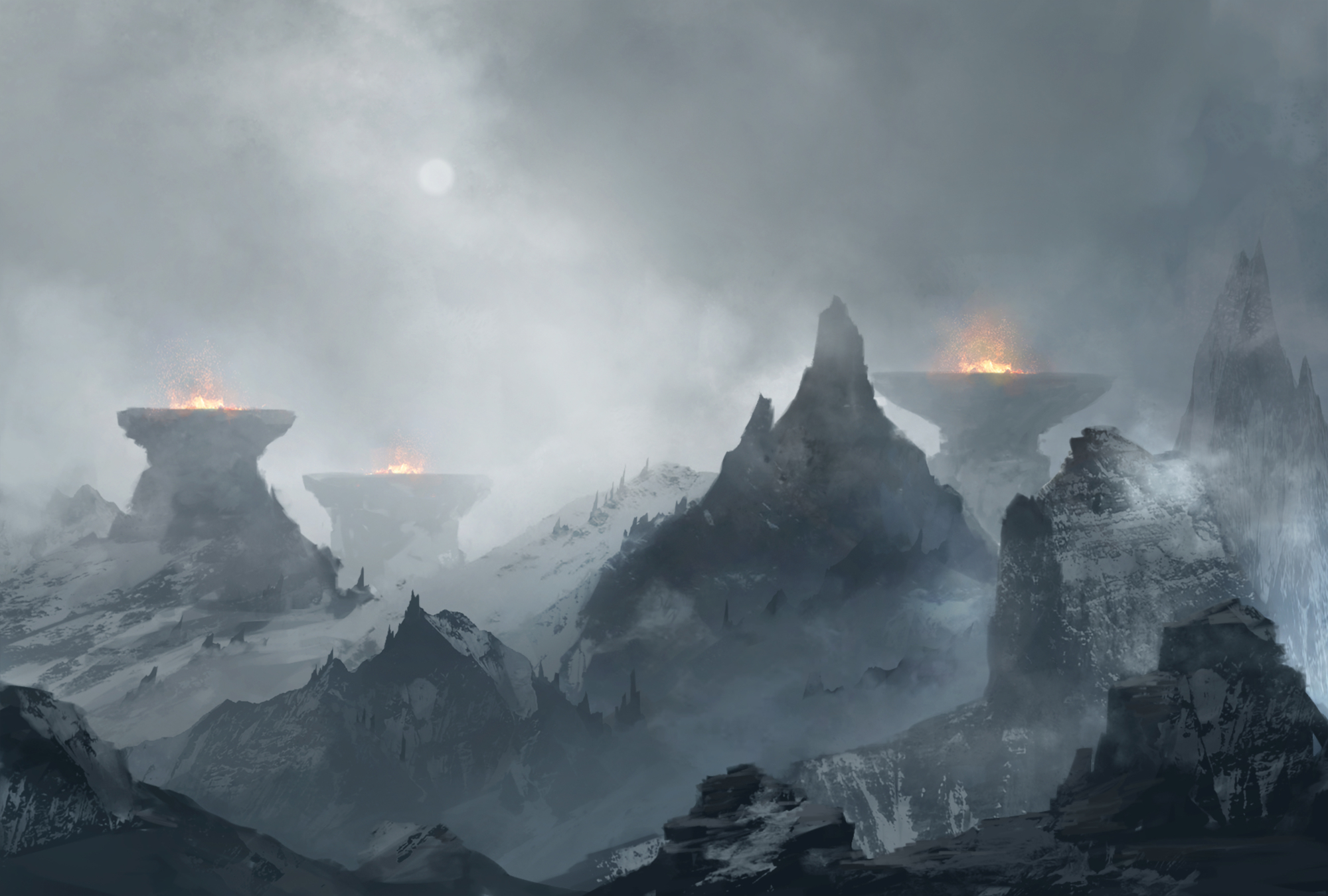
As the first planet with access to The Meta, Jhoutai has experienced many unfortunate stumbling blocks dealing with an incomplete understanding of the Meta.
Some of these perils are the result of disaster, most are the result of thousands of years of Meta building up and adopting unforseen behaviors.
In places of great misery or of great joy, an Echo of the Soul remains. Left unchecked, these may spiral into such terrors as Selschaeus Deposits and Sanity Marches. Measures can be taken to counter this, but Jhoutai has many hidden scars and bruises leftoever from finding this out.
There are places on Jhoutai you simply do not visit.
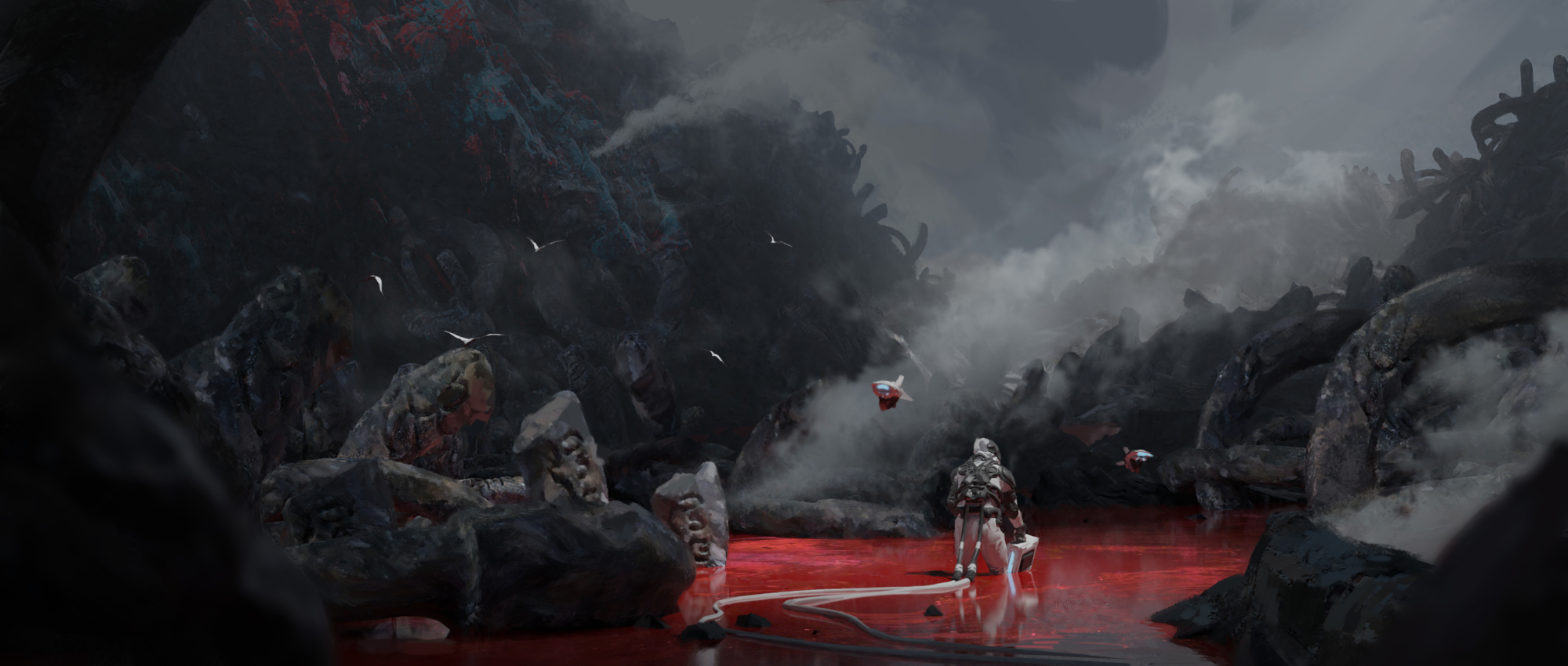
Jhoutai is a cruel world of cruel people.
We are 12 days and 9 deaths into the survey of the previously forbidden FalguMer'rh Region, a region I lobbied aggressively to survey. They agreed, under the stipulation that they would'nt supply guides.
A willful death sentence, in retrospect.
I will spare you the gruesome details of our journey so far, reader—if even this is ever read. We found wonders of magic here, and were possessed to go deeper. Now, we are in land where its rains blood, where there is no sun, yet beyond the hills an eternal red dawn beckons.
Our equipment is gradually failing, even the flashlights. I hear mumbling in the dark, the voices of our dead.
Lana, I love you. Give our boys my best.
Farewell.


Comments