
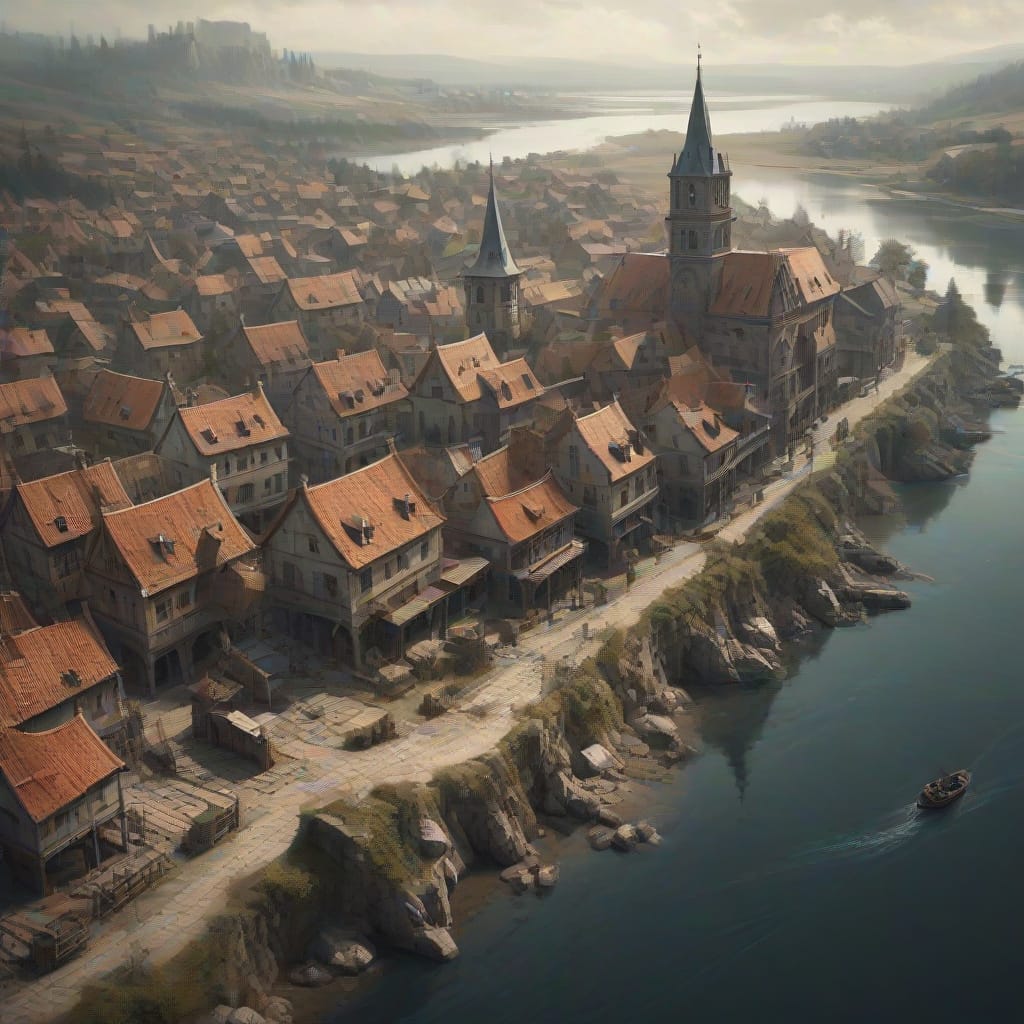
Teryk
Teryk is the seat of the Principality of Terykova, nestled against the Lash River at the edge of the Shadowmount Forest. It thrives on its position along the Orien Trade Road, yet retains an insular, tight-knit culture shaped by generations of hardship and the scars of the Last War.
Its government is dominated by the Domn ir’Filipek, whose word carries the weight of his station. The town’s nobles jockey for influence beneath him, forming a precarious web of alliances and rivalries that define local politics.
Demographics
- Population: 5,361
- 79% Human
- 9% Dwarf (Galifarian 50%, Kundarak 20%, Mror 30%)
- 5% Halfling (Talentan 35%, Urban 65%)
- 3% Half-Elf (Elf-raised 10%, Human-raised 30%, Khoravar 60%)
- 2% Elf (Aerenai 30%, Drow 10%, Khorvaire 40%, Tairnadal 20%)
- 2% Other
- Population Breakdown
- 3,873 working adults
- 1 Captain, 2 Lieutenants, 4 Sergeants, 28 Guards, 268 Militia (conscriptable)
- 317 Children
- 32 Elderly
Government
The Nobility of Teryk
- House Filipek (Princes of Terykova)
- Domn Stosla ir’Filipek, Middle-Aged Male Human – Soldier-lord, pragmatic and hard-edged.
- Lady Sofiya ir’Filipek – Administrator and political mind of the family.
- House Bartek (Representative of Starýhrad district)
- Barness Katarina ir'Bartek, Middle-aged female human - keeper of traditions, and de facto steward of the town’s oldest defenses.
- House Cermak (Representative of Novýtrh district)
- Baron Normgath ir’Cermak, Old Male Dwarf – Controls ferries and river tariffs. Profits handsomely from the Lash’s trade, though his methods skirt legality.
- House Zupan (Representative of Železniční district)
- Baron Durrim ir’Zupan, Old Male Dwarf – Oversees mining concerns in the Ashen Spires foothills. Known for shrewd dealings with the Mror clans.
- House Kohut (Representative of Božičtvrť district)
- Dame Yuliana Kohut, Venerable Female Human – Beloved matriarch with ties to Arawai’s clergy. Though frail, her voice carries weight among townsfolk.
- House Ionescu (Representative of Poljane district)
- Rytíř Ludvik Ionescu, Male Human – Commands the “Brass Battalion,” a contingent of the Karrnathi Army stationed at Fortress Starýhrad by the Crown.
- House Rusnak (Representative of Riečna district)
- Sir Julian Rusnak, Male Human – Watch captain of Teryk Gauntlet. His family holds little land but commands loyalty through policing and law enforcement.
The Rule of Teryk
Though Domn Stosla ir’Filipek is the hereditary lord of Terykova Principality, the actual governance of the town rests on a careful balance between him, his appointed Județ, and the lesser nobles who represent the six districts of the town. In practice, Stosla sets the tone—his name carries authority, his banner flies over the manor, and his word is final—but it is Județ Dorin Varga who ensures that order is maintained.
The Județ acts as both mayor and supreme judge, chairing the town’s council sessions and ruling on all serious disputes. Day-to-day administration flows through his office: trade tariffs, civic projects, militia organization, and interpretation of Karrnathi law. While Domn Stosla presides at ceremonies, tournaments, or public gatherings, it is often Județ Varga who quietly drafts the policies that shape the town.
Each of the six noble houses of Teryk oversees a district of the town, acting as representatives of its people and extensions of the Domn’s authority. These nobles are responsible for everything from collecting taxes and organizing levies to maintaining streets, bridges, and wells. In return, they are granted prestige, stipends from the principality’s treasury, and the right to field their own household guards.
The council of governance is thus a hybrid body: the Domn presides ceremonially, the Județ moderates and enforces law, and the six nobles bring forward the needs of their districts. Together, the eight voices form a ruling chamber, though everyone knows who truly keeps the wheels of the town turning—Varga, with his iron grasp of law and ledger, and his ability to rein in both the Domn’s whims and the nobles’ ambitions.
For the people of Teryk, the system provides stability. They know that appeals for justice or trade disputes will land before the Județ; that levies and taxes, while heavy, are predictable; and that their nobles can be approached for local grievances. The result is a town that runs with military precision, tempered by the quirks of noble politics and the shadow of Domn Stosla’s prideful but hesitant rule.
Defences
Teryk’s defenses are spoken of with equal parts respect and unease throughout the principality. At its heart rises the Old Fortress of Starýhrad, an angular mass of black granite that dominates the river bend. Though only a portion of its halls are still occupied, its curtain walls remain intact, their battlements bristling with crenellations and fitted with arrow slits that cover every approach. The fortress is both residence and final refuge: in the event of invasion, nearly three-quarters of the town’s population can be sheltered within its outer bailey, though overcrowding and shortages would swiftly follow.
The town wall, constructed of heavy stone blocks faced with timber reinforcements, forms a tight ring around the central districts. It is not so tall as the fortress walls, but it is stout, patrolled by regular watch and punctuated by four gated bastions. Each gatehouse is double-doored and ironbound, with killing grounds between. The gates leading to the Orien Trade Road and the lightning rail station are the most heavily fortified, as the lifeblood of Teryk depends on their security.
Within, the Teryk Gauntlet serves as the professional guard force, numbering just over thirty trained men-at-arms under Sir Julian Rusnak. They are supported by nearly three hundred conscriptable militia, drilled with grim Karrnathi discipline and accustomed to fighting in shield-wall formations. When summoned, each noble family is expected to field its own household retainers and sworn men, adding another layer of defense. Rytíř Ionescu’s so-called Brass Battalion, though more parade unit than true army, is nonetheless composed of hardened veterans who know how to hold a line.
Strategic placement enhances these defenses. St. Godzimira’s Parish, a temple to Dol Dorn, doubles as a keep, its thick buttressed walls and watchtower guarding the southern district. Along the Lash River, stone quays are fitted with chains and barricades that can be drawn to prevent riverborne assault. Beyond the town itself, a half-dozen ruined Dhakaani watchtowers still stand, their lines of sight overlapping. Though most are abandoned, local patrols occasionally use them as forward outposts, and more than one would-be raider has learned to fear their silhouette against the horizon.
Industry & Trade
Trade is the lifeblood of Teryk, and its streets hum with the rhythm of commerce. The Orien Trade Road cuts straight through the town, bringing caravans from Korth and Vulyar, while the lightning rail station ensures a steady stream of goods and travelers. What cannot be made locally is imported, taxed, and resold at a premium, making Teryk’s markets richer than most towns of its size. The central Market Ward is a constant bustle: drovers unloading wagons, Orien agents negotiating tariffs, and guildsmen haggling over stock.
The town’s primary industries lie in ironworking, lumber, and farming, bolstered by nearby resources. Softwood from the fringes of the Shadowmount Forest fuels carpenters, roofers, and ropemakers, while iron ore from the Ashen Spires feeds the forges of four blacksmiths and several armorers. Base metals like lead and tin also find their way into smelters, producing tools and trade bars for export. Butchery and cattle raising flourish in the outer districts, where ranches provide high-quality beef and poultry prized across Karrnath. Though the land has not yet recovered from the Last War, Teryk’s stubborn farmers have managed to restore a steady flow of grain, barley, and root vegetables, with vineyards and breweries slowly reclaiming their prewar prominence.
Teryk is also a hub of specialty crafts. Tanneries and cobblers churn out sturdy boots for Orien teamsters and soldiers on the march. Tailors, dyers, and scribes cater to the noble houses and guild officials, while brewers and vintners ship barrels upriver. The presence of many brothels, though whispered about, brings steady coin from travelers who linger between caravans. House Kundarak maintains discreet vaults for merchants dealing in gemstones from the Ashen Spires, while Deneith hirelings and mercenaries often pass through, exchanging wages for arms and drink.
Trade in Teryk is not free-flowing but heavily regulated. Every wagon, crate, and barrel is tallied by the town’s trade guild, whose officials extract stiff tariffs and enforce strict quality standards. This makes business costly but secure: merchants know that goods purchased in Teryk are reliable, and caravans that depart are protected by local militia until they reach safer roads. In this way, the town has earned a reputation as a place where trade is clean, orderly, and—if somewhat expensive—trustworthy.
Districts
Teryk stands as both fortress and crossroads, its infrastructure shaped as much by war as by trade. The town’s foundation lies in Starýhrad, the Old Fortress District, where Domn Stosla ir’Filipek rules from his ancestral keep. The district has been carefully watched over by House Bartek for generations, having been instrumental in the foundation of the original fortress. This stone-walled compound dominates the hill at Teryk’s center and houses not only his family but also the archives, council chambers, and barracks for the town guard. Narrow cobbled lanes wind outward from the keep, lined with tall, steep-roofed homes, guildhalls, and the oldest workshops — a constant reminder of Teryk’s roots as a stronghold first, a town second.
To the south sprawls Novýtrh, the New Market District, where merchants gather beneath the banners of the trade guilds. Its broad market square teems with stalls selling lumber, iron, wool, and livestock, as well as foreign goods arriving overland. Warehouses crowd its edges, many owned or taxed by Baron Normgath ir’Cermak, who enriches himself through tariffs and guild contracts. Here, travelers find the inns and taverns that make Teryk a welcoming pause on the long Orien trade road.
Modern ambition rises in Železniční, the Ironward, where the lightning rail freight station stands as a monument to both progress and pragmatism. Baron Durrim ir’Zupan commands this district like a clever spider sitting in his web, earning him is popular nickname, "The Old Spider". Brick warehouses, iron-bound platforms, and paved boulevards mark this district as something new in Karrnath, humming with commerce and military logistics. The ward has a raw, industrial energy, its smoke and sparks a sharp contrast to the medieval heart of the town.
Spiritual and defensive life centers on Božičtvrť, the Holy Quarter, anchored by St. Godzimira’s Parish — a fortress-like church of Dol Dorn with thick walls, arrow slits, and bell towers doubling as watch posts. This district is the soul of Teryk, with cloisters, almshouses, and shrines crowding the streets. Dame Yuliana Kohut, a venerable knight of faith, oversees both religious observance and the training of warrior-clerics. In times of danger, Božičtvrť serves as a rallying point, its stone buildings capable of resisting assault nearly as well as the Domn’s keep.
Beyond the walls, Poljane, the Southern Fields, spreads into patchwork farms, ranches, and granaries. Rytíř Sir Ludvik Ionescu and his “Brass Battalion” enforce strict order, ensuring goods and soldiers alike flow through the station without delay. Cattle and poultry have largely supplanted exhausted croplands. The war left much of the soil fallow, but the ranchers’ beef and chickens are prized across the region, their reputation for quality nearly matching Karrnathi steel. Watchtowers guard the roads and barns, giving the countryside a military cast even in times of peace.
Finally, the Riečna, or Riverside Ward, stretches along the banks of the Lash. Its docks creak with barges, ferries, and fishing boats, while watermills churn grain into flour for the markets. Fishmongers, ropemakers, and boatwrights crowd the muddy streets, their livelihoods tied to the river’s currents. Sir Julian Rusnak, the town’s watch captain, serves as both noble patron and lawkeeper here, ensuring tolls are paid and smuggling curbed. The riverside is often Teryk’s rowdiest quarter, but it is also its lifeline, linking the town to settlements up- and downstream.
Together, these six districts weave Teryk into a single whole: a garrison town turned regional hub, fortified by necessity, but alive with commerce, culture, and the lingering scars of war. Its walls and watchmen keep it secure, its markets and railways keep it thriving, and its nobles — bickering though they may be — bind it together under the watchful eye of Domn ir’Filipek.
Assets
In the eyes of Karrnathi chroniclers, Teryk is more than a frontier town—it is a bulwark of discipline and a beacon of trade. Its greatest strength lies in the Old Fortress of Starýhrad, a granite keep whose walls have never been breached. From within its towers, Domn Stosla ir’Filipek commands the town garrison: a cadre of seasoned guards and knights, supported by a militia drawn from nearly every household. The surrounding walls, high and black against the horizon, speak of Karrnath’s long tradition of martial vigilance, while the bastions of St. Godzimira’s Parish serve both as sanctuary and redoubt, keeping watch over the southern roads.
Yet Teryk’s value is not solely martial. Its location at the meeting point of the Orien trade road, the lightning rail, and the Lash River has made it a crossroads of the realm. In the east, warehouses and markets bustle with the exchange of wool, iron, cattle, and poultry, while the docks along the river bring grain and lumber downstream from the hinterlands. To the south and west stretch ranches and fields, where hardy crops of rye and barley grow in the shadow of smokehouses and dairies, providing the salted meat and cheese that feed soldiers and merchants alike.
The soul of the town rests in its people and their faith. The priests of Dol Dorn and the Sovereign Host rally the spirits of the weary, while Rytíř Ionescu and his knights remind all who dwell here of their sacred duty to Karrnath. Each noble family adds its own weight to the scales—Domn ir’Filipek with his command of arms, the barons ir’Cermak and ir’Zupan through wealth and food, Rytíř Ionescu commanding the Battalion, Sir Rusnak keeping the river safe, and Dame Kohut tending to the souls of both soldier and merchant. Even beneath its cobbles, the crypts whisper of Karrnath’s darker legacies, a reminder that Teryk’s foundations are as steeped in death as in duty.
Guilds and Factions
The Trade Guild
The most powerful faction in Teryk, the Trade Guild holds the keys to the town’s prosperity. Every wagon, shipment, and contract that passes through the market is subject to their tariffs. Their guildhall in Market Ward is a fortress of ledgers and coin-lockers, where deals are struck under the eyes of sharp-eyed clerks and heavily armed guards. While the guild ensures fair weights and measures, it is infamous for squeezing merchants with steep fees. Still, few complain too loudly—membership grants protection, connections, and the right to sell in Teryk’s lucrative market.
The Smiths’ and Miners’ Fellowship
Drawing ore from the Ashen Spires and shaping it in Teryk’s forges, the Smiths’ and Miners’ Fellowship wields quiet but steady influence. Blacksmiths, masons, armorers, and miners band together under its banner. They supply tools, weapons, and trade goods not only to the town but to the armies of Karrnath. The Fellowship is fiercely protective of its privileges; outsiders seeking to open a forge in Teryk without approval risk “accidents” in their workshops.
The Ranchers’ and Butchers’ Circle
Beef and poultry from Teryk’s hinterlands are prized across Karrnath, and the Circle ensures that reputation remains untarnished. Ranchers, butchers, and brewers form its core, focusing on quality stock and foodstuffs. They often clash with the Trade Guild over taxation, insisting that their goods feed both citizen and soldier alike and deserve lighter levies. Their symbol—a stamped iron cleaver—is common on meat stalls and tavern signs throughout the town.
House Orien
Though not a guild in the local sense, House Orien dominates travel and transport. Their lightning rail station is the beating heart of Teryk, and the caravans they dispatch are lifelines for villages far beyond. The House’s enclave is run like a small fortress, complete with its own guards, stables, and teleportation circles. Their influence shields them from most local squabbles, though the Trade Guild eyes their untaxed wealth with envy.
The Gauntlet
Teryk’s local militia and enforcers of the law, the Teryk Gauntlet, are less a formal guild and more a feared institution. Every citizen knows their black-and-scarlet tabards, and few would dare cross them. Though technically under the command of the Județ and the Domn, the Gauntlet answers more often to its own captains. They maintain order with military discipline, but whispers persist of brutality, bribes, and old grudges quietly settled under the cover of law.
The Veil of St. Godzimira
A religious faction centered on St. Godzimira’s Parish, this group blends devotion with political influence. Priests of Dol Dorn lead the Veil, with strong ties to local militias and mercenaries. Their parish is built like a small keep, both house of worship and fallback bastion in times of siege. The Veil insists on strict moral conduct, clashing openly with the brothels, taverns, and even Orien officials. Still, their healing magic, food drives, and public works ensure their place in the town’s hierarchy.
The Gilded Lantern
Operating in the shadows, the Gilded Lantern is an open secret—a loose network of brothels, gambling dens, and smugglers. Though many disapprove, few deny that the Lantern brings steady coin from travelers and soldiers. Rumor claims one or more noble families quietly back the Lantern to fund their debts or rivalries. The Gauntlet cracks down occasionally, but never hard enough to extinguish it entirely.
Architecture
Teryk’s architecture reflects both its Karrnathi roots and its role as a growing trade hub. The town’s skyline isn’t defined by soaring towers or sprawling palaces, but by the sturdy, practical lines of a people who expect war, winter, and hard work in equal measure.
The oldest structures are unmistakably Karrnathi: thick stone-and-timber houses with steep, gabled roofs to shed the heavy snows, their whitewashed plaster walls broken by dark wooden beams and heavy shutters. These homes cluster tightly in Oldtown, giving the streets a shadowed, almost fortress-like feel. Narrow alleys twist between them, and many basements double as cellars, bunkers, or hidden storage spaces left over from the Last War.
By contrast, the newer quarters—particularly near the lightning rail station—show brighter colors and lighter woods. Painted façades, turned wooden posts, and wrought-iron balconies signal prosperity and modernity. Here, inns and merchant houses compete for attention, their signs brightly painted and lanterns hung high to catch the eye of travelers stepping off Orien carriages.
Public buildings lean toward defensibility rather than beauty. St. Godzimira’s Parish rises like a stone sentinel in the center of town, more keep than church, its buttresses thick and its doors barred with iron. The Județ’s manor, similarly, stands encircled by its own stout wall—a miniature fortress looming over the town, large enough to shelter most of the population in a crisis.
Even the market square carries that militaristic bent: arcades and guildhalls have been built with heavy stone bases, their upper levels timbered but reinforced with iron bands and shutters. The smithies and forges along the river are low, blocky, smoke-stained structures, their chimneys coughing black plumes against the pale Karrnathi sky.
Still, for all its grim practicality, Teryk is not without charm. Red-tiled roofs, brightly painted shutters, and carved wooden lintels decorated with knotwork and heraldic beasts soften the severity. Market stalls add splashes of color, and flowers in window boxes bloom defiantly even in the chill air. The result is a town caught between two faces: one a fortress, the other a market square—both equally essential to its identity.
Natural Resources
The Lash River is the town’s lifeblood, providing both steady water for irrigation and swift passage for trade. Its banks are rich in alluvial soil, allowing for hardy crops such as barley, rye, cabbages, root vegetables, and beans. Orchards of apples and plums thrive in sheltered valleys, and hemp is cultivated for both rope and cloth. The surrounding temperate forests yield an abundance of softwood lumber—especially pine, spruce, and birch—though logging ventures seldom push far into the looming Shadowmount, where tales of curses and ancient ruins keep the superstitious wary.
The fields that spread across the southern and western reaches of Teryk’s hinterland provide good grazing ground. Ranchers have shifted from traditional farming to raising cattle, pigs, and poultry, with Karrnathi beef in particular commanding high prices across the region. Sheep are common as well, their wool feeding both local textile work and export markets. These herds are supplemented by dairy cattle, whose cheeses are considered a modest luxury along the Orien trade road.
The Ashen Spires foothills to the west conceal the true treasure: veins of iron and lead, along with pockets of copper and semi-precious stones such as garnet and smoky quartz. Mining here is hard and dangerous—the rock brittle, the winters brutal—but the ore is abundant enough to feed Teryk’s smithies and fuel its role as a supplier of arms, tools, and metalwork for much of eastern Karrnath. Dwarven masons and miners, particularly those with roots in Mror, are prized in these operations, and much of Novýtrh is built upon their expertise.
Game and fish round out the picture. Deer and boar still roam the fringes of the Shadowmount, though their numbers are dwindling as settlement pushes outward. The Lash teems with pike, carp, and trout, providing steady fare for the common table.
- Corruption: +2 Crime: -3 Economy: +1 Law: +5 Society: -2
- Qualities: Insular, Strategic Location
- Danger: +0
Marketplace
- Base Value: 1100gp
- Purchase Limit: 5000gp
- Spellcasting: 4th
- Minor Items:
- Mwk Studded Leather Armor with a Locked Gauntlet,
- +1 shortbow
- Mwk Sling
- wand of curse water
- Golembane Scarab
- Medium Items:
- +1 halfling sling staff,
- +2 tower shield,
- +1 shortspear,
- +1 light wooden shield
Churches
- St. Godzimira’s Parish (Dol Dorn, built like a fortress)
- The Chapel of the Shining Flame (Silver Flame, austere and uncompromising)
- Shrine of the Ninefold (Sovereign Host, small but ornate)
- The House of Endless Rest (Keeper, morbid and unsettling, but tolerated)
Animal Trainers
- Lash River Kennels — Breeds and trains hounds for guard duty and hunts.
Apothecaries
- The Bitter Draught — Potions, salves, battlefield tonics.
- Sunleaf Remedies — Herbalist; teas, poultices, gentle cures.
Artists
- The Atelier Radek — Portraits of merchants and minor nobility.
- Stained Glass of the Lash — Ecclesiastical glass and civic emblems.
- Mila’s Frescoes — Wall and ceiling commissions; saints and victories.
Bakeries
- The Warm Loaf — Everyday bread; feeds half the ward at dawn.
- The Red Oven — Spiced buns and festival loaves.
- Ashen Spires Rye — Dense soldiers’ rations and travel loaves.
- Golden Crust — Flaky pastries; honeyed tarts.
- Thresh & Hearth — Country-style wheat and oat rounds.
- Nightwood Bakehouse — Dark molasses loaves; keeps for weeks.
- Riverbend Brioche — Rich buttery breads; pricey but beloved.
- Three Sisters Bakery — Corn, barley, rye braids.
- Banner & Bun — Marching rolls stamped with unit crests.
- Starlit Pretzel — Salted pretzels and seed twists.
- Millstone Breads — Stone-ground heritage grains.
- Crust & Candle — Savory pies for dockhands.
- Pilgrim’s Pockets — Hand pies; cheap, hot, fast.
Barbers
- The Gentleman’s Razor — Hot towels, close shaves, quiet gossip.
- Marta’s Clippers — No-nonsense cuts; soldiers first.
- Blue Basin Barbers — Beards braided to regulation or flair.
Bathhouses
- Steam of the Spires — Mixed pools on feast days; private rooms by the hour.
Blacksmiths
- Brassbell Forge — Hinges, nails, farm iron.
- Stahl’s Arms — Blades, helms, and mail repairs.
- The Red Spark — Tool steel; lathe and die work.
- Orien Ironworks — Wagon parts, wheel rims; rail fittings.
- Hammer of Odakyr — Reinforced coffinwork, ossuary fittings, funerary iron.
Bookseller
- The Black Quill — Imported tomes, alchemical notes, banned pamphlets.
Brewers
- Shadowmount Brewery — Black beer with roasted barley.
- Foam & Flame — Pale ales and seasonal casks.
Brothels
- The Velvet Lantern — Discreet luxury; private salons.
- The Scarlet Curtain — Loud, lively, cheap; dice and dancing.
- The White Rose — Officers’ haunt; jealous tempers, brisk duels.
Butcheries
- The Cleaver’s Pride — Prime cuts; displays like sculpture.
- Lashbend Meats — River-salted sausages; long shelf life.
- Bone & Barrel — Smoked beef for caravans.
- Three Hooves — Offal and bargain stews; nothing wasted.
- Kohut’s Cutting Block — Parish-certified slaughter on holy days.
- Pike & Pastern — Poultry and game birds from hill farms.
Candlemakers
- Tallow & Wick — Everyday tapers by the crate.
- Saint’s Light — Beeswax for shrines and noble halls.
- Nightwatch Chandlery — Smokeless “scribe sticks” for long study.
Carpenters
- Woodwright’s Hall — Guild house; contracts and apprentices.
- The Lashbend Joinery — Fine cabinetry and counters.
- Beam & Brace — Bridge timbers, rafters, trusses.
- Oak & Iron Works — Shop-fronts, shutters, stout doors.
- Pilgrim Carpentry — Repairs for wagons and waystations.
- Riverside Planers — Finish carpentry; moldings and paneling.
Cartographer
- The Surveyor’s Desk — River charts, forest plats, old watch-tower maps.
Cobblers
- Razska Shoes — Domn Stosla’s tribute; bespoke boots.
- The Stitched Step — Workmen’s soles, guards’ hobnails.
- Kundarak Cobblings — Dwarf-lasted, indestructible.
- Pilgrim’s Heel — Cheap sandals and travel repairs.
- Velvet Strap — Court slippers and festival finery.
- Rope & Leather — River waders, fisher’s boots.
- Golden Awl — Arch-support and orthotics (Jorasco-advised).
- Thorn & Thistle — Forest gaiters; burr-resistant.
- Seven Nails — Military issue, fast and rugged.
- Patch & Peg — “While-you-wait” street stall.
- Heelhouse — Children’s shoes and growth swaps.
- Stonepath Shoes — Mason’s clogs; spark-resistant.
- Cindertread — Fire-stoker boots; heat-lined.
Dyers
- Varga Colors — Județ’s family; regulation blues and parade reds.
Entertainment Halls
- The Copper Lyre — Opera on market weeks; boxing on feast eves.
Foundries
- Železná Cupola — Bell castings, rail plates, and furnace grates.
Furriers
- Winter’s Mark — River otter, fox, and mammoth-wool trims.
General Merchants
- Zoric & Sons Mercantile — All-purpose; Orien contracts.
- The Lash Market Stalls — Rotating food, cloth, tools.
- Gregor’s Sundries — Frontier gear and adventurer kits.
- The Honest Ledger — Guild-certified; dear but dependable.
- Old Varna’s Emporium — Oddities, salvage, curios.
Glassworks
- Lumen & Lead — Bottles, panes, vials; orders for apothecaries.
Grocers/Fishmongers
- The Basket of Plenty — Produce from Poljane farms.
- Olenik’s Greens — Pickles, preserves, winter veg.
- River & Rill — Fresh pike, trout, smoked eel.
- Spice & Measure — Dry goods and imported spice tins.
- Farthing Fare — Worker rations by the sack.
Institutes
- House of Measures — Counting school, survey class, guild maths.
Inns
- The Lashbend Rest — Pilgrims and traders; big common room.
- The Argent Stag — Nobles, Orien agents; private suites.
Leatherworkers
- Ashen Hideworks — Harness, tack, saddles.
- The Tanner’s Guild — Contracts for armor, belts, sheaths.
Library
- The Filipek Reading Room — Public stacks, censored shelf, exam tables.
Locksmiths
- Keywright’s Craft — Master keys, lockplates, safe repairs.
Magical Supplies
- The Sigiled Satchel — Ink, chalks, foci, ritual regents.
Masonries
- Stone of the Spires — Cut stone; bridges and vaults.
- Vulyar Blocks — Pavers, curbstone, sewer stone.
Outfitters
- March & Mantle — Cold-weather kit, tents, bedrolls.
- Forestline Outfitting — Trap, snare, lantern, oil.
Papermaker
- Lash Pulp & Paper — Rag-and-wood pulp; ledgers and broadsheets.
Pawnshops
- Three Keys Pawn — Tools and weapons; fair buy-back.
- Kramer’s Exchange — Books, instruments, curios.
Police Stations
- Watch-House Northgate — Muster yard; cells for twelve.
- Market Watch Post — Patrol hub; license inspections.
- Riverside Toll House — River patrol; smuggling desk.
Perfumers
- Aroma of Aureon — Subtle oils; clergy-favored blends.
Potteries
- Old Kiln Works — Household wares; shrine lamps.
Roofers
- Skyline Masters — Slate, shake, and lightning-rod fits.
Ropemakers
- The Twisted Strand — Mooring line, miners’ rope, silk cord.
Salteries
- Grey Hand Saltworks — River-evap pans; pickling salt.
Sawmills
- Lashbend Timber Mill — Water-wheel; hardwood and softwood.
Sculptors
- Chisel & Chant — Funerary stone, civic statuary.
Scribes
- The Inked Page — Contracts, wills, proclamations.
- Sable Quire — Copyists; illuminated charters.
Shipwrights
- Lashbend Boatworks — River skiffs, barges, repair ways.
Stables
- Orien Relay Stables — Fresh teams and fast swaps.
- Brass Battalion Livery — Sir Ionescu’s mounts; war-trained stock.
Tailors
- Filipek & Brandt Clothiers — Court wear and civic livery.
- Needle & Knot — Journeyman coats; sturdy seams.
- The Golden Thread — Khoravar cuts; tasteful glamers.
- Three Spindles — Work smocks, aprons, uniforms.
- The Silver Hem — Wedding gowns, mourning veils.
Tanneries
- Rivershade Tannery — Bark-tan leathers; strict runoff channels.
Taverns
- The Black Bear — Rough crowd; brawls routine.
- The Golden Tankard — Off-duty guards; loud toasts.
- The Hammer & Anvil — Dwarven ales; iron-bench tables.
- The Hollow Horn — Music, story, traveling bards.
- The Iron Flagon — Caravan guards; huge steins.
- The Lantern’s Glow — Thick stew; warm hearth.
- The Farrier’s Mug — Teamsters’ haunt; muddy boots welcome.
- The Stonecup — Mason’s guild nook; strong bitters.
- The Pike & Penny — Riverfolk and net-menders.
- The Copper Captain — Merchant deals over quiet corners.
Tinkerers
- Rusnak’s Wonders — Gadgets, tools, a few odd enchantments.
Weavers
- Loom & Lash — Bolts of wool, linen, and blends.
- Winterwarp Weaving — Mammoth-wool capes and throws.
- Thread & Threnody — Funeral cloth, banners, standards.
Wineries
- The Lashbend Vintners — Deep reds; respectable exports