
Karrnath
Karrnath stands in the north of Khorvaire like an old fortress that has never been allowed to rest. Its land is cold, its forests dark, its rivers slow and deep, and its people shaped by centuries of siege—both real and remembered. Where other nations boast of innovation or wealth, Karrnath endures. Stone walls, iron discipline, and the quiet acceptance of hardship define the realm as much as banners or crowns. The scars of the Last War run deep here, etched into fields left fallow, towns rebuilt in darker stone, and a population that learned long ago that survival is not guaranteed by hope alone.
This is a nation forged by necessity. Karrnath’s culture prizes order, loyalty, and preparedness, born from a history of invasion, famine, and relentless conflict. Its people are taught to work with what they have, to honor tradition not out of nostalgia but because old methods have proven their worth. Military service is respected even when it is no longer compulsory, and discipline is seen less as oppression than as a shared language that allows millions to move in step when crisis comes. Even faith in Karrnath reflects this pragmatism: the gods are respected, the dead remembered, and power—divine or otherwise—judged by what it preserves rather than what it promises.
Yet Karrnath is not merely grim or cruel, despite how outsiders often paint it. Beneath the severity lies a deep sense of communal responsibility. Villages rebuild together. Families endure loss without spectacle. Mercy is valued, though it is rarely soft. The same nation that once marched tireless undead legions now debates the ethics of their use with sober seriousness, aware of the cost of every choice. Karrnathi pride does not come from righteousness or glory, but from having survived when others broke—and from the conviction that, should the world darken again, Karrnath will still be standing.
In the shadow of the Mournland, along frozen coasts and ancient roads, Karrnath watches, waits, and prepares. It does not claim to be the brightest light in Khorvaire—but it has learned how to burn low and steady, long after others have flared and gone out.
Structure
In Karrnath, power is clear and unyielding. At the very top sits our King, Kaius III, whose word shapes the fate of the nation. He is commander of the armies, judge of disputes, and the ultimate voice of policy. To some, absolute power might seem dangerous—but here, it is tempered by duty. The King carries the weight of every citizen’s safety and security on his shoulders, and tradition binds him to place the strength of Karrnath above all else.
By his side is the Royal Council, a circle of trusted advisors who ensure the machinery of the kingdom runs without falter. This is no idle debate club: each member has a role, each role matters. The Warmaster keeps the military sharp, ready for war at a moment’s notice. The Chancellor of the Exchequer manages our treasury, keeping our economy stable in times of peace and war alike. The Master of Laws upholds justice and order, while the Spymaster watches the shadows, rooting out threats to the realm.
Below the Council is the nobility, the backbone of Karrnath’s leadership. Their power is not just in their titles—it comes from their ability to command men, defend land, and serve the Crown.
At the highest tier are the Domn, the great lords whose lands stretch across provinces and whose armies are feared across the continent. Loyal to the King, yet ambitious, they are a constant reminder of the balance between duty and power.
Next come the Voievod, powerful overseers of key territories. They guard borders, organize conscriptions, and maintain the fortresses that protect Karrnath from its enemies.
The Cneaz follow, trusted commanders of vital regions or important garrisons. Often veterans or descendants of loyal families, their word carries weight within their communities.
At the base of the nobility sit the Județ, the barons and minor lords whose authority is smaller but no less significant. They earn respect through courage, tactical skill, and leadership of their own soldiers. Even a single company of elite troops can make a Județ a force to be reckoned with.
In Karrnath, nobility and military service are inseparable. From Domn to Județ, prestige is measured not in gold or land alone, but in how well one commands and protects the nation.
Yet it is the Free Citizens who truly keep Karrnath alive: farmers who feed our people, artisans who craft what the kingdom needs, merchants who sustain trade, and soldiers who form our militias. They may not wield titles or command armies, but their service is the foundation of our strength. They pay taxes, obey the law, and in return, are promised protection, justice, and the chance to rise through their own merit. Karrnath is a nation of opportunity as well as obligation—a sharp contrast to the serfs of other lands.
And we cannot forget the Undead, strange as it may seem to outsiders. They are not bound by titles or noble birth, yet under the careful supervision of necromantic advisors, they serve Karrnath in the field and in specialized industries, answering only to the King himself.
Here in Karrnath, every hand, every sword, every mind has a role. From the cobbled streets of Vulyar to the snow-swept border fortresses, the pulse of the nation beats through discipline, duty, and the unbreakable resolve of its people.
Culture
Karrnath is a nation shaped by hardship, discipline, and memory. Its people see themselves as inheritors of a legacy forged in conquest, endurance, and sacrifice, tracing their cultural identity back to Karrn the Conqueror and the foundations of Galifar itself. Order is not merely a political preference in Karrnath—it is a moral good. The Code of Kaius, a system of martial law enacted during the Last War, persists because it reflects values long embedded in Karrnathi society: obedience to lawful authority, respect for hierarchy, and the belief that personal freedom must sometimes yield to collective survival. Military service is universal and formative; even in peacetime, the army functions as law enforcement, civil engineers, and public laborers, reinforcing the idea that citizenship itself is a form of service to the nation. To many Karrns, other nations appear indulgent or naïve, having forgotten the price of security .
Karrnathi culture is also deeply pragmatic. Scarcity of resources—exacerbated by harsh winters, poor farmland, and the devastation of war—has fostered a mindset that values efficiency over sentiment. This pragmatism famously extended to the use of undead soldiers during the Last War, a decision born less of cruelty than necessity. The undead are viewed by many Karrns not as abominations, but as tools—extensions of the state’s will that spared the living from starvation and annihilation. While international opinion fixated on the horror of necromancy, many Karrnathi citizens remember it as a grim but effective solution to famine and manpower shortages. Even after the Blood of Vol lost its status as state religion, undead labor and military assets remain woven into Karrnath’s infrastructure, particularly in regions such as Atur, where Mabaran manifest zones are carefully managed rather than feared .
Tradition holds enormous weight in Karrnath, but it is not static nostalgia. Karrns value precedent as a tool for survival, not mere reverence for the past. Noble titles are worn with pride, and lineage matters—but competence matters more. Many Karrnathi nobles rose through military merit rather than inheritance, and this ethos permeates all levels of society. Farmers, artisans, and soldiers alike are expected to know their role and perform it well. Education often includes practical knowledge—animal husbandry, logistics, basic economics—reflecting a belief that every citizen should be prepared to rebuild if war returns. This cultural emphasis on preparedness explains why Karrnath was both willing to sign the Treaty of Thronehold and quietly skeptical of its permanence; peace is respected, but never fully trusted
Tradition holds enormous weight in Karrnath, but it is not static nostalgia. Karrns value precedent as a tool for survival, not mere reverence for the past. Noble titles such as “warlord” or “shield” are worn with pride, and lineage matters—but competence matters more. Many Karrnathi nobles rose through military merit rather than inheritance, and this ethos permeates all levels of society. Farmers, artisans, and soldiers alike are expected to know their role and perform it well. Education often includes practical knowledge—animal husbandry, logistics, basic economics—reflecting a belief that every citizen should be prepared to rebuild if war returns. This cultural emphasis on preparedness explains why Karrnath was both willing to sign the Treaty of Thronehold and quietly skeptical of its permanence; peace is respected, but never fully trusted.
Public Agenda
Karrnath’s public agenda is stability first, sovereignty always. Official rhetoric emphasizes reconstruction after the Last War, internal security, and the preservation of national unity in a fractured post-Galifar world. The crown and its institutions present themselves as guardians against chaos—economic collapse, foreign influence, religious extremism, and internal dissent. Public policy is framed around preparedness: a standing military, maintained fortifications, regulated trade routes, and a legal system designed to deter disorder before it manifests. Even civic projects are often justified in martial language, described as “shoring defenses” or “strengthening the nation’s spine.”
Externally, Karrnath seeks respect rather than affection. Its diplomats project reliability and resolve, signaling that while Karrnath is not eager for renewed war, it is fully prepared should one come. Internally, the state promotes a narrative of shared sacrifice: citizens are reminded that peace is fragile and must be actively maintained through obedience to law, service to the state, and vigilance against subversion. This agenda resonates with a population accustomed to hardship, even as it sometimes chafes against younger generations who did not fight in the war but still live under its shadow.
Assets
Karrnath’s assets are extensive, if unevenly distributed. Its greatest wealth lies in disciplined manpower: a professional army supported by reserves, conscripts, and a deeply ingrained martial culture. Though diminished from wartime highs, Karrnath’s military infrastructure remains formidable, including training academies, armories, necromantic facilities, and fortified garrisons across the nation. Castles, border forts, and urban keeps—many dating back centuries—form a layered defensive network designed for endurance rather than rapid conquest.
Economically, Karrnath commands significant material assets. Rich iron and base-metal deposits feed foundries and forges, while timber, livestock, and grain support both civilian life and military logistics. State granaries, coin reserves in silver and gold, and tightly regulated trade hubs ensure that shortages are managed centrally rather than left to chance. The nation’s roads, canals, and rail lines are maintained with military efficiency, reflecting their dual role as commercial arteries and strategic supply routes. Even Karrnath’s more controversial assets—such as undead labor and long-term martial law authority—are treated as strategic reserves: tools kept in readiness, not indulgence, to be deployed when survival demands it.
History
Pre-Galifar
Karrnath was one of the first human established nations on the soil of Khorvaire, founded by Karrn the Conqueror in -1002 YK. Before Galifar, this land was a fractured collection of warring tribes. Karrn, with his strategic brilliance and unwavering resolve, forged these disparate groups into a single, formidable force. He understood that true strength comes not from brute force alone, but from discipline, organization, and a willingness to adapt. This is the bedrock upon which Karrnath was built, a philosophy that has guided us through centuries of strife.
Karrn unsuccessfully attempted at the time to unite all of the five settlements of Khorvaire beneath him, but his power was not yet strong enough. 957 years later in -45 YK Galifar I was born in Karrnath. 21 years later Galifar assumed leadership of Karrnath. Ten years into his reign he resumed the campaign that Karrn the Conqueror abandoned nearly a millennium before, the unification of the five settlements of Khorvaire. Galifar accomplished this feat after fourteen long years of struggle. His grandson, King Galifar ir'Wynarn II, "the Dark", later institued a new calendar starting at the very year that Galifar I united the Five Nations.
Under Galifar
Karrnath always held a special place under Galifar I. In the first year of his reign, Galifar I assigned each of the Five Nations to one of his children to oversee as Governor-prince/princess. To Karrn, his eldest son, he gave the appropriately-named territory of Karrnath. However, by the time he finally abdicated his throne at the age of 85, several of his older children had already died and it was his youngest son, Cyre, who would succeed him as the second King of Galifar.
During the reign of Galifar, Karrnath served as its shield, its bulwark against external threats. Our legions, renowned for their discipline and unwavering loyalty, stood ready to defend the realm. We supplied Galifar with its finest soldiers, its most capable generals, and its staunchest defenders. While the other nations indulged in art and diplomacy, Karrnath focused on the grim realities of war, ensuring the safety and stability of the entire kingdom.
The Last War
King Jarot's son Kaius I was one of those opposed to handing the crown to Mishann of Cyre. This, of course, was the spark that ignited the Last War and Karrnath suffered some of the heaviest casualties of the war. We fought with the same ferocity and dedication that defined our legacy, but the war ground on, consuming lives and resources with insatiable hunger. Our king, Kaius I, made the difficult but necessary decision to embrace necromantic arts, bolstering our ranks with the undead. This decision, while controversial, was driven by a desperate need to protect our borders and preserve our people. Let those who scorn us for this choice remember the sacrifices we made to survive.
However, three generations later it was Kaius III who ascended to power over Karrnath in 991 YK and who was the biggest proponent of peace. It was he who established that peace talks should commence in Thronehold and though the destruction of Cyre in the Day of Mourning in 994 YK is often seen as being the primary reason to end of the conflict, there is no doubt that it was through King Kaius III's establishing of an environment where compromise could be reached that the peace talks actually began.
Post-War
The Treaty of Thronehold brought an end to the Last War, but the scars run deep. Karrnath emerged weakened, our lands ravaged, and our reputation tarnished. Yet, from the ashes of conflict, we are rebuilding. King Kaius III, a wise and forward-thinking ruler, seeks to heal the wounds of the past and forge a new path for Karrnath. He understands that true strength lies not only in military might, but also in economic stability and diplomatic prowess.
Today, Karrnath stands at a crossroads. The allure of the Blood of Vol, with its promises of immortality and power, tempts some. Others yearn for the glory days of Galifar, seeking to restore the old order. But Karrnath must forge its own destiny. We must embrace innovation, foster trade, and cultivate alliances, not through blind loyalty, but through mutual
Demography and Population
Karrnath is a land of wide distances and concentrated strength. Though its total population is estimated at roughly 15.3 million souls, fewer than half reside in cities, and even fewer in true metropolitan centers. Unlike Breland or Aundair, Karrnath’s heart does not beat in sprawling urban sprawls but in river valleys, lake basins, fortified market towns, and ancient keeps that predate Galifar itself. Vast tracts of wilderness—over four hundred thousand square miles—remain only lightly settled, watched over by standing fortifications whose stones remember older wars than the Last. This uneven distribution gives Karrnath its distinctive character: a nation that feels sparsely peopled in the countryside, yet densely ordered wherever people gather.
Population Distribution
Humans form the backbone of the realm, comprising just over half the population. They are found everywhere—on isolated farmsteads, in fortified towns, and in the great cities of Korth and Karrlakton alike. Unlike other nations where ethnicity maps cleanly to geography, Karrnathi humans are evenly spread, reflecting centuries of conscription, resettlement, and fortress-building. Faith among them is layered rather than singular: most publicly identify as Vassals of the Sovereign Host, especially its martial and domestic aspects, yet many still carry the habits, idioms, and quiet devotions of the Blood of Vol, a legacy of its former status as state creed.
Dwarves represent a striking eighteen percent of the population, an unusually high proportion by Khorvairan standards. Their presence is most concentrated in the eastern regions and along major fortification networks, where their expertise in stone, iron, and defensive architecture is indispensable. Though fewer in noble rank than their numbers might suggest, dwarven houses wield quiet but formidable influence through guilds, foundries, and fortress maintenance. Their religious life tends strongly toward the Sovereign Host, whose emphasis on endurance and continuity resonates deeply with dwarven culture.
Elves account for roughly eight percent of the population, but their cultural footprint far exceeds that number. Many are descendants of those who fled or followed House Vol in the wake of its destruction, carrying with them the philosophical seeds that would become the Blood of Vol. In cities like Atur and Korth, elven communities are often entwined with Volist institutions, preserving rites and histories that stretch back before Galifar. Alongside them stand the Aereni elves of Korth, whose open opposition to undead labor has introduced a visible fault line within elven society—and within Karrnathi politics more broadly.
Halflings, concentrated in the south and around Vedykar, form about ten percent of the population. Their long coexistence with humans predates Karrnath’s unification, and they often serve as merchants, healers, and intermediaries between settled Karrnathi folk and the Talenta Plains. Religiously, they favor the Sovereign Host, frequently blending it with older Talentan beliefs centered on fate, luck, and endurance. While generally trusted, halflings sometimes find themselves caught between settled Karrnathi expectations and lingering prejudice against nomadic Talentans.
Khoravar—half-elves—make up approximately eight percent of the populace and occupy a culturally pivotal position. Born of generations of human and elven intermingling, they were instrumental in shaping the Blood of Vol into an organized faith, spreading its mutual-aid networks and philosophical language throughout Karrnath. Today their future feels unsettled: Kaius III’s marriage to an elf has raised questions of succession and belonging, while the cultural pull of Valenar remains a distant but persistent alternative.
Other Peoples and Marginal Populations
The remaining four percent of Karrnath’s population encompasses a wide array of peoples, many living on the edges of society. Goblinoids are rare, remnants of earlier conquests and failed mercenary traditions. Goliath clans cling to the Ashen Spires and Icetop Mountains, increasingly pressured by settlement and resource extraction. Kalashtar communities, largely confined to Korth’s Temple Ward, remain cautious and inward-looking after past persecutions.
Orcs are uncommon west of the Ironroot Mountains, though House Tharashk mercenaries are a familiar presence. Planetouched individuals are viewed less as outcasts than as omens—sometimes revered, sometimes feared. Mabaran scions, including dhampirs and spitespawn tieflings, are often admired for their resilience and beauty, while Thelanian-blooded folk are met with suspicion for their perceived ties to the fey. Risian- and Daanvi-touched lineages, by contrast, are respected for discipline and clarity, qualities Karrnath values deeply.
Undead occupy a grimly unique demographic category: legally classified as property, whether mindless or sapient. Some thrive under patronage, serving estates, guilds, or the military; others languish in neglect, reminders of the moral cost of Karrnath’s wartime pragmatism. Warforged, still bound by martial law, form another constrained population—respected when useful, distrusted when idle, and rarely allowed full civic participation.
A Nation of Fortresses
Karrnath’s population is inseparable from its fortifications. Over two hundred standing castles, keeps, and towers dot the landscape, many active, many abandoned, all shaping settlement patterns. Villages cluster near walls, towns grow around gates, and even wilderness is never truly unwatched. Birthrates remain steady but cautious; death rates are higher than in more peaceful nations, shaped by harsh winters, military service, and dangerous frontiers. The result is a people accustomed to loss, discipline, and endurance—a population spread thin across a vast land, yet bound together by stone, memory, and duty.
Territories
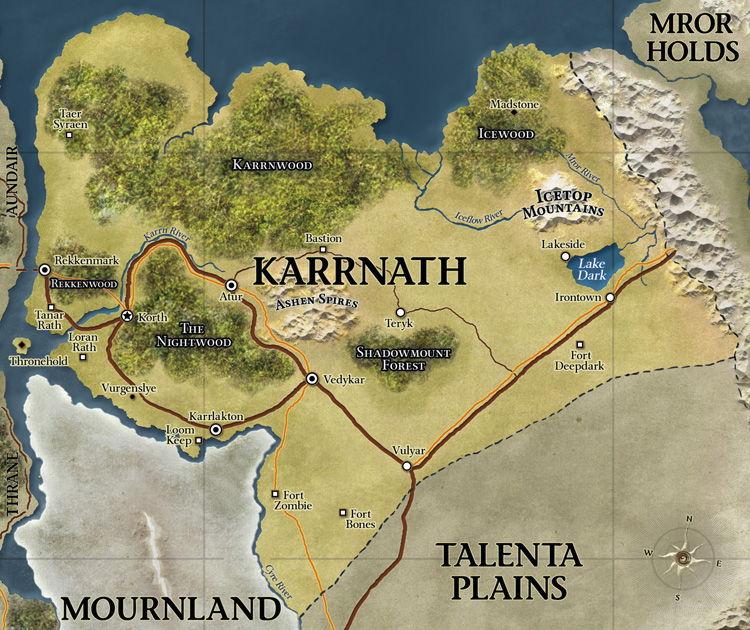
Karrnath occupies the northeastern reaches of Khorvaire, a land of cold seas, deep forests, broad river valleys, and fortified highlands. Its borders are both ancient and scarred—shaped by migration, conquest, imperial unification, and the grinding attrition of the Last War. To the Karrnathi mind, territory is not merely land held, but ground defended, measured in blood, stone, and obligation.
Much of Karrnath’s core territory is ancestral, tracing its roots back to pre-Galifar warlord realms that coalesced under Karrn the Conqueror. These heartlands—centered around Korth, Atur, and the interior river systems—are deeply integrated, culturally Karrnathi to their marrow, and governed through long-established noble lines and military jurisdictions. Fortresses, canals, and roadways bind these regions together, reflecting centuries of deliberate state-building rather than sudden expansion.
Beyond the core lie regions that are assimilated rather than ancestral. The eastern marches, settled heavily by dwarves from the Mror Holds after the fall of Dhakaan and later formalized under Galifar, remain culturally mixed. These lands are firmly loyal but maintain strong clan identities and economic ties beyond Karrnath’s borders. Their occupation is consensual but pragmatic: Karrnath provides protection and infrastructure; the clans provide labor, stone, and steel.
The southern and southwestern territories, bordering the Talenta Plains and the Mournland, are more tenuous. Here, Karrnath’s presence has historically been enforced by fortification and military oversight rather than cultural integration. The devastation of Cyre has frozen expansion in this direction, leaving abandoned forts, half-resettled lands, and populations living under the constant shadow of the gray mist. These regions are held, not settled—garrisoned to prevent incursion rather than developed for prosperity.
In the north and northeast, along the Bitter Sea and the edge of the Karrnwood, Karrnath is actively resettling and consolidating. Driven by displacement from the Mourning and wartime losses inland, the Crown has sponsored new towns, naval facilities, and logging camps. This is colonization in the quiet, Karrnathi sense: measured, militarized, and justified as necessity rather than ambition. Indigenous peoples—goliath tribes, isolated forest clans, and scattered goblinoid hamlets—are tolerated so long as they do not resist integration or threaten state security.
Karrnath does not claim land lightly, nor does it relinquish territory willingly. Even regions no longer fully inhabited are considered held in trust, their abandonment temporary, their return inevitable. To retreat permanently would be to admit weakness, and Karrnath’s identity is bound to the belief that a nation survives by holding fast—whether through stone walls, iron law, or the long memory of land once defended.
Military
Karrnath’s military is not merely an institution of defense; it is the spine around which the nation’s identity has been built. Forged through centuries of warlord conflict, imperial unification, and finally the crucible of the Last War, the Karrnathi military remains disciplined, hierarchical, and deeply entwined with civil governance. Even in peacetime, Karrnath does not demobilize so much as it reorients, maintaining readiness as a cultural norm rather than an emergency posture.
At its core stands the Royal Karrnathi Army, a professional standing force divided into regional commands aligned with the principalities. Infantry remains its backbone, favoring heavy armor, pikes, shields, and disciplined formations over mobility or individual heroics. Officers are educated, often through Rekkenmark Academy, and expected to possess not only tactical acumen but logistical and administrative competence. The army’s doctrine prizes endurance, attrition, and positional warfare—lessons learned painfully during the Last War’s long sieges and frozen campaigns.
Interwoven with the living soldiery is the legacy of Karrnathi necromancy. While the mass deployment of undead legions has officially ceased since the Treaty of Thronehold, the infrastructure, knowledge, and limited practice remain. Skeleton units are still maintained for labor, fortification work, and emergency reserve under strict legal oversight. Specialized officers—often graduates of Rekkenmark with additional training—retain the authority to command undead in times of national crisis. This lingering capacity serves as both deterrent and political burden, shaping how foreign powers view Karrnath’s intentions.
Supporting the army is the Karrnathi Navy, smaller than Breland’s but hardened by the Bitter Sea. Its fleets are tasked with coastal defense, convoy escort, and the protection of northern resettlement efforts. Naval doctrine emphasizes fortressed harbors, heavy ships, and disciplined crews over speed or innovation. The navy works closely with House Lyrandar when necessary but remains wary of overreliance on dragonmarked interests.
Internally, militia forces and provincial guards provide local security. These units are often staffed by veterans, warforged under state contract, or conscripts drawn from rural populations. While less prestigious than the Royal Army, they are tightly regulated and expected to uphold martial law when invoked. In many towns, the line between civil authority and military command remains deliberately thin.
Elite formations persist as symbols of national pride. The Order of Rekkenmark serves as both officer corps and ideological anchor, instilling loyalty to Karrnath above crown or creed. Knightly orders, though diminished in number, still exist as ceremonial and practical leaders, particularly in frontier regions. Specialized corps—engineers, siege masters, and arcane logisticians—reflect Karrnath’s belief that war is won as much by preparation as by courage.
In the postwar era, Karrnath’s military faces a quiet transformation. Numbers have been reduced, but discipline has not. Training emphasizes internal security, border defense, and rapid mobilization rather than continental conquest. Yet beneath the reforms lies an unspoken truth: Karrnath does not believe the age of war has ended, only that it has paused. The army exists not merely to fight the next conflict, but to ensure that when it comes, Karrnath will be ready—cold, resolute, and unyielding.
Technological Level
Karrnath occupies a pragmatic middle ground in Khorvaire’s technological and scientific development: not as flamboyantly innovative as Aundair, nor as commercially experimental as Breland, but exceptionally adept at refining, standardizing, and weaponizing what it adopts. Civilian technology reflects a late–industrial-magical society. Most citizens have access to basic magewright services—preservation charms, simple heating glyphs, treated tools, and low-grade alchemy—particularly in towns and along major rivers. Rural areas rely more on traditional craft supplemented by occasional magical assistance, reinforcing a culture where magic is a tool, not a spectacle.
Scientifically, Karrnath emphasizes biology, medicine, metallurgy, and logistics over abstract arcane theory. Its universities and military academies produce surgeons, battlefield medics, engineers, quartermasters, and necromantic researchers rather than flamboyant wizards. Advances in anatomy, embalming, preservation, and stamina enhancement emerged from necessity during the Last War and remain unmatched elsewhere. These disciplines are tightly regulated and often classified, blurring the line between civic science and military secret. While Aundair may invent, Karrnath perfects.
The nation’s greatest technological edge lies in its necromantic-industrial synthesis. The Odakyr rites, corpse-preservation methods, negative-energy containment, and disciplined undead command protocols represent a uniquely Karrnathi field of applied science. These techniques allow the creation of tireless laborers and soldiers that require no food, morale, or rest—though their use is now more limited by law and diplomacy. Even outside military application, research into negative energy has yielded breakthroughs in disease control, long-term storage, and trauma medicine, giving Karrnath an understated but profound advantage in survivability.
Karrnath also excels in heavy industry and materials science. Its forges produce durable steels, cold-resistant alloys, and mass-standardized weapons renowned for reliability rather than elegance. Domestic manufacturing focuses on arms, armor, tools, rail components, siege equipment, and preservation-treated goods. While it imports many fine arcane devices, Karrnath’s own workshops specialize in equipment meant to function in mud, snow, blood, and darkness. In short, Karrnathi technology is built to endure failure—and that, more than brilliance, is what has kept the nation standing.
Religion
Religion in Karrnath is not a matter of fervent belief so much as disciplined observance, shaped by centuries of hardship, militarization, and pragmatic survival. Faith is treated as a cultural inheritance—something practiced because it has proven useful, stabilizing, and enduring, not because it demands emotional surrender. The Sovereign Host remains the dominant religious framework, but in Karrnath it is approached less as a collection of benevolent patrons and more as a philosophical system that reinforces hierarchy, duty, and continuity. Worship is formal, restrained, and often interwoven with civic life: prayers before drills, rites before harvests, and invocations before oaths. The gods are respected as exemplars of idealized roles—war, work, endurance, foresight—rather than intimate confidants, reflecting a national temperament forged through scarcity and war.
The rise of necromantic practice during the Last War fundamentally altered Karrnathi religious consciousness. While many outsiders frame this as a moral transgression, within Karrnath it is understood as a grim but rational extension of statecraft and faith. The dead were not raised in defiance of the gods, but in service to the living, an interpretation that reframed concepts of sacrifice and sanctity. This led to a subtle but lasting shift: death became less sacred as an ending and more sacred as a resource entrusted to the nation. Even after the Treaty of Thronehold curtailed the use of undead armies, this outlook persisted. Funerary rites emphasize honor, remembrance, and usefulness to lineage rather than spiritual transcendence, and clergy are expected to reconcile doctrine with necessity rather than condemn it outright.
As a result, Karrnathi religion today functions as a stabilizing institution rather than a proselytizing force. Temples act as record keepers, arbiters of tradition, and moral educators, preserving continuity between generations rather than seeking personal revelation. Zealous faith is viewed with suspicion, associated either with foreign theocracies or dangerous instability. What Karrnath values instead is constancy: rituals performed correctly, ancestors remembered accurately, and doctrines interpreted with restraint. In this way, religion becomes another pillar of the state—alongside the military, the nobility, and the land itself—quietly reinforcing the belief that survival, order, and legacy are the highest virtues a nation can uphold.
The Sovereign Host
In Karrnath, the Sovereign Host is not approached as a source of comfort or personal salvation, but as the moral and functional backbone of society. The Host is understood as a constellation of idealized roles—warrior, ruler, artisan, farmer, judge—each god representing not an emotional relationship but a duty to be fulfilled correctly. To a Karrnathi mind, the Sovereigns do not “watch over” the faithful in a parental sense; they embody the standards by which one measures oneself. Worship is therefore disciplined and procedural. Offerings are made, rites are observed, and names are invoked not to seek favor, but to acknowledge responsibility. A soldier honors Dol Dorn not to feel brave, but to remember what bravery demands. A farmer invokes Arawai not for abundance, but for perseverance through lean seasons.
This interpretation lends itself naturally to hierarchy and structure. The Sovereign Host reinforces the idea that every person has a place, and that fulfilling one’s role well is a sacred act. Karrnathi clergy emphasize balance within the Host, discouraging excessive devotion to any single Sovereign. Overindulgence in one god’s portfolio—whether war, commerce, or ambition—is viewed as a destabilizing excess rather than piety. A soldier who prays only to Dol Dorn and neglects Aureon’s wisdom or Onatar’s craft is seen as incomplete, even dangerous. Thus, sermons often focus on moderation, discipline, and the interdependence of roles, mirroring the nation’s military doctrine and civic philosophy.
Historically, the Sovereign Host in Karrnath has also served as a legitimizing force for state decisions. During the Last War, necromantic practices were justified not by denying the Host, but by reframing sacrifice and duty within its teachings. The dead, properly honored and ritually bound, were seen as continuing their service under Dol Dorn’s martial ideal and Kol Korran’s stewardship of resources. While this interpretation remains controversial abroad, within Karrnath it cemented the Host as adaptable—capable of being interpreted through necessity without abandoning tradition. Even now, many Karrnathi view this flexibility as proof of the Host’s strength rather than a corruption of it.
In everyday life, devotion to the Sovereign Host is quiet and ubiquitous. Shrines are common, but lavish temples are rare outside major cities. Most households keep a small icon or prayer board, rotated depending on season or circumstance. Clergy are respected as custodians of tradition and record keepers of rites rather than charismatic leaders. A Karrnathi believer does not expect miracles; instead, they expect continuity. The Sovereign Host, as understood in Karrnath, does not promise salvation or joy—it promises that if one endures, fulfills one’s duty, and remembers those who came before, the nation will endure as well.
Blood of Vol
In Karrnath, the Blood of Vol is not regarded as a heretical cult or a nihilistic rejection of the gods, but as a deeply pragmatic and culturally resonant philosophy—one that took root because it spoke plainly to a people long accustomed to hardship, loss, and the brutal arithmetic of war. At its core, the faith’s assertion that divinity lies within mortal blood rather than in distant, indifferent gods aligns uncomfortably well with Karrnathi historical experience. The Blood of Vol teaches that no external power will intervene to save you, and in Karrnath this is not a scandalous claim but a familiar truth. Survival, legacy, and meaning must be forged by mortal hands, and the self—mind, blood, and will—is the only reliable vessel of power.
This belief reshapes how Karrnathi adherents view death and undeath. Where other cultures recoil at necromancy, many Karrnathi see it as an extension of duty and continuity rather than a violation of the natural order. The dead, when preserved and bound with respect, are not abominations but remnants of mortal purpose made useful beyond a single lifespan. Within this framework, raising the dead is not about domination or cruelty, but about refusing waste—of skill, of sacrifice, of blood already paid. Clerics of the Blood of Vol emphasize reverence for remains, meticulous record-keeping of the deceased’s service, and strict ritual codes governing animation. Improper use of the dead is condemned not because it is unnatural, but because it dishonors the individual’s contribution to the collective.
Socially, the Blood of Vol appeals most strongly to soldiers, laborers, and those who feel overlooked by distant hierarchies—people whose lives have demonstrated that piety does not guarantee protection. In Karrnath, the faith often manifests in small, tightly knit congregations rather than grand temples. These gatherings function as mutual-aid societies, preserving family histories, tending graves, and ensuring that no one’s death goes unrecorded or unmourned. Faith leaders act less as preachers and more as archivists of lineage and custodians of remembrance. To be forgotten, in Vol’s doctrine, is the only true damnation, and Karrnathi adherents take this warning seriously.
Politically and culturally, the Blood of Vol occupies an uneasy but persistent position. While no longer openly endorsed by the crown, it is quietly tolerated in many regions, especially in areas scarred by the Last War. Attempts to eradicate it have historically failed, as suppression only reinforces its central tenet: that institutions abandon individuals when convenient. Many Karrnathi reconcile the Blood of Vol with outward devotion to the Sovereign Host, seeing no contradiction in honoring tradition while privately embracing the belief that only mortal will endures. In this way, the Blood of Vol has become less a rebellion against Karrnath’s culture and more a shadow cast by it—a faith shaped by loss, endurance, and the refusal to let sacrifice vanish into silence.
The Dark Six
In Karrnath, the Dark Six are not treated as a singular cult nor as an organized religion, but as an unavoidable truth of the world—forces that exist whether honored or ignored. Where other nations frame the Six as forbidden or purely villainous, Karrnathi culture approaches them with a colder, more utilitarian understanding. They are not gods to be loved, but powers to be acknowledged, placated, and respected at a distance. To deny their existence is seen as naïve; to worship them openly is considered reckless. Instead, most Karrnathi regard the Dark Six as embodiments of forces that must be endured, bargained with, or survived, much like winter, famine, or war.
This attitude is especially pronounced among soldiers, criminals, and frontier folk, who often recognize the Dark Six as reflections of harsh realities rather than moral choices. The Devourer is feared by riverfolk and sailors, whose offerings are meant to avert disaster rather than seek favor. The Fury is whispered about in moments of rage or despair, not invoked as a patron but blamed as a warning sign of losing oneself. The Keeper, perhaps the most universally acknowledged of the Six in Karrnath, is treated with grim practicality: graves are warded, wills meticulously written, and debts carefully settled to deny him leverage. These acts are not acts of worship, but of defiance—small assertions of mortal control against inevitable entropy.
Cults of the Dark Six do exist in Karrnath, but they are fragmented, localized, and deeply distrusted even by those who share aspects of their worldview. The Karrnathi state draws a sharp distinction between acknowledging the Six and submitting to them. Organized worship, sacrifices, or attempts to channel their power are harshly suppressed, not out of moral outrage but because such practices are seen as destabilizing. A person who venerates the Six openly is viewed less as evil and more as dangerously unbalanced—someone who has stopped negotiating with reality and begun inviting catastrophe. The memory of cult-fueled atrocities during the Last War reinforces this stance, and even pragmatic commanders remember how quickly “necessary evils” spiral out of control.
Culturally, the Dark Six serve as cautionary figures woven into folklore, military sayings, and civic instruction. Parents warn children not to “feed the Fury.” Officers remind recruits that “the Keeper counts mistakes twice.” Builders mark foundations to ward off the Shadow, and hunters leave signs to discourage the Mockery’s attention. These practices are not religious rites so much as inherited superstitions shaped by lived experience. In this way, the Dark Six occupy a paradoxical role in Karrnath: ever-present, deeply feared, rarely worshipped, and quietly influential. They are reminders that strength without discipline becomes ruin, and that survival in a brutal world requires acknowledging darkness without letting it rule you.
The Silver Flame
In Karrnath, the Silver Flame is regarded with a mixture of respect, caution, and ideological distance. Unlike Thrane, where the Flame defines national identity, Karrnathi culture views it as a powerful *foreign* faith—one that has proven its effectiveness, but whose absolutism sits uneasily beside Karrnath’s pragmatic worldview. The Flame is acknowledged as a genuine force of cosmic good, an undeniable bulwark against fiends, undead run amok, and existential threats. Yet it is also seen as dangerously uncompromising, prone to excess when belief eclipses judgment. To most Karrnathi, the Flame is not false—but it is *not theirs*.
Historically, Karrnath’s relationship with the Silver Flame was shaped by proximity and conflict. During the Last War, Thranish crusades and inquisitorial movements left deep scars on the Karrnathi psyche. Even when those actions were justified in hindsight, the memory of Flame-led armies crossing borders under banners of righteousness hardened attitudes. As a result, many Karrnathi distinguish sharply between the *Flame itself*—a metaphysical force of purification—and the *institution* that claims to interpret its will. The former is respected; the latter is watched closely. This separation allows Karrnathi citizens to admire individual Flame clerics for their courage and sincerity while remaining deeply skeptical of Flame-based governance.
On a personal level, some Karrnathi do revere the Silver Flame, particularly among border communities, monster-hunters, and those who have suffered directly from fiends or aberrations. These adherents tend to practice a restrained, almost austere form of devotion, focusing on vigilance, sacrifice, and personal discipline rather than evangelism. They rarely preach. Instead, they frame the Flame as a responsibility rather than a salvation—something that demands constant effort and self-denial. Such believers often coexist uneasily with followers of the Sovereign Host or Blood of Vol, choosing cooperation over confrontation in daily life.
Philosophically, Karrnath finds the Flame’s moral absolutism troubling. The notion that evil must be destroyed outright, rather than contained, repurposed, or endured, clashes with Karrnathi traditions of necessity and survival. Undead labor, pragmatic alliances, and morally gray decisions—cornerstones of Karrnathi resilience—are all practices the Flame condemns. Thus, while Karrnath recognizes the Silver Flame as a legitimate cosmic power, it rejects the idea that purity alone can sustain a nation. In Karrnathi thought, light without restraint can blind just as surely as darkness, and faith without pragmatism is simply another form of fanaticism.
Druidism
Druidism as a whole is regarded as ancient, potent, and fundamentally other—a tradition rooted in forces older than nations and largely indifferent to the concerns of crowns, borders, and laws. Karrnathi culture respects druidism’s power over land, weather, and beasts, but struggles with its priorities. Where Karrnath values endurance through structure—armies, laws, infrastructure—druidic philosophy often embraces cycles of decay and renewal that can appear callous or even dangerous to settled folk. As a result, druids are neither persecuted nor embraced; they are tolerated as long as they remain distant, predictable, and uninterested in reshaping civilization.
At a conceptual level, Karrnathi thinkers see druids as custodians of a different ledger of value. Forests, rivers, and beasts matter deeply to them, sometimes more than human lives or prosperity. This worldview clashes with Karrnath’s long history of war, famine, and harsh climate, where survival has often required exploiting land ruthlessly and efficiently. To a Karrnathi officer or magistrate, a druid who opposes logging, mining, or river control may seem dangerously idealistic—or worse, indifferent to human suffering. Still, there is grudging acknowledgment that druidic warnings have often proven correct in the long term, especially where overharvesting or reckless land use led to disaster.
The Wardens of the Wood are the most familiar druidic sect to Karrnathi citizens, particularly along forested borders such as the Karrnwood and Shadowmount fringe. They are viewed as stern but honorable guardians who prefer isolation over interference. Karrnath respects their consistency: Wardens draw clear boundaries and enforce them without apology. While conflicts over logging or settlement do occur, Wardens who negotiate in good faith are often met with equal seriousness by Karrnathi authorities. There is even a quiet professional respect between Wardens and certain Karrnathi military engineers, both of whom understand the importance of terrain, choke points, and long-term planning.
The Gatekeepers, by contrast, inspire a deeper, more uneasy respect. Their ancient role in sealing away extraplanar threats resonates strongly with Karrnath’s obsession with existential dangers—fiends, aberrations, and things buried beneath the world. Many Karrnathi scholars and warlords privately regard the Gatekeepers as doing the kind of grim, thankless work that Karrnath itself has long embraced. While their rituals and orcish roots place them outside mainstream society, Gatekeepers are rarely dismissed. When they speak of sealed evils or weakening wards, even cynical Karrnathi officials listen, if only because history has taught them the cost of ignoring such warnings.
The Greensingers are met with suspicion bordering on discomfort. Their ties to Thelanis, emotion-driven magic, and capricious fey powers run counter to Karrnath’s preference for discipline and control. Karrnathi folklore is already rich with tales of dangerous forests, cursed glades, and bargains gone wrong, and Greensingers often embody those fears. While not openly hostile, Karrnath tends to view them as unreliable allies at best—useful in narrow circumstances, but never to be fully trusted. Their tendency to blur the line between nature and whimsy clashes with a culture shaped by scarcity and hard choices.
Finally, the Ashbound are widely condemned. Their open hostility toward arcane magic, industry, and civilization places them at odds with everything Karrnath represents. To Karrnathi eyes, the Ashbound are not defenders of nature but extremists willing to burn villages and starve populations to prove a philosophical point. Even those sympathetic to druidic ideals draw a firm line here. Ashbound actions are framed as terrorism rather than faith, and Karrnath responds accordingly—with force, containment, and little remorse.
In sum, Karrnath views druidism as a necessary counterweight to unchecked ambition, but not a guiding philosophy for society. Druids are respected when they act as wardens against catastrophe and distrusted when they place ideology above human survival. To a Karrnathi mind, nature is not sacred—it is powerful, dangerous, and must be managed with the same cold respect given to armies, winters, and the dead.
Foreign Relations
Karrnath approaches foreign relations with the same philosophy it applies to war and governance: prepare for conflict, hope for stability, and never mistake politeness for safety. Decades of existential struggle during the Last War, followed by the moral compromises required to survive it, have left the nation wary of idealism and deeply conscious of precedent. Diplomacy, to Karrnathi eyes, is not a replacement for strength but a tool that functions best when backed by disciplined armies, secure borders, and a reputation for resolve.
The Treaty Nations of Galifar
Breland is viewed with pragmatic caution. Karrnathi diplomats respect Brelish flexibility, intelligence networks, and mercantile strength, but distrust its populist politics and tolerance for disorder. Breland’s emphasis on personal liberty is often seen in Karrnath as naïve—useful in peace, dangerous in crisis. Relations are stable, if cool, with trade continuing while military planners quietly assume Breland would act first in its own interest should tensions rise.
Aundair is treated with open suspicion. Karrnath remembers Aundair’s arcane supremacy and political maneuvering during the war, and many officers believe Aundair still seeks advantage through influence rather than open confrontation. While formal relations remain intact, Karrnathi envoys regard Aundairian diplomacy as a game of masks and layered intentions. Cultural exchanges exist, but intelligence-gathering is constant on both sides.
Thrane represents the most complex relationship. Ideologically, the two nations diverged sharply after the rise of the Silver Flame’s theocracy and Karrnath’s embrace of necromancy and the Blood of Vol. While open hostilities have ceased, theological mistrust runs deep. Karrnath respects Thrane’s discipline and unity, even as it resents moral condemnation from a state that now denies its own past excesses. Diplomacy between the two is formal, restrained, and often conducted through intermediaries rather than direct warmth.
Karrnath’s stance toward Cyre is colored by grief, guilt, and unease. The Mourning shattered not only a nation but the balance of Khorvaire itself. Officially, Karrnath expresses sympathy and support for Cyran refugees, yet many citizens quietly fear that the catastrophe was either punishment or portent. Relations with Cyran remnants are polite but distant, haunted by the possibility that unresolved secrets still linger across the river.
Border States and Regional Powers
Relations with Zilargo are outwardly cordial but inwardly tense. Karrnath values Zilargo’s efficiency, record-keeping, and mercantile reliability, but deeply distrusts the gnomish talent for secrets and manipulation. Intelligence officers assume Zilargo knows far more about Karrnath than it admits—and plans accordingly.
The Mror Holds enjoy comparatively warm relations with Karrnath, grounded in shared values of endurance, craftsmanship, and fortification. Trade in arms, stonework, and engineering expertise flows steadily, and while political goals do not always align, mutual respect keeps relations stable.
The Talenta Plains remain a source of quiet friction. Karrnath sees the Plains as strategically vulnerable and economically underutilized, while the halflings view Karrnathi order as intrusive. Diplomacy here is minimal, relying instead on House intermediaries and localized agreements.
Valenar is watched closely. Karrnathi strategists respect Valenar’s martial culture but view its aggressive raiding traditions as destabilizing. While no formal conflict exists, Karrnath assumes Valenar warbands could become a threat with little warning and plans defenses accordingly.
Dragonmarked Houses and Transnational Powers
Karrnath maintains strictly transactional relationships with the dragonmarked houses. House Orien and House Lyrandar are tolerated as necessities for trade and transport, while Houses Cannith and Kundarak are valued for their expertise but monitored carefully. House Jorasco is respected for its neutrality, though some hardliners resent dependence on halfling healers.
The nation remains deeply cautious of extraplanar and ideological powers, including cults, druidic sects with cross-border influence, and foreign faiths attempting to proselytize within Karrnath. Such movements are not immediately suppressed, but they are always observed.
Laws
Law in Karrnath is conceived not as an expression of moral virtue, but as a mechanism of survival. Its purpose is order, continuity, and the protection of the state above the comfort of the individual. Karrnathi law is extensive, codified, and deliberately conservative, built atop precedents stretching back to pre-Galifar warlords and the imperial codes of Galifar itself. While reforms occur, they are incremental and justified through lineage, tradition, or necessity rather than ideology. To a Karrnathi mind, a law that has endured hardship has proven its worth.
Creation and Codification of Law
Laws are formally enacted by the Crown of Karrnath, advised by the Royal Council and its Master of Laws. In practice, many statutes originate as military ordinances, emergency measures, or administrative decrees during times of crisis and are later normalized into civil law. The Last War accelerated this process, producing a vast body of “temporary” legislation that remains in force decades later.
All national laws are recorded in the Codices of Korth, a growing archive maintained by royal scribes and jurists. Provincial laws and precedents are preserved locally, often in fortress-keeps or civic halls, where generations of annotations have layered interpretation atop original text. In rural regions, unwritten customary law—especially regarding land use, inheritance, and military obligation—still carries legal weight if recognized by local magistrates.
Enforcement and Interpretation
The Executive arm of the law is divided between the military, provincial authorities, and local watch organizations. In cities and towns, enforcement falls to trained watch forces operating under appointed magistrates (such as Județi). In rural or frontier regions, enforcement is often delegated to noble retainers, military detachments, or chartered militias.
Judicial authority is similarly layered. Minor crimes are adjudicated locally, while serious offenses—treason, necromantic abuse, sedition, large-scale fraud—are escalated to provincial courts or royal tribunals. Judges are expected to interpret law strictly, but precedent allows for limited discretion when doing so preserves stability. Mercy is permitted, but indulgence is frowned upon.
Crime and Punishment
Karrnathi punishments are punitive and corrective, not redemptive. Fines, hard labor, and incarceration are common, often paired with mandatory service—military, industrial, or civic. Execution is rare but accepted for crimes that threaten the state: treason, insurrection, sabotage of defenses, or unauthorized creation or liberation of undead.
Public punishment exists but is restrained; the state prefers fear born of certainty rather than spectacle. A criminal may escape justice temporarily, but the prevailing belief is that law is patient. Debts, warrants, and sentences do not expire easily, and many fugitives find that time only deepens their eventual reckoning.
Property, Commerce, and Labor
Property law is rigid and favors stability over innovation. Land ownership is carefully recorded, tied to service obligations and taxation. Confiscation is legal in cases of treason, dereliction of duty, or unpaid wartime debts. Commerce is heavily regulated, with guild charters, tariffs, and licenses required for most trades.
Labor laws reflect Karrnath’s martial culture: conscription is legal, emergency requisition of labor is permitted, and refusal to serve during crisis can be punished. Indentured service—especially among warforged and criminals—is lawful and widely practiced, though increasingly controversial.
Flexibility and Escape
Karrnathi law is difficult to evade but possible to navigate. Loopholes exist, particularly for those with education, wealth, or noble patronage. Bribery is illegal and harshly punished if exposed, yet discreet favors and influence remain realities of enforcement. The system is not blind—but it is consistent.
To live under Karrnathi law is to understand that freedom is conditional, order is paramount, and justice is less about fairness than endurance. The law does not promise happiness. It promises that the nation will survive another generation.
Agriculture & Industry
Karrnath is a nation sustained by endurance rather than abundance, its agricultural and industrial systems shaped by harsh winters, long wars, and a cultural emphasis on self-sufficiency. While it cannot rival Breland’s manufactories or Aundair’s arcane refinement, Karrnath has built a resilient economy capable of feeding armies, supplying fortresses, and rebuilding after devastation.
Agriculture
Karrnathi agriculture favors reliability over yield. The heartlands along interior rivers and lakes support grain farming—primarily rye, barley, and hardy wheat varieties bred to withstand cold and poor soil. Root vegetables such as turnips, beets, and cabbages dominate rural diets, supplemented by legumes and preserved greens. Orchards are rare and tightly protected, producing apples and hardy berries used more often for spirits and preserves than fresh consumption.
Livestock husbandry is a major pillar of the rural economy. Cattle, sheep, and hardy mountain goats are bred for meat, leather, wool, and tallow. Poultry farms have expanded since the Last War, replacing labor-intensive crops lost to depopulation. Horse breeding is strategically important: Karrnathi warhorses are known for stamina and cold tolerance, raised in state-regulated studs. Specialized kennels breed hounds for patrol, tracking, and border security, often contracted by the crown or local authorities.
Necromancy, once openly employed, has left a lasting imprint even where its use has receded. Undead labor is no longer common in the fields, but infrastructure built by tireless skeletal workers—canals, levees, and granaries—still underpins agricultural productivity, allowing fewer hands to work larger tracts of land.
Industry
Karrnath’s industry is heavy, martial, and decentralized. Iron and lead mining in the Ashen Spires and eastern regions feeds a network of foundries producing weapons, armor, tools, and fortification components. Steel production is not elegant, but it is dependable; Karrnathi steel is renowned for its durability rather than refinement. Blacksmith guilds, many founded during wartime necessity, remain influential and closely regulated.
Forestry supports both construction and fuel. Lumber from the Karrnwood and northern forests is carefully managed, with strict quotas to prevent depletion. Timber feeds shipbuilding, fortification repair, and charcoal production. Stone quarrying—often overseen by dwarven guilds—supplies fortress walls, roads, and civic buildings, reinforcing the nation’s preference for permanence over ornamentation.
Food processing and preservation are industries in their own right. Salteries, smokehouses, breweries, and distilleries ensure surplus production can be stored and transported. Karrnathi spirits, particularly grain vodkas and bitter ales, are exported widely and serve as both trade goods and morale staples. Textile production—wool, leather, and heavy cloth—supports both civilian needs and military supply chains.
Strategic Character
Taken together, Karrnath’s agriculture and industry form a system designed not for prosperity in peace, but survivability in crisis. The nation can feed itself, arm itself, and rebuild its walls without relying heavily on foreign imports. This self-reliance comes at the cost of comfort and innovation, but it ensures that Karrnath remains difficult to starve, difficult to cripple, and difficult to conquer.
Trade & Transport
Trade in Karrnath is governed by necessity, security, and control, rather than openness or speed. The nation’s transport networks were built first to move troops and supplies, and only secondarily to serve merchants. As a result, Karrnath possesses some of the most durable—and most tightly regulated—trade arteries in Khorvaire.
At the heart of domestic movement are the interior rivers and lakes, which form a natural lattice connecting farms, market towns, and fortress-cities. Barges carry grain, timber, stone, iron ore, and preserved foodstuffs along these waterways under armed supervision. River traffic is preferred over overland hauling whenever possible, as it is cheaper, easier to police, and less vulnerable to banditry. Toll stations, signal lanterns, and fortified locks are common sights, and most river trade operates on schedules approved by local authorities.
Overland transport relies on a dense web of stone-built military roads, many dating back to early Galifaran rule or earlier Karrnathi kingdoms. These roads favor straight lines and defensible terrain over convenience, often running ridge-to-ridge rather than valley floors. House Orien maintains courier and caravan services along these routes, but in Karrnath their operations are more restricted than elsewhere. Licenses, manifests, and inspections are routine, and Orien caravans are often required to travel in convoys accompanied by local guards.
The lightning rail has altered long-distance trade, but less dramatically in Karrnath than in western nations. Passenger platforms are carefully monitored, and freight stations are treated as strategic assets. Bulk goods—arms, armor, tools, stone blocks, preserved rations—are prioritized over luxury items. Rail traffic is coordinated with military logistics offices, ensuring that civilian trade never interferes with mobilization capacity. This has made Karrnath a reliable but slow-moving partner in continental commerce.
International trade is cautious and selective. Karrnath exports steel goods, preserved foods, spirits, leather, stonework, and war-trained animals, while importing refined arcane goods, luxury textiles, spices, and certain magical components unavailable locally. Trade agreements favor partners who can guarantee steady supply in wartime—most notably Breland and select Lhazaar principalities—while relations with Aundair remain economically cool despite formal peace.
Ports along the northern coast handle maritime trade, though they are smaller and more heavily fortified than their southern counterparts. Shipping lanes are patrolled, and foreign captains are subject to inspection before unloading. Smuggling exists, particularly of arcane items and prohibited texts, but carries severe penalties when uncovered.
Education
Education in Karrnath is shaped by discipline, utility, and the long shadow of war. From an early age, most children receive basic instruction in reading, numbers, civic duty, and the history of the realm—often delivered locally by parish tutors, retired soldiers, or guild-sponsored instructors rather than centralized schools. Literacy is common by the standards of Khorvaire, especially among humans and dwarves, but education is rarely abstract. Knowledge is valued insofar as it serves the state, the household, or the profession into which one is born.
Beyond this foundation, education quickly diverges along class and function. Noble families, officer households, and wealthy guild dynasties provide their children with private tutors or send them to academies in cities such as Korth, Atur, or Rekkenmark. These institutions emphasize military science, law, administration, logistics, and theology, with arcane studies tightly regulated. Rekkenmark Academy stands foremost among them, producing officers and strategists rather than scholars in the Aundairian sense. Higher learning in Karrnath is rigorous but narrow, focused on command, endurance, and control rather than innovation for its own sake.
For the common citizenry, apprenticeship is the true path of education. Children of artisans, farmers, and laborers are expected to learn by doing—through guild training, household instruction, or service in militias. Dwarven communities maintain especially strong craft traditions, passing down architectural, metallurgical, and engineering knowledge through clan lines. Halfling and khoravar communities emphasize practical numeracy, negotiation, and healing arts, reflecting their economic roles. Formal schooling beyond basic literacy is uncommon for these classes, but competence is high, and ignorance is rarely tolerated.
Religious institutions play a quiet but persistent role in education. The Sovereign Host maintains parish schools that teach moral instruction and civic obligation, while the Blood of Vol emphasizes literacy, anatomy, and personal philosophy, particularly in urban centers. Access is uneven—warforged and the very poor often receive only functional instruction—but Karrnath does not value ignorance. A citizen who cannot read an order, tally a ration, or understand the law is seen not as pitiable, but as a liability. Education, like everything else in Karrnath, exists to ensure survival, stability, and the endurance of the state.
Infrastructure
Karrnath’s infrastructure is built first and foremost for endurance. Roads, bridges, and public works are designed not for speed or beauty, but for reliability under strain. A dense network of stone-paved military roads—many dating back to the early Galifar period or earlier Karrnathi fort-kingdoms—connects fortresses, market towns, and river ports. These roads favor gradual grades, reinforced embankments, and wide turning radii suitable for wagons, artillery, and troop columns. Even lesser roads are carefully maintained, often through corvée labor obligations that remain culturally accepted as civic duty rather than punishment.
Water management is a particular point of pride. Along the interior rivers and lakes, Karrnath maintains canals, locks, levees, and regulated floodplains that protect farmland while enabling bulk transport. Most towns possess gravity-fed cistern systems and stone-lined wells, with older cities like Korth and Atur featuring partial aqueducts and covered waterways inherited from Dhakaani or early human construction. Sewage systems are uneven—extensive in major cities and fortress-towns, rudimentary in villages—but waste is generally directed away from population centers with grim efficiency. Clean water is considered a strategic resource, not merely a civic amenity.
Defensive infrastructure defines the landscape. Castles, keeps, border towers, and fortified towns are omnipresent, often layered atop older foundations. Karrnathi fortifications favor thick walls, overlapping fields of fire, kill zones, and redundancy over ornamentation. Many strongholds include subterranean storehouses, barracks, and ritual chambers originally designed for undead forces, now repurposed for reserves and logistics. Border regions—particularly along the Mournland, Valenar frontier, and northern coasts—are studded with watchtowers and signal beacons, some mundane, others enhanced by magewright signaling systems.
Finally, Karrnath has embraced selective modernity through lightning rail lines, river ports, and administrative hubs. While less extensive than Breland’s or Aundair’s networks, Karrnathi rail stations are heavily fortified and tightly regulated, prioritizing freight and military movement over civilian convenience. Town halls, courts, and record houses are solid stone structures, often attached to or integrated with garrisons. Infrastructure in Karrnath is never merely functional—it is symbolic: a visible assertion that the state endures, watches, and will not fail through neglect.

Death Holds No Terror
The Principalities of Karrnath
Principality of Atur
- Capital: Atur (City of Night)
- Population ~2.2 million
- Geography: Rolling hills and valleys, shadowed by ancient forests.
- Economy: Necromantic craft, funerary industries, gemstone trade.
- Culture: Deeply influenced by the Blood of Vol. Citizens are pragmatic about death and unusually tolerant of undead auxiliaries.
- Military: Necromantic forces supplement conventional armies; priests of Vol advise commanders.
Principality of Gorahatár
- Capital: Irontown
- Population: ~1.1 million
- Geography: Rugged uplands, mineral-rich hills, and Lake Dark.
- Economy: Mining (iron, silver), fishing, arms forging.
- Culture: Independent-minded and rough-hewn. Villages often rely on their own militias first and the crown second.
- Military: Provides the kingdom’s best raw materials for arms and armor. Skilled crossbowmen and mountain infantry.
Principality of Karrlyn
- Capital: Karrlakton
- Population: ~1.9 million
- Geography: Southern heartland along the Cyre River, fertile plains and fortified towns.
- Economy: Agriculture, river trade, officer academies.
- Culture: The people are proud of their military traditions, conservative and loyal to crown and duty.
- Military: Second most heavily defended by both human and undead soldiers. Guard river from Mournland crossing.
Principality of Korth
- Capital: Korth
- Population: ~3.0 million
- Geography: Central seat of government, surrounded by fertile farmland.
- Economy: Administration, trade fairs, bureaucracy, luxury crafts.
- Culture: Cosmopolitan, aristocratic, deeply political. Citizens pride themselves on wit, learning, and connections.
- Military: Houses many of the Crown’s elite guards and the royal armory. Home to Rekkenmark Academy, the kingdom’s elite officer school. Heavily fortified against Aundairan influence.
Principality of Mélisötétsk
- Capital: Vulyar
- Population: ~1.4 million
- Geography: Southern breadbasket, scarred by the Last War and bordering the Mournland and Talenta Plains.
- Economy: Grain, livestock, vineyards. Still recovering from war destruction.
- Culture: Somber but resilient. Folk festivals have taken on darker tones since the Mourning.
- Military: Supplies cavalry and grain for the armies. Necromantic auxiliaries common due to heavy war losses.
Principality of Narathles
- Capital: Narath
- Population: ~1.2 mllion
- Geography: Western marches along the Wynarn River, border with Aundair.
- Economy: Farming villages, frontier trade, horse breeding.
- Culture: Blunt, martial, practical. Border folk are suspicious of outsiders but fiercely loyal to Karrnath.
- Military: Constant vigilance against Aundair. Numerous fortresses line the frontier.
Principality of Terykova
- Capital: Teryk
- Population: ~0.9 million
- Geography: Northern tundra, dense forests, icy rivers, harsh winters.
- Economy: Furs, timber, fishing, iron mining.
- Culture: Stoic, insular, and superstitious. Folklore and old traditions endure stronger here than elsewhere.
- Military: Rugged woodsmen and cold-weather soldiers; vital for northern defenses against raiders.
Principality of Vedychev
- Capital: Vedykar
- Population: ~1.8 million
- Geography: Central plains with broad rivers, crossroads of trade routes.
- Economy: Trade, medicine (House Jorasco stronghold), textiles.
- Culture: Cosmopolitan, wealthier than most. Known for healers, apothecaries, and craft guilds.
- Military: Logistics hub; soldiers here often serve as quartermasters and medics across the kingdom.
Karrnath uses the Galifaran Crown system in name and denomination, but in practice the nation treats currency as a tool of logistics rather than prestige. Platinum dragons, gold galifars, silver sovereigns, and copper crowns circulate as elsewhere in Khorvaire, yet Karrnathi coins are heavier, plainly stamped, and intentionally difficult to clip—an echo of wartime anti-counterfeiting measures.
For large transactions, especially those involving land, grain, or military supply, sealed promissory tallies and state-backed ledgers are preferred over bulk coin. These documents are honored by the crown, redeemable through recognized banks or military quartermasters, and tracked meticulously. In rural regions, barter—grain, timber, ironwork—remains common and socially accepted. Among Karrns, wealth is respected, but liquidity and reliability are valued more than display.
Karrnath’s exports reflect its character: durable, disciplined, and born of necessity rather than indulgence. Chief among these is grain and preserved foodstuffs. The interior riverlands and lake-fed plains produce a reliable surplus of wheat, rye, barley, and oats, much of it processed into hardtack, flour, and long-keeping rations. Salted meats, smoked fish, and preserved vegetables—perfected during the long years of the Last War—remain in high demand across Khorvaire, particularly in regions still rebuilding or lacking stable agriculture. Karrnathi provisions are valued not for flavor, but for consistency and shelf life.
Closely tied to this is Karrnath’s export of military goods and martial expertise. The nation produces arms, armor, and equipment designed for endurance: spears, swords, shields, heavy crossbows, mail, and plate built to last decades rather than seasons. Dwarven-forged stonework, iron fittings, and fortification components are especially prized. While Karrnath no longer exports undead troops as it once did, it still exports doctrine—officers, advisors, and mercenary companies trained in logistics, siegecraft, and command. Rekkenmark-trained veterans find employment abroad as instructors and consultants.
Karrnath also exports significant quantities of raw and worked materials. Timber from managed forests, iron and base metals from the eastern foothills, stone blocks cut to precise military specifications, and lead for construction and alchemical use all move steadily along river and rail. Dwarven guilds are particularly active in exporting prefabricated architectural elements—arches, keystones, defensive statuary—that reflect Karrnathi principles of permanence and order.
Finally, there are quieter but lucrative exports: healing services, necromantic scholarship, and timekeeping devices. House Jorasco’s medical expertise, refined in Karrnathi cities like Vedykar and Atur, draws clients from across the continent. Magewright-crafted orbs of time and precision instruments are traded widely, symbols of Karrnath’s emphasis on discipline and coordination. Even in peace, the realm exports what it knows best: preparedness, endurance, and the means to survive a hostile world.
Despite its reputation for iron self-reliance, Karrnath depends on foreign trade to sustain critical gaps left by its climate, culture, and long militarization. Most significant are arcane and alchemical imports: refined magical components, precision artificer tools, dragonshard instruments, and finished magic items. While Karrnathi necromancy and battlefield enchantment are formidable, civilian and elite applications are often cheaper or superior when sourced from Aundair or Breland.
Luxury goods flow quietly but steadily into the realm, favored by nobles, officers, and guild elites. Fine silks, spices, wines, perfumes, inks, ornamental glass, and illuminated books serve as markers of status in an otherwise austere society. These imports are not signs of decadence so much as symbols of survival and success after decades of deprivation.
Karrnath also relies on imports for climate-bound foodstuffs and industrial specialties. Fruits, sugars, oils, rare herbs, and distant fish stocks supplement domestic staples, especially after poor harvests. Likewise, specialty metals, treated timbers, and refined chemicals—used in shipbuilding, lightning rail maintenance, and preservation practices—are more efficiently acquired abroad.
Finally, there is a persistent trade in knowledge. Foreign maps, philosophical works, historical treatises, and banned texts circulate among universities, private collectors, and military academies. In a nation shaped by war and censorship, imported ideas are as vital as steel—quietly strengthening Karrnath where isolation once threatened to weaken it.
Law in Karrnath is authored by the Crown Council, a centralized legislative body chaired by the monarch and composed of high nobles, senior military officers, and vetted civil jurists. Unlike more populist nations, Karrnath does not pretend its laws emerge from public consensus; they are deliberate instruments of stability, written with an eye toward enforcement rather than idealism.
Custom, precedent, and wartime statutes carry exceptional weight. Many current laws are refinements of emergency measures from the Last War, preserved because they proved effective. Once enacted, laws are rarely repealed outright—more often amended, annotated, or restricted in scope. To a Karrnathi mind, a law that once preserved the nation deserves respect even when it must be constrained.
Justice in Karrnath is administered through a hierarchical court system overseen by appointed magistrates, most of whom are trained in both civil law and military code. These judges are expected to interpret not only the letter of the law, but its intent within historical context. Precedent matters greatly, and rulings often cite cases decades—or centuries—old.
Trials are efficient, formal, and rarely theatrical. Guilt is weighed pragmatically, with strong emphasis placed on evidence, testimony, and civic consequence. Punishments tend toward restitution, service, or confinement rather than spectacle. The Karrnathi ideal of justice is not mercy, nor cruelty, but containment—of crime, unrest, and instability.
Enforcement of law falls to a dual structure: the Royal Army of Karrnath and locally empowered civil watches. In matters of national security, sedition, or border integrity, the army acts directly, often with sweeping authority. In cities and towns, watch captains and magistrate-backed officers handle daily order, taxation enforcement, and criminal investigation.
This overlap is intentional. Karrnath believes that law without force is fragile, and force without law is chaos. Officers are trained to document actions meticulously, and misuse of authority is punished harshly—not out of moral outrage, but because disorder within the ranks threatens the entire system. The goal of enforcement is not fear, but predictability. Citizens may not love the law, but they are expected to understand it—and trust that it will be applied consistently.