
Talenta Plains
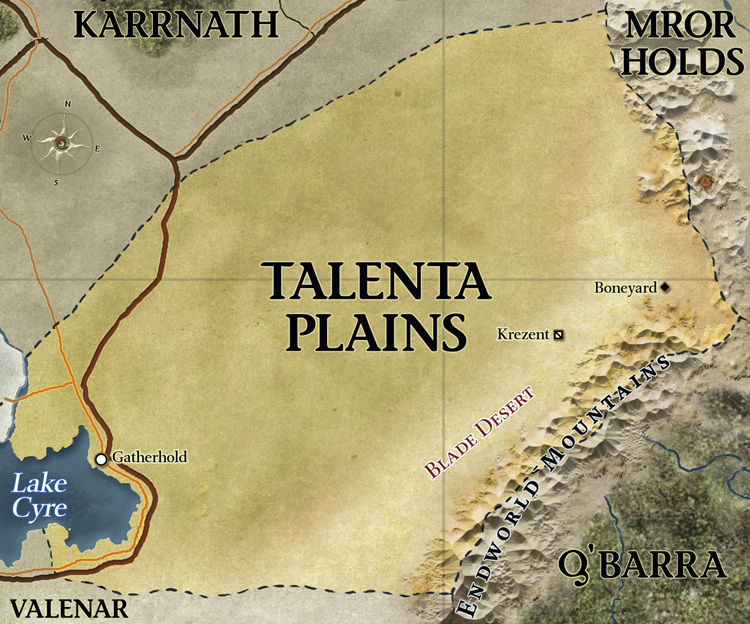
The Talenta Plains are a sprawling expanse of grasslands, stretching from the parched edge of the Blade Desert to the very borders of Karrnath and the desolate Mournland. This vast, open territory is a land shaped by the wild rhythms of nature, most notably by the wandering herds of colossal dinosaurs that freely roam its endless vistas. For millennia, it has also been the ancestral home of the tribal halflings, a people who steadfastly maintain their ancient nomadic way of life, a heritage that predates even the earliest human footsteps upon the continent of Khorvaire.
Geography
The Talenta Plains are a sweeping inland sea of grass, occupying the broad basin between the Endworld Mountains to the east and the Ironroot Mountains to the northwest. To the west, the plains unfurl right up to the shifting boundary of the Mournland, swallowing Lake Cyre as one of their sacred waters. In the south and southeast, the plains bleed into the slow-creeping sands of the Blade Desert, where hardpan earth and dry winds nibble steadily northward—roughly a mile of grassland lost each year.
Despite their reputation as “featureless,” the Plains are a land of dramatic subtleties: long, rolling horizons broken by low mesas, ancient river washouts, and the occasional jut of fossilized stone where prehistoric dinosaurs once wallowed. Grass dominates the landscape, but the term hides huge ecological variation. In some stretches, the grass barely reaches the ankle—a windswept shortgrass steppe. In others, it rises above a halfling’s head—dense, golden tallgrass hiding clawfeet, tribex herds, and predators even larger.
Water defines the Plains more than outsiders expect. While no major rivers cut across Talenta, shallow aquifers sit close to the surface; halflings and dinosaurs alike know the scattered sinkholes, hidden springs, and seasonal ponds that turn the land into a giant, breathing system. To the north and northwest, melt-runoff from the Ironroots feeds intermittent streams, vanishing into the earth by mid-summer. To the west, Lake Cyre offers a shimmering, mournful water border—its calm surface now haunted by unpredictable mists that creep outward at dawn and dusk.
From a distance, the Talenta Plains appear serene. Up close, the land pulses with movement: towering thunder-herds of hadrosaurs shaking the ground, hawk-like pteradons circling thermals, and halfling travelers riding two-legged dinosaur mounts that dart across the horizon like living arrows. To a Talenta halfling, this is the center of the world—the land that raised their ancestors before humans ever set foot on Khorvaire.
Ecosystem
The Talenta Plains function as a vast semi-arid grassland shaped by constant movement, periodic droughts, and the seasonal rhythm of the great grazing herds. The environment resembles a warm prairie or savanna rather than a jungle, with sweeping open horizons, shallow basins that gather seasonal water, and stretches of dry shortgrass broken by isolated stands of hardy shrubs. Most life on the Plains is adapted to long-distance travel, heat, and scarcity. Nothing here remains still for long—both predators and herbivores migrate extensively, and the nomadic halfling tribes follow the same ancient routes carved into the land by generations of wandering animals.
The ecology of the region is essentially built around four overlapping zones. The tallgrass heartlands in the central Plains serve as the primary grazing belts, where the richest forage supports immense migratory herds. Surrounding this are the shortgrass drylands, where leaner vegetation favors swift runners, small omnivores, and predators that rely on speed more than ambush. Along the southern and western edges, the Blade Desert transitions into the Plains in a wide semi-arid fringe that supports only the hardiest wildlife and fluctuates dramatically from year to year. Finally, the lakes and wetlands—especially those around Lake Cyre—form isolated pockets of aquatic and shoreline ecosystems that differ sharply from the dry grasslands around them.
Interactions within this ecosystem are governed by scarcity and mobility. Massive herds of grazing animals shape the prairie itself, consuming vegetation in sweeping arcs and opening broad migration corridors that other species depend on. Predators follow these herds, creating a constant flow of movement across the Plains as each species reacts to the presence or absence of another. Smaller omnivores, aerial scavengers, and opportunistic hunters fill the ecological gaps left in the wake of the larger animals. The halfling tribes weave themselves into this pattern, moving alongside the herds, taking advantage of seasonal abundance, and avoiding unnecessary disruption to the natural cycles. The Talenta Plains therefore sustain life not through stability but through continuous motion, with every organism—from smallest burrowing creature to the largest land-dwelling behemoths—participating in a dynamic and interdependent system.
Ecosystem Cycles
The Talenta Plains follow a yearly ecological rhythm defined by alternating seasons of plenty and scarcity. During the short, warm wet season, rains sweep up from the south and ignite rapid growth across the grasslands. Tallgrasses surge upward, shallow basins fill with temporary wetlands, and smaller streams reconnect with Lake Cyre. This brief period of abundance triggers the major grazing migrations: vast herds move north and east to take advantage of fresh forage, while smaller herbivores cluster around the newly replenished water sources. Predators shift accordingly, trailing the herds or staking out migratory bottlenecks carved by generations of instinctive movement.
As the rains fade, the long dry season asserts itself. Grasses grow brittle and pale, watering holes shrink or vanish entirely, and the tallgrass belts contract toward the central Plains. Many species adapt by entering cyclical migrations toward areas of residual moisture—such as the shores of Lake Cyre or the more fertile northern reaches—while smaller animals retreat to burrows or shaded scrublands to conserve energy. Predators become increasingly mobile and opportunistic during this time, tracking prey across greater distances as resources dwindle. The halfling tribes mirror these patterns, adjusting their routes based on the condition of grazing lands for their domesticated herds.
The year also includes brief transitional moments that mark the shift between seasons. Early spring brings violent storms as hot southern winds clash with lingering winter currents from the Ironroot Mountains, resulting in sudden lightning bursts, localized flooding, and unpredictable weather fronts. In late autumn, cooler winds sweep down from the northern mountains, prompting many creatures to increase feeding before scarcity returns. Across these cycles, the Plains thrive not through stability, but through the continual ebb and flow of movement, growth, and retreat—a landscape always in the process of becoming.
Localized Phenomena
The Talenta Plains are shaped by a number of distinctive natural and supernatural phenomena that influence both the land and the nomadic cultures that traverse it. Foremost among these is the Bladewind, a violent weatherfront that forms where the expanding Blade Desert meets the open grasslands. These storms bring sudden walls of scorching air and abrasive dust, capable of stripping vegetation and carving shallow scars into the earth. Though brief, they are intensely destructive, and their increasing frequency mirrors the slow desertification creeping northward each year.
Scattered throughout the central and southern Plains are the whisper-lows, shallow depressions where a convergence of warm updrafts and geological formations gives rise to faint harmonic tones as the wind passes through cracks and stone fragments. Many describe these sounds as soft, flute-like whistles, but in strong winds they can escalate into eerie multi-tonal drones audible across vast distances. Halfling shamans believe whisper-lows carry ancestral messages, though naturalists attribute them to unique acoustics in the Plains geology.
Another common feature is the presence of groundshimmer, a mirage-like optical phenomenon created by heat radiating from the dense, sunbaked soil. During the height of the dry season, the plains can appear to ripple like water, causing travelers and animals alike to misjudge distance and movement. Groundshimmer frequently distorts the silhouettes of herds and predators, making hunting and scouting significantly more difficult during midday hours.
Near Lake Cyre and the lowlands bordering the Mournland, the Plains experience the unsettling gray squalls—abrupt drops in temperature coupled with banks of ashen mist carried by erratic winds. These events are short-lived but unnerving, as the mists sometimes carry faint echoes, shifting shadows, or metallic scents reminiscent of the Dead Gray Mist. Though not dangerous in themselves, gray squalls often portend the appearance of unusual predators wandering from the Mournland’s border.
Finally, the Talenta Plains occasionally produce lightning crawlers, long, branching arcs of electricity that race horizontally along the ground during powerful thunderstorms. These rare discharges follow mineral seams in the topsoil and can travel great distances with startling speed. While seldom lethal, they can start grass fires and disrupt herds, prompting both dinosaurs and riders to scatter until the storm passes.
Together, these phenomena form a landscape where the unusual is commonplace, and where centuries of adaptation—both cultural and ecological—have taught the Talenta halflings to navigate a world shaped as much by sudden change as by open horizons.
Climate
The Talenta Plains exhibit a predominantly continental steppe climate, defined by wide temperature swings, long dry seasons, and a marked contrast between scorching summers and frigid winters. The region’s vast, treeless expanse offers little to break the wind, allowing weather systems to sweep unhindered from the Blade Desert, the northern mountains, and the lands surrounding Lake Cyre. As a result, the Plains shift rapidly between calm skies and sudden, intense weather events.
Summers are hot, dry, and sun-drenched, with daytime temperatures soaring high enough to parch the grasslands and intensify the slow northward creep of the Blade Desert. Heat-driven mirages and groundshimmer become common, and nighttime offers only marginal relief. Thunderstorms build frequently along the desert’s edge, releasing bursts of lightning and brief, violent rainfall that evaporate almost as quickly as they form.
Winters, by contrast, bring sharp cold and persistent winds rolling off the Icehorn Mountains and the highlands near Karrnath. Snowfall is typically light but widespread, covering the grasses in a shallow, brittle layer that migratory herds must paw aside to forage. In especially severe years, blizzards can sweep across the Plains with almost no visibility, pushing tribes and wildlife alike to seek temporary shelter.
Spring and autumn are short transitional periods marked by unpredictable shifts in weather—sudden thaws followed by frost, warm winds followed by chilling downpours. These seasons tend to be wetter overall, replenishing grazing lands with fresh growth and drawing herds northward or southward depending on rainfall patterns.
The territory surrounding Lake Cyre experiences slightly milder and more humid conditions, with increased fog and morning dew due to the lake’s moderating influence. However, proximity to the Mournland introduces erratic gray squalls and occasional temperature anomalies that defy typical seasonal patterns.
Despite its harsh extremes, the Plains maintain a resilient rhythm that has shaped the migrations of dinosaurs, the movements of halfling tribes, and the cycles of the land itself for thousands of years.
Fauna & Flora
Flora
The Talenta Plains support a diverse and surprisingly resilient collection of plant and animal life shaped by long seasons of heat, wind, and migration. The region’s defining vegetation is tallsteppe grass, a family of hardy, waist-high grasses with deep roots capable of surviving drought, fire, and winter frost. These grasses form the foundation of the Plains ecosystem, anchoring the soil and feeding everything from small browsing animals to massive herds of herbivorous dinosaurs. Interspersed among them are pockets of saltbrush, hardy sedges, warm-season wildflowers, and thorny scrub, which thrive in drier pockets or along seasonal waterways.
Closer to the northern mountains, vegetation becomes more varied. Shortgrass meadows, cold-tolerant mosses, and needleleaf shrubs emerge in the cooler climate, while the wetlands surrounding Lake Cyre support rushes, cattails, broadleaf reeds, and shallow-water kelp analogues adapted to freshwater environments. These marshy zones attract distinct assemblages of amphibious dinosaurs, migratory birds, and smaller reptilian species that depend on the lake’s stability amid the increasingly arid southern plains.
Fauna
Fauna across the region reflects the Plains’ open horizons and shifting seasonal cycles. Small creatures such as compsognathids, burrowing mammals, and prairie reptiles form the base of the food chain, feeding on seeds, insects, and roots. Swift-footed omnivores and opportunistic scavengers range widely, adapting to fluctuating conditions. The signature inhabitants of the Talenta Plains, however, are its dinosaurs—from vast migratory herds of grazing thunderfoot and trumpetbeak species to agile clawfoot riders, plateback browsers, and domehead foragers. These animals move across the Plains in predictable seasonal loops, shaping the availability of grazing and influencing halfling tribal routes.
Apex predators maintain the balance of the ecosystem. Large swordtooth and greatmaw hunters dominate the open grasslands, while more reclusive ambush predators haunt canyonlands, wooded river margins, and the transitional scrublands near the Blade Desert. Aerial life is equally adapted to the steppe environment: glidewings, soarwings, and other pterosaur species use thermal currents rising from the warm plains to survey herds below, feeding on small reptiles or scavenging kills left by larger carnivores.
Scattered among this wildlife are distinct species tied to particular ecological niches—semi-aquatic reptiles in the rivers feeding Lake Cyre, nocturnal troodontids in denser grass thickets, and desert-edge specialists adapted to the advancing sands. Despite the harsh climate and the region’s growing desertification, the Plains remain a vibrant and interconnected ecosystem, its life shaped by the rhythms of migration, fire, drought, and storm that have defined it since long before the first halfling tribes wandered its horizon.
Natural Resources
The Talenta Plains possess a wealth of natural resources shaped by their vast grasslands, seasonal wetlands, and scattered desert-edge environments. The most important resource is the rich steppe vegetation, particularly tallsteppe grasses whose deep roots stabilize the soil and provide reliable forage for the region’s immense herds of dinosaurs, tribex, and domestic cattle. These animals, in turn, form a core component of Talenta subsistence, providing meat, hides, bone, sinew, and horn that the nomadic tribes convert into tools, structures, clothing, and trade goods.
The Plains’ megafauna represent another essential resource. Herbivorous dinosaurs supply the halflings with transport animals, mounts, labor beasts, and raw materials, while predator species—though dangerous—contribute scavenged bone, teeth, and rare hides valued for weapons and ornamentation. Certain species also produce oils or biological extracts used in medicine, alchemy, or ritual work. The halflings maintain a careful balance with these herds, harvesting what they need while ensuring long-term sustainability through seasonal migration patterns.
Freshwater is concentrated around Lake Cyre and the region’s seasonal rivers and springs. These waterways provide fish, marsh reeds, and aquatic plants used for weaving, thatching, and medicinal purposes. The lakebed and its surrounding marshes also yield minerals such as salt, chalk, and fine clays, which are gathered in small quantities for trade or local use. In drier regions approaching the Blade Desert, exposed badlands offer pockets of flint, jasper, fossil bone, and soft iron deposits, though halfling tribes rarely engage in large-scale extraction.
Other notable resources include wild grains, root vegetables, medicinal herbs, fire-resistant lichens, and resin-bearing shrubs whose saps can be worked into adhesives, waterproofing agents, and aromatic burnables. Scattered stands of stunted hardwoods and thorn-brush provide limited fuel and woodworking stock, though most tribes rely on bone, leather, or imported lumber for durable goods.
Overall, the natural wealth of the Talenta Plains is tied not to mined metals or dense forests, but to its living landscape—its grasses, its massive herds, its freshwater basins, and its seasonal abundance. These resources sustain the halfling way of life and shape the nomadic, lightly extractive culture that has persisted for thousands of years.
History
The history of the Talenta Plains stretches back far beyond written memory, rooted in eras when dinosaurs roamed eastern Khorvaire long before human civilization took shape. The halflings are the region’s oldest known inhabitants, maintaining oral traditions that describe their ancestors living as nomadic foragers and herders since time immemorial. For thousands of years, their tribes moved with the seasons, following the great herds, harvesting wild grains and river reeds, and forging deep bonds with the plains’ dinosaurs.
As the Five Nations expanded in the Age of Galifar, the traditional roaming grounds of the Talenta tribes slowly contracted. While the halflings resisted direct annexation, they accepted limited oversight under the Kingdom of Galifar in exchange for maintaining autonomy. Gatherhold, originally a seasonal meeting point, grew into a central neutral ground where tribes exchanged news, held negotiations, and interacted with the outside world. During this period, the first dragonmarks appeared among the halflings, leading to the emergence of the Ghallanda and Jorasco tribes and later the formation of their formal dragonmarked houses.
The Last War profoundly reshaped the region. Both Cyre and Karrnath claimed the plains, and repeated military incursions disrupted traditional migration patterns, devastated grazing lands, and killed large numbers of domesticated animals. These pressures pushed the halfling tribes to unprecedented unity. Under the leadership of Lathon Halpum—one of the few laths charismatic enough to unite many tribes—the halflings asserted their independence and presented a coordinated front against foreign forces. Lathon’s delegation to the Treaty of Thronehold secured recognition of the Talenta Plains as a sovereign nation.
In the aftermath of the war, the halfling tribes resumed their ancestral nomadic lifestyles, though the region remains more active than at any point in its past. Increased foreign travel, the proximity of the unstable Mournland, Valenar raiding routes, and the presence of bandits and settlers from neighboring Q’barra have introduced new tensions. Some halflings advocate cooperation and continued diplomacy with outsiders, while others—particularly followers of the shaman Holy Uldra—argue for isolation and a renewal of traditional ways. Despite these challenges, the tribal structure endures, and the halflings continue to navigate a landscape shaped equally by ancient custom and the shifting politics of post-war Khorvaire.
Tourism
Despite its remoteness and the dangers posed by its wildlife, the Talenta Plains attract a small but steadily growing number of visitors. Most come seeking experiences they can find nowhere else in Khorvaire: sweeping horizons of golden grass, herds of dinosaurs migrating across the steppe, and encounters with the nomadic halfling tribes whose way of life predates the Five Nations. Scholars, naturalists, and hunters often travel to the region hoping to study or observe the dinosaurs in their natural habitat, while others arrive simply to witness the beauty of the plains’ austere landscapes, dramatic skies, and starlit nights unmarred by urban light.
Gatherhold serves as the primary point of entry for most travelers. It is the only established settlement in the region and offers modest accommodations, markets, and guides familiar with both tribal customs and the hazards of the open plains. The dragonmarked halflings of House Ghallanda ensure that visitors find basic comforts, while local artisans sell traditional bone carvings, masks, and dinosaur-hide goods prized by foreign collectors.
Those who venture beyond Gatherhold typically do so with a guide or under the protection of a halfling tribe willing to host them for a time. Visitors may witness communal hunts, storytelling gatherings, or seasonal festivals, though these experiences depend on the tribe’s disposition and current needs. The halflings are wary of outsiders, and travelers who ignore local etiquette risk being turned away—or attracting the attention of territorial dinosaurs.
Tourism remains limited by the dangers of the region: unpredictable storms, the encroaching Blade Desert, marauding Valenar warbands, and the presence of predators such as swordtooth titans. Yet for those willing to brave these risks, the Talenta Plains offer an unparalleled glimpse into one of Khorvaire’s oldest cultures and its vibrant, living ties to a prehistoric world.