
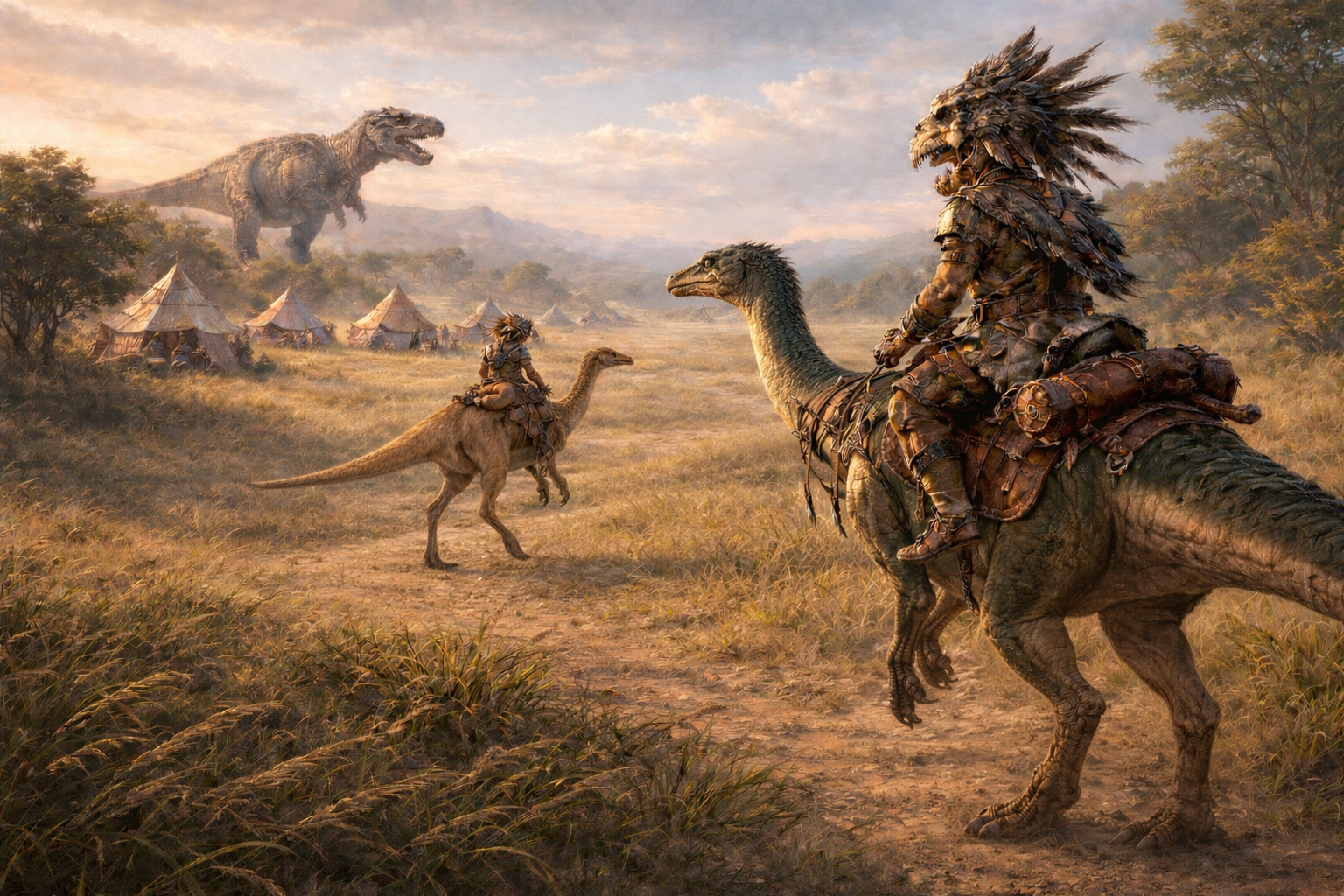
Talenta Halfling
Before there were crowns in Khorvaire, before stone cities and lightning rails and dragonmarked monopolies, there were halflings running the open plains behind thunderous herds. The Talenta halflings are not a frontier culture or a provincial offshoot of the Five Nations—they are one of the oldest continuous civilizations on the continent. They were nomads when humans were still crossing oceans, riders when others still walked, and herders of beasts that most of Khorvaire only knows from bone and legend.
To the Talenta, the Plains are not empty land. They are a living sea of wind and grass, a moving world of migration routes, spirit paths, ancestral trails, and hunting grounds measured not in miles but in stories. Every rise of land has a memory. Every watering hollow has a name. Every herd carries history. A Talenta child learns the land the way a city child learns streets—by movement, by repetition, by the unbroken rhythm of travel.
Talenta culture is built on motion. Tribes do not settle; they circulate. Camps are not homes so much as pauses. Possessions are few, portable, and purposeful. What endures is not architecture but memory: songs that preserve lineages, hunt-masks that embody ancestral beasts, and oral histories that stretch back to an age when the world itself was different. A halfling does not ask where someone is from. They ask which herds they follow, which spirits watch them, and which stories shaped their feet.
Central to Talenta identity is the bond between halfling and beast. The dinosaurs of the Plains are not livestock in the Five Nations sense, nor are they mere mounts. They are partners in survival, war, and worship. From an early age, Talenta halflings are taught to ride, to hunt from the saddle, and to read the moods of creatures far larger and stronger than themselves. When a rider dons a hunt-mask and takes to the plains, they are not pretending to be a beast—they are completing a bond that is as spiritual as it is practical.
Outsiders often mistake the Talenta for primitive, because their culture does not express itself in stone, coin, or crowns. This is an error the Plains have swallowed whole armies for. Talenta society is subtle, deeply ritualized, and ruthlessly functional. Their strategies are hunter-strategies. Their politics are clan and blood politics. Their faith is practiced with bone, breath, and motion, not scripture. They have endured precisely because they change slowly, choosing what to adopt and what to reject with the same care they use when selecting a mount.
Today, the Talenta stand at a rare moment in their long history. Recognized as a sovereign nation, threaded with dragonmarked interests, and increasingly entangled with the economies and conflicts of Khorvaire, they remain a people defined by ancient rhythms in a rapidly modernizing world. Whether the Plains will bend without breaking—or whether something essential will be lost in the process—is a question even the oldest storytellers cannot answer.
Culture
Culture and cultural heritage
Talenta heritage is carried through story-lines rather than bloodlines. A halfling inherits not only family ancestry but herd routes, ancestral spirits, hunt traditions, and tribal obligations. Each tribe maintains living genealogies—recited histories linking riders, beasts, victories, tragedies, and migrations. Cultural memory is preserved by speakers, elders, and spirit-keepers who can recite centuries of names, routes, and events. To become such a keeper is one of the highest honors a non-lath can attain.
Shared customary codes and values
Talenta culture is guided less by written law than by a constellation of shared expectations passed through story, example, and ritual. The most universal of these values are endurance, contribution, memory, and balance.
Endurance is respected above almost all else. Hardship is not romanticized, but it is understood as inevitable, and the ability to withstand hunger, fear, loss, and exhaustion without becoming cruel or unreliable is considered a mark of maturity. Closely tied to this is contribution: every halfling is expected to be useful to the tribe, whether through hunting, herding, craft, healing, child-rearing, scouting, or storytelling. Idleness is not condemned, but sustained unhelpfulness is.
Memory is sacred. The Talenta do not build monuments; they carry them. To forget ancestors, to misrepresent the past, or to erase the names of beasts, routes, or fallen riders is seen as a form of cultural death. Finally, balance governs Talenta ethics. Between beast and rider, tribe and self, tradition and necessity, taking and giving—extremes are distrusted. A halfling who tips too far into excess, cruelty, or indulgence is believed to invite disaster.
Common Etiquette rules
Talenta etiquette is practical, understated, and shaped by nomadic life. It is customary to announce oneself when approaching a camp from a distance, often by holding a visible tool or weapon downward and calling out a greeting. To ride silently into another tribe’s space is considered threatening. Hospitality is expected, but it is also reciprocal; guests are offered food, water, and fire, and in return are expected to share news, assist with chores, or offer entertainment or trade.
Eye contact is brief rather than prolonged, especially between strangers. Staring is associated with predatory beasts. Respect is shown through attentiveness—listening without interrupting, offering hands rather than commands, and waiting for elders or laths to finish speaking before responding. Boasting is frowned upon unless it takes the form of humorous storytelling or ritualized challenge. Direct praise is rarer than appreciative teasing, and mockery without affection is a serious social offense.
Common Dress code
Talenta dress is layered, functional, and symbolic. Clothing is typically made from cured hide, woven grasses, light leathers, feathers, bone fastenings, and trade fabrics when available. Garments are designed to protect against sun, wind, and riding friction while allowing freedom of movement.
Most halflings wear riding wraps, sleeveless tunics, fitted trousers, soft boots, and light cloaks. Jewelry tends toward the organic: teeth, horn, polished stone, beads, carved bone, and shed dinosaur scales. Hairstyles often incorporate braids, cords, or tribal markers.
Ceremonial wear is distinguished not by extravagance but by transformation. Body paints, ash markings, feather mantles, spirit cords, and especially hunt-masks alter the wearer’s silhouette and identity, signaling participation in rites, hunts, or war.
Art & Architecture
Talenta art is portable, performative, and impermanent by design. Visual art appears most often in body paint, mask-making, tool decoration, talismans, beadwork, and carved bone or horn. Patterns tend to be abstract or animalistic, reflecting herd routes, storm shapes, claw marks, and spiritual motifs. Masks are the highest art form, combining craftsmanship, storytelling, and religious devotion.
Music, dance, and oral narrative are equally revered. Drums stretched from dinosaur hide, flutes of bone or reed, and call-and-response chants dominate Talenta musical tradition. Dance frequently mimics herd movement, hunts, and predator behavior.
Permanent architecture is rare and culturally uncomfortable. Even Gatherhold is considered a necessary compromise. Most Talenta structures are tents, windbreaks, mobile shrines, and collapsible frames. The Plains themselves are the sacred space; to enclose life in walls is often seen as a sorrowful necessity, not an achievement.
Foods & Cuisine
Talenta cuisine centers on meat, milk, blood, and foraged plants. Herd beasts provide flesh, marrow, fat, hides, and fermented drinks. Meat is roasted, dried, smoked, or ground into travel rations. Broths thickened with roots, insects, or ground bone are common. Milk from herd beasts and dinosaurs is used to create cheeses, yogurts, and mildly alcoholic fermented drinks.
Blood stews, heavily spiced and thickened, are ritual foods associated with hunts and funerary feasts. Plant foods include tubers, grasses, berries, cactus fruits, and hardy Plains vegetables. Trade goods—salt, grain, tea, and imported spices—are highly valued. Food is almost always shared. To eat alone in sight of others is a grave discourtesy.
Common Customs, traditions and rituals
Evenings are communal. Fires are shared, meals are public, and stories are expected. Silence around the fire is considered unhealthy. Before major hunts or journeys, tribes perform smoke and ash rites to invite ancestral favor. New routes are always marked by a small offering left behind: bone shards, braided grass, beads, or painted stones. Tribes regularly exchange members through marriage, adoption, and alliance riding, preventing cultural stagnation and blood isolation.
Birth & Baptismal Rites
Birth is a tribal event. Laboring parents are attended by healers, elders, and singers. Newborns are washed in warmed herd milk or water mixed with Plains dust, symbolically binding them to land and tribe. Names are not permanent. A child receives a milk-name at birth, a rider-name after their first successful solo mount, and may earn additional names through deeds, bonds, or spiritual encounters.
Coming of Age Rites
Coming of age is marked by the First Bond. Adolescents are separated from the tribe and guided to claim or be accepted by a young dinosaur or herd beast. This trial may take days or weeks and involves survival, observation, and restraint. Upon return, the youth crafts their first hunt-mask and is formally acknowledged as a rider and contributor. From this point, they are considered an adult with voice in tribal matters.
Funerary and Memorial customs
The Talenta do not bury their dead in the earth. Bodies are traditionally given to sky, flame, or beast, returning them to the Plains’ cycles. Masks of the dead are either broken, burned, or ritually dismantled and redistributed among family members. Names are added to tribal memory chants. Particularly honored individuals may have a route, herd, or gathering named for them. The Boneyard is considered a mythic warning rather than a burial place.
Common Taboos
Among the Talenta, taboos are not arbitrary prohibitions but violations of the balance that keeps the tribes alive. The most serious offenses include killing a bonded beast except as an act of mercy, hoarding food, water, or other essential resources while others are in need, and desecrating ancestral remains or sacred sites. To ride another halfling’s bonded mount without permission is considered a profound personal violation, akin to striking a family member. Likewise, claiming sole credit for a communal success—whether a hunt, a victory, or a great migration—is seen as a dangerous kind of pride that invites misfortune. Building permanent dwellings along sacred routes or ancestral paths is viewed as an attempt to chain what must remain free. Above all, however, the gravest taboo is forgetting: to deliberately erase names, stories, deeds, or obligations is to wound the tribe’s living memory, a cultural sin far more terrible than any theft or act of violence.
Common Myths and Legends
Talenta myths center on spirit-beasts, ancestral riders, living storms, and the first herds. Many legends describe halflings teaching beasts to run, beasts teaching halflings to listen, and the Plains itself as a dreaming entity that remembers every footprint. Couatl ruins like Krezent appear in myth as “the Cities That Learned to Fly Wrong.”
Ideals
Beauty Ideals
A beautiful halfling is one whose body shows a life well-lived on the Plains: skin darkened by sun and wind, hair bleached in streaks by heat and dust, muscles corded and balanced from years in the saddle. Scarification, ritual scarring, and natural marks earned from hunts or stampedes are often seen not as blemishes but as records of survival. To bear no marks at all is sometimes taken as a sign of youth, softness, or an untested life.
Adornment is practical, symbolic, and almost never frivolous. Beads of bone, carved horn, shed scales, braided sinew, feathers, and polished stones are worked into hair and clothing. Face paint and body pigments—usually made from ash, clay, crushed insects, or plant dyes—are worn for hunts, rites, and gatherings, marking tribal ties, spiritual devotions, or personal deeds. The most revered aesthetic objects are hunt-masks, each one an artistic invocation of a bonded dinosaur’s spirit, crafted by its wearer and never truly “finished.”
Symmetry is less important than story. A halfling with a crooked tooth taken in a hunt, or a burn scar from saving a herd, may be considered more striking than one with unblemished features. Among the Talenta, beauty is not about perfection—it is about evidence.
Gender Ideals
Talenta culture is not built on rigid divisions of gendered labor. Survival on the Plains demands adaptability, and so Talenta social roles are defined far more by aptitude than by sex. Riders, hunters, herders, shamans, crafters, warriors, and laths may be of any gender, and children are encouraged from an early age to pursue what their talents and spirits incline them toward.
Rather than “men’s work” or “women’s work,” Talenta thought in terms of paths—the rider’s path, the keeper’s path, the speaker’s path, the spirit-touched path. Respect is earned through contribution, endurance, and reliability. A halfling who keeps herds alive through drought, who calms a maddened mount, who leads a warband, or who remembers the old stories faithfully will command esteem regardless of gender.
That said, Talenta culture does recognize the physical and spiritual realities of bodies. Pregnancy and early child-rearing are treated as sacred intervals, and tribes shift responsibilities around expecting parents rather than confining them. Many tribes also recognize halflings who walk between or outside conventional gender expressions, often viewing them as especially suited to spiritual roles, mediation, or storytelling, since they embody balance and transition—concepts deeply respected in a nomadic worldview.
Courtship Ideals
Talenta halflings are drawn to displays of competence, courage, humor, and harmony with the tribe. Boasting alone impresses no one. Action does. A potential partner is more likely to be noticed for how they handle a frightened mount, soothe a wounded beast, guide a herd through a dust storm, or tell a story that makes elders laugh and children listen.
Courtship commonly takes the form of shared rides, joint hunts, and cooperative tasks. A halfling interested in another may seek reasons to travel beside them, trade crafted gifts, offer to help with a difficult mount, or invite them to collaborate on a hunt-mask or talisman. Songs are common vehicles of flirtation—clever, teasing, often public performances woven into evening gatherings.
Among many tribes, the crafting or gifting of a small personal token—a carved fang, a painted strip of hide, a braided cord worn at the wrist or throat—marks the transition from casual interest to acknowledged courtship. These objects often incorporate symbols of both individuals’ paths and bonded beasts.
Courtship is generally understood as exploratory rather than contractual. Partnerships are encouraged to grow naturally, tested through shared hardship rather than rushed by ceremony.
Relationship Ideals
A bond between halflings is expected to strengthen the tribe: through shared labor, emotional steadiness, and mutual protection. Relationships are evaluated less by exclusivity and more by whether they make the partners—and those around them—stronger, calmer, and more reliable.
Long-term unions are common, often formalized through simple tribal rites involving the exchange of masks, vows spoken before ancestors, or joint offerings to the spirits of the Plains. However, separation is neither scandalous nor rare. When a partnership no longer functions—when it weakens those involved or endangers the tribe—it may be respectfully ended. Former partners are expected to continue cooperating as clanmates, especially when children are involved.
Children are considered members of the tribe first, family second. While biological parentage is acknowledged, child-rearing is communal: elders teach, riders train, shamans guide, and every adult is expected to protect and instruct the young. As a result, Talenta halflings often speak of having many parents and many siblings, regardless of blood.
Major organizations
Though the Talenta halflings possess no centralized state in the traditional sense, the Plains are far from politically empty. Influence flows through tribes, spiritual movements, dragonmarked institutions, and traveling networks that bind the nation together without binding it down. These organizations are less like governments and more like living currents—overlapping, competing, and constantly reshaped by migration, tradition, and crisis.
The Tribal Circles
At the foundation of all Talenta society are the tribes themselves. Each tribe is a complete social unit, encompassing families, herds, riders, elders, spirit-keepers, and warriors under the guidance of a lath. Some number only a few dozen souls; others swell into mobile nations of hundreds.
From time to time, tribes gather in great seasonal assemblies—called Circles—to settle disputes, exchange members, arrange alliances, conduct rituals, and share news. These gatherings are not fixed institutions but recurring events that serve as the closest equivalent to a national forum. During such meetings, laths debate migration pressures, foreign threats, trade relations, and spiritual concerns. No Circle can bind all tribes permanently, but decisions reached by strong consensus carry immense cultural weight.
When a particularly respected lath succeeds in drawing many tribes into sustained cooperation, they are named a lathon. Such figures do not rule; they persuade, embody, and coordinate. Lathon Halpum remains the most prominent living example, his authority rooted entirely in earned respect rather than codified power.
The Followers of Holy Uldra
Holy Uldra’s movement is less a formal church than a growing ideological tide. Her followers cross tribal boundaries, gathering from many camps to hear her speak, hunt under her banners, and spread her teachings. She preaches a return to what she defines as the “true” Talenta way: harsher rites, stricter spiritual observance, rejection of dragonmarked influence, and resistance to foreign entanglements.
Her adherents maintain no permanent headquarters, instead forming roving ritual camps that move along the Plains like migratory shrines. Within them, beast-priests, mask-speakers, and blood-chanters reinterpret ancestral traditions, often pushing them into more absolutist forms. Some tribes welcome her as a purifier of weakened customs. Others view her as dangerously divisive. Foreign powers and intelligence services have begun quietly courting members of Uldra’s following, recognizing the destabilizing potential of a charismatic movement rooted in ancient legitimacy.
House Ghallanda of Gatherhold
House Ghallanda remains the most visible and influential permanent institution on the Plains. Though dragonmarked, the house is still culturally Talenta at its core. Gatherhold, maintained and administered by Ghallanda, functions as the only true fixed town in the nation—a shared hearth where all tribes may trade, celebrate, hold councils, or shelter from disaster.
The Ghallanda Enclave at Gatherhold is more than an inn complex. It is a diplomatic hub, trade exchange, intelligence relay, and cultural archive. Ghallanda agents track tribal movements, mediate disputes, manage relations with foreign merchants, and quietly ensure that Talenta interests are represented beyond the Plains. While most tribes accept Ghallanda’s role as a necessary bridge to the wider world, some accuse the house of slowly domesticating a people meant to remain wild.
House Jorasco and the Healers’ Routes
Though headquartered in Karrnath, House Jorasco maintains deep and complicated ties to the Talenta. Healer caravans follow semi-predictable routes across the Plains, offering medical aid, midwifery, spiritual care, and antidotes to venom and disease.
Among many tribes, Jorasco is valued not as a commercial entity but as a lineage of wandering life-keepers, little different from ancient spirit-healers. Among others—particularly those influenced by Holy Uldra—the house is regarded with suspicion, accused of exporting Talenta knowledge while importing foreign dependency. Jorasco quietly maintains extensive genealogical, medical, and migratory records, making it one of the best-informed organizations operating anywhere in the Talenta nation.
House Vadalis Prospectors
House Vadalis has no centralized seat in the Plains, but its presence is growing. Vadalis enclaves, breeding camps, and contracted scouts study Talenta herds, dinosaur species, and halfling training techniques. Some tribes work willingly with Vadalis handlers, trading beasts, techniques, and access in exchange for wealth and protection. Others regard them as thieves of sacred knowledge.
Vadalis prospectors are often the first outsiders to encounter newly discovered species, ancient nesting grounds, or spiritually significant beasts—making them frequent catalysts for conflict between tradition, profit, and preservation.
The Wandering Inn Network
The Wandering Inn is both a traveling marketplace and an informal institution. Its moving encampments act as neutral ground where tribes far from Gatherhold can trade, receive messages, arrange marriages, contract mercenary service, or hear foreign news. Staffed primarily by House Ghallanda affiliates and independent Talenta traders, the Wandering Inn also functions as a rumor exchange, cultural showcase, and recruitment ground for guides, riders, and escorts. Many significant intertribal agreements have begun not in councils, but over shared firepits beneath its tents.
Foreign Military and Intelligence Presences
Karrnath maintains forts such as Fort Bones along the northern margins, officially to protect Talenta territory from Valenar incursions and desert threats. Unofficially, these outposts serve as listening posts, influence centers, and pressure valves. Aundair, Breland, and Valenar all maintain covert agents among traders, mercenaries, and religious movements. No foreign power controls territory in the Plains—but many are quietly cultivating loyalties.
Common Racial Traits
Ability Score Modifiers
Halflings are nimble and strong-willed, but their small stature makes them weaker than other races. They gain +2 Dexterity, +2 Charisma, and –2 Strength.Size
Halflings are Small creatures and gain a +1 size bonus to their AC, a +1 size bonus on attack rolls, a –1 penalty to their CMB and CMD, and a +4 size bonus on Stealth checks.Type
Halflings are humanoids with the Halfling subtype.Base Speed
(Slow Speed) Halflings have a base speed of 20 feet.Languages
Halflings begin play speaking Common and Halfling. Halflings with high Intelligence scores can choose from the following: Dwarven, Elven, Gnome, and Goblin. See the Linguistics skill page for more information about these languages.Fearless
Halflings receive a +2 racial bonus on all saving throws against fear. This bonus stacks with the bonus granted by halfling luck.- Halfling Luck Halflings receive a +1 racial bonus on all saving throws.
Outrider
Some halflings specialize in mounted combat. Halflings with this racial trait gain a +2 bonus on Handle Animal and Ride checks. This racial trait replaces sure-footed.Weapon Familiarity
Halflings are proficient with the Talenta Boomerang and treat any weapon with the word “Talenta” in its name as a martial weapon.Keen Senses
Halflings receive a +2 racial bonus on Perception checks.