
Overview
The Blanket Brush is a Jhoutai-native, atmospheric plant species known for forming massive, migrating families in the sky. Traveling thousands of kilometers on global winds, these organisms act as a double-edged sword for the lands beneath them.
While they provide a bounty of sweet food and sustainable textiles, untended swarms cause severe infrastructure damage and ecological disruption.
The berries of the Blanket Brush, called Stratus Berries, are a staple crop of Jhoutai. They have a high vitamin content, are widespread across the globe, and are sweet and milky in flavor.
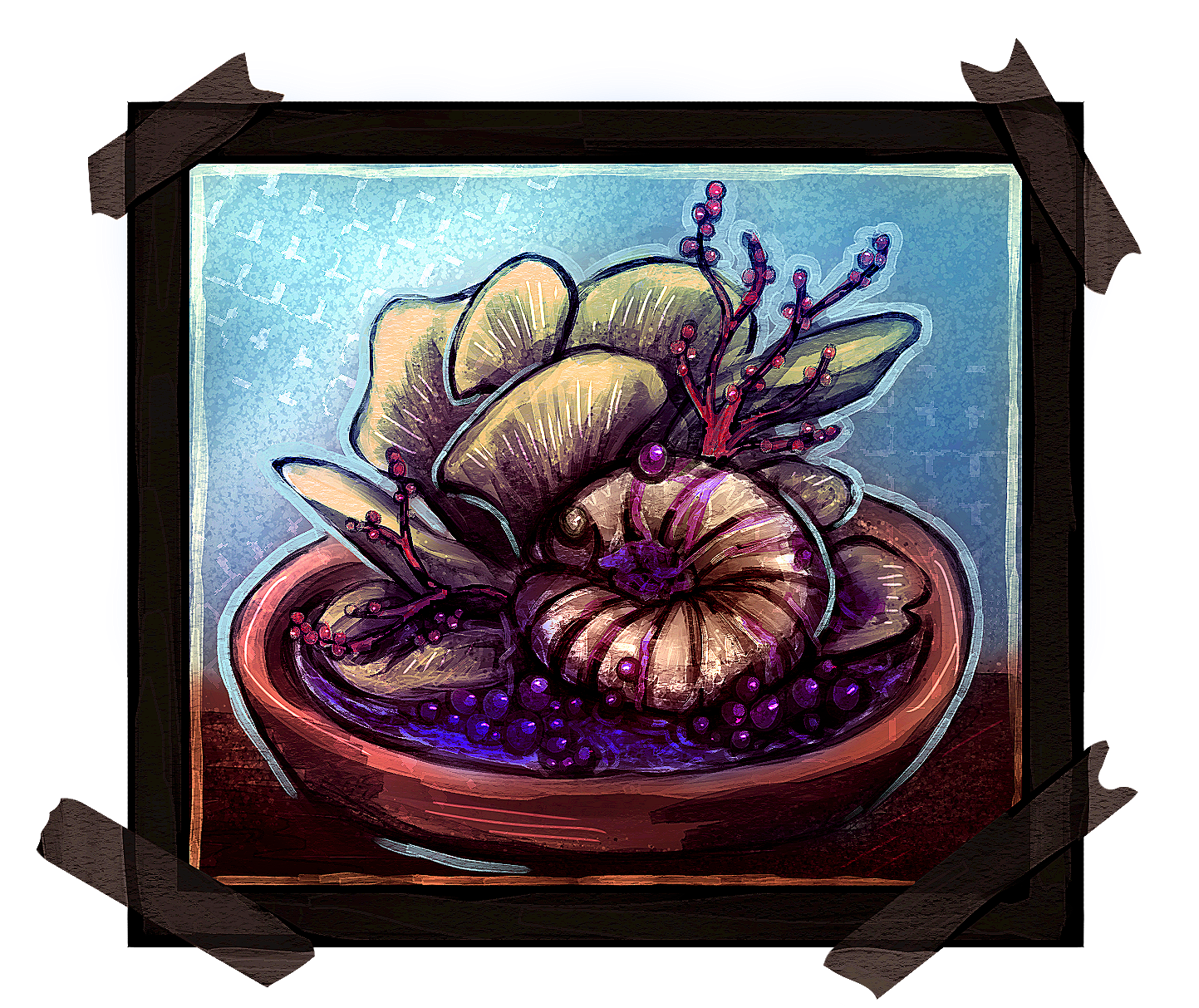

You haven't lived until you've had Rutas baked with caramelized Stratus cream sauce.
Toss in a few filets of grilled corralum...
Sweet and salty perfection.
The Brush and Berry
Blanket Brushes possess a structure optimized for aerial travel and colonization. They can clump together and turn into massive sheets, sharing collected sun and nutrients as they fly.
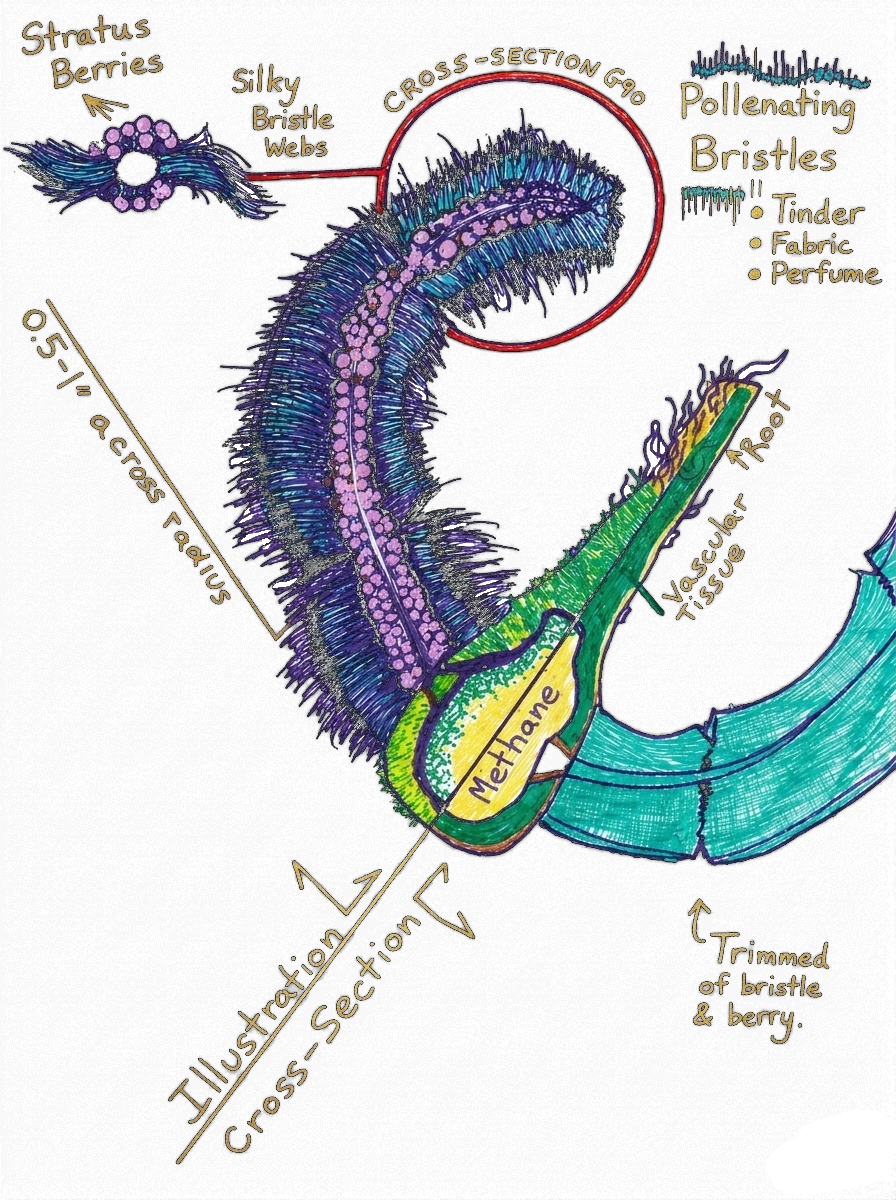
Root System: A narrow, interlocking network connects the stems of the fruits together. The roots can only widen enough to still maintain buoyancy.
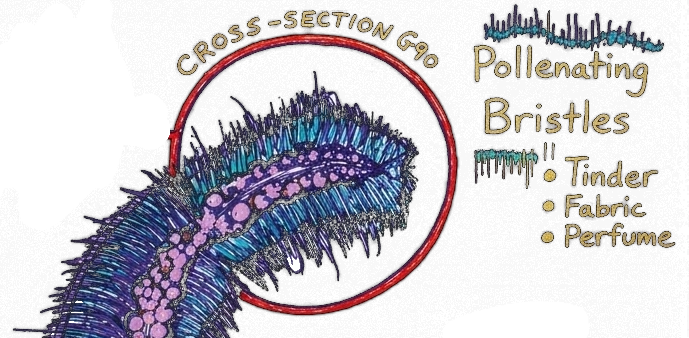
Silken Webbing: Several layers of fibrous, multi-pigmented silk bind the roots and fruits together. It grows from the fruit and the roots, weaving together and acting as a weighted sail to catch atmospheric winds.
Methane Segment: In the center of each berry, a small chamber regulates its own methane content to help the entire blanket fly.
Scale and Growth: A seed blanket can range from the size of a palm warmer to the size of a small town. They frequently collide and fuse mid-air to form a single, massive organism.
Botanical Weaves: The patterns and designs of the final silk weave are unique to their geographic birthplace, allowing skilled botanists to determine a blanket's exact origin.
Disease-hardy: Blanket Brushes protect their roots with a slightly acidic mucus layer that destroys and digests organic material in the air. This mucus layer carries a lasting fragrance that is used to repel predators.
// IMPORTANT NOTE // BIOHAZARD RISK
Being Disease-hardy does NOT mean you should eat Stratus Berry without washing them first.
The Lifecycle of Stratus Berries
The primary fruit of the Blanket Brush is the Stratus Berry, an edible aggregate fruit dangling from the organism's underside. Stratus Berries earn their name because they grow in the atmosphere, eventually falling to the ground where they can be caught and harvested.
Phase 1 : Flight Phase
The lifecycle begins as airborne seed clusters embedded within the floating silk. Clusters can begin strung together before flight, leading to sheets of seeds being peeled off by a strong gust of wind.
A previous unkempt sheet can lend itself to making huge blankets containing hundreds of thousands of seeds.
Phase 2 : Maturation Phase

During flight, the seeds and the inner blanket exude a small layer of acidic slime from fine cilia. Small airborne plankton and fungal spores are captured and digested in the goop. A light layering of leaves shades the berries from any solar radiation and absorbs energy for the berries below.
Some clusters may fuse during this stage or be ripped apart by predators or obstacles. The umbrella-like shape of the berries begins to plump up as nutrients are stored.
Phase 3 : Descent Phase
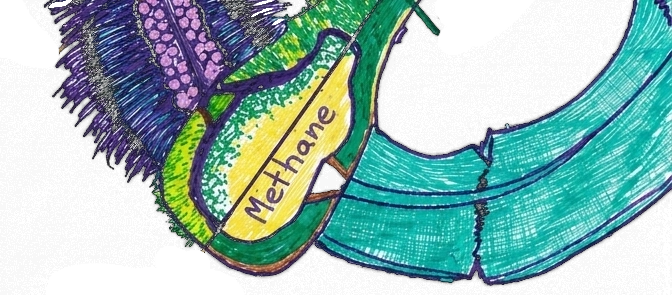
Upon reaching full maturity, the sheer weight of the ripe fruit drags the entire migrating carpet down to the ground. The methane in the berries is expelled as they fill with fruit, compounding the forces that drag the blanket down.
The Descent phase can last for a thousand kilometers, which gives ripening fruit a chance to catch up on the way down.
Phase 4 : Resprouting Phase

Berries that impact the earth will sit underneath their blanket, twisting and being dragged along until they hook into dirt, pop free, and bury themselves using the power of their twisted stem.
After a week of germination, sprouts will shoot upwards, punching through and blooming into brushy leaves and brilliant flowers that will soon extrude silken strands and repeat the process again.
Harvesting & Agriculture
The Blanket Brush has been a forage crop since the first Protoverin walked on the Verra Peninsula
Early Verin praised the arrival of the fruit as a sign of divine blessing, and considering it came from an entirely different continent halfway across the globe, it might as well have been. Early Verin used the berries as a sweetener and to make ceremonial wines.
During the colonization of the Mainland, Sazashi relied heavily on Blanket Brush harvests to survive and, as they were much closer to the source, received far more yield than Verra did. Exports of Stratus Berry preserves from Jhoutai fueled trade across the sea.
Organizing farming of the Berries is a matter of understanding the wind. Early in Sazashi and Verin history, learning where to set up nets came down to years of experience. In the modern age of weather probes and jetstream plotting, finding a good farm is a matter of science.
Stratus Harvesting Tools
The berries are harvested by using a specialized scythe, called a 'Moon Blade'
The curving angle of the scythe allows it to be swung overhead, catching the berries in a head-worn basket.
Hooks on the back of the blade are used to hoist out the roots and the strong strands attached to them.
Modern Agriculture
Automated catching nets are deployed during descent season. This network of posts rolls out into a thin wire mesh.
When the posts detect the weight of a blanket, the nets will roll back up to the base. The machinery mechanically strips away the berries, bundles the roots, and compresses the raw silk webbing into dense, transportable material bricks for textile manufacturing.

Societal Impact & Hazards
Infrastructure Threats
When unmanaged, Blanket Brushes can cause civic disruption. Stray blankets cover and inhibit solar panels, smother agricultural fields, clog air infrastructure, and can block natural sunlight.
The berries, if left unharvested, rot on the stem and fall to earth, splattering and leaving a deep purple stain and sticky residue. This can ruin public areas, stain property, and incur a hefty cleaning cost.
Leftover blankets dry out when they die. The feathery silk is a major fire hazard, burning swiftly and sending out flaming embers.
Biological Threats
Blankets that descend can drag down harmful organic and inorganic compounds.
The pollens can trigger severe allergies where they land, and even dangerous fungal spores can be brought down and cause infection.
Certain bacterial infections can live on Stratus Berries, so it is always recommended to wash raw berries before consuming.
Cultural Significance & Traditions
Despite the logistical challenges, the species' arrival is widely celebrated across the general populace. Stratus Berry has been a staple in cuisine long enough to evolve multiple cultural meanings.
It is popular for its culinary uses; it is common in soups, baked goods, aged in wine, or served raw. It also has a strong presence in the fragrance industry, thanks to the roots' long-lasting fragrance that can be easily distilled. It is among some of the oldest known perfumes on Jhoutai.
The silks peeled from the roots and fruit are used to form fabric. Commercial blanket fabric is dyed before use, but home-made clothing can form all sorts of colorful patterns.

Blanket Brush and Stratus Berry harvesting provides a large and convenient source of cloth and food. Farming the brush is resource-efficient, and it has widespread use in countless markets.
Growing Stratus Berry on other planets requires Jhoutai-style terraformation and biospheres, making it a rare and expensive export to other Banners.
Stratus Berry products are a major Pact export
Almost every culture on Jhoutai holds seasonal celebrations during the descent.
The populace views the floating carpets as a definitive sign of spring or in some cases worships them as a savior food source.
The Verin have some of the oldest festivals celebrating the arrival of the harvests, dating back ten thousand years.
The Sazashi view the bundles of hanging umbrella-like fruit clusters as a symbol of fertility. Gifting Stratus Berry treats is a common tradition with lovers new and old.
Similar to humanity's ancient 'mistletoe' tradition, Sazashi culture encourages kisses under Stratus Berry blankets.
Stratus Berry scent has notes of honey and citrus, and is worn when trying to be promiscuous.

My gracious Shelt-Ra hosts invited me to catch 'Blankets' with them. A bit of a confusing statement, but I followed along.
The 'blankets' made themselves obvious pretty fast. Shadows of what looked like cotton sheets floated through the air, listing toward the ground like an old flat balloon.
Already, hundreds of Sazashi of all ages milled about with their eyes to the sky.
Ahead of us, a green and yellow splotched sheet landed on a family, who scrabbled underneath it for a while before balling up the fabric and coming out from under it with an entire bowl of umbrella-shaped purple fruit.
Stratus Berry in the Kitchen
Stratus Berry is a popular kitchen ingredient, thanks to its acidic nature, milky sweet taste, and prolific growth. The harvest of the Blanket Brush has been noted in ancient Verin history, and even today the same Stratus berries are being used to create Monolithic gastronomic feats.
[\WELCOME TO YAKKOLI CULINARY DATA ARCHIVE \]
TOPIC SELECTED - JHOUTAI // FRUIT // STRATUS BERRY
HOVER THE RECIPES TO VIEW DETAILS
Pejra Reduction
An ancient recipe that draws its roots back to the first sophontic life on the Verra Peninsula.
Creating A Pejra Reduction involves picking the berries and setting them to simmer in a massive pot for several days. The distilled dark-purple liquid is thick like molasses and calorie-dense.
It is still used today as a sweetener in many dishes, but historically it was used as a preservation method for Stratus Berries.
>> Recipe Info
- Founded During Tremulous Era
- Place of Origin Verra
- Calories 440 kcal
- Sugars 30 G
- Value 10R for 1 L
Deconstructed Stratus Glaze
A contemporary dessert popular in Aempis. A sphere of crystalline sugar is set on a plate. At tableside, a server punches a hole in the sphere and pours a hot, watery Stratus Berry syrup over the sphere.
The sphere melts away in a satisfying display, leaving an inner shell coated in a bright purple, delicate glaze.
During the Advent Era this dish could only be found in high-end establishments. It had a renaissance and became widely available as an at-home delicacy.
>> Recipe Info
- Founded During Advent Era
- Place of Origin Aempis
- Calories 390 kcal
- Sugars 58 G
- Value 35R for 2 Servings
Stratus Berry Brining
Stratus Berries have a high acidic content and are common in brining solutions. They add a sweet and milky flavor to whatever is pickled. Eggs, boiled Rutas, and vegetables are all common choices for pickling in berry brine.
Stratus Berry pickled vegetables are a household commodity, used to preserve food and have a sweet snack throughout the day.
>> Recipe Info
- Founded During Tremulous Era
- Place of Origin Verra
- Calories 80 kcal
- Sugars 6 G
- Value 5R for 1 L
Street Mane
A popular street food and take-away meal on Jhoutai. Street mane uses strands of Euphraesthi's Mane served with additional proteins such as fried millomi.
After toasting the noodles and proteins, the entire mix is cooked with a helping of Stratus berry juice. The acidity of the berries cuts through the oils and the flavor adds a creamy note.
Street Mane is a popular meal to have in space, especially on Pact vessels.
>> Recipe Info
- Founded During Advent Era
- Place of Origin Valdutan
- Calories 600 kcal
- Sugars 12 G
- Value 10R for 2 Servings
Rajh Tea
A comforting morning ritual for many households. Hot water is steeped directly with dried Stratus Berry slices and other herbs.
The fruit rehydrates and releases its clear sweetness, naturally cutting the bitterness of the herbs with a smooth milk-like flavor.
Rajh Tea can also be served cold as a refreshment during the hot seasons.
>> Recipe Info
- Founded During Crescendo Era
- Place of Origin Khatoum
- Calories 10 kcal
- Sugars 5 G
- Value 10R for 10
Griddle Cakes
Griddle Cakes are a staple baked good amongst the Sazashi. The berry juice is whisked straight into a simple Jhoutaioan Wheat batter.
The berries serve as the activating acid for the leavening in the wheat. Whisked until smooth and poured into molds, it cooks into fluffy, purple cakes that taste as if made with sweetened milk.
Traditional Griddle Cakes with Stratus Berry is exceptionally popular amongst the Shelt who invented it.
>> Recipe Info
- Founded During Advent Era
- Place of Origin Valuser'rh
- Calories 340 kcal
- Sugars 11 G
- Value 5R for 4 Servings
Stratus Berry Creme Pie AKA. "Sky Pie"
The Sky Pie is the result of a chemical reaction of aged acidic Stratus Berry juice and the prepared starch from Pinkroot. The starch causes the juice to expand rapidly, trapping gases and forming a thick, purple foam. The mix and preparation of ingredients can change the density of the reaction and the balance of flavors dramatically.
Nearly every major Jhoutai city claims the 'Original' Sky Pie. The most accepted theory is the invention of the Sky Pie by the Faecha, as the Prepared Pinkroot was a staple source of food during their early settlement of Tyrn-Cha.
>> Recipe Info
- Founded During Advent Era
- Place of Origin Valuser'rh
- Calories 340 kcal
- Sugars 11 G
- Value 5R for 4 Servings
Stratus Wines
There are countless Stratus Berry Jhoutaioan wines; it is an art as old as Sophont itself. Different additives, different blends, different processes. Some take weeks to make, others measure their age in millennia.
In the historical sense, Stratus Berry wine is a crystal-clear liquid. The wine has a sweet, acidic nose, full-bodied taste, and sweet cream notes.
Stratus Wine is popular among amorous lovers; on the flip side, it can be seen as pitiful to drink Stratus Berry wine alone.
>> Recipe Info
- Founded During Tremulous Era
- Place of Origin Verra
- ABV 15-30%
- Sugars 3 G
- Value 50-50000R
Other Uses in the Home
Stratus Berry Extract is used as a primary scent in many cultural applications. With its sweet and soothing aroma. Stratus Berry incense and candles are used to promote relaxation, especially in romantic settings.
Wearing Stratus Berry perfume is a good way to promote your desire for close social interactions.
Windpot Kites and other livestock crops feast on Stratus Berry in their natural habitats.
During the Descent season, Windpot Kites will be flown outside of cities to ensure that the protective nets do not get overloaded with blankets.
I'm 3000 words into this article please help me

'I'm 3000 words into this article please help me' No, please, keep going. XD XD XD I love this article so much. The recipes, the traditions, the dangers, all the botanical illustrations... <3 <3
Explore Etrea | Summer Camp 2026