
AEL'CANORAS
The High Canopy Refuge · First Haven of the Ael'vari · Ael'sethana
"Three elves have described Ael'canoras to me over the course of forty years. They described it differently in detail and identically in character: a place that grew into what it is rather than being built into it, over generations of patient attention and patient asking. All three used the word answered to describe what happened when the forest provided new structures. None of the three appeared aware of the theological implications of that word. I have not been able to stop thinking about it since the first time I heard it."
Ael'canoras is the oldest inhabited settlement in Aethermarch — older than Rome's arrival, older than the dwarven holds, older by several centuries than any structure that any other people has built in this world. It sits in the high canopy of Sylvanmere's interior, its structures grown rather than built, its walkways formed from living wood over generations of what the elves describe as sustained attention and sustained asking. It is, as best Roman scholarship can determine, both a city and a prayer: the physical expression of a fourteen-hundred-year relationship between a people and the forest that is, in some sense I have not yet adequately named, their god.
Caladris Ael'ven, the eldest of the three Triumvirs, has her quarters here. This is where the elf who will not open the forest's borders lives, and where the archive that may contain what she found forty years ago is kept. Ael'canoras is the heart of elvish isolationism. It is also the place where the Silence has been felt the longest, and where the absence of children has had the most time to change what a city is.
"I know more about Ael'canoras than I know about any other settlement I have never visited. This is not a satisfying kind of knowledge. It is the knowledge of someone who has stood outside a door for sixty years and listened carefully to what can be heard through it."
Demographics
Ael'canoras is entirely Ael'vari. There are no non-elf residents, no foreign quarters, no trading population from outside the forest. This has been the case for the fourteen hundred years of the haven's existence and there is no indication it will change. The haven is the oldest of the three inhabited sites and has the character, by elf account, of a place where the oldest elves tend to settle: those who have been alive long enough that the high canopy's particular quality of time — slow, deep, attentive — is more comfortable than the waterfall's sound or the lake's openness.
The population of approximately seventy-five thousand is declining, as all elvish populations are, by the arithmetic of the Silence. There are no children in Ael'canoras. There have been none for three hundred and fifty years. The structures that were once used for purposes that required the presence of the young have been repurposed. An elf who mentioned this in passing said only: we have found other uses. She did not say what the other uses were. I did not ask.
Government
Ael'canoras is entirely Ael'vari. There are no non-elf residents, no foreign quarters, no trading population from outside the forest. This has been the case for the fourteen hundred years of the haven's existence and there is no indication it will change. The haven is the oldest of the three inhabited sites and has the character, by elf account, of a place where the oldest elves tend to settle: those who have been alive long enough that the high canopy's particular quality of time — slow, deep, attentive — is more comfortable than the waterfall's sound or the lake's openness.
The population of approximately seventy-five thousand is declining, as all elvish populations are, by the arithmetic of the Silence. There are no children in Ael'canoras. There have been none for three hundred and fifty years. The structures that were once used for purposes that required the presence of the young have been repurposed. An elf who mentioned this in passing said only: we have found other uses. She did not say what the other uses were. I did not ask.
Defences
The forest is the defence. Ael'canoras has no walls, no gates, no garrison. It does not require them. Sylvanmere itself — the whole of it, not merely the approaches to the haven — functions as a defensive system of a kind that Roman military engineering has never encountered and cannot replicate. Non-elves who enter Sylvanmere without permission do not, in my experience and from every account I have found reliable, emerge from it in the same condition as they entered. Whether the forest-god's agency is the mechanism, or whether the elves maintain active guardianship through means invisible to Roman observation, the practical result is the same: no external force has successfully reached any haven interior in fourteen hundred years. The Bellum Magnum of -900 A.P. is the one recorded exception, and the first haven was destroyed in it. What the Ael'vari did in response to that destruction is not documented in any source available to me.
"I have stood at the treeline of Sylvanmere seven times. On each occasion I have had the distinct sensation of being assessed. I do not know what assessed me. I know that I was permitted to leave each time, which I take as information."
Industry & Trade
There is no external trade. The Ael'vari conduct no commerce with Rome, with the dwarves, or with any other people. The forest provides what the elves need; what the forest does not provide, the elves have learned over fourteen hundred years to live without. Roman scholarship has no documented record of any good or service passing between Sylvanmere and any external party in the twelve hundred years of Rome's presence in Aethermarch.
The internal economy of Ael'canoras — the exchange of labour, skill, and knowledge among its inhabitants — is not observable from outside the forest and has not been described to me in terms that would allow a useful account. What the elves make, tend, study, and teach within the haven is their own business, conducted entirely within a system that has had no contact with Roman economic categories long enough that the categories may have ceased to apply.
Infrastructure
The walkway network is Ael'canoras's primary infrastructure: the system of grown-wood paths connecting the haven's structures across the three inhabited district levels. Sources describe three tiers of walkway — the high routes at canopy level, the mid-canopy connectors between Ael'thalas and Vel'anen, and the descent structures that allow movement to Ithren-Nor at root level. The descent structures are not simply stairs. One source described the process of moving between levels as requiring the cooperation of the forest — a phrase she declined to elaborate on.
Water reaches the high canopy through mechanisms that no elf source has explained and that Roman botanical knowledge cannot account for. The trees appear to convey water to the inhabited levels in the same way that they convey it to their own upper foliage, which is to say through biological processes that the forest has apparently adapted or extended for the elves' use. Whether this is a natural extension of the trees' function or something the forest-god does deliberately is a question I have decided I will not resolve in this lifetime.
Districts
Ael'canoras is organised across three vertical districts. Ael'thalas (The High Boughs) is the uppermost: the open canopy platforms, elder council spaces, and communal walkways where the haven's governing life concentrates, with the sky visible above on clear days. Below it, Vel'anen (The Mid-Canopy) is the intellectual and contemplative heart of the haven — the working spaces of the practitioners, the archive grove where the Ael'vari's accumulated knowledge is kept, and the district through which all movement between the upper and lower zones passes. Ithren-Nor (The Root-Hall) is the lowest district, formed by the root systems of the great canopy trees at the forest floor: not a residential space but a place of deep consultation with the forest, still and heavy, where the Silence research has been conducted for two centuries. One source described it as the place the elves go when they need to be close to what is wrong.
Guilds and Factions
Ael'canoras has no organisations in the Roman sense — no guild structure, no collegium, no commercial faction. Its internal organisation is the Triumvirate's authority as exercised through the elder practitioner council and through whatever mechanisms of decision-making the elves have developed over fourteen hundred years that are not visible to outside scholarship.
The one faction of political consequence is the position that Caladris herself represents: the isolationist argument, the belief that the Silence will be resolved from within Sylvanmere or not at all. This position does not require an organisation because it is already the governing position of the oldest and most senior Triumvir, implemented daily in the continued closure of the forest. Its opponents are in the other two havens. In Ael'canoras, it is the consensus — or, at minimum, the unchallenged position of the elder who has lived here for seven hundred and eighty years and to whom the forest appears to respond with particular directness.
History
Ael'canoras was established at the First Permutatio in -1400 A.P., making it the oldest continuously inhabited settlement in Aethermarch. The first fourteen hundred years of its history are recorded in the Vel'ithren archive in a form that Roman scholarship cannot access; what is known externally is a series of events filtered through eleven treeline conversations. The Bellum Magnum of -900 A.P. destroyed the first haven — Locus Primus Ael'vari — and the elves withdrew further into the forest's interior. Ael'canoras was among the havens established or expanded in the aftermath. Whether it predates the Bellum Magnum or was established in response to it is a question no elf source has answered directly. The three hundred and fifty years of the Silence have been spent in Ael'canoras as they have been spent across all of Sylvanmere: in research, in argument, in the long patience that a people with indefinite lifespans can sustain in a way that shorter-lived peoples cannot. The current moment — 1200 A.P., with Rift XIII approaching — is one that the elves in Ael'canoras are aware of and have not discussed with outside parties.
See Annales Mundi · -1400 A.P. (First Permutatio), -900 A.P. (Bellum Magnum), 850 A.P. (Onset of the Silence), 1160 A.P. (Caladris's archive discovery, undocumented externally).
Points of interest
Ael'canoras is organised across three vertical districts. Ael'thalas (The High Boughs) is the uppermost: the open canopy platforms, elder council spaces, and communal walkways where the haven's governing life concentrates, with the sky visible above on clear days. Below it, Vel'anen (The Mid-Canopy) is the intellectual and contemplative heart of the haven — the working spaces of the practitioners, the archive grove where the Ael'vari's accumulated knowledge is kept, and the district through which all movement between the upper and lower zones passes. Ithren-Nor (The Root-Hall) is the lowest district, formed by the root systems of the great canopy trees at the forest floor: not a residential space but a place of deep consultation with the forest, still and heavy, where the Silence research has been conducted for two centuries. One source described it as the place the elves go when they need to be close to what is wrong.
Tourism
Section omitted. Ael'canoras is closed to all non-elven visitors. No Roman, dwarf, or other external party has entered the haven in the documented period of Aethermarch history. There is no mechanism by which a visitor could be accommodated and no indication that one will be created.
Architecture
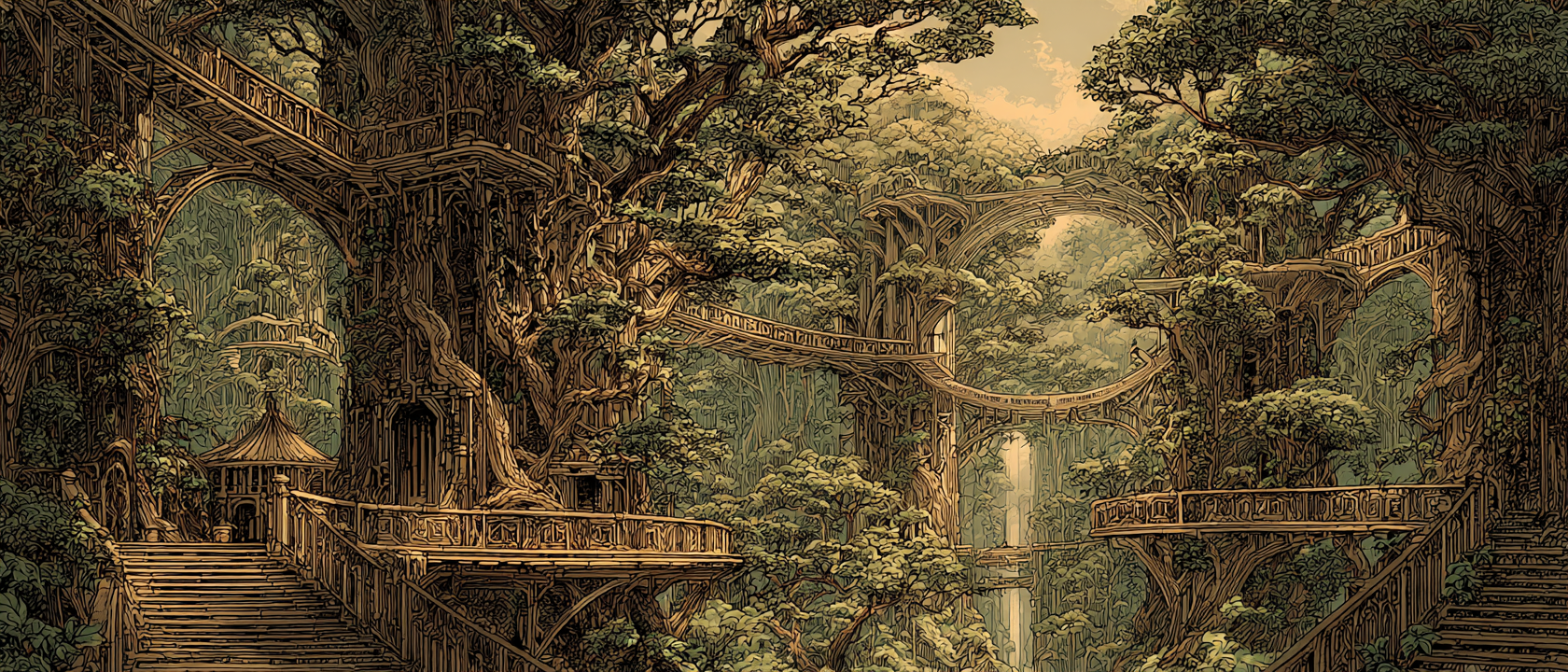
The built environment of Ael'canoras is not built in any Roman sense. No stone is quarried, no timber cut, no material extracted from the forest and shaped elsewhere. The structures of the haven are the forest: shaped over years or decades of what the elves describe as sustained intention, the living trees growing into the configurations that are needed, their branches thickening and curving to form floors, their canopy thickening into roofs, their root systems developing into the foundations of the root-level chambers far below. Three elf sources have used the word answered to describe the moment when the forest provided a new structure — not the word completed, not built, not finished. Answered. The theological implication of this usage has occupied me for twenty years.
The walkways between structures are grown in the same manner: living wood that has widened and stiffened over generations, with a surface that three sources independently described as smooth in a way that wood does not normally become without cutting. The walkway network connects the districts of the haven at the high canopy level and extends, at a lower tier, to the mid-canopy zone. The descent to the root-level chambers requires a different kind of movement that no source has described in terms I could visualise. I have not pressed the question.
The colour of Ael'canoras, in the accounts I have received, is green and gold and the particular quality of light that comes through a very high canopy: filtered, directional, moving slowly as the day passes. One source said: it is the colour of being inside something that is alive. I have recorded this and not attempted to improve upon it.
Geography
Ael'canoras occupies a zone of the northeastern interior of Sylvanmere where the great canopy trees reach their highest growth — specimens that Roman botanical scholarship, to the extent it has been able to observe the forest's edge species, estimates at three to four hundred feet in height. The haven is not at ground level. It is not at the forest floor, which by elf account is a different environment entirely from the inhabited canopy: darker, quieter, and characterised by a quality of attention that even the elves find heavy. Ael'canoras is in the high boughs, connected to the upper canopy and open, in places, to the sky above the forest's ceiling. An elf source who described it in 1181 A.P. said that on clear mornings, from the highest platforms, you can see the distance that the forest covers. She said this as though it were a comfort. I believe for her it was.
The precise location within Sylvanmere is not known to Roman cartography. The three elf sources who have described it to me have not provided coordinates, and I have not asked for them. Asking would have ended the conversation.
Climate
The high canopy zone of Sylvanmere's interior has its own microclimate, distinct from the forest's edge environment that Roman observers can directly study. The great trees moderate temperature and wind in ways that the inhabited canopy platforms experience differently from the forest floor. Sources describe the high canopy as consistently cooler than the forest floor and more variable in light than the mid-canopy — on clear days, the sky is visible above the highest platforms; in low cloud or storm, the canopy absorbs the worst of the weather. Seasons exist but are muted. One source said: the canopy has its own weather, which is not quite the same as the sky's weather. I found this a precise description of something I had not previously had language for.
Natural Resources
Roman scholarship has not documented the resource base of Ael'canoras in any systematic way. What can be inferred from general knowledge of the forest: Sylvanmere supports an elf population of approximately 180,000 through the forest's own provision, which means the high canopy zone around Ael'canoras yields what its inhabitants need in terms of food, water, and materials. The forest provides. What the forest provides, and how, is not a subject that elf sources have addressed with me.

Comments