
AEL'CORUM
The First Tree · Locus Primus Ael'vari · Sylvanmere
"An elf told me, in 1193 A.P., that there is a tree at the centre of the original settlement that came through the Rift with them. She said this in the way that people mention things they consider too obvious to require explanation, and then immediately changed the subject. I spent six years trying to understand what it meant for a tree to have come through a Permutatio event. I have an answer now. I am not certain it is less troubling than the question."
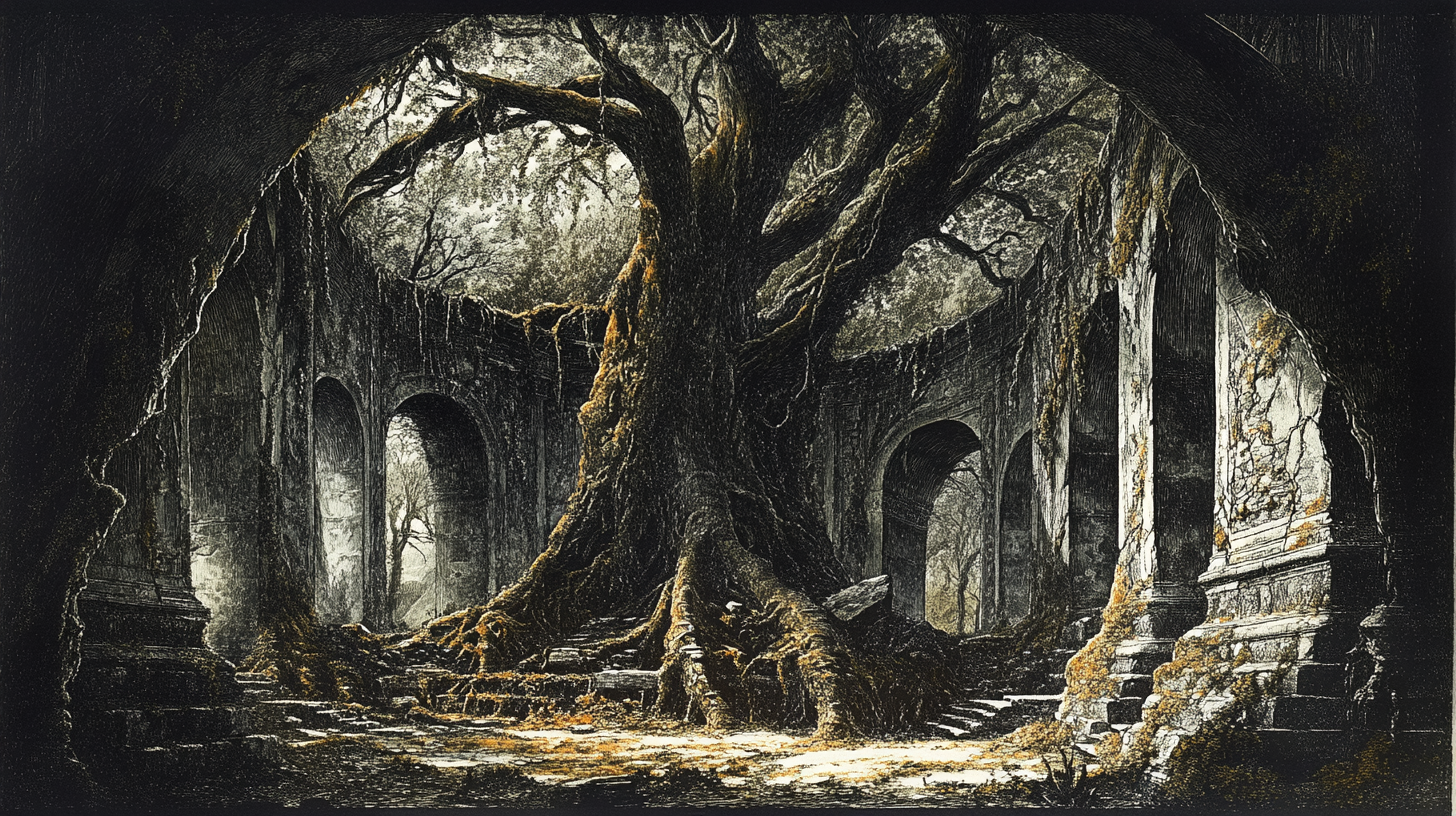
Ael'corum is the oldest living thing in Aethermarch that did not originate in Aethermarch. It came through the First Permutatio with the Ael'vari fourteen hundred years ago: a tree already ancient in the world the elves left, transposed into this one at the moment of arrival and established in the soil of what became the original settlement. It has grown for fourteen hundred years since. What it was in the world the elves came from is not documented in any source available to Roman scholarship. What it has become here is visible from the edges of the Ruins in which it stands: the largest living structure in Sylvanmere, its trunk wider than a Roman forum, its canopy a self-contained sky above the ruins of the first settlement.
It is dying. The process is not fast by any standard a human observer would apply — a tree of this age does not die quickly — but the signs are present and have been present since approximately the onset of the Silence three hundred and fifty years ago. The bark of the lower trunk shows the specific grey-black discolouration that the Academy's eastern boundary studies document in dead and dying specimens of the transition zone species. The root buttresses at the base are cracked in ways that living wood of this quality does not crack. In the upper canopy, visible on clear days from the Ruins' central open space, there are sections where the leaves do not return in spring.
The elves who make the annual Day of Remembrance journey to the Ruins sit near it. They do not discuss what they observe. They have been sitting near it and not discussing what they observe for three hundred and fifty years.
Physical Description
The trunk of Ael'corum is approximately thirty metres in circumference at its base , wider than any tree documented in the Academy's botanical studies anywhere on the primary continent. The root buttresses extend outward from the base in five directions, each several metres tall at the trunk and tapering over a distance of fifteen to twenty metres before descending below the soil. The bark is a deep brown-grey in the living sections, darkening to the grey-black of early decay in the lower portions of the trunk between the buttresses — the decay is patchy rather than continuous, advancing unevenly in the way that a large organism's decline advances when the cause is systemic rather than local.
The canopy is approximately seventy metres above the forest floor and extends across an area sufficient to shade the majority of the Ruins' central open space. From beneath it, in clear weather, the sky is visible only in the gaps between the branches. The branches themselves are the diameter of mature trees; the smallest visible branch from the Ruins' floor is wider than a Roman load-bearing column. In the canopy's northern quadrant, there are sections — three at last reliable elf account — where the leaves do not return in spring. The bare branches are visible from below as a different quality of light in those sections: the direct sunlight that the living canopy filters elsewhere, entering unfiltered through the dead sections in the way that light enters through a broken roof.
The Decay
The specific pattern of the decay is not random. It began in the lower trunk — in the sections of bark between the root buttresses, the parts of the tree closest to the soil of this world — and has been advancing upward over three centuries. This is consistent with a systemic cause originating at the root level rather than a canopy disease or a mechanical injury. The root network of a tree of this size extends, by any reasonable estimate, throughout the central zone of the Ruins and into the surrounding forest for a considerable distance. What is happening at the root level — the point of the tree's contact with the soil that the forest-god inhabits — is not visible to any outside observer. What is visible is the upward progress of what the root system is no longer adequately supplying to the bark above it.
In the past fifty years, by the account of the one elf source who mentioned the tree's condition at all, the decay in the canopy has accelerated relative to the previous two centuries. Three dead sections in the canopy fifty years ago; the same three sections, now larger, and the beginning of a fourth. The acceleration is consistent with the overall rate of population decline in the Silence's later centuries: fewer elves, less accumulated attention, less of what the forest-god requires to sustain the physical form that Ael'corum represents.
Purpose / Function
Ael'corum has no assigned purpose. It predates the Ael'vari's presence in this world as an adult tree; it was not planted for a purpose in the way that cultivated trees are planted. Its relationship to the forest-god of Sylvanmere is the question that its presence raises most immediately. The forest-god is a divine entity that grew into being over fourteen centuries as the Ael'vari's sustained attention and reverence — the specific quality of elvish consciousness engaged with the natural world — created, slowly, an awareness in the forest that had not existed before. Ael'corum was here at the beginning of that process. It was the first tree the forest-god inhabited, in the sense that a divine presence inhabits the physical world through the things that are most attended to.
The elves did not know they were creating a god. They know, by now, that they have one. They do not know, or do not permit themselves to know, that the god is dying because they are dying — that the attention which created the forest-god is diminishing as the population diminishes, and that Ael'corum is the place where the god's diminishment is most physically legible.
Sensory & Appearance
Approaching Ael'corum through the Ruins, the scale becomes apparent before the tree does: the canopy is visible above the ruined structures long before the trunk is reachable. The sound near the tree is different from the sound elsewhere in the Ruins — quieter, or more precisely, attending in a different way, as though the specific quality of the forest-god's presence at this location has a character distinct from its ambient presence throughout Sylvanmere. One source, who described reaching the tree on the Day of Remembrance, said: it sounds the way a very large thing sounds when it is in pain, except that a very large thing in pain does not sound like anything you have heard before, so you do not recognise it as pain until afterward. She said this without apparent metaphor.
The smell near the lower trunk, in the sections of active decay, is the specific smell of very old wood dying: different from the smell of recently fallen timber, different from the smell of soil, the particular complex of processes that a tree of this age and mass generates when its bark's biological systems are shutting down in sections. It is a heavy smell. It is present in still conditions and disperses in wind. The Triumvirs, who sit near the tree for three days each year, do not comment on it in any elf account that has reached me.
History
Ael'corum arrived in Aethermarch at the First Permutatio in -1400 A.P., already ancient. In the world the elves came from, it held a significance that elf sources have not described directly to any outside scholar, but which the elves' treatment of it here — their choice to settle the original haven around it, their maintenance of the Ruins in which it stands, their annual gathering at its location — implies was constitutive of something important. The original haven was destroyed in the Bellum Magnum in -900 A.P. Ael'corum was not destroyed. The ruins were not rebuilt. The elves have maintained both the ruins and the tree's location as the site of the Day of Remembrance ever since.
The Silence began in 850 A.P. The first documented evidence of the tree's decay is not in any external record, but the elf source who mentioned it placed its onset in approximately the same period. Three hundred and fifty years of decay in a tree of this size and age produces visible but not yet catastrophic change: the lower trunk's decay, the advancing canopy sections, the cracked root buttresses. What the next three hundred and fifty years produce, if the Silence continues, is a question the three Triumvirs sit with once a year and do not answer in each other's presence. See Annales Mundi · -1400 A.P. (First Permutatio), -900 A.P. (Bellum Magnum), 850 A.P. (onset of the Silence and approximate onset of the tree's decay).

Comments