
LITH'SERA
The Lake Haven · Third Haven of the Ael'vari · Ael'sethana
"Two separate elves have described Lith'sera to me, in conversations twenty years apart. Both used the word beautiful without being asked whether it was beautiful — it was the first word they reached for, unprompted, which I take as an indicator that it is the first word anyone who sees it reaches for. The second elf, twenty years after the first, used the same word but then paused and said: it is still beautiful. The beautiful parts are smaller than they were. She did not appear to intend this as an observation about anything other than the physical haven. I believe it was an observation about more than the physical haven."
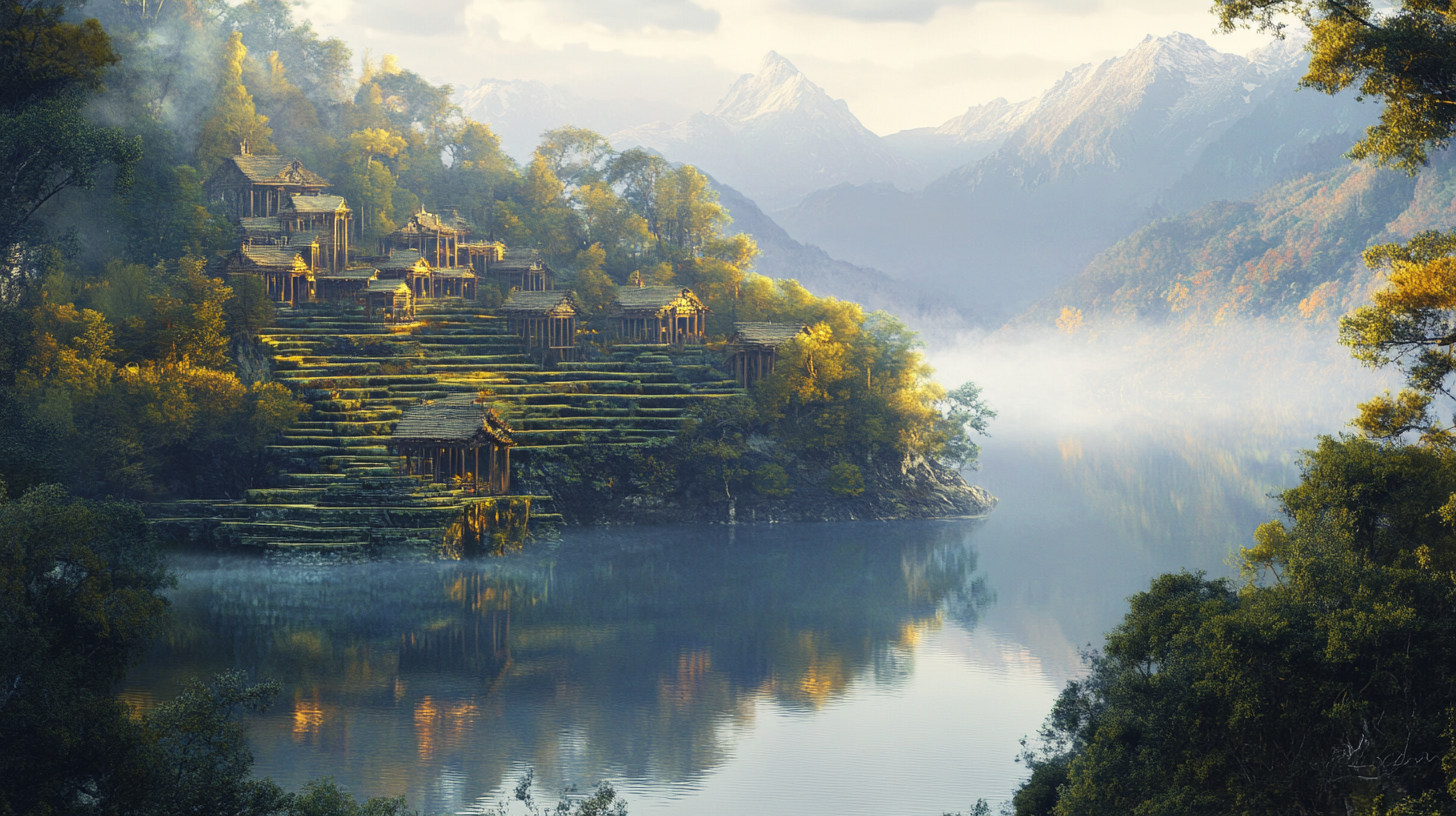
Lith'sera is the most beautiful of the four havens, by the consistent testimony of every elf source who has mentioned it — and the one in which beauty is most consciously understood as a diminishing quantity. It sits on the shores of a mountain lake in the forest's northern interior, its structures grown along the shore and up the lower slopes above it, the lake's surface the defining visual feature of the haven in the same way that the falls' sound defines Vel'thuris. What the second elf source meant when she said the beautiful parts are smaller than they were — whether she was describing the lake's margins, the structures, or the population — I have not been able to determine. I suspect she meant all three simultaneously, and that the simultaneity was the point.
It is the haven of Aeveth Lith'sera, the third Triumvir, who has accepted that the Ael'vari are dying and has spent a century building an archive that will survive them. The archive is nearly complete. What it contains — including Aeveth's own assessment of why the Silence began, which is the most uncomfortable of the three Triumvirs' conclusions — is the most significant body of knowledge about elvish civilisation that will ever exist in a form accessible to the outside world, if Aeveth's plans succeed. Caladris Ael'ven does not know. Mirewen Vel'thuris suspects.
Demographics
Lith'sera holds the smallest population of the three inhabited havens, currently estimated at approximately forty-five thousand and declining faster than Ael'canoras or Vel'thuris by Aeveth's private calculation. The haven's population has the character of a community that is, in some way its members have not fully articulated, preparing. Aeveth's work on the archive has shaped the haven's culture over the past century — there is a quality of documentation, of deliberate recording of practice and knowledge, that is more present in Lith'sera than in the other havens. The practitioners here tend toward the preservative traditions: the recording of knowledge, the maintenance of records, the transmission of practice to the youngest elves who are now three centuries old and are, in this haven more than the others, treated with a specific quality of attention that reflects their position as the last generation born before the Silence.
Government
Lith'sera is governed by Aeveth Lith'sera as Tertia Triumviratus, exercising her authority with the particular quality that characterises her position: she governs as someone who has accepted a conclusion and is working from it, rather than someone still in argument. Her governance of Lith'sera has the efficiency of a person who has one significant thing left to do and intends to do it properly. The haven's elder council operates with less deliberation and more practical focus than those of the other havens — Aeveth does not convene it to discuss the Silence, which she considers a closed question. She convenes it to manage the haven's ongoing life and, when required, to make decisions about the archive's progress.
Defences
Lith'sera shares Sylvanmere's forest-wide defensive capacity, with the qualification that the haven's northern exposure — the lake and the mountains beyond it — represents a different kind of boundary from the deep forest that surrounds the other havens. The forest's defensive attention does not extend beyond the treeline into the mountain terrain, and the lake's northern shore is not within the forest's full protective envelope. This has never been militarily significant in the haven's history, but it is the reason Lith'sera is the one haven where something from outside Sylvanmere has, in the past decade, come close enough to be heard by the haven's most sensitive practitioners.
Industry & Trade
There is no external trade. What distinguishes Lith'sera from the other havens is not economic activity but the specific intellectual production of the archive: the systematic documentation of Ael'vari knowledge, history, and magical tradition that Aeveth has been conducting for a century. This is not trade in any Roman sense. It is a form of production whose intended recipient does not yet exist — whatever civilisation or scholar will eventually inherit the archive, which Aeveth has arranged to be placed with the dwarven archivists for safekeeping, without the knowledge of the other Triumvirs.
Infrastructure
The lake is Lith'sera's primary infrastructure in the way the falls are Vel'thuris's: the central fact around which everything else is arranged. The landing stages along Caer-Lithos allow movement across the lake for those practitioners whose work takes them to the northern shore, though the northern shore is less inhabited than the southern. The path network connecting the three districts rises from the shore level through the stepped groves to the archive structures above, following the natural terracing of the slope. The archive itself has specific infrastructure requirements — preservation environments for materials that must survive centuries without elvish maintenance — that Aeveth has been developing and refining for decades, in consultation with the dwarven archivists who have been told, indirectly, what they will eventually be asked to house.
Districts
Lith'sera is organised across three districts arranged vertically from the lake shore upward. Caer-Lithos (The Shore) is the lakeside district: the grown structures at the water's edge, the landing stages, and the open spaces where the lake's beauty is most immediate and where the beautiful parts that are smaller than they were are most legible. Anel-Thira (The Stepped Groves) is the terraced residential district rising from the shore up the lower slopes — the main inhabited zone, its structures visible from the lake below in tiers that the haven's sources have consistently described as one of Lith'sera's defining visual features. Meren-Dûr (The Archive) is the upper-slope district where the archive is being compiled: functional, purposeful, and nearly complete.
Guilds and Factions
Lith'sera has no organisations in the Roman sense. Its factional character is defined entirely by Aeveth's position: the Triumvir who has concluded the argument is over and is working on what comes after. This is not a faction but a gravity — the haven's practitioners have, over a century of Aeveth's presence and work, oriented themselves toward the archive project in ways they might not have chosen consciously but that have become the shape of Lith'sera's collective life. They are helping to build the record of what they are. Most of them have not articulated this to themselves. Aeveth has not told them that this is what they are doing. She has simply made the work available and found that it is taken up.
History
Lith'sera is the most recently founded of the three inhabited havens, established approximately three centuries after the Permutatio when the northern interior of Sylvanmere was sufficiently settled for a community to develop around the mountain lake. Its history is the quietest of the three havens — it has not been a seat of governing authority in the way Ael'canoras has, or a centre of the specific practitioner tradition that Vel'thuris developed around its falls. It has been beautiful, and it has been declining, and for the past century it has been building the record of what the Ael'vari were. See Annales Mundi · -1100 A.P. (approximate founding), 850 A.P. (onset of the Silence), 1100 A.P. (Aeveth begins the archive project).
Points of interest
Lith'sera (The Lake) is the haven's defining feature and primary named landmark — the mountain lake around which the settlement is organised, cold and clear, its surface a mirror for the sky and the slopes above it. Meren-Dûr (The Archive District) contains the nearly complete archive of Ael'vari knowledge, and within it the specific repository where Aeveth's own assessment of the Silence's cause is recorded. Aeveth Lith'sera's quarters in Anel-Thira have no established name in any source available to Roman scholarship. Both the lake and the archive have their own articles.
Tourism
Section omitted. Lith'sera is closed to all non-elven visitors.
Architecture
Lith'sera occupies the northern interior of Sylvanmere, in the forest's highest elevation zone where the great canopy trees thin toward the mountain terrain and a lake of considerable size sits in a natural bowl formed by the landscape's northern rise. The lake's water is cold and clear, fed by snowmelt from the mountains above the forest's northern limit. The haven is built on the lake's southern shore and up the lower slopes above it — the shore itself is Caer-Lithos, the stepped groves rising above it are Anel-Thira, and Meren-Dûr, the archive district, occupies the upper slopes where the trees begin to give way to the mountain's rocky character.
The lake is the haven's northern boundary. The mountains beyond it are outside the forest and outside Sylvanmere's defensive envelope in a way that the forest's interior is not. Lith'sera is the most exposed of the three havens to the world beyond Sylvanmere, which is a fact that has shaped both the haven's character and Aeveth's particular relationship to the question of what survives the Ael'vari.
Geography
Lith'sera occupies the northern interior of Sylvanmere, in the forest's highest elevation zone where the great canopy trees thin toward the mountain terrain and a lake of considerable size sits in a natural bowl formed by the landscape's northern rise. The lake's water is cold and clear, fed by snowmelt from the mountains above the forest's northern limit. The haven is built on the lake's southern shore and up the lower slopes above it — the shore itself is Caer-Lithos, the stepped groves rising above it are Anel-Thira, and Meren-Dûr, the archive district, occupies the upper slopes where the trees begin to give way to the mountain's rocky character.
The lake is the haven's northern boundary. The mountains beyond it are outside the forest and outside Sylvanmere's defensive envelope in a way that the forest's interior is not. Lith'sera is the most exposed of the three havens to the world beyond Sylvanmere, which is a fact that has shaped both the haven's character and Aeveth's particular relationship to the question of what survives the Ael'vari.
Climate
Lith'sera has the most demanding climate of the three havens. The northern elevation and the mountain lake's thermal character produce colder winters than the forest's interior, and the lake modifies the microclimate in ways that the other havens' water features do not — the cold water's evaporation creates mist over the lake in the mornings that the haven's shore-level structures exist within for several hours daily. The summers are clear and the light quality on the lake is, by every account that has reached me, striking — the mountain light at this latitude and elevation has a specific character that the lower forest does not produce. This is, presumably, part of what both elf sources meant when they used the word beautiful without being asked.
Natural Resources
The mountain lake provides cold clear water of exceptional quality. The northern slopes above the haven yield the stone and rock material that is incorporated into Lith'sera's structures in a degree not seen in the other havens. The lake's fish population — a cold-water species not found in the forest's lower elevations — constitutes a food resource that distinguishes Lith'sera's diet from the other havens. Roman scholarship has not documented these resources with any specificity.

Comments