
LITH'CAEN
The Lake · Mountain Lake · Caer-Lithos, Lith'sera
"Both elves who described Lith'sera to me mentioned the lake first. One said beautiful. The other, twenty years later, said still beautiful. I have tried to hear the difference between those two statements. The difference is twenty years and one word, and the word is still, and still is doing more work in that sentence than any other word I have been given about this world."
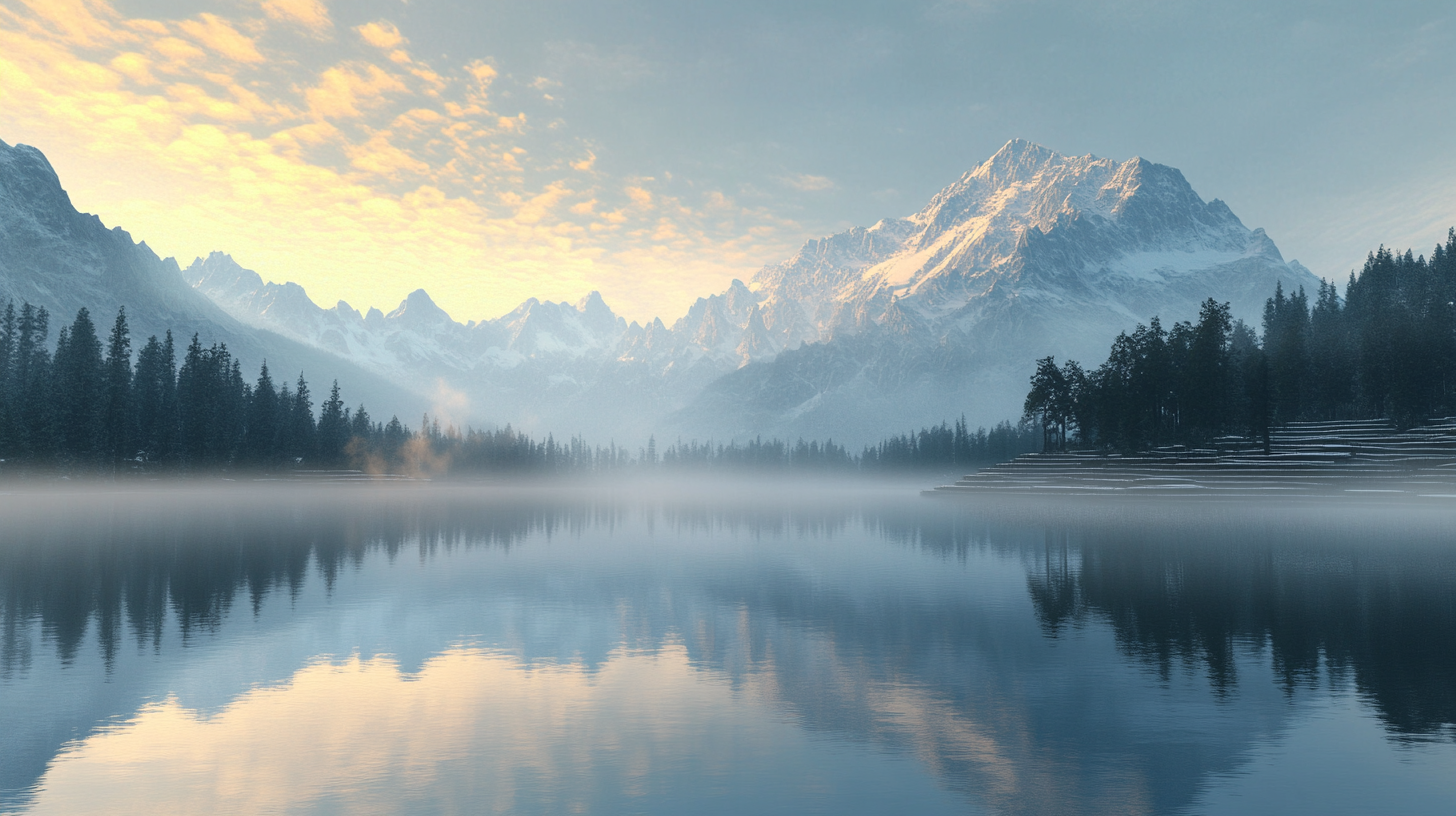
Lith'caen is the mountain lake at the heart of Lith'sera: a body of cold, still water set in a natural basin at the northern interior of Sylvanmere, fed by snowmelt from the mountains above the forest's northern limit. It is the first thing both elf sources mentioned when describing the haven — not the settlement, not the structures, but the lake. It predates the haven by an unknown period and the elves by longer. In fourteen hundred years of elvish presence, it has not changed its fundamental character. It is cold, and still, and clear, and the settlement that has grown on its southern shore is organised entirely around it. The beautiful parts are smaller than they were. The lake is not among them.
Geography
The lake occupies a natural basin formed by the mountain terrain at Sylvanmere's northern limit — the point where the great forest's canopy gives way to the exposed rock of the higher elevations. Its southern shore is within the forest's full protective envelope; its northern shore is beyond the treeline and outside Sylvanmere's defensive capacity. The lake's longest axis runs roughly north to south, with the settlement of Lith'sera built along the southern shore and the lower slopes immediately above it. The northern shore is uninhabited and exposed to the mountain climate without the forest's moderation.
The lake is fed by snowmelt channels descending from the peaks above the northern treeline and by subsurface springs whose sources are within the mountain rock. It drains southward through the forest via a river that the haven uses for its downstream water supply. Roman cartography has not documented the lake's dimensions with any precision — no Roman survey team has reached the interior of Sylvanmere, and the measurements in this account are inferred from elf sources who provided spatial descriptions rather than measurements.
Ecosystem
The lake supports a cold-water ecosystem distinct from the forest's lowland biology. The central water column is cold year-round, the surface layer warming marginally in high summer but the depth remaining at the temperature of snowmelt regardless of season. This produces a stratified lake environment in which the surface biology and the deep biology are distinct communities with minimal interaction. The surface supports the cold-water fish species that are specific to Lith'sera's diet and that are not found in the lower-elevation waters of the forest's interior. The deep water, by elf account, has its own character that is not fully known even to the haven's practitioners — the lake is deep enough that its floor has not been directly observed.
The southern shore sustains the transition ecosystem between the lake's edge and the forest's interior — a zone of specific growth shaped by the daily mist and the cold water's influence on the soil. The northern shore, outside the forest's envelope, supports the exposed mountain ecology of the higher elevations: sparse, adapted to cold and wind, fundamentally different from the forest's biology.
Ecosystem Cycles
The lake's seasonal cycle is more pronounced than the forest interior's, the northern exposure and the mountain terrain producing sharper temperature differentials than the canopy's moderation allows in the lower elevations. In deep winter, the lake's margins freeze — typically from the northern shore inward, as the southern shore is partially sheltered by the forest — though the central lake does not freeze in any winter on record. Spring brings the snowmelt surge, raising the water level marginally and introducing the cold mineral-rich water from the peaks that sustains the deep-water chemistry through the summer. Autumn brings the mist season's peak: the temperature differential between the cooling air and the relatively warm lake surface (warm being relative to the mountain air, which is cold) produces the morning mist that drifts through Caer-Lithos's structures from spring through autumn, thickest in the transition seasons.
Localized Phenomena
The lake's reflective surface has a specific property that practitioners have documented over centuries of observation: on very still mornings, the reflection of the southern settlement and the northern mountains is more accurate than ordinary physics of reflection should produce, as though the water is showing something slightly fuller than what is directly above it. Practitioners describe the reflection as occasionally appearing to show the forest at a different stage of growth from its current state — the canopy slightly denser, the terracing of Anel-Thira slightly fuller. This observation has been documented independently by multiple practitioners over several centuries. No explanation has been reached.
In the past decade, on specific nights when the air is very still and the moon is absent, three practitioners have separately reported that the reflection of the northern mountains shows peaks in a configuration that does not match the mountains in daylight. The anomaly is brief and has not been explained. Aeveth Lith'sera has seen it twice. She has incorporated it into her working notes without explaining what she believes it shows.
The low sustained note audible from the northern shore at night — identified by Aeveth as the cosmological frequency of Rift XIII's approach, carried across the lake from the mountain terrain beyond the treeline — is the most significant localised phenomenon currently associated with Lith'caen. It is not audible from the southern shore's interior structures. It is most clearly perceptible at the Ael'lithos landing stage on still nights, to practitioners who have developed the specific quality of attention required to distinguish it from the lake's ambient quiet.
Climate
Lith'caen's climate is the most demanding in the haven: cold year-round, with the northern exposure unmoderated by the forest's canopy. The lake's thermal mass moderates the immediate shore temperature — the water is cold but not as cold as the mountain air above the treeline, and the southern shore benefits from the lake's relative warmth in deep winter. The morning mist is the lake's most consistent climatic contribution to the haven: the temperature differential between the lake surface and the cooling night air produces condensation that drifts southward through Caer-Lithos for several hours each morning.
The mountain light at this latitude and elevation has a quality that the lower forest does not produce — higher, clearer, and on clear days of striking intensity as it crosses the lake's open surface without the filtering of the canopy. Both elf sources who described Lith'sera to me mentioned the light, without being asked about it, in terms that suggested it was part of what they meant by beautiful.
Fauna & Flora
Lith'caen's climate is the most demanding in the haven: cold year-round, with the northern exposure unmoderated by the forest's canopy. The lake's thermal mass moderates the immediate shore temperature — the water is cold but not as cold as the mountain air above the treeline, and the southern shore benefits from the lake's relative warmth in deep winter. The morning mist is the lake's most consistent climatic contribution to the haven: the temperature differential between the lake surface and the cooling night air produces condensation that drifts southward through Caer-Lithos for several hours each morning.
The mountain light at this latitude and elevation has a quality that the lower forest does not produce — higher, clearer, and on clear days of striking intensity as it crosses the lake's open surface without the filtering of the canopy. Both elf sources who described Lith'sera to me mentioned the light, without being asked about it, in terms that suggested it was part of what they meant by beautiful.
Natural Resources
The lake provides cold clear water — the haven's primary direct water source — and the cold-water fish that are specific to Lith'sera's diet. The lake's stone, shaped by centuries of water and ice action, is incorporated into Lith'sera's structures in a degree not matched by the other havens. The mist contributes to the specific growing conditions of the shore's transition ecology. The lake's deep cold may have preservation properties that the archive district's rock-face chambers are designed to complement — Aeveth has selected Meren-Dûr's position in part for its proximity to the lake's thermal influence on the upper slope's ground temperature.
History
Lith'caen predates the Ael'vari by an unknown period. It was present when the first elves explored the northern interior of Sylvanmere following the First Permutatio, and the haven of Lith'sera was established around it approximately three centuries after arrival. The lake has not changed in the fourteen hundred years of elvish observation — its dimensions, its cold, its clarity, and its reflective quality are consistent across all elf sources who have described it across multiple centuries. The Silence has not affected the lake directly. The beautiful parts that are smaller than they were are the settlement's parts, not the lake's. See Annales Mundi · -1400 A.P. (First Permutatio), -1100 A.P. (approximate establishment of Lith'sera around the lake).
Tourism
Section omitted. Lith'caen is within Sylvanmere and closed to all non-elven visitors.

Comments