
SYLVANMERE
The Eternal Forest · Ael'sethana, The Wood That Remembers · Closed
"To name the wound is to make it real."
I have spoken with elves on eleven separate occasions over the course of my career. All eleven conversations took place at or near the treeline. I have never been inside the forest. Everything in this account that concerns Sylvanmere's interior comes from elf sources who chose what to tell me, dwarf sources who have had their own limited contacts, and the kind of careful inference that sixty years of scholarship and eleven conversations with elves can produce.
I want to be clear about what this means. I am a carefully managed recipient of this information. It was still informative.
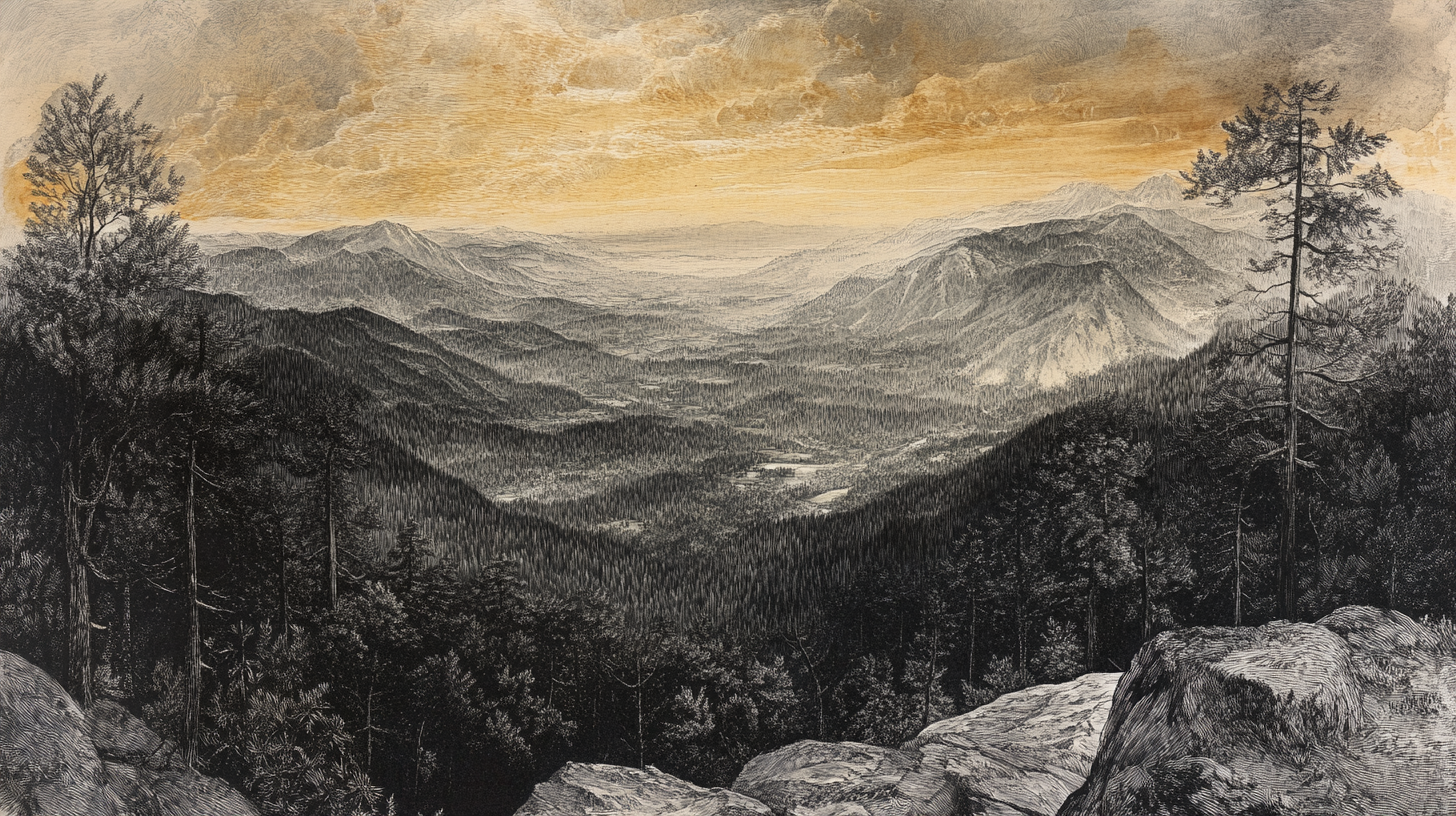
Sylvanmere is the oldest continuously inhabited territory on the primary continent. The Ael'vari have been in this forest for fourteen hundred years — since before the dwarves arrived, before the orcs arrived, before anyone now living on this continent arrived. The great trees of its interior are among the oldest living things on the continent, their trunks wider than Roman buildings, their canopy high enough that clouds catch in the upper branches. The forest as seen from outside presents as a solid mass of deep green, unbroken, uniform in the way that very large natural features are uniform at a distance that conceals their internal complexity.
What makes Sylvanmere unlike any other forest on this continent or, I suspect, any other is not its size, its age, or its closure to outsiders. What makes it unlike any other forest is what it is. I will address this directly in the section below. I have chosen not to bury the conclusion.
Geography
Sylvanmere occupies the northeastern quadrant of the primary continent — bounded on the west by the treeline that faces Provincia Orientalis, on the north by the coastline that the Legion's survey charts show as continuous forest to the water's edge, on the east by whatever the continent's eastern boundary is in that direction, and on the south by the transitional terrain where the forest grades, over perhaps twenty kilometres, into the open land that the Iron Spine's eastern foothills approach from the other side.
The external dimensions are known from Legion survey work conducted along the accessible boundaries. The forest is large — larger than any Roman province, substantially larger than most scholars' estimates before the survey was completed. The interior geography is known only from elf accounts and the handful of dwarf contacts who have been inside and have described what they experienced with the particular precision of people who are reporting something unusual and want to be believed.
The treeline itself is Sylvanmere's most significant geographic feature from an external perspective. On the Provincia Orientalis side — the most-observed edge — it is abrupt to a degree that feels architectural. In most places the transition from non-forest to forest vegetation takes twenty metres. At Sylvanmere's western boundary it takes less than three. The change is abrupt enough to feel like a decision. The forest has honoured that decision for fourteen centuries.
The boundary markers placed by Rome in 85 A.P. have moved — not been removed, moved — westward by a total of approximately 400 metres over twelve centuries, in increments measured between five and thirty years apart. The markers are maintained by the provincial road authority. Their movement is documented in every annual survey since 1167 A.P. The movement is not continuous. The last recorded event was in 1167 A.P. A survey conducted in the second month of 1200 A.P. found them moved again — approximately sixty metres, the largest single movement in four centuries. This coincides with the Pale Wanderer's return.
The Interior — What I Have Been Told
The forest changes as you move toward its centre. The trees grow older and larger. The undergrowth thins, replaced by a ground-level complexity of moss and small-scale growth that looks managed and is not managed by any hand. The light changes: even on an overcast day, there is light in the deep forest that has no direct source — a diffuse illumination that seems to come from everywhere and nowhere simultaneously.
Sound is different in the deep forest. The forest is not quiet — there are birds, insects, the movement of very large trees in wind that does not reach the ground. But these sounds have a quality that sources describe as present in a way that outdoor sound normally is not. As though the sound is being attended to, rather than simply occurring.
The three inhabited havens are located in the forest's interior at distances from the treeline that place them beyond easy reach of any incursion from outside. The Ruins are the oldest point in the forest — by elf account, the centre of the original settlement fourteen hundred years ago. The four sites, when mapped by their relative descriptions, form a loose triangle with the Ruins at a fourth point that is not quite the centre.
Ecosystem
What Can Be Observed
The forest near its edges presents a botanical density and species complexity that Roman naturalists who have studied the boundary describe as directed, but not by any hand we can identify. More species in a smaller area than ought to be possible, growing in patterns that follow no natural logic. The last hundred metres before the treeline proper has this quality most intensifiedly — the transition zone where the outside world and the forest meet.
Within the forest: trees of extraordinary age and size. Ground-level growth of a complexity that implies management. Light of no identifiable source. These are the observations that can be made. Their explanation is what follows.
DM KNOWLEDGE — What the Forest Actually IsThe forest of Sylvanmere is a divine entity.
Not metaphorically. The forest of Sylvanmere is, by the operational definition of divinity that the evidence of this world supports — a being of genuine awareness and agency, capable of responding to worship, capable of sustaining the lives of those who maintain relationship with it, and capable of being weakened by the withdrawal of that relationship — a god.
The elves do not know this. They have lived inside their god for fourteen hundred years and believe they are living inside a forest they tend with great skill. They are correct that the relationship is reciprocal — the forest responds to their presence, grows toward them, provides for them. They interpret this as the natural consequence of excellent botanical knowledge and the particular elf attunement to the living world. What they do not see is that the causation runs the other way. The forest does not respond to their magical cultivation. Their magical cultivation is the mechanism through which they, without knowing it, worship. The havens are not the products of elf craft. They are answers to elf prayer.
The evidence: First, the forest grows in patterns that no known natural mechanism produces — in response to elf presence and need, for fourteen hundred years. When the elves needed shelter, shelter grew. When they were threatened, the forest responded; the giant sagas record this with specificity, the elves deny it, and the giant sagas are the most accurate oral archive in the world. Second, the Silence — no birth in three hundred and fifty years — is not a biological or magical problem. It is what happens to a people when the divine force sustaining their connection to life weakens. Third, the elves' own theological language describes worship while calling it something else. The closest word in Elvish for their relationship with the forest translates as the quality of attention that allows right relationship. This is a devotional term. Fourth: what Caladris found in the archives forty years ago that she has told no one. I do not know what she found. A scholar of her stature does not choose silence over disclosure unless what she found is something her people are not ready to know.
The forest-god is dying. Not quickly — gods die slowly — but measurably. The Silence is the first symptom most easily observed. The treeline appears less certain than it did a century ago to those who know how to read it. The boundary markers have just moved sixty metres in a single event after thirty-three years of stillness. Something is accelerating.
Ecosystem Cycles
The forest does not have seasons in the way that exterior woodland does. The treeline does not thin in winter. The trees visible at the edge are green in winter when native deciduous species are bare. Academy scholars have noted this in writing since the third century. It has not been explained, because the explanation requires accepting what the forest is — and Rome has not yet accepted that.
What the forest has are cycles of attention. These are not observable from outside except in their effects: the boundary marker movements, the quality of the treeline's awareness at different times of year, the specific conditions of the third and ninth months when the sound the Academy has documented — not identifiable as any known species — is audible from the treeline.
The Ael'vari's own cycle is the Day of Remembrance, held annually on the anniversary of the Bellum Magnum in the elvish calendar. The three Triumvirs travel from their separate havens by paths through the deep forest to the Ruins. The meeting lasts three days. No record of what is said at these meetings is kept. They return to their havens without having resolved their fundamental disagreement. They have been doing this for two centuries.
Localized Phenomena
The Treeline
Standing at Sylvanmere's treeline, a person who is paying attention experiences something that is difficult to classify. It is not darkness — the forest is not dark at its edge. It is not cold — the temperature does not change significantly. It is not threatening, exactly, though not threatening is not the same as welcoming. It is something closer to the sensation of standing outside a door to a room where something very large is present and attending to the fact that you are standing there. The something does not act. It does not speak. It is simply attending.
Four different soldiers who have served at Porta Silvae, in four separate conversations, have described this experience using some version of: It knows you're there. Independent confirmation of a consistent experience is significant. I treat it as such.
The Boundary Movement
Documented above. The 1200 A.P. movement — sixty metres, largest in four centuries, coinciding with the Pale Wanderer — is the current most significant phenomenon. The College of Pontiffs was briefed by a senior Academy scholar following the discovery. What was discussed at that meeting has not been communicated back to the Academy.
The Third and Ninth Month Sound
Audible from the treeline in the early morning hours of the third and ninth months. Described in two hundred separate records over six centuries with consistency that implies a real source. Not identifiable as any known species. The College has a formal theological classification. The classification satisfies no one who has heard it.
The Forest's Response to Intrusion
Non-elves who enter Sylvanmere without permission do not emerge from it in the same condition as they entered. This is not speculation — it is the consistent finding of twelve centuries of Roman frontier documentation. In no recorded instance has a Roman incursion into Sylvanmere succeeded. The mechanism is not known. Whether this is military capacity in the conventional sense or something else is undetermined. The Bellum Glaciale, when the forest apparently acted against a giant advance, is the most significant documented instance. The elves deny involvement. The giant sagas are specific about what they observed.
Climate
The forest maintains its own climate. This is the most straightforward way to state it. The interior temperature, light, and moisture conditions do not correspond to what the exterior climate at the same latitude and season would predict. The treeline represents a thermal boundary: the temperature immediately adjacent to it on the forest side is consistently two to three degrees lower than the open farmland fifty metres west, regardless of wind direction, time of year, or cloud cover. The Academy has measured this for a century without producing a satisfactory mechanism.
The exterior climate of the surrounding region — northern Provincia Orientalis, the Iron Spine's eastern foothills — is temperate and unremarkable. The forest occupies a position that should experience those same conditions. It does not.
Fauna & Flora
External Zone
The botanical anomalies of the treeline transition zone are documented in the Academy's eastern studies catalogue across twelve editions. Several species that venture out from Sylvanmere — birds, insects, the occasional larger animal — do not correspond to any species in the standard catalogue. The specimens collected are catalogued. They are not classified. The classification problem has been open for two hundred years, because classification requires understanding the organism's relationship to its environment, and the environment that produced these organisms is not available for study.
Interior — What I Have Been Told
The great trees. The ground-level growth of unidentifiable management complexity. The specific quality of moss in the deep forest that elf sources describe as living in a different way from exterior moss — more responsive, more present, as though it participates in events rather than simply existing through them.
There are animals in the deep forest that the elves know by name and relationship rather than by taxonomic category. I do not have those names. I do not have descriptions of the animals. I have the impression, from the way elf sources speak about the forest's fauna, that the distinction between animal in the forest and part of the forest is less clear in Sylvanmere than it is anywhere else.
What the Forest Knows
The forest is aware of everything within it. Every tree, every animal, every elf, and the condition of each. The Silence is experienced by the forest as an absence — the absence of new belief, of new attention, of the specific quality of elf consciousness engaging with the forest for the first time. The elves have been giving it something for fourteen hundred years. The supply is diminishing. The forest knows this. It does not have the capacity to communicate this to the elves in terms they would understand, because the elves do not know they have been giving it anything.
Natural Resources
This section is intentionally limited. The resources of Sylvanmere's interior are not accessible to Roman scholarship and I do not propose to speculate about them at length. What can be noted:
The timber at the treeline's edge — the species that grow at the forest's margin — has never been harvested by any party, Roman or other, and remained unharvested throughout the Bellum Magnum even when the dwarves and the orc clans were both actively deforesting territory for military use. This is not because the timber is inaccessible. It is because every party that has considered harvesting it has decided not to. The reasons given vary. The effect is consistent.
The forest does not export resources. It does not trade. The Ael'vari's material needs are met by the forest directly — they do not need what Rome produces and they do not offer what Rome wants. The only exchange that has occurred between Sylvanmere and the outside world in twelve centuries has been informational, selective, and on the elves' terms entirely.
The Four Havens
The geography of Sylvanmere's interior is organised around its four significant sites — three inhabited, one in ruins. Each is unique because each grew from the specific character of its forest surroundings, shaped over centuries by the relationship between the elves who lived there and the forest that answered them.
Ael'canoras — The High Canopy Refuge
The oldest inhabited haven, described by three elf sources with consistency that gives me confidence in the basic character if not the specific details. The haven grows from the high canopy rather than from the forest floor — the living structures are among the great trees' upper branches, connected by walkways that the elves describe as having grown into place over generations of patient intention. Three sources have used the word answered to describe what happened when the forest provided new structures. None of the three appeared aware of the theological implications of the word they chose.
Haven of: Caladris Dawnweave, First of the Triumvirate.
Vel'thuris — The Waterfall Haven
A haven built around a significant waterfall in the forest's interior, described with consistent reference to sound — the falls are the haven's dominant sensory character, present in every account I have received. An elf who lives there told me three years ago, at the treeline, that the falls have always sounded the same — except that now, if you listen in a particular way, there is a note underneath the main sound that was not there a century ago. She did not elaborate. She left before I could ask what the note sounded like.
Haven of: Mirewen Starhold, Second of the Triumvirate.
The most beautiful of the three inhabited havens, by the consistent testimony of every elf source who has mentioned it. Built on the shores of a mountain lake in the forest's northern interior. Two sources described it in separate conversations twenty years apart; both used the word beautiful as their first unprompted descriptor. The second, twenty years after the first, used the same word and then paused and said: It is still beautiful. The beautiful parts are smaller than they were. I believe this was an observation about more than the physical haven.
Haven of: Aeveth the Grey, Third of the Triumvirate.
The Ruins — Locus Primus Ael'vari
The oldest point in the forest. By elf account, the centre of the original settlement fourteen hundred years ago — the place where the Ael'vari first established their relationship with what they call the forest and what I believe is something else. Destroyed in the Bellum Magnum (-900 A.P. never rebuilt; maintained in its ruined state by what the elves describe as a decision made collectively long ago, which I take to mean a decision that predates the Silence and that they have not revisited since.
The Triumvirs meet at the Ruins once a year. The annual gathering is the Day of Remembrance. An elf once told me about it and said, almost as an aside: We go to remember what we lost and to understand what we are losing. I asked what they were currently losing. She stopped. She looked at me for a long time. Then she said: The question is not quite right. She left before I could ask her what the right question was.
I have been trying to find it ever since. I believe the right question is: what is losing you?
History
Sylvanmere is the primary continent's oldest inhabited territory, and the Ael'vari are the continent's oldest people, and almost nothing that can be said about their history is said with confidence, because the elves do not share historical records and the events that shaped their first fourteen centuries in this world are known, where known at all, from dwarf archives, giant sagas, and a small number of elf statements made at the treeline to a scholar who was careful about what he asked and careful about what answers he kept.
The foundation events: the First Permutatio, -1400 A.P., brought the Ael'vari to this forest. The Bellum Magnum (-900 A.P.) is the defining military event of their history — the forty-year war that established the territorial lines still in place in 1200 A.P. and destroyed the original haven. The Bellum Glaciale (approximately -530 A.P.) is the second military event, the one about which the giant sagas make a claim the elves deny. Five hundred years of relative isolation followed. Then Rome arrived — adjacent, not inside — and has been adjacent ever since without having penetrated the treeline once in twelve centuries.
The Silence began approximately 850 A.P. One year without births became two, became ten, became a century, became three and a half centuries. The Triumvirate has been debating it for two hundred years. Caladris found something in the archives forty years ago. She has told no one.
In 1200 A.P., with the Pale Wanderer returning to the sky, the boundary markers have just moved sixty metres in a single event. The Day of Remembrance meetings have been sharper and stiller in recent years, by a source I will not identify. Mirewen has received word, three years ago, from a source she will not name even to the other Triumvirs, that the cause of the Silence is known to someone outside Sylvanmere. Aeveth has been quietly corresponding with the dwarven archivists about placement for the Archive — a complete record of Ael'vari knowledge, stored where it will survive the death of the last elf. And the Pale Wanderer's landing zone, by the best calculations available to parties who have shared that information with me, is in the northeastern forest.
For full chronological detail, see: Annales Mundi.
Tourism
There is no tourism in Sylvanmere. The forest is closed. It has been closed to non-elves since before Rome existed in this world. No Roman citizen has entered it and emerged in the same condition as they entered. No invitation to enter has been issued to any Roman in twelve centuries.
What exists is the tourism of the boundary — the experience of standing at the treeline and looking in. This is addressed fully in the Provincia Orientalis article, under the entry for Porta Silvae. The view from the forest edge is the most psychologically significant sight on the primary continent for those who stand at it knowing what they are looking at. For those who do not know what they are looking at, it is merely a treeline where the trees are very large and the light is wrong, and something in the quality of the air makes the back of the neck certain that it is being observed.
Both categories of visitor are correct. The forest knows they are there. It has known since the moment they came within range of its awareness. Whether it does anything with this knowledge is not, in most cases, answered in a way the visitor can observe.

Comments