
AEL'ITHREN
Ruinae Primae · The Root of the Ael'vari · The Ruins · Sylvanmere
"The elf who told me about the Ruins was the one who said more than she intended to. She was describing the annual gathering and she said — almost as an aside, as though she had said it so many times it had ceased to carry its full weight — we go to remember what we lost and to understand what we are losing. I asked her what they were currently losing. She stopped. She looked at me for a long time. Then she said: the question is not quite right. She left before I could ask her what the right question was. I have been trying to find it ever since. I believe the right question is: what is losing you?"
Locus Primus Ael'vari is the oldest point in Sylvanmere and the oldest elvish site in Aethermarch: the place where the Ael'vari first settled when the First Permutatio brought them to this world fourteen hundred years ago, and the place they returned to build what became the heart of their original civilisation in this world. It was destroyed in the Bellum Magnum of -900 A.P. It has not been rebuilt. The decision not to rebuild was made collectively by the Ael'vari in the years following the war, and it has not been revisited in five centuries.
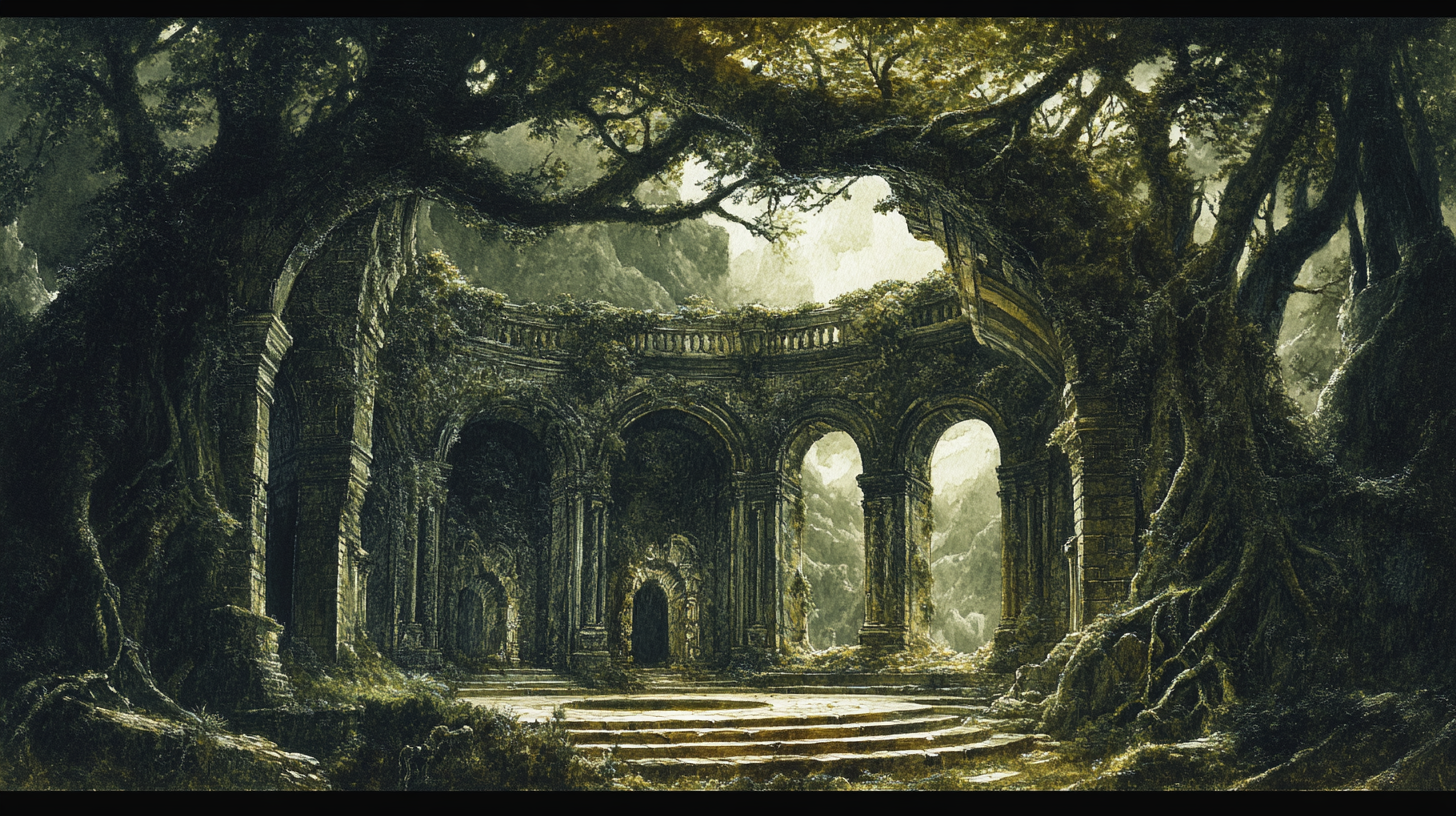
What remains is a clearing in the deep forest containing five hundred years of ruins under five hundred years of moss and root growth, a gathering space maintained by the forest at the centre, and Ael'corum — the First Tree, which came through the Permutatio with the elves and has grown here for fourteen hundred years and is dying. The three Triumvirs travel to this site once each year, on the Day of Remembrance. They spend three days. They do not agree on what the Silence means or what should be done about it. They have been coming here to not agree for two centuries.
Demographics
Nobody lives here. The Ruins have had no permanent population since their destruction in -900 A.P. The three Triumvirs visit for three days each year. The forest maintains the site in their absence. The gap between those two facts — the annual three-day human presence and the five-hundred-year maintenance of the clearing — is not something any elf source has addressed directly. I have not asked about it. I believe the forest maintains the clearing for reasons of its own that the elves participate in without fully understanding.
Government
There is no government at the Ruins. The Triumvirate's authority over Sylvanmere encompasses the site, and the Day of Remembrance gathering is the nearest thing to formal governance that occurs here — the three elders who govern the Ael'vari, in the same place, for three days, without resolving the question they have been meeting to address for two centuries. The governance of the Ruins is the governance of a site that has been waiting for five hundred years for a decision that has not been made. What that decision should be is the Triumvirate's fundamental disagreement, conducted annually in the presence of Ael'corum, which is the best available evidence for what the decision concerns.
Defences
The forest is the defence, as it is for all of Sylvanmere. At the Ruins, the forest's defensive attention has a character that elf sources have described as different from its ambient quality elsewhere — heavier, more deliberate, as though the site's significance concentrates what the forest provides everywhere into something more specifically directed. Non-elves who somehow reached the deep interior of Sylvanmere would encounter the forest-god's awareness at its most concentrated at this location. What the forest-god would do with an uninvited presence at the site of its physical anchor and the origin of its own creation is not information any external source has been in a position to acquire.
Infrastructure
There is no infrastructure at the Ruins in any functional sense. What exists is maintained by the forest: the clearing, the Gathering Circle's surface, the paths through the deep forest that connect the site to the three inhabited havens and that exist when the Triumvirs need them. The paths' existence is not a Roman engineering problem. It is a different kind of problem entirely.
History
Locus Primus Ael'vari was established at the First Permutatio in -1400 A.P. as the original point of elvish settlement in this world. For five centuries it was the heart of elvish civilisation in Sylvanmere — not a capital in any Roman sense, but the founding site, the oldest place, the location of the first relationship between the Ael'vari and the forest that became, over those five centuries, the relationship between the Ael'vari and the forest-god they were creating without knowing it. The Bellum Magnum of -900 A.P. destroyed it over forty years of war. The decision not to rebuild was made in the years following the war and has been maintained ever since. The Ruins have been maintained in their ruined state for five hundred years. The Day of Remembrance gathering began approximately two centuries ago, as the Silence made the Triumvirate's disagreement formal. The annual meetings have sharpened in recent years, by a source I will not identify. In 1200 A.P., the Ruins contain the answer to the Silence, the physical evidence of the forest-god's decline, and the annual gathering of the three elves who have been closest to understanding what is happening and furthest from agreeing on what to do about it. See Annales Mundi · -1400 A.P. (First Permutatio), -900 A.P. (Bellum Magnum and destruction of the original haven), 850 A.P. (onset of the Silence), 1000 A.P. (Day of Remembrance gatherings formalised).
Points of interest
Ael'corum (The First Tree) is the site's defining feature: the tree that came through the Permutatio with the elves, the oldest living thing in Aethermarch that did not originate here, and the physical anchor of the forest-god that has been dying at the rate of the Silence for three hundred and fifty years. It has its own geography article. Ael'caras (The First Foundation) is the oldest surviving stonework in the Ruins, the original construction of the first settlement's central structures, partially preserved by Ael'corum's root buttresses. Vel'magnum (The Bellum Grove) is the zone of deliberate destruction from the Bellum Magnum — the stones that were scattered rather than fallen, the scarring the forest has grown over but not healed.Ithren-Vel (The Gathering Circle) is the open maintained space at the Ruins' centre where the Triumvirs gather annually. Dur-Ithren (The Silent Nursery of the First Place) is the ruined structure at the site's edge whose scale and configuration makes its original function apparent without requiring explanation, and which has not been named in any elf account that has reached me.
Tourism
Locus Primus Ael'vari is within Sylvanmere's deep interior and is inaccessible to any non-elven visitor under ordinary circumstances. The only parties who visit are the three Triumvirs, once annually, for three days.
Architecture
The ruins of the original settlement are five hundred years old and have had five hundred years of Sylvanmere's interior growth working on them. The structures that survived the Bellum Magnum — those not deliberately destroyed in the war, those that collapsed in the decades after without maintenance — have been progressively incorporated by the forest: root systems splitting foundations, canopy growth replacing the roofs that fell, moss covering every horizontal surface to a depth that makes the original stone geometry legible only on close examination. The overall impression is not of abandonment but of return: the forest reclaiming what the elves shaped from it, slowly, over half a millennium.
Three categories of structure remain distinguishable. The oldest stonework — the First Foundation, the original construction of the settlement's central buildings — is partially preserved where Ael'corum's root buttresses have protected it from the worst of the structural movement. The Bellum Grove marks the zone of greatest destruction: structures that did not fall on their own but were deliberately brought down, their stones scattered in a pattern that is not consistent with structural failure. The Gathering Circle is the exception to the general state of the Ruins: an open space maintained in usable condition by the forest, its ground surface clear, its perimeter defined by the ruins' edge in a way that makes it immediately apparent as different from everything around it.
Geography
The Ruins occupy a position in Sylvanmere's deep interior that the four sites — the three inhabited havens and the Ruins — form into a loose triangle with the Ruins at a fourth point not quite at the centre. This position places the Ruins beyond easy reach of any incursion from outside, and at a sufficient distance from all three inhabited havens that the annual journey between any haven and the Ruins requires passage through the forest's deep interior. The paths between the Ruins and the havens are not fixed in the way that Roman roads are fixed. They are known to the Triumvirs and to the forest, and exist when they are needed.
The site itself is a clearing maintained by the forest against the natural tendency of Sylvanmere's interior growth to reclaim open space. The clearing is approximately the size of a Roman forum — large enough to contain the ruins of the original settlement's central structures, the Gathering Circle at its centre, and Ael'corum's root buttresses extending outward from the tree's base. The surrounding forest does not encroach on this space. The decision to maintain it was made five hundred years ago and has not been reversed.
Climate
The microclimate of the Ruins' clearing is shaped by Ael'corum's canopy above and by the clearing's position as an open space in the deep forest. The canopy filters light and moderates temperature in the way characteristic of Sylvanmere's interior, with the additional modification of the three dead canopy sections — the zones where the living growth has failed and direct light falls through in columns. The clearing's climate is cooler than the surrounding forest due to the reduced solar input from the heavy canopy, and more variable than a closed forest interior due to the opening that the clearing provides. On the Day of Remembrance, in the period of the Bellum Magnum anniversary — which falls in the deep forest's equivalent of late autumn — the clearing is cold, the light is failing early, and the three sections of dead canopy admit shafts of direct late-afternoon light that fall across the Gathering Circle at the angle the gathering's hours require. Whether this is a property of the Ruins' position or of the forest-god's arrangement of the site, I cannot determine. I note only that the light does what a scholar of theatrical staging would recognise as deliberate.
Natural Resources
The Ruins are not a resource site in any sense applicable to the categories Roman scholarship uses. What the forest provides here it provides for the forest's own reasons.
RUINED SETTLEMENT
-900 A.P. — destroyed in the Bellum Magnum; not rebuilt by collective decision of the surviving Ael'vari

Comments