
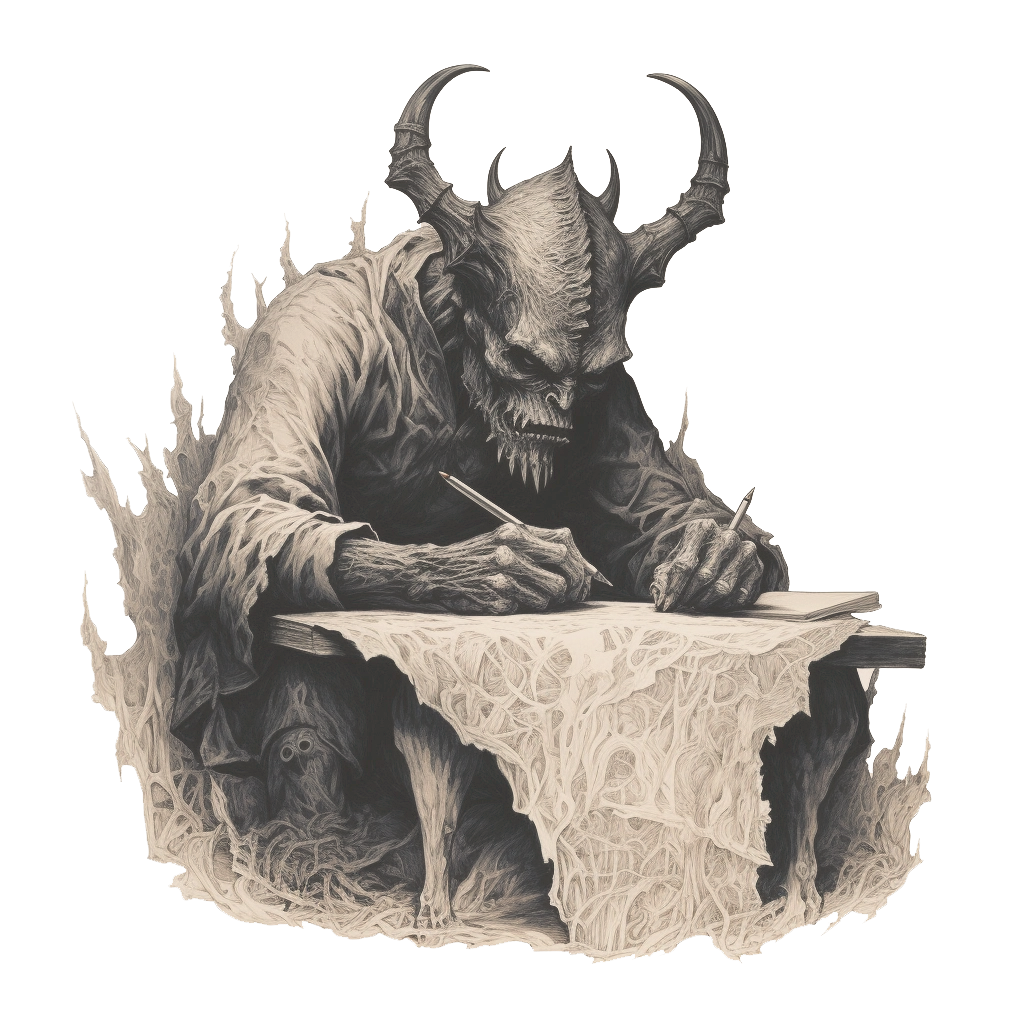
Thirmashir (THIR-ma-SHIR - θir.ma.ʃir)
The Tongue of Command
The language spoken by the peoples of Ardi-Kokufa and the Gleaming City. It reflects the deeply heriarchical system of command and subservience that the Lords of Fire have set across the sunside regions. The name of the language literally meaning 'Tongue of Command'.
Author note: This is experimental. The language of Thirmashir was created with the help of a Chat GPT conlang tool called Conlang Creator by AGNES SARIC. See the footer for more information
Author note: This is experimental. The language of Thirmashir was created with the help of a Chat GPT conlang tool called Conlang Creator by AGNES SARIC. See the footer for more information
From: First Contract, TazhqorthirVen thirnak erhthranlok tazhkirnath vennor thirashar erhnak tazhkirnath nor Zarvulnath, Zar’Qul Drazul.Translation
We devote the souls of this world to sever our bonds from the God Who Hungers, Ghul Drazul.
Sample usage in names of people, places and things
| Name | Meaning | Reference |
|---|---|---|
| Tazhqorthir | The First Contract, literally means "Original contract with the divine." | First Contract, Tazhqorthir |
| Zalthirnath | The Gleaming City, literally: "the shining place of those who command" | The Gleaming City |
| Ushokuva (Usokufa) | Those who make use of the dead | Usokufa |
| Tar'raq Naeth | The price of freedom | Tar'raq Naeth |
| Malliush (Mallius) | The Judge, or keeper. In this sense he is the judger of souls upon death. | Mallius |
| Tazhthirnaktar | Tithe binding (lit. Sacred soul payment) | Tithe Binding |
Geographical Distribution
Thirmashir is the language of the Lords of Fire, and is spoken up and down the communities along the Godswollen River and across the deserts of Ardi-Kokufa, and even the tribes of the Shimmerlands speak it as a trade language.
The language is the closest to what many believe was the original language spoken by the Eldar and the Eldarkin before The Cosmic Defiance, and scholars in the Protectorates have wondered if the languages of the Deepkin and the Reutrned might share Thirmashir as a common ancestor.
Most recently, the Soulhusk Chimeras under the banner of the Dead Lord Kholkosi have begun speaking a simplified dialect of Thirmashir amongst themselves. Known as 'Komir (of the tongue)', it shortens much of what it uses from the parent language, and keeps to a very physical and action-focussed lexicon. Mortugurrans think it little more that a brutish imitation.
The language is the closest to what many believe was the original language spoken by the Eldar and the Eldarkin before The Cosmic Defiance, and scholars in the Protectorates have wondered if the languages of the Deepkin and the Reutrned might share Thirmashir as a common ancestor.
Most recently, the Soulhusk Chimeras under the banner of the Dead Lord Kholkosi have begun speaking a simplified dialect of Thirmashir amongst themselves. Known as 'Komir (of the tongue)', it shortens much of what it uses from the parent language, and keeps to a very physical and action-focussed lexicon. Mortugurrans think it little more that a brutish imitation.
Phonology
The language of the Lords of Fire is deep and hard hitting, with heavy use of hard consonants, gutteral stops and harsh frictaves. When devilkin speak it can sound like gravel sliding over rock, or sand crunching underfoot.
It does have a percussive rythmic quality to it, with the hard consonents broken by short vowel sounds.
The stress is usually on the first syllable, especially for prefixes which stress the dominant/submissive relationships of the things being dicsussed.
It does have a percussive rythmic quality to it, with the hard consonents broken by short vowel sounds.
The stress is usually on the first syllable, especially for prefixes which stress the dominant/submissive relationships of the things being dicsussed.
Consonants
| t, d, k, q | Sharp plosives, providing the percussive element to the language. Q is a deeper "k" from the back of the throat. |
|---|---|
| v, z, zh, sh, th, x | Longer frictives, tending to hissing sounds at the front of the pallet and teeth. zh "measure, sh "ship"; th "thin"; x harsh "kh" |
| l, r | The l is a clear, flowing consonant, while the r has a short tapping trill |
| n, m | Short nasal sounds |
Vowels
| a | as in "father" |
|---|---|
| e | as in "bed" |
| i | as in "machine" |
| o | as in "toe" |
| u | as in "book" |
Morphology
The language is constructed by heavy uses of root words as prefix and suffixes. The most common of these are to do with elements of the heriarchy that is so central to the Lords of Fire and the culture they command.
There is a distinction between the mundane (Erh-) and the sacred (Tazh-), and these terms are used to signify the power relationships up and down the social heriarchy.
There are also key terms for bonds between people embedded into the language, like qor (civil binding) and ven (devotional binding).
Naeth is a contested word. it literally means 'unbound', and the original was am insult for betrayal ofnduty or one who is outcast. In recent years it has earned a new meaning, one of pride, for gaining freedom from bondage.
There is a distinction between the mundane (Erh-) and the sacred (Tazh-), and these terms are used to signify the power relationships up and down the social heriarchy.
There are also key terms for bonds between people embedded into the language, like qor (civil binding) and ven (devotional binding).
Naeth is a contested word. it literally means 'unbound', and the original was am insult for betrayal ofnduty or one who is outcast. In recent years it has earned a new meaning, one of pride, for gaining freedom from bondage.
Prefixes
| Ek- | absence, lack, negation |
|---|---|
| Ek'- | shamed / cast-out (name prefix) |
| Erh- | mundane, low-status, material |
| Ko- | of / belonging-to |
| Kur- | movement, carrying, transport |
| Qem- | legal/civic ratification (physical object) |
| Qor- | legal/civic agreement |
| Tazh- | sacred, divine, higher self |
| Usho- | employ, harness, press into service |
| Ven- | Religious/devotional agreement |
| Xoth- | taboo, forbidden |
| Zar- | cosmic, otherworldy, beyond law, dread |
Suffixes
| -ar | used to indicate 'doing'in verb construction |
|---|---|
| -ek | belonging to marker, clans, families, organisations |
| -en | direct blood lineage marker |
| -ir | used to indicate 'doing'in verb construction |
| -ith | essence of / quality |
| -lok | place / domain |
| -nath | agent, person who does |
| -naeth | betrayer / freed from bonds |
| -nathrak | of bodyservants |
| -nor | negation / opposition |
| -qut | obligated to / owned by |
| -thir | source / origin |
Syntax
Thirmashir is centred on the heriarchical relationships between the people and what they do for each other.
The default order is Verb - Object - Subject, with adjectives normally following the thing they describe. The adjective order can change when used poetically or when naming proper nouns.
There are four key relationship words that get used within standard sentence structures.
The default order is Verb - Object - Subject, with adjectives normally following the thing they describe. The adjective order can change when used poetically or when naming proper nouns.
There are four key relationship words that get used within standard sentence structures.
| Word | Meaning | Example | translation |
|---|---|---|---|
| qut | under obligation to | Qor qut Erhnak raq Malliush. | I am contracted to Mallius. |
| raq | in service to | Raq Malliush Erhnak. | I am in service to Mallius. |
| shar | under command of | Thirzar Erhnak shar Malliush. | Mallius commands me. |
| nor | away-from / against | Nor Malliush Erhnak. | I am against Mallius. |
Vocabulary
Verbs
| kir | to guard / ward |
|---|---|
| kith | to grasp / take / seize |
| kur | to carry / transport |
| mal | to judge / measure |
| mazh | to celebrate / proclaim (rite) |
| mek | to burn / ignite |
| qem | to seal / ratify |
| qor | to contract / bind by law |
| raq | to serve / attend (as duty toward) |
| roq | to exchange / share |
| rashun | to guide / lead / bear-duty |
| tax | to chop / hew |
| thirzar | to invoke command |
| thramun | to fall / be imposed |
| ushokuv | to reanimate the dead |
| val | to speak / declare |
| ven | to devote / covenant-bind |
| vennor | to unbind / sever |
| xalthi | to shine (emit steady radiance) |
| xir | to inscribe / write |
| xoth | to forbid / taboo |
| zal | to gleam / shimmer (reflected light) |
| zarath | to illuminate / reveal |
| zeth | to witness / attest |
| zhan | to create / construct |
| zor | to vow / swear |
Examples
The verbs are used in sentence structure V-O-S, with the subject being added at the end of the statement.Conjugation is simple and based on the formality of the context. The full verb (ending with ar/ir) is used in everyday speach, while the root verb used for more formal decrees. eg:
| Zal Tazhkamek thrith Thirnath. | The city reflects the radiance of the Everfire. |
|---|---|
| Mal Erhnak zeth Malliush Kuvmalnath. | I am judged worthy by Mallius. |
| Raq Mekornath Erhnath. | We serve the Lords of Fire. |
| Naethar thirashar Zheknak | You betray duty |
| Naethar thirashar Erhnak | I free myself / abandon duty |
Articles and conjunctions
| ka | the (definite article) |
|---|---|
| ek | a / an (indefinite article) |
| zhak | this/that/td] |
| va | and |
| vaq | or |
| no | but / however |
| ko | belonging to |
| ith | that/which |
Kithnor rashunith raq Kuvqemnath zhaknak. Kithnor thrithith raq Ushokuvnath zhaknak. Ven zhaknak raq Kith nathrak kurnath zhaknak.Translation
He had not the patience to be an Embalmer. He lacked the grace of a Vivifier. Instead, he devoted himself to gathering the dead.
Pronouns
| Erhnak | I / me (humble) |
|---|---|
| Erhnath | we / us |
| Tazhnak | I / me (authoritive) |
| Zhernak | you (singular) |
| Zhernath | you (pluralk) |
| Zhak | it |
| Zhaknak | Singlular he / she / him / her / they / them |
| Zhaknath | Plural they / them |
Familial terms
| Dath | blood / kin / lineage |
|---|---|
| Dathlok | household / the house (as a unit) |
| Dath'thir | ancestry / lineage-source |
| Vennak | spouse |
| Dathven | blood-bond / contracted house member |
| Thirnath | parent (lit. “source-person”) |
| Dathran | child (lit. “blood-sprout”) |
| Dathrir | sibling / cousin (lit. “blood-ripple/echo") |
Kith rhaldul vashir qut Nukrhazbishlok, qut Nuklok Zarvash.Translation
The tastiest salt dumplings can be found at the Mudstop Tavern on the Godswollen River.
heriarchy relationship terms
| Eknarnaeth | The Unbound |
|---|---|
| Erhkirnath | civic guard / watch |
| Kornath | lord / ruler |
| Malnath | judge / measurer |
| Qemnath | bureauocrat |
| Qornath | contract writer |
| Raqnath | servant / attendant |
| Tazhkirnath | sacred guardian |
| Thirasharnath | commander / superior |
Everyday terms
| Bish | refuge / shelter |
|---|---|
| Kurnath | transporter |
| Makor | food / sustenance |
| Makoren | host / innkeeper |
| Makorul | bread / staple food |
| Mek | fire |
| Mekmakor | cooked food |
| Mekmakornath | cook / chef |
| Nuk | water |
| Nuklok | river / water-source |
| Nukmakor | stew / soup |
| Raqnath | servant / attendant |
| Taxnath | woodcutter / forester |
| Thran | stone |
| Thranath | mason / stoneworker |
| Valroq | Conversation |
| Zhanlok | building / structure |
From Impetine: Reflections and Conversations by Nameless Legate of the Risen LordLokvash Zalthirnath, kith Tazhkamek, eth dath dath, eth rhazkar mek mekul.Translation
The Gleaming City was always there, touching the Everfire since before the kin were kin and before the sands had melted.
Nature and environment terms
| Ardi Kokuva | Dead Wastes / Deadlands |
|---|---|
| Bish | shade / refuge |
| Mekith | heat |
| Mekxar | hot wind |
| Nuk | water |
| Nuklok | river / water-place |
| Nukvashir | ocean |
| Rhazkar | sand |
| Rhazlok | desert |
| Rhazthramun | sandstorm |
| Thran | stone / rock |
| Thrangor | mountain |
| Thranlok | rocky ground |
| Thrith | radiance / light |
| Xalrith | sun |
| Xalrithmek | sun-heat / sunfire |
| Xar | wind / air |
| Zalnuk | mirage (water-gleam) |
Religious terms
| Malliush Kuvmalnath | Mallius, Judge of the Dead |
|---|---|
| Mazhar | ritual |
| Mazhkithar | priest |
| Qut | obligation “upon” (ritual particle) |
| Tazhka | the divine / the sacred |
| Tazhkamek | Everfire (sacred flame) |
| Tazhlok | temple / sacred place |
| Tazhqorthir | The First Contract |
| Thirith | origin / source |
| Thirzar | issuing of holy order |
| Ukobish | Ukobis, Lord of shelter |
| Ven | devotion |
| Zar’Qul Drazul | the Elder God |
| Zarxoth | taboo name for Zar’Qul Drazul |
| Zethnath | witness / oracle |


Comments
Author's Notes
The language was created with the help of a Chat GPT conlang tool called Conlang Creator by AGNES SARIC.
My primary reason was that previously I have been using Google Translate for inspiration when naming places within the world. I've been aware that this could potentially be problematic in that certain names and terms within Shadowfire are closely related to real world languages and cultures and this could lead to inadvertent appropriation or innapropriate meanings being assigned. While Shadowfire has been just a personal project of mine I was not too worried, but it has been a concern in the back of my mind as I do hope to one day publish and share more widely.
This mainly an experiment so far, one that i think holds some promise. I'll start using what I have generated using Conlang Creator as an inspiration for updating names across the world to help minimise any real-world connections and give Shadowfire a more customised sound to the places and people within. Of course, the black box of the AI may similarly contain inadvertent wording, but i hope that there is now an additional layer of obfuscation than previously.
My intention isn't to offend or be derivative, while at the same time, I don't have the time, resources or skills to dive into proper conlanging myelf. Perhaps one day I will be able to work with someone with real conlanging skills to do this type of thing for me. In the meantime, I hope this compromise can suffice.
If any of the words or phrases do stick out as problematic, derivative or if there are any issues you notice within what i've thrown together, please let me know.