
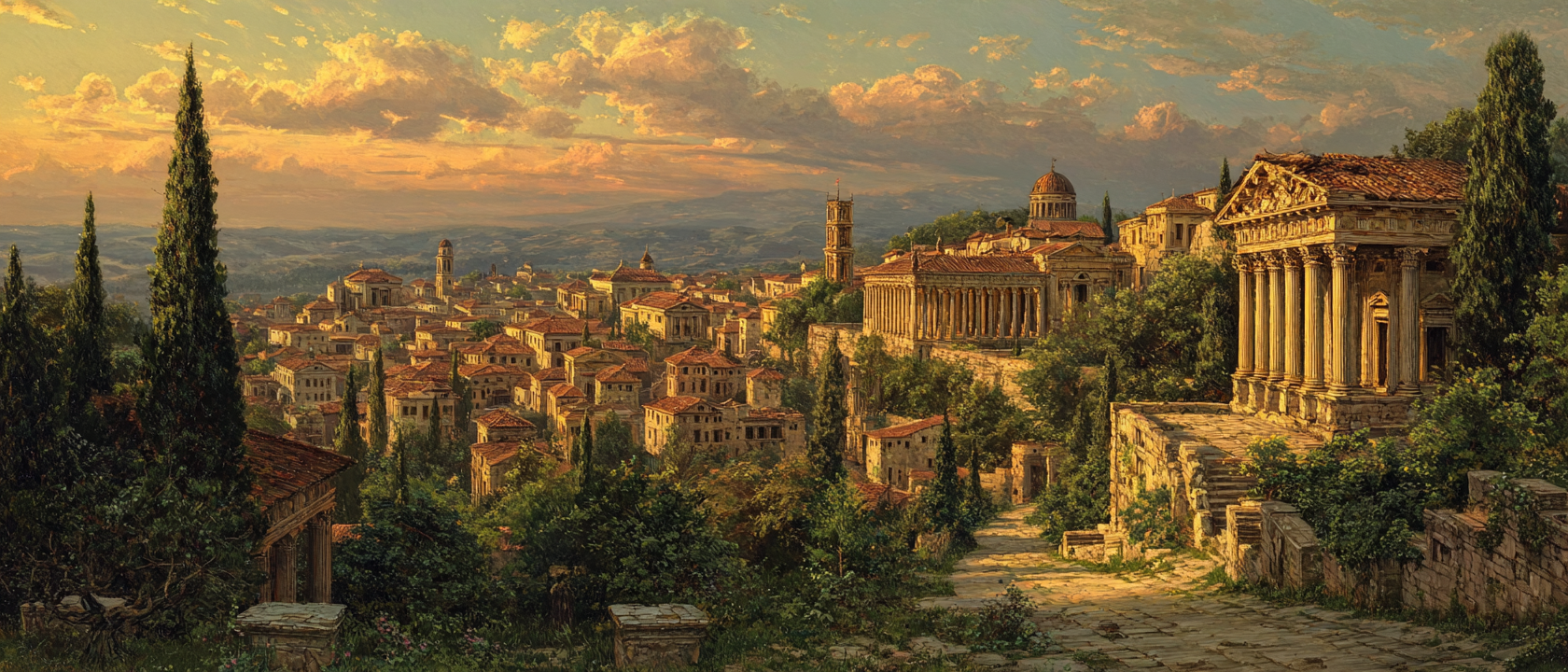
WESTERN QUARTER
The City's Back · District · Porta Silvae
"The Western Quarter faces west. This is its distinguishing characteristic and in Porta Silvae it is, genuinely, distinguishing. The people who live here are the same people as the people who live in the eastern districts — the same families, the same occupations, the same six centuries of proximity to the forest — but they have organised their daily lives around the practical requirements of a city rather than the contemplative requirements of a frontier, and the result is a neighbourhood that feels, from the inside, like any prosperous provincial town in the interior. I find this restful in the specific way that an interruption in sustained attention is restful. The Western Quarter is where Porta Silvae remembers that it is also, in addition to everything else it is, a city."
The Western Quarter is the city's ordinary residential and commercial heart — the markets, the workshops, the families whose lives are not primarily organised around the forest, the Via Orientalis's commercial district where the travellers from the interior arrive and the city's westward commerce is conducted. It is the largest district by population and in some ways the least distinctive, which is itself a distinction in a city where every other district has been shaped by the eastern proximity into something unusual. The Western Quarter has the specific quality of a place that is aware of the phenomenon next door and has decided that awareness is sufficient and immersion is not required.
Demographics
Approximately twenty thousand permanent residents — the largest district population, predominantly the working and commercial class of a fifty-thousand-person city. The district has a higher proportion of long-established families than the eastern districts, which draw more new arrivals from outside the province. The families who have been here for six generations without becoming particularly involved in the forest tradition are a significant element of the city's permanent character — people who know the walk, have done it, respect it, and have organised their lives primarily around the more conventional satisfactions of commerce, family, and civic participation.
Government
Standard Governor's civic administration — the watch, the Aedilitas, the markets inspection, the road maintenance. The Western Quarter is the district that functions most like any other provincial capital's equivalent, and its governance reflects this: competent, unremarkable, effective. The watch's primary concerns here are the management of the very large visitor population arriving on the Via Orientalis and the specific commercial regulation challenges that a city with a significant pilgrim economy generates.
Defences
The city watch's primary posts are in the Western Quarter, where the incoming traffic and the commercial district generate the most routine enforcement requirements. The garrison's western gate watch is the district's military presence, managing the Via Orientalis's entry point with the straightforward protocols of a road gateway rather than the nuanced procedures of the eastern approaches.
Industry & Trade
The Via Orientalis commercial strip is the city's primary market for the goods that fifty thousand people and a significant visitor population require. The inn industry is concentrated here — the visitors from the capital and the interior arrive from the west and require accommodation before undertaking the eastern experience that brought them here. The pilgrim supply trade — the equipment, the appropriate clothing for the Boundary Walk, the documentation and guide materials that the shrine and the Academy produce — is a secondary commercial specialty that the western district's merchants have developed with the specific commercial intelligence of people who understand what their visitors need before the visitors do.
Guilds and Factions
The merchants' association, the innkeepers' cooperative, and the craftspeople's guilds constitute the district's commercial powers. The merchants' association's relationship with the pilgrim economy is the district's most commercially significant institutional question: the association has been developing, for fifteen years, a formal visitor services framework that would standardise and improve the pilgrim experience while generating commercial income for its members. The shrine and the Academy both find this proposal concerning for different reasons and have been working together, with unusual institutional cohesion, to ensure that its implementation does not extend eastward of the forum.
History
The Western Quarter is the oldest continuously commercial district in the city — the first settlement beyond the military camp that the founding Legion established was here, on the road that had brought them. It has been the city's commercial spine for six centuries without the dramatic changes that the eastern districts' development around the forest tradition has produced. For full chronological detail, see: Annales Mundi.
Points of interest
The Via Orientalis western terminus — the point where the road enters the city — is the architectural counterpart to the eastern gate: a functional gateway rather than a symbolic one, its arch solid and plain, marked with the standard imperial road insignia and the city's name. The contrast between this gateway and the eastern gate's carved eye is the most compressed expression of the city's dual character available in a single visit: the western gate is how Rome arrived; the eastern gate is what Rome found when it got here.
The Central Market, at the intersection of the Via Orientalis and the city's main north-south road, is the largest commercial space in the province and the most varied — not grain specialised like Agropolis's market, not frontier-goods focused like the border markets, but the generalist market of a prosperous provincial city that receives visitors from throughout the Empire and has developed a commercial range to serve them. The forest-art secondary market here — the reproductions, the derivative works, the interpretive crafts that the tradition generates around its serious practitioners — is the most extensive in the Empire and the one that the Watching Painters' community finds most uncomfortable and least able to prevent.
Tourism
The Western Quarter is where visitors arrive and where they find accommodation, food, and the practical requirements of a stay in Porta Silvae. It is the starting point rather than the destination. The district's residents are the most experienced in the Empire at providing visitors with accurate expectations for what they are about to experience in the eastern districts, and the inns' staff in particular have developed a genre of pre-walk conversation that prepares visitors more effectively than any printed guide while asking for nothing in return except the ordinary courtesy of a paying guest.
Architecture
Standard provincial Roman architecture in the local warm sandstone — the same material as the rest of the city, used here without the eastern orientation, dark timber detailing, or contemplative design intention that the eastern districts bring to the material. The commercial buildings on the Via Orientalis strip are the district's most varied architecture — the product of twelve centuries of commercial construction, each replacement building reflecting the commercial priorities of its period. The residential buildings are solid, practical, and maintained to the standard that comfortable provincial prosperity produces.
Geography
The Western Quarter occupies the city's western half, from the Via Orientalis's entry at the western gate to the forum's western boundary, and north and south to the city's outer extent. The Via Orientalis's commercial strip is the district's spine — the road that brought the city into existence and continues to connect it to the empire's interior runs through this district's centre, its commercial buildings concentrated along this axis. The residential streets spread outward from the commercial strip in the standard Roman grid that flat terrain produces.
Access
Fully publicly accessible.

Comments