
TEMPLUM SILVAE
The Forest Temple · Sacred Site · Shrine District, Porta Silvae
"Every delegation from the College of Pontiffs returns to Nova Romae with a report finding no specific violation and recommending no specific action. I have read all three reports. I have also read the private communications that two of the three inspection heads sent to the College after their reports were filed. The private communications are not in the public record. Their content was shared with me by a third party. What they say, in different ways and with different degrees of candour, is that the Templum Silvae is doing something correct that the College’s categories are not equipped to describe."
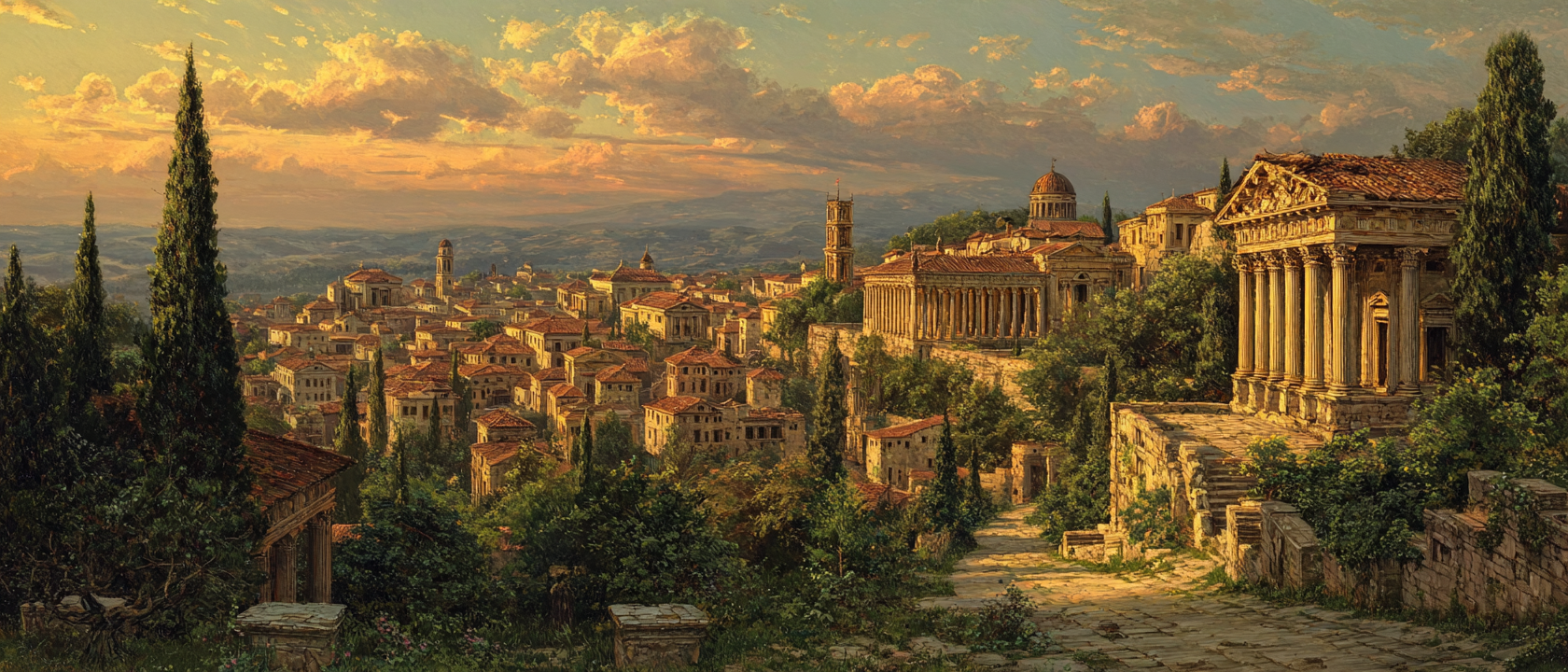
The Templum Silvae is the most theologically unusual building in the Empire that the College of Pontiffs has not formally censured: a second-century temple whose pale limestone exterior signals the College’s institutional affiliation and whose interior has been arranged, since the third century’s modifications, around a practice that the College’s approved liturgical catalogue does not contain. The Watching liturgy — conducted at dawn and dusk by Pontifex Maior Vera Silvicola, sixty-one, in her twenty-second year, from the eastern colonnade’s end, facing the forest, without spoken text, addressed deity, or offering in the usual sense — is the religious practice most associated with Porta Silvae throughout the Empire, and the one that has been producing, over five centuries of development, something that the three College inspection delegations have been unable to classify as incorrect.
Silvicola has managed the shrine within the College’s formal structures while conducting practices the structures do not authorise, for twenty-two years, with a degree of institutional precision that the inspections’ outcomes demonstrate. She knows exactly which of her practices are within the boundary of what the College can disapprove. She has arranged her observances accordingly. The three inspectors who requested private conversations before departing know the difference between what the College can disapprove and what it cannot, which is a distinction Silvicola does not discuss publicly and has apparently communicated to each of those inspectors with sufficient clarity that none of them filed the report that would have required the College to act.
Purpose / Function
Standard College shrine functions: the maintenance of the sacred precinct, the standard calendar of observances, the administration of the rites that Roman civil and religious life requires. The Watching liturgy is the shrine’s primary additional function — the practice that draws pilgrims from throughout the Empire and that constitutes the city’s most significant theological contribution to Aethermarch’s religious culture. The shrine’s archive function is a secondary operational purpose whose significance, for the scholars and priests who access it, rivals the liturgy’s.
Design
The exterior is in pale College limestone. The interior’s arrangement has not been in any College liturgical plan since the third-century modifications. The altar’s position on the axis between the westernmost entrance and the central observation aperture — the east-west line of the treeline’s midpoint on the horizon — means that a priest conducting the sunset observance stands at the exact intersection of the building’s Roman institutional form and the forest’s presence, and that the light from the eastern apertures passes through the altar’s position at specific times of day.
Entries
The main entrance faces west into the shrine district’s residential streets. The eastern colonnade faces east toward the Boundary Walk approach. Pilgrims normally enter from the western entrance; Lira, on her visits, enters through the eastern colonnade’s side access. The main interior is open during services. The archive is accessible to scholars by application to Silvicola — she approves approximately seventy percent of applications and declines the rest with a courtesy that does not include the reason for the declination, which is that she has assessed the applicant as someone who will use the archive’s content to confirm what they already believe rather than to understand what the archive actually contains.
Sensory & Appearance
Approaching from the shrine district’s quiet streets: the pale limestone exterior against the warmer sandstone of the surrounding buildings is immediately distinguishable. The colonnade’s shade at midday, the smell of the specific incense that the shrine uses — a compound that includes transition zone botanical material and that the College’s standard supply does not provide — and the particular quality of directed quiet that a religious precinct established over five centuries produces. Inside during the Watching liturgy: the congregation, if present, faces east with the priest. Forty minutes of silence in front of the forest, the eastern apertures casting their specific light patterns into the interior as the sun moves. Visitors who find this less than they were expecting and visitors who find it more are both having a correct experience.
Denizens
Pontifex Maior Vera Silvicola , sixty-one, twenty-two years: the most theologically unconventional senior priest in the College’s current active roster, the keeper of a private journal that has been locked for twenty-two years and that contains her record of Lira’s visits to the shrine, her experience of the Watching liturgy’s development, and — since the platform conversations with Silvana began — something that she has not yet found the right words for and that she is approaching with the care of someone who knows that premature articulation is a way of not-knowing rather than knowing. Will speak about the Watching tradition with anyone who has practiced it seriously. Will not speak about the private journal’s content. Is reviewing the shrine archive for Silvana’s calculation and has found, in the process, the older record that the calculation’s founding generation context requires.
Contents & Furnishings
The main interior: the altar on its east-west axis, the lamp holders in the standard College arrangement whose combined positioning produces, with the observation apertures’ light, the specific quality of illumination that the Watching tradition uses. The incense braziers with the transition zone botanical compound. The priestly library’s working copies of the shrine’s accumulated liturgical practice, in a form that is not the College’s approved text and that would require explaining to a College inspector if one found it. The archive’s lower-floor fireproofed chambers.
Valuables
The archive is the shrine’s primary valuable: the most complete single-institution record of treeline observation in the Empire, now cross-referenced with the Academy’s records and currently being reviewed for the forest movement calculation whose additional content Silvicola is finding. Silvicola’s private journal is the most significant private document in the shrine district, containing twenty-two years of observations that she has not shared with anyone including the College, including the Governor, and including the three inspectors who asked to speak with her privately. She will share it, at some point, with someone. She does not know when or who.
Special Properties
The observation apertures’ combined effect at the altar’s position at the equinox: the three light patterns converge on the altar’s surface for approximately four minutes. During those four minutes, the altar is the only surface in the building that receives the combined light of all three apertures simultaneously. The third-century priest who designed the aperture placement knew this would happen. The archive’s record of her two years at the treeline’s edge before designing the colonnade suggests this was the intended outcome. What the combined light does during those four minutes is recorded in the archive’s equinox observation section, in entries that Silvicola’s predecessor’s predecessor began marking with a specific notation. The notation is in a language that is not Latin and is not standard Elvish.
Alterations
The exterior’s pale College limestone has not been altered since the building’s second-century construction. The interior’s altar position was modified in the third century to its current east-west axis. The observation apertures were added in the same third-century modification. The archive’s fireproofed chambers were added in the sixth century, funded by private donation from a family whose descendants still live in the shrine district and whose current senior member attends every Watching liturgy without fail.
Architecture
Pale College limestone on the exterior, the standard signal of institutional affiliation maintained with the precision of someone who understands that the exterior’s orthodox appearance is the condition under which the interior’s practice is possible. The interior’s observation apertures in the eastern wall — three openings at specific heights and widths, capturing the treeline’s light at specific times of day — are a feature the College approved in the original plans without, apparently, calculating what the combined effect of their positioning would produce at the altar’s location at the equinox.
History
The Templum Silvae was built approximately two centuries after the city’s founding, when the city had accumulated enough experience of the forest to understand that the standard College shrine was not an adequate institutional response to what they were living with. The Watching liturgy developed over the subsequent centuries from the specific requirements of sustained forest attention. Silvicola’s twenty-two-year tenure is the longest in the shrine’s history. The College has sent three inspection delegations in this period. All three have returned to Nova Romae without recommending action. See Annales Mundi for full chronological detail.
Tourism
The Watching liturgy at dusk is the most widely recommended experience in Porta Silvae for first-time visitors. Attendance is open to all. The shrine’s staff have developed considerable skill at orienting visitors before the liturgy in ways that improve the experience without determining it — the specific art of preparing someone for an experience that depends on their own attention rather than any performer’s.
Observation aperture light convergence at altar position: equinox only, approximately four minutes. Effect documented in archive’s equinox observation section in non-Latin non-Elvish notation. Silvicola’s translation is in progress.
Services
Watching liturgy: dawn and dusk, daily.
Standard College observances: full calendar.
Archive: scholars by application.
Guest facilities: pilgrims by arrangement.

Comments