
ACADEMY QUARTER
The Eastern Monitoring Station · District · Porta Silvae
"The Academy's eastern monitoring station is the most comprehensively resourced research facility outside Nova Romae, which reflects the Senate's assessment that Sylvanmere is the Empire's most significant unresolved question. The scholars here have been studying the forest with better instruments, larger budgets, and more institutional support than any other frontier research effort in Aethermarch. They have been doing so for three centuries. Their understanding of the forest's external observable properties is the deepest available in the Empire. Their understanding of the forest's nature is, by their own assessment, approximately where Centurion Arbor's reports were in the first century. The subject resists the tools being applied to it."
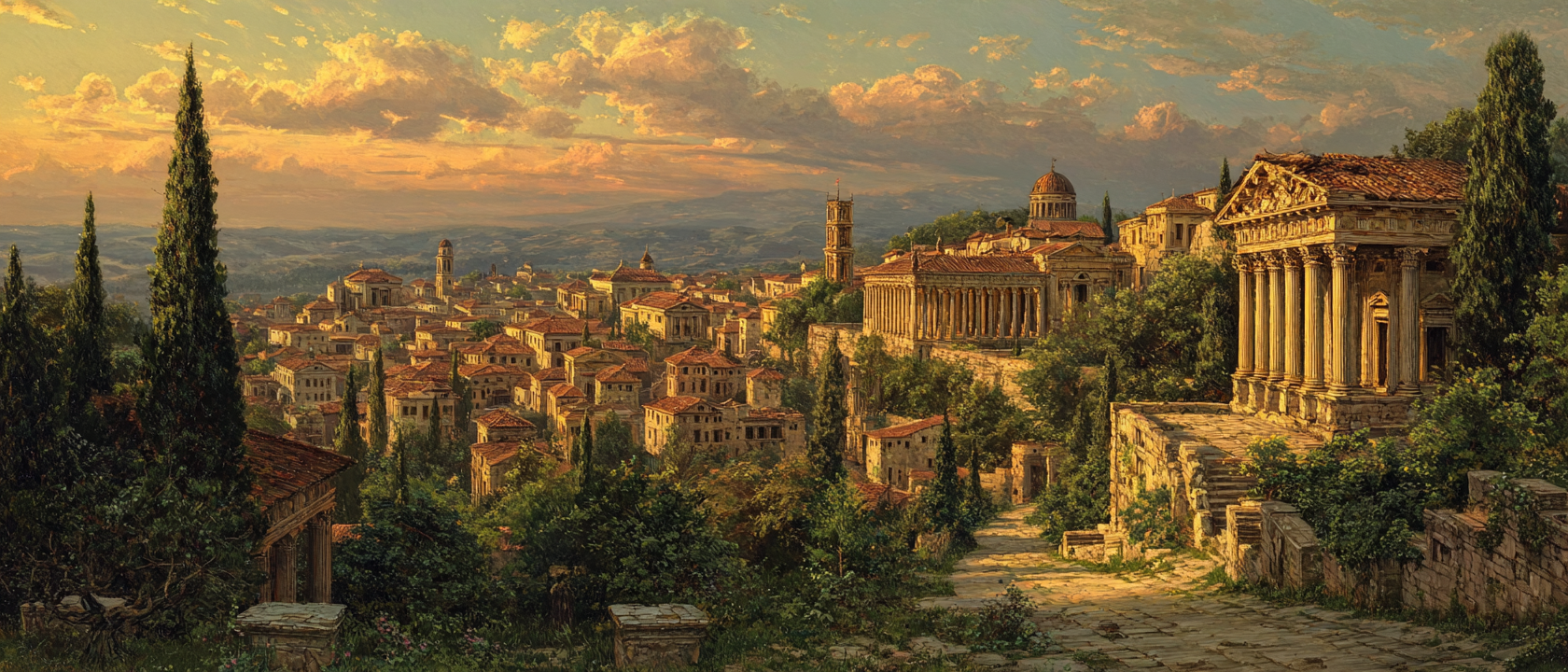
The Academy Quarter occupies the city's northern section — set back from the eastern approach deliberately, the Academy's position reflecting its role as observer rather than participant in the frontier relationship. The monitoring station is the most generously funded Academy outpost in the Empire, its instruments, library, and staff funded to a standard that reflects the strategic importance of understanding whatever Sylvanmere is. It has been operating for three centuries. Its understanding of the forest's measurable properties is unmatched. Its relationship with the Templum Silvae's archive — both institutions studying the same subject from different disciplinary positions — is the most productive inter-institutional research collaboration in the provincial Empire, and the collaboration that the College in Nova Romae finds most concerning.
Demographics
The scholarly community of approximately five hundred researchers and their support staff — the most international population in the city after the Artists' Quarter, drawn from every part of the Empire by the specific research opportunity the position provides. The station director, a natural philosopher of fifty-eight named Marcus Scrutator Silvanus — no relation to the Governor, a coincidence of naming that both find occasionally useful — has held the role for fourteen years and is the Empire's foremost external scholar of the forest's measurable properties. His published work is the standard reference on the subject. His unpublished work is significantly more interesting and is in the station library's restricted section.
Government
The scholarly community of approximately five hundred researchers and their support staff — the most international population in the city after the Artists' Quarter, drawn from every part of the Empire by the specific research opportunity the position provides. The station director, a natural philosopher of fifty-eight named Marcus Scrutator Silvanus — no relation to the Governor, a coincidence of naming that both find occasionally useful — has held the role for fourteen years and is the Empire's foremost external scholar of the forest's measurable properties. His published work is the standard reference on the subject. His unpublished work is significantly more interesting and is in the station library's restricted section.
Defences
No military presence in the district. The station's security is managed by its own staff, whose primary concern is the instruments — several of which are irreplaceable at any price — and the restricted archive. The garrison is aware of the station's work and maintains an officer liaison who attends the station's quarterly briefings, an arrangement that both parties find useful: the station provides the garrison with the most detailed current assessment of the transition zone's observable condition; the garrison provides the station with the most detailed current account of anything that has been observed at the treeline.
Industry & Trade
Research. The station's outputs — the published measurements, the atmospheric data series, the botanical surveys of the transition zone that are updated annually — are the primary scientific reference for everything the Empire knows about Sylvanmere's external properties. The station also maintains the most complete cartographic record of the transition zone's botanical changes, updated annually since the station's founding, which is the dataset that would allow Silvana's calculation of the forest's movement rate to be extended back three hundred years rather than the fifty years the shrine's archive covers.
Guilds and Factions
The research community's internal organisation is by disciplinary specialty — the atmospheric researchers, the botanists, the light-property investigators, the historians of the contact record — with Marcus Scrutator's directorship providing the coordination across these groups. The collaboration with the shrine's archive community is the station's most significant external relationship, producing the daily working contact between natural philosophers and priests that the College finds institutionally irregular and the Academy finds professionally productive.
History
The monitoring station was established three centuries ago, approximately two centuries after the city's founding, when the Academy determined that systematic measurement was required in addition to the shrine's observational record. Its founding coincided with a period of increased elf sightings at the treeline that prompted the Academy's interest. The observation tower was added one century after the founding. The restricted archive's systematic development began in Marcus Scrutator's predecessor's tenure, approximately sixty years ago. For full chronological detail, see: Annales Mundi.
Points of interest
The observation tower's upper platform is accessible to Academy-credentialled visitors and to members of the public who submit a formal request to the station director's office — a process that takes one week and is approved for approximately ninety percent of applicants. The view from the platform encompasses the entire transition zone, the boundary stones, and the treeline beyond them. At the anomalous light hour, with the forest's warmth doing something to the sunset that the instruments below are measuring and the eyes above are experiencing simultaneously, it is the most complete version of what Porta Silvae is available to a single human perception in a single moment.
The restricted archive contains the station's unpublished research — the observations, measurements, and analyses that Marcus Scrutator has judged significant but not ready for the Academy's publication process. The restriction is not unusual for an active research station. What is unusual is the size of the restricted archive relative to the published work: the restricted material is approximately three times as extensive as everything the station has published in three centuries. Marcus Scrutator has been building this archive for fourteen years and his predecessors built it before him. The Academy's central office has noted the size disparity in two separate administrative reviews. Both reviews concluded that a productive research station should be trusted to manage its own publication timeline.
Tourism
The observation tower is the recommended visit for anyone who wants the most complete single view of the transition zone and the forest available from within the city. The station's public library — the published research, the open archive section — is available to any visitor and constitutes the best reading preparation for the Boundary Walk available anywhere. The quarterly public lectures that the station offers on current research findings are the city's most attended public intellectual event, drawing audiences that include the garrison soldiers, the shrine's junior clergy, and working artists, which Marcus Scrutator finds both gratifying and slightly bewildering.
Architecture
The monitoring station's observation tower is the tallest structure in the city — not by design but by necessity, the instruments requiring elevation that no other building provides. Its upper platform is the most complete view of the transition zone and the forest canopy available from any built structure in the province, and it has been used not only for the instruments' purposes but as an observation point by every significant visitor to the city for three centuries, including Varro on all seven of his visits, and including, on one occasion approximately twenty years ago, Lira — who asked permission of the station director of the time, was granted it with considerable astonishment, and spent two hours on the platform before returning to the street without comment.
Geography
The quarter is set slightly back from the city's main east-west axis, accessed from the forum via a northern road that the Academy's early residents negotiated to be wider than standard to accommodate instrument transport. The station building itself — a substantial structure in the Academy's characteristic pale limestone — faces east as everything in the city faces east, its observation tower rising above the roofline to provide the elevated eastern sightline that atmospheric and light measurements require. The residential buildings for the scholarly community cluster around the station, their gardens oriented eastward in the pattern the city has established over six centuries.
Access
Public library — open.
Observation tower — credentialled visitors and approved public requests.
Restricted archive — senior Academy staff and Director's discretion.

Comments