
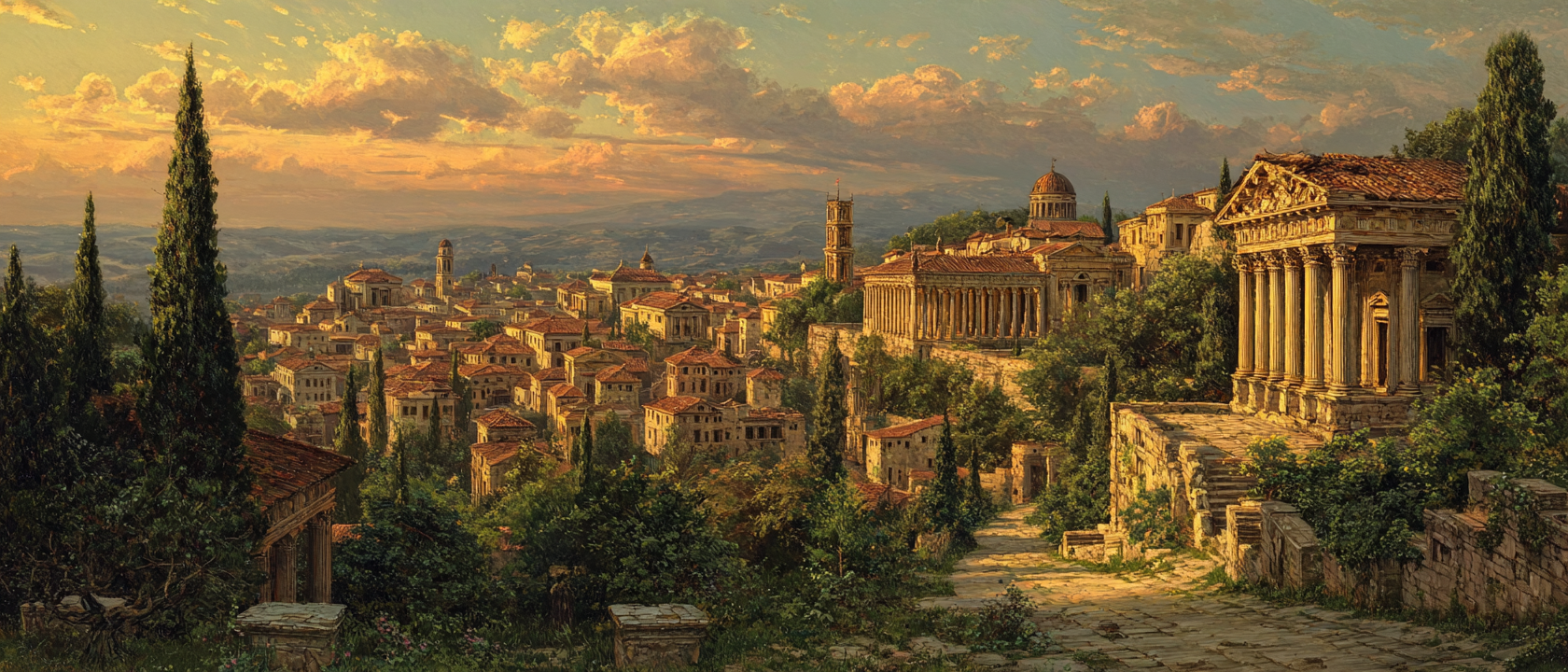
SHRINE DISTRICT
The Templum Silvae and its Quarter · District · Porta Silvae
"The Templum Silvae is the most theologically unusual building in the Empire that has not been formally censured by the College of Pontiffs, and I use the word 'formally' with precision. The College has sent three inspection delegations in Pontifex Silvicola's tenure. All three have returned with reports that find no specific violation. All three delegations, I am reliably informed, have included at least one inspector who requested a private conversation with Silvicola before departing, and whose subsequent conduct suggests that the conversation was significant. I do not know what is said in these conversations. I know that nobody who has attended the Watching liturgy at sunset and then spent an evening in honest reflection has subsequently argued that something incorrect is happening here."
The Shrine District surrounds the Templum Silvae in the city's eastern residential zone, its streets quieter than the forum's by design and long tradition, its population the most theologically engaged in the city. The district is the centre of the religious syncretism that defines Porta Silvae's most distinctive cultural contribution to Aethermarch: the absorption, into formally Roman religious practice, of forest-facing observances that the city has been developing for six centuries and that the College in Nova Romae has been unable to classify as either orthodox or heretical because they do not fit neatly into either category.
Demographics
The shrine's priestly community of approximately sixty — Silvicola's senior priests, the junior clergy, the acolytes in training — and the broader residential community of approximately four thousand who have chosen to live in the district because they find proximity to the shrine's practice meaningful. The district's population has a higher proportion of people who have come from elsewhere specifically for the religious tradition than any other district in the city; it is the destination for Romans throughout the Empire who have heard about the Watching practice and want to experience it in the place where it has been developed.
Government
The shrine district is under the Governor's civic jurisdiction and the Templum's priestly authority in the standard College arrangement, with the additional complexity that the priestly authority here extends into theological territory that the standard arrangement does not account for. Silvicola's management of the shrine operates within the College's formal structures while conducting practices that the formal structures do not authorise — a position that requires the specific kind of institutional navigation that twenty-two years of practice has made her extremely good at. She knows exactly which of her practices are within the boundary of what the College can disapprove and which are outside it, and she has arranged her observances accordingly.
Defences
No garrison in the district. The shrine's ceremonial guards manage the precinct's security. The district has the specific security requirement of a religious site that attracts people in unusual emotional states, and the guards' training reflects six centuries of experience with the specific kinds of incident that pilgrims who have just walked the Boundary Walk sometimes generate.
Industry & Trade
No garrison in the district. The shrine's ceremonial guards manage the precinct's security. The district has the specific security requirement of a religious site that attracts people in unusual emotional states, and the guards' training reflects six centuries of experience with the specific kinds of incident that pilgrims who have just walked the Boundary Walk sometimes generate.
Guilds and Factions
The shrine's priestly community under Silvicola is the district's dominant institutional presence and the city's most influential theological voice. The community of lay practitioners who have come to the city specifically for the Watching tradition constitutes an informal congregation whose relationship with the College's formal structures is variable — some are certified clergy practicing in the tradition; more are laypeople who find the tradition meaningful and the College's normal structures inadequate for what they are experiencing. Silvicola manages this community with the pastoral sophistication of someone who has been doing it for twenty-two years and who understands that the people who come here are not, in general, in the wrong.
History
The Templum Silvae was built in the city's sixth century A.P. — approximately two centuries after the city's founding — when the city had accumulated enough experience of the forest to understand that the conventional College shrine was not an adequate institutional response to what they were living with. The Watching liturgy developed organically over the subsequent centuries from the combination of Roman observance practice and the specific requirements of sustained forest attention. Silvicola's twenty-two-year tenure is the longest in the shrine's history. For full chronological detail, see: Annales Mundi.
Points of interest
The Watching liturgy — conducted at dawn and dusk by Silvicola or a designated senior priest from the Templum's eastern colonnade — is the district's central public event and the religious practice most associated with Porta Silvae throughout the Empire. It is not a conventional service. There is no spoken text, no addressed deity, no offering in the usual sense. The priest stands at the colonnade's eastern end, facing the forest, and watches. The congregation, if present, watches with them. The duration varies — typically twenty to forty minutes at dawn, longer at dusk when the anomalous light extends the experience. The College's official classification of the liturgy is 'contemplative observance, theologically unspecified.' This classification was agreed after the second inspection delegation's visit and has not been revised.
The shrine's archive occupies the building's lower floor in fireproof chambers whose construction was funded by private donation in the sixth century of the city's history. It contains the treeline observation records from the shrine's founding — more than three centuries of daily weather-and-light observations at the forest edge, supplemented by the specific documentation of anomalous events, elf sightings, and the slow changes in the transition zone's botanical character that the shrine's priests have been noting since before the Academy's station existed. The archive's oldest records are in a hand so old that the Academy's palaeographers can barely read them. The content of those oldest records, in so far as it has been transcribed, is the most careful early documentation of the treeline's anomalous properties available anywhere.
Lira's practice when in the city includes, invariably, one visit to the Templum Silvae — she enters through the eastern colonnade, which pilgrims do not normally use, and spends time in the interior before the altar on the treeline axis. Silvicola has been present on approximately half of these visits. They do not speak during Lira's time in the shrine. After Lira leaves, Silvicola returns to her office and writes in a journal that is not the shrine's official record. She has been keeping this journal for twenty-two years. It is locked.
Tourism
The shrine district is the primary destination for religious pilgrims visiting Porta Silvae, and the Watching liturgy at dusk is the most widely recommended experience for first-time visitors. Attendance is open to all. The experience varies enormously by individual — some visitors find it profoundly affecting, others find forty minutes of collective silence in front of a forest less than they were hoping for. The shrine's staff have developed considerable skill at assessing which visitors will benefit from preparation and offering it without patronising people who did not ask for it.
Architecture
The Templum Silvae's exterior is standard Roman temple architecture in pale limestone — the College's material signature, present here as at every significant shrine, the visual signal of institutional affiliation. The interior is something else. The eastern wall's observation apertures — three openings positioned at specific heights and widths — are designed to capture the treeline's light at specific times of day and cast it into the interior in patterns that change with the season and the atmospheric conditions. The altar is positioned on the axis between the westernmost entrance and the central aperture, so that a priest conducting the sunset observance stands between the interior light and the forest. This arrangement is not in any College liturgical plan. It has been in the building since the third century.
Geography
The district occupies the ground immediately west of the boundary zone approach, its eastern edge giving onto the beginning of the Boundary Walk's maintained path. The Templum Silvae is at the district's centre, its eastern colonnade aligned precisely with the treeline on the horizon, its entrance facing west into the residential streets. The priests' residences, the shrine's archives, the small guest facilities for pilgrims staying more than a day — these cluster around the Templum in the organic arrangement of a religious precinct that has grown into its neighbourhood over five centuries rather than being planned for it.
Access
Templum exterior and colonnade — publicly accessible.
Interior — open during services.
Archive — scholars by application to Silvicola

Comments