
ARTISTS' QUARTER
The Watching Painters and Their Neighbourhood · District · Porta Silvae
"The Watching Painters are the most sustained artistic community working on a single subject in Aethermarch's cultural history. Five centuries of painters, sculptors, and more recently, mosaic workers and weavers, have been attempting to capture what the treeline light does at the specific moment of the anomaly. None has fully succeeded. All have contributed something. The body of work produced is the largest single-subject artistic archive in the Empire and, in the opinion of the Academy's cultural historians, the most important. I find it impossible to look at these works consecutively without concluding that the thing they are collectively failing to capture is real, and that its reality is the most significant thing the collection demonstrates."
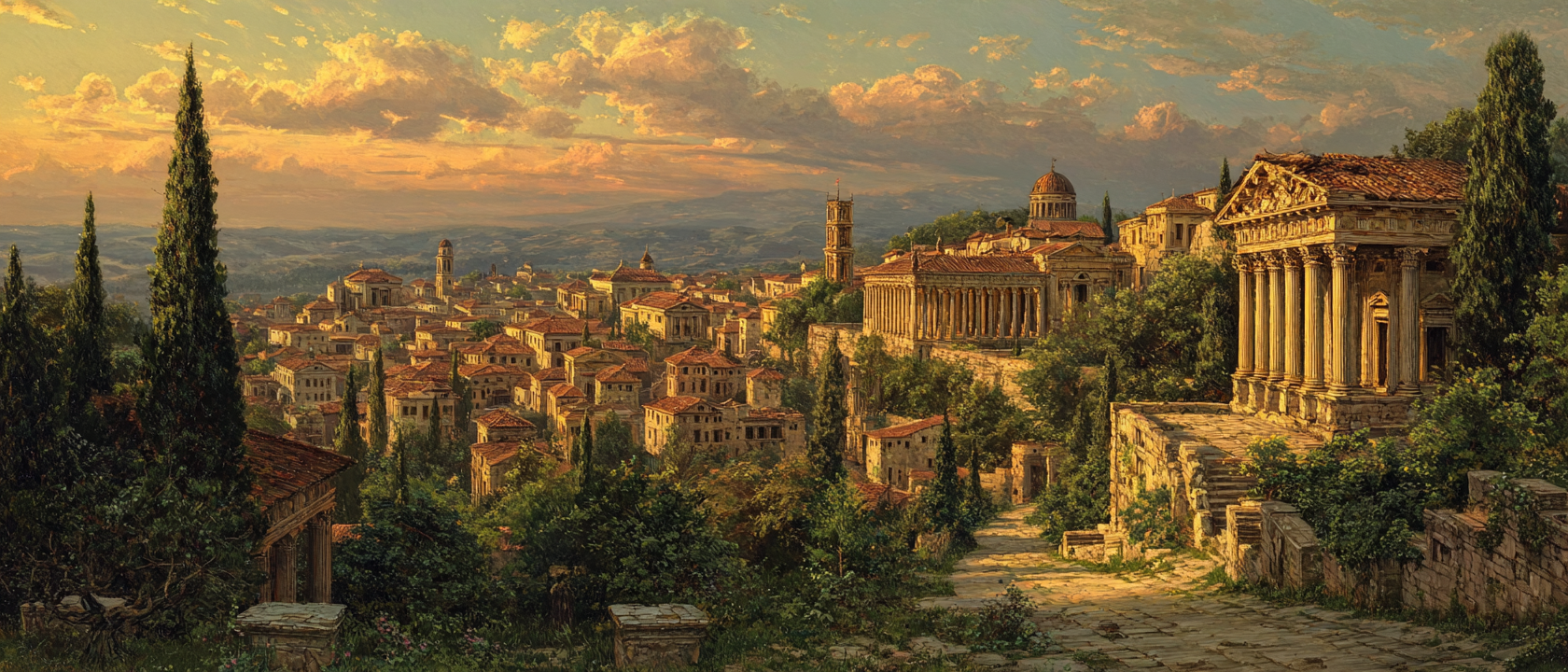
The Artists' Quarter occupies the eastern residential zone north of the shrine district, its streets progressively denser with studios, galleries, and the communal spaces that an artistic community requires as proximity to the treeline increases. The most sought-after studios in the city are those with direct eastern windows onto the transition zone — the light that reaches them in the late afternoon is the subject the community is working on, and working in it rather than travelling to it is worth the premium. The quarter is the only district in the city that organises its social life around the evening light — dinner is late here, by the standards of the rest of the city, because the artists are at their eastern windows through the sunset.
Demographics
Approximately six thousand permanent residents, perhaps half of whom are practitioners in some artistic medium, the rest the support community that artists require — the materials suppliers, the framing and mounting craftspeople, the gallery operators, the critics and commentators whose presence the community finds simultaneously essential and irritating. The quarter has a higher proportion of residents from outside the province than any other district, artists having come from across the Empire to work on the subject that has no equivalent anywhere else. The community's relationship with the city's permanent population is generally warm and occasionally competitive about who has the more authentic relationship with the phenomenon they are all living with.
Government
The quarter falls under the Governor's civic jurisdiction and is, in practice, self-governing through the informal authority of the Watching Painters' senior practitioners. There is no guild in the formal sense — the Watching tradition has resisted guild formation for five centuries on the grounds that the subject does not lend itself to the quality standards and commercial structures that guilds require — but the senior practitioners' collective view on what constitutes significant work in the tradition carries the force of institutional judgment and is treated accordingly by the community, the market, and the Academy's cultural historians.
Industry & Trade
The art market in the quarter is significant by any provincial standard — the Watching Painters' work commands prices in the capital that reflect both the tradition's cultural prestige and the specific desirability of owning something that has been made in proximity to the forest. The market distinguishes carefully between work made in the quarter and work made elsewhere in a forest-adjacent tradition, with corresponding price differentials. The materials trade is correspondingly significant — the specific pigments required for the treeline light's anomalous warmth have been a subject of ongoing technical development for five centuries, and the quarter's specialist suppliers are the Empire's foremost experts in the optical properties of warm-spectrum painting materials.
Guilds and Factions
The Watching Painters' informal senior practitioner council, the gallery's management committee, and the materials suppliers' informal cooperative constitute the quarter's governance structures. The relationship between the working painters and the critics and commentators is the quarter's primary internal tension — the practitioners consider most critical writing about the tradition insufficiently attentive to what is actually happening in the work, and the critics consider the practitioners insufficiently articulate about their own practice. Both assessments are partially correct. Varro has been cited in the critical literature and has been told, by three separate practitioners, that his account of the tradition is the most accurate available from a non-practitioner and that this is a low bar.
History
The artistic community in this part of the city is documented from the city's third century — approximately three hundred years after the founding. The Gallery of the Watching was established in the fourth century. The Watching Painters as a recognised tradition is fifth-century. Gaius Viridis's eleven-year work on a single canvas is the longest sustained effort on a single piece in the tradition's history and has become, among the quarter's residents, a reference point for the question of whether full success at the central technical problem of the tradition is achievable or whether the subject resists completion by its nature. For full chronological detail, see: Annales Mundi.
Points of interest
Gaius Viridis's studio — a large ground-floor space at the quarter's eastern edge, its eastern wall effectively replaced by glass in a construction that the Aedilitas approved with the specific condition that it could withstand winter storms, which it has — is the most visited working studio in the quarter. The unfinished canvas is the room's dominant presence: two metres by four, its current version the seventeenth, depicting the treeline at the precise moment of the light anomaly in the atmospheric conditions that produce it at its most distinct. Viridis does not discuss the work. He accepts visitors during the morning hours only. He has repainted the central light-transition section of the canvas three times since Lira's last visit. The current version is, by the judgment of the quarter's senior practitioners who have been watching the work develop for eleven years, the closest he has come to the thing he is looking for. It is still not finished.
The Gallery of the Watching — the quarter's communal exhibition space, maintained since the fourth century as the repository for works in the tradition that the community judges significant — contains five centuries of sustained effort at a single subject. The collection is not curated in the conventional sense — works are added when the senior practitioners agree they belong and are never removed. The result is a five-century progression that the Academy's cultural historians find extraordinary: the earliest works show a forest edge at sunset that is beautiful and somewhat generic; the later works progressively isolate and attempt to capture something specific that the earlier works either did not see or could not render; the most recent works are so specifically focused on a single quality of light that they are barely representational. The progression is, cumulatively, the most precise documentation of the anomaly's specific character available in any medium.
Tourism
The Artists' Quarter is fully accessible and is a recommended visit for everyone who comes to Porta Silvae, regardless of their primary interest. The Gallery of the Watching is the most practical experience of the tradition available without sitting through the entire Watching liturgy, and the progression of five centuries of work at a single subject is among the most affecting cultural experiences in the provincial Empire. Viridis's studio is accessible during morning hours. The quarter's other working studios are variably accessible depending on the practitioner, and the community has a general policy of welcoming informed visitors and discouraging tours.
Architecture
The quarter's architecture reflects its function: studios with large eastern windows, galleries with controlled northern light, the workshops of craftspeople who require specific conditions and have built to provide them. The oldest buildings are fourth-century, their large window apertures a period innovation driven by the community's requirements rather than any broader architectural fashion. The newest are recent construction, their eastern windows larger than any previous generation has built, reflecting both improved glass quality and the community's ongoing commitment to the proposition that what they need is more light.
Geography
The quarter extends from the shrine district's northern edge to the Boundary Walk's access road, its eastern face approximately two hundred metres from the nearest boundary zone approach. The proximity is not accidental — the community has been consolidating eastward over five centuries, each generation of artists finding that the additional hundred metres toward the forest makes a difference they can work with. The current eastern edge of the quarter is the closest residential ground to the treeline of any district in the city, a position that the garrison watches with mild but consistent concern.
Access
Streets and gallery — publicly accessible.
Viridis's studio — morning hours.
Working studios — practitioner's discretion.

Comments