
PORTA SILVAE
The Gate of the Forest · City · Provincia Orientalis
Every city I have visited in Aethermarch has organised itself around something: a harbour, a wall, a river, a market. Porta Silvae has organised itself around an absence. The forest is there, to the east, and the city faces it, and nothing crosses between them except the light and, occasionally, the young. Six centuries of coexistence with something that does not acknowledge you formally, that watches you with the quality of a god that has not decided what to do with you yet, produces a civic culture unlike any other in the Empire. The people of Porta Silvae are not afraid. Fear would be easier. What they are is attentive, in the specific way of people who have learned that attention is the only honest response to something they cannot fully understand.
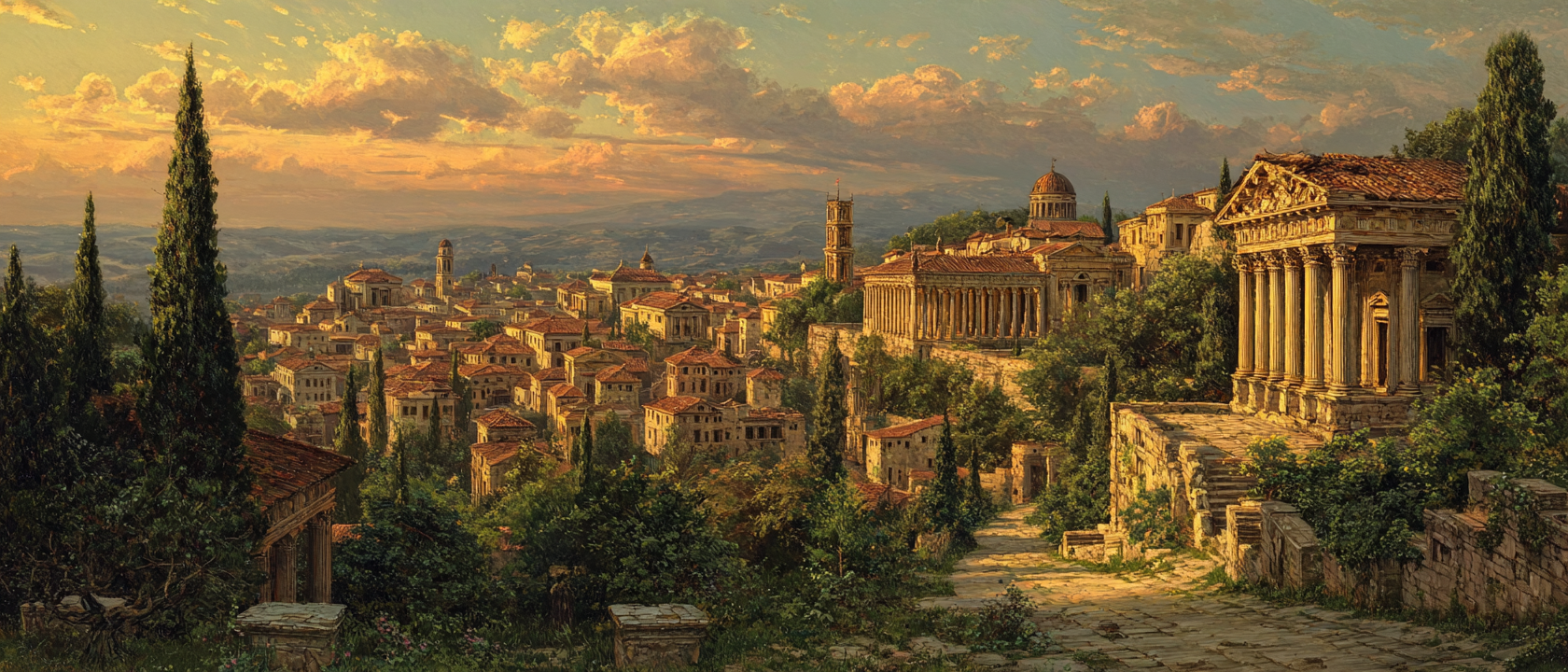
Porta Silvae is the provincial capital of Provincia Orientalis and the Empire's easternmost significant city: the last Roman settlement before the Via Orientalis ends and the forest begins. It has a population of approximately fifty thousand permanent residents and a civic culture that has been shaped, over six centuries, by proximity to Sylvanmere in ways that no other city in Aethermarch has experienced. The city faces east. This is not a metaphor. The forum is oriented eastward. The principal temple faces east. The public spaces, the viewing platforms, the promenades and gardens of every district are arranged around the eastern prospect, the daily event of the sunset over the forest canopy, and the permanent fact of the treeline three kilometres from the city's eastern gate.
What makes Porta Silvae genuinely unusual — in a way that takes time to understand and longer to adequately describe — is that it has lived next to the inexplicable for six centuries and has neither dismissed the inexplicability nor been destabilised by it. The city's religious life has absorbed forest-facing practices that the College of Pontiffs in Nova Romae classifies as irregular and has not successfully suppressed. Its artists produce work that attempts to capture what the treeline light does at sunset, an attempt ongoing for five centuries that has produced a body of work the Academy considers the most sustained engagement with a single aesthetic problem in Aethermarch's cultural history. Its ordinary residents have treeline rituals and theories developed through generations of living with something they cannot explain, and they hold these rituals and theories with the particular combination of conviction and uncertainty that sustained proximity to genuine mystery produces.
I have visited Porta Silvae seven times over my career. Each time I have stood at the forest edge in the early evening and watched the light change, and each time I have been unable to determine whether what I am experiencing is natural beauty complicated by knowledge of what the forest is, or something that is genuinely different from natural beauty, or whether the distinction between those two things is as meaningful as I usually assume it to be. I note this not as a mystical observation but as an empirical one. The light at the Porta Silvae treeline at sunset does something that the same light, at the same time of day, does not do two kilometres to the north or south. I have measured this. I remain uncertain what the measurement means.
Demographics
Fifty thousand residents with the specific demographic character of a city that receives pilgrims, scholars, and the curious in significant numbers but has a permanent population not primarily defined by any of those categories. The frontier families here — Romans whose ancestry in the city extends six centuries — are the city's core, and their relationship to the forest is the most intimate available: they have grown up watching it, their parents watched it, their grandparents' grandparents watched it, and the accumulated weight of that watching has produced a population whose relationship to inexplicability is unusually sophisticated. They are not more mystical than other Romans. They are more precise about what they do and do not know.
The scholarly community attached to the Academy's eastern monitoring station is the city's second significant intellectual presence, larger than any other Academy outpost except Castellum Magnum's, reflecting the forest's status as the Empire's most significant unresolved research question. Artists constitute a notable fraction of the permanent population, drawn by the light and the subject and the community of other artists who have come for the same reasons. The garrison of two hundred soldiers is the smallest proportional military presence of any provincial capital in the Empire, a reflection of the Senate's six-century uncertainty about what military force is appropriate for a frontier that nothing has ever crossed aggressively.
Government
The city is governed by Governor Flavia Lucerna Silvana, in her third year — a former Academy faculty member appointed by the Senate specifically because the Senate wanted a Governor who understood the forest situation rather than one who would attempt to manage it through conventional provincial administration. Silvana is the first Governor of Provincia Orientalis in four generations with scholarly credentials, and her appointment has produced a relationship between the Governor's office, the College shrine, and the Academy's monitoring station that is more collegial and more productive than anything her predecessors managed. It has also produced a relationship with the garrison commander that is more fraught, because Silvana's assessment of the forest situation diverges from the Legion's operational framework in ways the garrison commander finds professionally uncomfortable.
The College shrine's senior priest, Pontifex Maior Vera Silvicola, has held the role for twenty-two years and is the most theologically unconventional senior priest in the College's current roster. Her management of the shrine's absorbed forest-facing practices — the Watching liturgy, the sunset observances, the careful documentation of treeline anomalies that the shrine has been maintaining since the third century — is technically within the bounds of her authority and operationally far outside what the College's central office considers appropriate. The College has sent three inspection delegations in her tenure. All three have returned to Nova Romae with reports that find no specific violation, recommend no specific action, and that the College's senior staff find deeply unsatisfying.
DM ONLYDefences
Two hundred soldiers constitute the entirety of Porta Silvae's garrison: a cohort undersized by every standard metric for a provincial capital and that the Senate has underfunded consistently for three centuries on the grounds that it is unclear what the garrison is for. The forest has never attacked. The elves have never threatened. The garrison's actual function is a combination of civil order maintenance, the specific watch protocols that the treeline's proximity requires, and the management of the boundary zone's access — ensuring that Roman civilians do not approach the treeline in ways that might constitute provocation, a task whose definition the garrison and the Governor's office disagree about with some regularity.
The garrison commander, Centurion Primus Lucius Hastus, commands his two hundred soldiers with the particular frustration of a competent military officer in a posting whose parameters he cannot fully define. His watch protocols for the treeline are the most detailed documentation of treeline observation procedures in the Empire, developed over his four years in the role and drawing on two centuries of his predecessors' accumulated practice. They include specific procedures for what to do when elves are observed at or near the treeline — procedures considerably more nuanced than the Legion's standard contact protocols, which Hastus wrote himself because no standard protocol existed.
Industry & Trade
The province's agricultural interior produces a comfortable economic base. The city's specific commercial character is defined by the pilgrim and scholar traffic that the forest proximity generates: Porta Silvae receives more visitors per capita than any other provincial capital in the Empire, the forest being the single most visited natural phenomenon in Aethermarch by people who make journeys specifically to experience it. The accommodation industry is correspondingly developed; the city has more inns per resident than anywhere else in the Empire. The art market is significant — the body of Porta Silvae forest art produced over five centuries is traded, collected, and commissioned here with the infrastructure of a mature cultural market.
The dark-timber craft industry — working the managed forest timber in the aesthetic tradition that has developed over six centuries of adjacent proximity to Sylvanmere — is the city's most distinctive export, its products recognisable in markets throughout the Empire by the specific joining and finishing techniques the city's craftspeople have developed. The timber is not from Sylvanmere. The aesthetic is entirely shaped by it.
Infrastructure
The Via Orientalis terminates at the eastern gate and is the city's primary connection to the interior. The road's quality is maintained to a high standard for the first four hundred kilometres from the capital and deteriorates significantly in the final hundred: the Senate's chronic uncertainty about investment in a frontier with no military threat expressing itself in road maintenance budgets. The city has consistently requested the final section's improvement and consistently received partial funding that repairs the worst sections without addressing the underlying standard. The eastern gate terminus — the stone arch with the carved eye — is the formal end of the Roman road network. Beyond it, a maintained path leads to the boundary stones and stops.
Districts
The city organises naturally around its eastward orientation. The Forum District is the administrative core, its civic buildings arranged to provide the maximum public access to the eastern prospect. The Shrine District surrounds the Templum Silvae and is the religious and contemplative heart of the city, its streets quieter than the forum's by design and long tradition. The Artists' Quarter has grown up in the eastern residential zone, its population drawn by proximity to the treeline and to each other. The Academy Quarter houses the eastern monitoring station and the scholarly community. The Boundary Walk District is the zone between the eastern gate and the boundary stones: not a residential district in the conventional sense but a maintained public space that is the city's most significant civic investment. The Western Quarter is the ordinary residential and commercial district that every city requires and that in Porta Silvae is notable primarily for the fact that it faces west, away from the forest, which gives it a character that the eastern districts lack.
Guilds and Factions
The Governor's office, the Templum Silvae's priestly community, and the Academy's monitoring station constitute the city's three institutional powers, currently operating with greater mutual cooperation than at any point in the city's history. The garrison operates as a fourth institutional presence whose relationship with the other three is functional and somewhat lonely: Hastus is a competent professional in a posting that rewards a kind of attention his training did not prepare him for, and he is developing that attention with the particular determination of someone who understands that the alternative is incompetence.
The Artists' Quarter's informal community is the city's fifth significant faction, lacking institutional form but possessing the specific kind of cultural authority that a five-century artistic tradition accumulates. The Watching Painters — not a formal guild, a descriptive term for the practitioners of the forest-facing tradition — are the city's most internationally recognised cultural product and the community whose work has done the most to shape how the rest of the Empire understands, or misunderstands, what Porta Silvae is.
DM ONLYHistory
The city was founded approximately six centuries ago when eastward expansion reached the forest edge and the Legion surveyors determined that the treeline constituted a boundary rather than an obstacle. The founding generation planted the boundary stones — which were moved forty metres west three days later — and built the first permanent settlement with its face toward the thing that had moved them. The Templum Silvae was built in the sixth century. The Academy's monitoring station was established in the seventh century. The first documented elf observation at the treeline near the city was recorded in the ninth century. The boundary stones' total westward movement since the original planting is approximately four hundred metres; their last recorded movement was in 1167 A.P. The famous contact of approximately two hundred years ago — a single elf who spoke at length with the Governor of the time and whose words are documented in the Governor's personal correspondence and nowhere else — remains the only direct confirmed elf communication with a Roman official in the city's history. For full chronological detail, see: Annales Mundi.
Points of interest
The Eastern Gate terminus (stone arch with the carved eye, formal end of the Via Orientalis) — the formal boundary of the Roman road network and the starting point of the Boundary Walk. The arch's keystone eye has been repaired three times in six centuries, each restoration reproducing the original carving without addition or interpretation. Whose eye it represents, and why the founders chose this specific symbol for the empire's easternmost road terminus, is not documented in any surviving source. The College has an official position on its religious significance. Silvicola privately disagrees with the College's position and has not published her disagreement.
The Boundary Walk (three-kilometre maintained path from eastern gate to boundary stones and treeline) — the most visited promenade in the province and the experience that defines Porta Silvae for everyone who undertakes it. The path is wide, well-maintained, and lined with the documentation of six centuries of treeline observation: carved stone markers recording significant events and observations, the formal boundary stones at the path's end, and beyond them the transition zone where the ordinary farmland gives way to the botanical density that precedes the forest proper. The walk takes approximately forty minutes at a comfortable pace. Most people who do it take considerably longer, because the forest makes them slow down without their quite noticing.
The Templum Silvae (Shrine District, most religiously unusual building in the Empire that the College has not formally censured) — its eastern colonnade opens toward the forest on the precise alignment of the treeline's midpoint, and the interior's arrangement reflects an understanding of the forest's daily and seasonal light patterns that could only have been accumulated over centuries of careful watching. The practices conducted here — the Watching liturgy at dawn and dusk, the sunset observances that Silvicola conducts from the colonnade's eastern end, the maintenance of the treeline documentation archive kept since the third century — are not in the College's approved liturgical catalogue. They have also not been officially disapproved.
Lira (elf visitor, thirty years of irregular visits, known by name throughout the city) — the name is not Elvish; it is what the city has called her since her third or fourth visit, when a child asked what her name was and she did not answer and the child named her instead after the sound the wind makes in the boundary zone on still evenings. She comes three or four times a year, stays for periods ranging from a day to two weeks, and moves through the city with the particular quality of someone experiencing something they cannot fully classify. She has spoken to perhaps forty residents over thirty years. She has had three extended conversations: one with Silvicola's predecessor, one with a painter named Gaius Viridis who has been working on the same canvas for eleven years, and one with a child who is now twenty-six and who has never told anyone what was said. She does not acknowledge Hastus's soldiers when they observe her, which they always do, and which she is always aware of.
DM ONLYTourism
Porta Silvae is the most visited city in the interior provinces after Nova Romae itself, and the only interior city that people visit specifically rather than passing through. The attraction is the forest: the experience of standing at the treeline and understanding, in person, what the descriptions and the paintings have been attempting to convey. Most visitors find the experience significantly more than they expected. A small percentage find it significantly less, having expected drama and received instead the particular quality of being attended to by something very large and very quiet — an experience that is not adequately captured in advance by any description including this one.
Architecture
Porta Silvae's architecture is eastern-facing in a way visible from outside the city. Buildings that in any other Roman city would have their significant facades on the forum side present here with their best elevations facing east — toward the forest, toward the sunset, toward whatever it is the city has been attending to for six centuries. The materials are the local warm sandstone, used throughout with the addition of significant amounts of dark timber in structural and decorative roles: timber from the province's managed forests west of the city, not from Sylvanmere, but shaped and joined in ways that suggest, without reproducing, the aesthetic of the great trees beyond the boundary.
The Templum Silvae is the architectural exception and the city's most discussed building. Built in the second century of the city's existence, it faces east through a colonnade that opens directly toward the forest, its interior arranged around a central viewing axis that aligns precisely with the treeline's midpoint on the eastern horizon. The College in Nova Romae approved the original plans. It has been disagreeing with what has been done to the interior ever since.
Geography
The city occupies gently rolling agricultural land at the western edge of the transition zone between the open farmland of Provincia Orientalis's interior and the botanical density that precedes the forest proper. The treeline is three kilometres east of the city's eastern gate — close enough to be a constant visual presence from the city's higher ground, close enough that the quality of attention the treeline produces is perceptible, on still evenings, from the eastern districts. The Via Orientalis enters the city from the west, passes through its administrative core, and ends at the eastern gate in a formal terminus whose design — a stone arch facing east, its keystone carved with a single unadorned eye — was chosen by the city's founders and has never been altered.
The land between the city's eastern gate and the treeline is the most carefully observed piece of terrain in the Empire. It is used for farming — the soil is excellent, the produce slightly unusual in ways that the Academy's botanists attribute to the transition zone's specific conditions — and it is crossed by the boundary stones that mark the Empire's formal eastern limit, stones the Romans placed and that were moved forty metres west three days later by a means never documented. The boundary stones have not moved since 1167 A.P. Their total westward displacement from the original planting is approximately four hundred metres. Nobody has tested whether they would move again.
Climate
The province's agricultural land is productive and well-settled. The managed forests west of the city provide the dark timber that the craftwork industry uses. The transition zone between the farmland and the forest proper — the three kilometres between the eastern gate and the treeline — is the most botanically unusual terrain in the province, its plant density and species complexity a function of the forest's proximity that the Academy's botanists have been documenting for three centuries without fully explaining. Several species found only in the transition zone have no known relatives elsewhere in Aethermarch. The Academy's current hypothesis is that they are forest species that have been slowly moving westward for centuries. The rate of movement has not been formally calculated. Silvana has asked Silvicola whether the shrine's archive contains early observations that would allow the calculation. Silvicola is reviewing the archive. She already knows the answer. She is deciding what to do with it.
Natural Resources
The province's agricultural land is productive and well-settled. The managed forests west of the city provide the dark timber that the craftwork industry uses. The transition zone between the farmland and the forest proper — the three kilometres between the eastern gate and the treeline — is the most botanically unusual terrain in the province, its plant density and species complexity a function of the forest's proximity that the Academy's botanists have been documenting for three centuries without fully explaining. Several species found only in the transition zone have no known relatives elsewhere in Aethermarch. The Academy's current hypothesis is that they are forest species that have been slowly moving westward for centuries. The rate of movement has not been formally calculated. Silvana has asked Silvicola whether the shrine's archive contains early observations that would allow the calculation. Silvicola is reviewing the archive.
- ACADEMY QUARTER
- AEDIFICIUM PRAEFECTURAE · SOLARIUM ORIENTALE
- ARTISTS' QUARTER
- BOUNDARY WALK DISTRICT
- CAUPONA OCULI SCULPTI
- COMPLEXUS IURIDICUS
- FORUM MERCATORIUM
- FORUM SILVANUM
- GALLÆRIA VIGILANTIUM
- LAPIS CCXLVII
- OFFICINA VIRIDIS
- PORTA ORIENTALIS
- SHRINE DISTRICT
- STATIO OBSERVANTIUM · TURRIS ORIENTALIS
- TABERNA EXPEDITIONIS
- TABERNA FORENSIS
- TABERNA LUCIS TARDÆ
- TABERNA SCHOLARIS
- TEMPLUM SILVAE
- WESTERN QUARTER
Military
Two hundred soldiers — the smallest garrison proportional to population of any provincial capital in the Empire
Economy
Provincial agriculture (foundation)
Pilgrim and scholar tourism (significant)
Forest art market
Dark-timber craftwork export
Connections
Nova Romae: Via Orientalis west, ~500km, 20-22 days civilian
Sylvanmere treeline: 3km east of eastern gate
Boundary stones: formal eastern limit of Roman road network
Notable NPC
Lira — elf visitor, thirty years of irregular visits, known by name to the city; the most sustained personal Rome-elf relationship in Aethermarch

Comments