
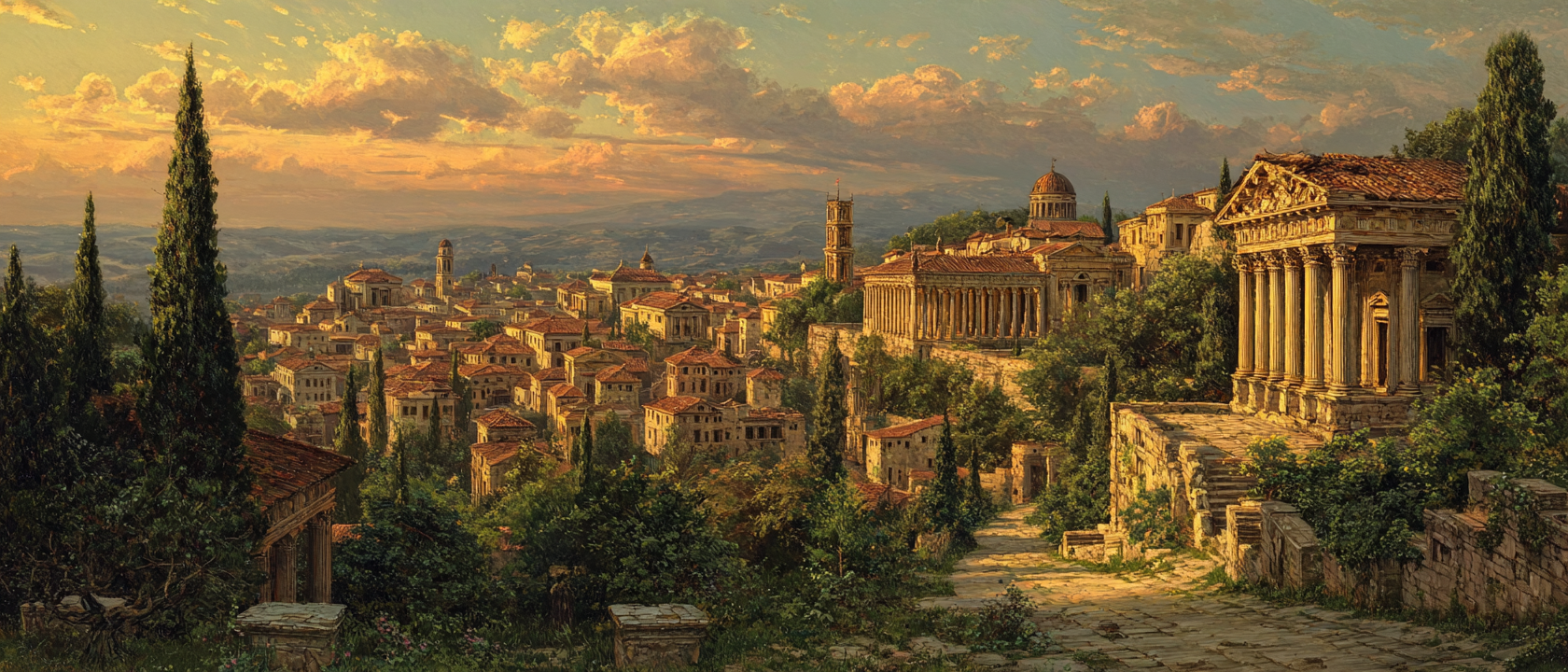
BOUNDARY WALK DISTRICT
The Three Kilometres · District · Porta Silvae
"Calling the Boundary Walk a district is technically accurate and practically inadequate. It is not a residential neighbourhood. It is a three-kilometre maintained path from the eastern gate to the boundary stones and the treeline beyond, and it is the civic experience that defines what Porta Silvae is. The city has invested in its maintenance, its documentation, and its accessibility for six centuries because it understands — in the specific way that a city develops understanding of things its residents have been experiencing for generations — that the walk is not an amenity. It is the city's primary relationship with the most significant fact of its existence, expressed in the act of walking toward it."
The Boundary Walk District is the maintained public zone between the city's eastern gate and the boundary stones — three kilometres of path, cultivated margins, carved stone markers, and the transition zone's progressively unusual botanical character. It is simultaneously the city's most important civic infrastructure, its primary tourist attraction, its most significant religious space in the view of the shrine's community, and the garrison's most challenging patrol responsibility. It has no permanent residents. It has more people in it, at any given daylight hour, than most residential districts.
Demographics
No permanent residents. The daily population varies from a few hundred on quiet winter mornings to several thousand on summer evenings when the anomalous light draws both residents and visitors. The sunset walk — departing the eastern gate approximately two hours before sundown, reaching the boundary stones at the light's anomalous peak, returning in the dusk — is the city's most recommended experience and the one that produces, by consistent report, the most significant personal effects on first-time visitors. Repeat visitors often develop regular walking schedules that they maintain over years or decades; it is not unusual to encounter the same individuals at the same positions on the path at the same time of day, week after week, having developed a relationship with the walk's specific light conditions that they could not articulate if asked to but that is clearly meaningful.
Government
The Boundary Walk's maintenance is jointly administered by the Governor's office and the Templum Silvae — the path itself is civic infrastructure funded by the provincial administration, and the carved stone marker tradition is maintained under the shrine's cultural authority. The garrison manages the access protocols at the boundary stones. The three-way administration has produced occasional territorial disputes about which institution's authority applies to which section of the path, disputes that Silvana has managed by the expedient of treating the walk as a single integrated space and refusing to allocate exclusive jurisdiction to any single institution.
Defences
The garrison's treeline watch is conducted primarily from the Boundary Walk, with two permanent observation positions along the path and the boundary stone line itself patrolled at intervals. The watch protocols are the most detailed operational documentation in the garrison's records, covering everything from standard observation procedure to the specific responses required when the transition zone's botanical character changes in ways outside the established baseline. Hastus conducts the boundary watch personally at irregular intervals — he does not announce these visits in advance, and the soldiers who encounter him on the path have learned not to appear surprised.
Guilds and Factions
The walk has no governing faction in the conventional sense — it is a public space whose significance is shared across the city's institutional and social divisions. The regular walkers' informal community — people who walk the path on consistent schedules and have developed the mutual recognition of regulars — is the closest thing to a Boundary Walk community, and their collective knowledge of the path's daily and seasonal variations is more detailed than the Academy's formal documentation in several respects. Silvana has proposed, and not yet implemented, a project to formally record the regular walkers' observations.
History
The path was laid out at the city's founding, the first maintenance investment the founding generation made after establishing the eastern gate. The carved stone marker tradition began in the city's third century. The current garrison protocols were established in the city's fifth century and have been revised twelve times since. The transition zone's botanical boundary has moved approximately twenty metres westward since the earliest Academy surveys, a movement that is documented in the station's records and that has not been publicly discussed because no one has presented the movement rate's implications in a form that the administration has had to respond to officially. Silvana has the calculation. For full chronological detail, see: Annales Mundi.
Points of interest
Marker 247 — at the path's approximate midpoint, its stone darker than those around it, its inscription in a fourth-century hand — is the most visited individual marker on the walk and the one most frequently cited in accounts of the Boundary Walk experience. It reads: 'Here, on the fourteenth day of the month of Janus in the year 804 A.P., the light stopped coming from the sun. Duration: until the sun set. Observed by: seventeen persons. Explanation: none recorded.' The shrine's archive contains a longer account of the same event. The Academy's archive contains an atmospheric measurement from the same date that shows nothing anomalous. Both institutions consider this discrepancy significant and have different views on what it signifies.
The boundary stones themselves are the walk's formal terminus and the Empire's legal eastern boundary. They are plain carved limestone, each approximately a metre high, marked with the Roman imperial symbol and a sequential number. The grass around them is consistently shorter than the grass elsewhere in the transition zone — a detail that the Academy's botanists have noted and not explained. The transition zone beyond the stones, visible from the path's end, is the most botanically complex terrain accessible to a Roman civilian's direct observation: more species in a smaller area than should be possible, growing in patterns that are directed but not by any hand that has been identified. Standing at the boundary stones and looking east, at the right time of day, in the right atmospheric conditions, is the experience that the Watching Painters have been attempting to capture for five centuries.
Tourism
The Boundary Walk is the reason most people come to Porta Silvae and the experience that defines the city for everyone who undertakes it. The recommended approach is the sunset walk, departing approximately two hours before sundown, paced to arrive at the boundary stones during the anomalous light. First-time visitors are encouraged to do the walk alone or in small groups rather than with the organised pilgrim parties that the shrine offers, because the organised parties produce a social experience rather than the individual one that the walk's character is suited to. This recommendation is in the city's visitor materials. Most people ignore it. The ones who follow it generally find it was correct.
Architecture
The path's carved stone markers are the Boundary Walk's primary architectural element — a tradition begun in the city's third century of noting significant observations and events on permanent stone placed along the route. The markers are not uniform: each was designed and carved for its specific content, their styles spanning six centuries of stone-carving fashion, their subjects ranging from the precise (a specific atmospheric measurement on a specific date) to the philosophical (several are inscribed with single sentences whose authorship is unknown) to the documentary (the marker at the path's second kilometre records, in careful Latin, the account of the one occasion approximately 200 years ago when an elf was observed approaching the path from the treeline direction rather than from the city). The total number of markers is currently four hundred and seventeen.
Geography
The path runs due east from the gate's stone arch along a maintained corridor approximately fifty metres wide, its margins planted with the province's native vegetation in the western sections and progressively replaced by the transition zone's own botanical density as the path approaches the boundary stones. The path's surface is paved for the first kilometre — the paving worn smooth by six centuries of foot traffic — and maintained as packed gravel for the final two. The boundary stones are at the path's end: twelve carved stones in a north-south line, spaced approximately ten metres apart, marking the formal edge of Roman territory. The treeline is visible beyond them, approximately two hundred metres further east, across the transition zone's densest botanical ground.
The transition zone between the boundary stones and the treeline is not accessible under the current garrison protocols without specific authorisation from the Governor's office. In practice this restriction is enforced with the pragmatic flexibility that a garrison of two hundred soldiers managing a path walked by thousands of people applies to all its protocols: visitors who stop at the boundary stones and look at the treeline from there are unimpeded; visitors who step past the boundary stones into the transition zone are asked to return; visitors who decline are escorted back with a firmness calibrated to the individual case.
Access
Path to boundary stones — fully publicly accessible.
Transition zone beyond boundary stones — restricted; Governor's office authorisation required.

Comments