
VICUS DIMIDIANUS
The Halfling Quarter · District · Portus Meridiani
"The halfling quarter in Portus Meridiani is unlike the Foreign Quarter in Nova Romae, and unlike anything in Brindala, and it took me some years to understand why. It is two hundred years old. The halflings who live here are not visitors and they are not quite Brindala halflings either. They are something new — Roman in their daily habits, halfling in their priorities, and entirely comfortable with being both. I find them the most interesting community on the primary continent, and I have spent time on the primary continent that qualifies me to have an opinion on this."
The Vicus Dimidianus occupies the bay shore's southern section, between the ocean quays and the headland, and extends a few blocks inland along streets that follow the bay's edge rather than any Roman survey grid. It has been continuously settled by halflings since approximately 1010 A.P. — ten years after their arrival in this world — which makes it the oldest halfling community on the primary continent outside the Archipelagus Brindala itself. Two centuries of continuous settlement in the same location has produced something distinct from either the commercial outpost it originally was or the assimilated minority community it has sometimes been described as. The Vicus is its own thing: Roman in its legal standing and its daily rhythms, halfling in its priorities, its architecture, its food, and its relationship to the bay that it looks out over constantly.
Demographics
The Vicus's permanent population of approximately eight thousand halflings is the settled, resident community — not the crossing crews, who rotate through the bay shore district and keep different hours, but the families who have been here for three, four, five generations and whose children have grown up speaking Latin alongside their own language and attending Roman schools without finding this arrangement unusual. Several family names in the Vicus trace their presence in Portus Meridiani to the first decade of halfling settlement. Their grandchildren's grandchildren are Roman in every practical sense and halfling in every priority that matters to them, and see no contradiction in this.
The community maintains a small but continuous connection to Brindala through the crossing crews and the Merchant Council's agent network; there are families in the Vicus who have cousins on every island in the archipelago and who exchange correspondence with the regularity and specificity of people who consider family geography a practical concern. The Merchant Council's influence in the Vicus is real but not direct — it operates through the community's own governance structures rather than through any formal authority.
Government
The Vicus governs itself through the Free Temples meeting hall, where the senior Hearth-Keepers and the heads of the established families conduct the community's internal affairs. This governance has no legal standing under Roman law; it functions entirely on the community's recognition of its own authority, which is complete. The Praefectura's relationship with the Vicus is the same managed acknowledgement that characterises Sura's approach to every institution in the city that has more practical authority than formal standing — he attends the winter Hearth-Feast annually, maintains a personal relationship with the senior Hearth-Keeper, and has not in eleven years of office taken any action that required him to formally acknowledge that the community's self-governance exists. Both parties find this arrangement satisfactory.
Defences
The Vicus has no military presence and no formal security arrangement with the Praefectura. The community's security is its own business, managed informally through the established families' networks and the specific advantage that a community of people who know every inch of their own streets has over anyone who does not. The piracy period of the 1080s produced the only documented incident of external threat to the Vicus; the response was managed commercially by the Merchant Council before it required physical defence. The Vicus is, by general understanding, not a sensible place to cause trouble, and this understanding has been sufficient for two hundred years.
Industry & Trade
The Vicus's economy is service-oriented in the way of settled maritime communities: the inns and eating houses that serve the crossing crews in port, the repair workshops for small boat equipment, the canvas and rope suppliers, the chandlers whose inventories are calibrated to ocean voyages rather than river traffic. The Hearth-Keeper bakeries, which produce goods for the Vicus and for sale throughout the city, are the district's most visible commercial presence outside the community itself. The lending library in the Free Temples building is not commercial but functions as a commercial asset — it is the reason several Roman professionals live in the Vicus rather than closer to the forum, and their presence has shaped the district's character in ways that the halfling community finds largely positive.
Infrastructure
The Vicus's water supply is a branch from the main aqueduct, negotiated by the community's representatives in 1050 A.P. — forty years of petitioning the Praefectura, during which the community relied on cisterns and the bay's fresh groundwater springs. The streets are maintained by the community rather than the Aedilitas, which is an arrangement the Aedilitas accepts on the grounds that the maintenance quality is consistently higher than what they would provide. The Free Temples' building on the Vicus's northern edge is the largest structure in the district: the six temple spaces, the lending library, the school, and the meeting hall occupy a converted warehouse that has been modified so thoroughly over a century that its original form is no longer recoverable from the exterior.
Guilds and Factions
The Hearth-Keeper council under Rosie Longfoot is the Vicus's effective governing institution, managing the Free Temples and the community's internal affairs. The established families' informal council is a parallel institution that handles commercial matters — the inns, the workshops, the supply contracts with the scheduled service — that the Hearth-Keepers consider appropriately outside their religious authority. In practice Rosie attends the families' council when invited and the families' council defers to the Hearth-Keepers on everything involving the Ara Transeuntium and the school. The distinction is maintained by mutual respect rather than formal boundary.
Pip Goodbarrel's presence in the Vicus as the Merchant Council's agent represents a third institutional layer — the external commercial authority whose interests are aligned with but not identical to the community's. Pip was born in the Vicus, which makes his position more complicated than a straightforwardly external agent's would be, and which explains why his relationship with Rosie Longfoot is one of the most carefully managed personal relationships in Portus Meridiani.
History
The first halflings arrived in Portus Meridiani within months of the Twelfth Permutatio in 1000 A.P. — scouts from the Merchant Council identifying the primary continent's southern coast as the obvious interface point for the commercial relationship they intended to build. The permanent community was established by 1010 A.P. The Free Temples were founded in 1015 A.P., the school in 1030 A.P., the lending library in 1080 A.P. — the community building its civic institutions in a sequence that reflects its own sense of what a community requires: worship first, then education, then knowledge. The current generation is the eighth or ninth born in the Vicus, depending on how you count the first arrivals' children.
For full chronological detail, see: Annales Mundi.
Points of interest
The Free Temples of Portus Meridiani are the community's spiritual and civic heart — six Hearth-Keeper temples whose deities are formally part of the Roman pantheon, a lending library that is the only one in Provincia Urbis outside the Academy, a school for sixty children that teaches Latin grammar alongside halfling commercial mathematics, and a meeting hall where the community's governance is conducted in the halfling language at the community's discretion. The Hearth-Keeper who leads the temple community, a woman of seventy-three named Rosie Longfoot, has been in the role for thirty years and is the most politically significant halfling on the primary continent who does not work for the Merchant Council. Rosie and Pip Goodbarrel have a relationship of mutual respect and occasional disagreement that the community navigates carefully.
The Night Market operates in the Vicus's central square from the second hour after sunset until the second hour before dawn — a halfling-organised market on a schedule that the Roman commercial calendar does not recognise, selling food, small goods, and information in proportions that vary by night. The food is from three culinary traditions — halfling, Roman, and the tabaxi-influenced cooking that arrived with the crossing crews who have spent time at Hearthsrest — producing combinations available nowhere else in the primary continent outside this square. Varro has eaten here four times. He considers the Night Market the second most interesting eating experience in the known world, after Hearthsrest's own market. He is probably correct.
The Ara Transeuntium — the departure altar on the bay shore's edge, technically in the Sinus Australis district but considered by everyone to be the Vicus's spiritual property — is maintained by the Hearth-Keepers from the Free Temples. The offerings collected nightly fund the Vicus's charitable operations, which include the school and a programme of assistance for passengers who arrive in Portus Meridiani for the crossing and find themselves in difficulty. Several people who now hold significant positions in Nova Romae received assistance from this programme in their younger years and have not publicly acknowledged this, which Rosie Longfoot considers their own business and Pip Goodbarrel considers a potential commercial asset.
Tourism
The Vicus Dimidianus is fully accessible and is the most visited district in Portus Meridiani among travellers who are not primarily commercial. The Night Market is the standard recommendation for first-time visitors to the city — not because it is listed in any official guide, but because everyone who has eaten there tells everyone they meet afterward. The Free Temples' lending library is open to visitors on presentation of a deposit against the safe return of borrowed items, which is an arrangement the Academy in Nova Romae considers irregular and which has produced no documented case of a borrowed item not being returned.
Architecture
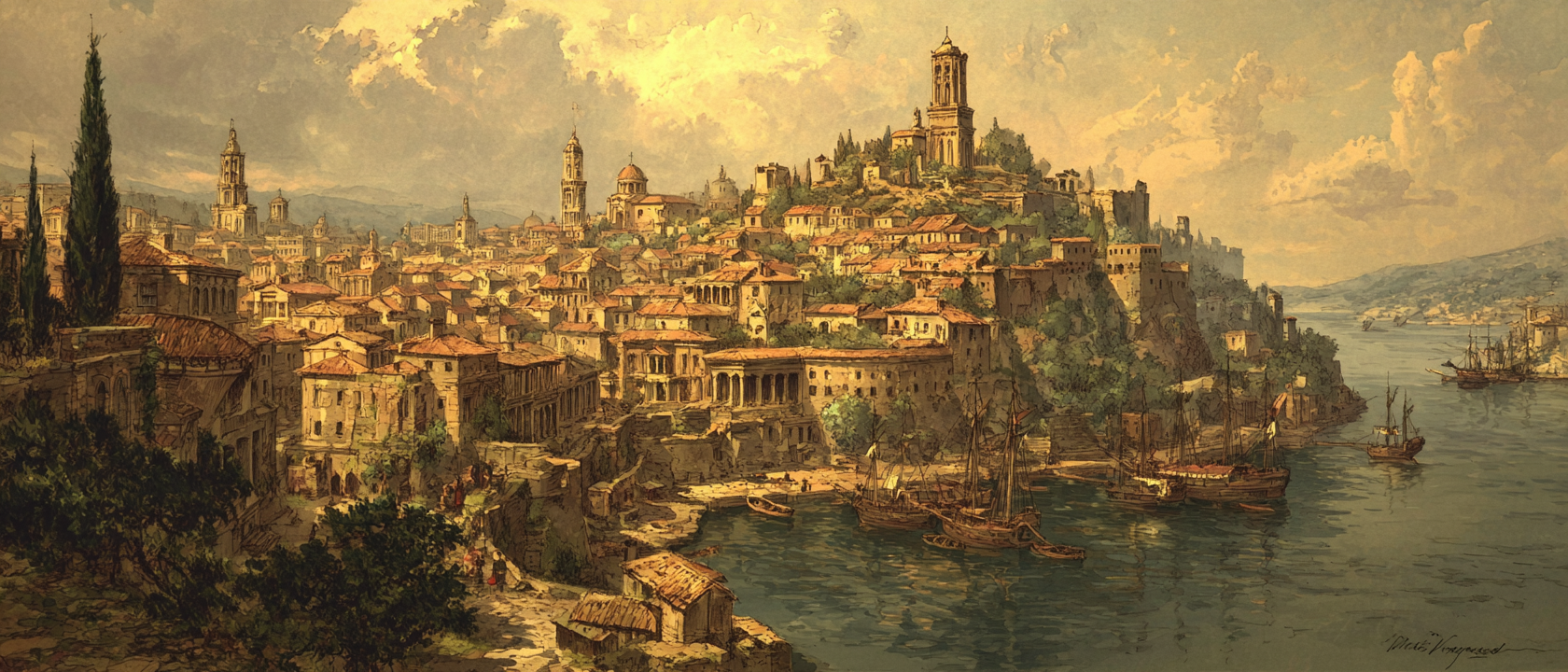
The Vicus Dimidianus is the only district in Portus Meridiani that reads as immediately, visibly different from the Roman city around it. Not different in structural principle — the buildings are stone and timber, two to four storeys, built to last — but different in every surface detail that two centuries of halfling occupation has accumulated. Lower doorways. Flower boxes. The warm ochre and terracotta colour-washing of facades that elsewhere in the city are left in plain limestone. Wrought iron balconies on the upper floors, most of them with something growing on them. The streets are too narrow for wagons, which the halflings consider appropriate and the Aedilitas considers a persistent minor administrative problem. The bakeries and eating houses operate from before dawn; the smell of the Hearth-Keeper baking reaches the bay shore before the sun does.
Geography
The Vicus occupies a roughly triangular area between the Southern Quay's landward approach, the headland's base, and the bay shore, its inland extent defined by the point where the limestone ridge begins to rise toward the Chain Tower path. The streets are narrow and follow the bay's natural contours — there is no Roman grid here, the original settlement having been laid out by halflings who organised space around the water's edge and foot traffic patterns rather than the surveyor's compass. The result is a district that is difficult to navigate by compass and easy to navigate by landmark: the smell of the bakeries, the sound of the bay, the colour of the quarter's facade-washing.
Access
Fully publicly accessible. Free Temples open daily. Night Market after dark.

Comments