
SINUS AUSTRALIS
The Bay Shore · District · Portus Meridiani
"The bay shore is where Portus Meridiani earns its name and its wealth. The river mouth wharves to the north handle what comes from the Empire. The bay quays handle what comes from everywhere else. The difference is visible immediately: the barges at the river mouth are Roman, broad and practical and built for a river. The vessels at the bay quays are something else — built for open water, for weather, for thirty days with no land visible. Standing between the two, you understand something about the difference between an empire and a world."
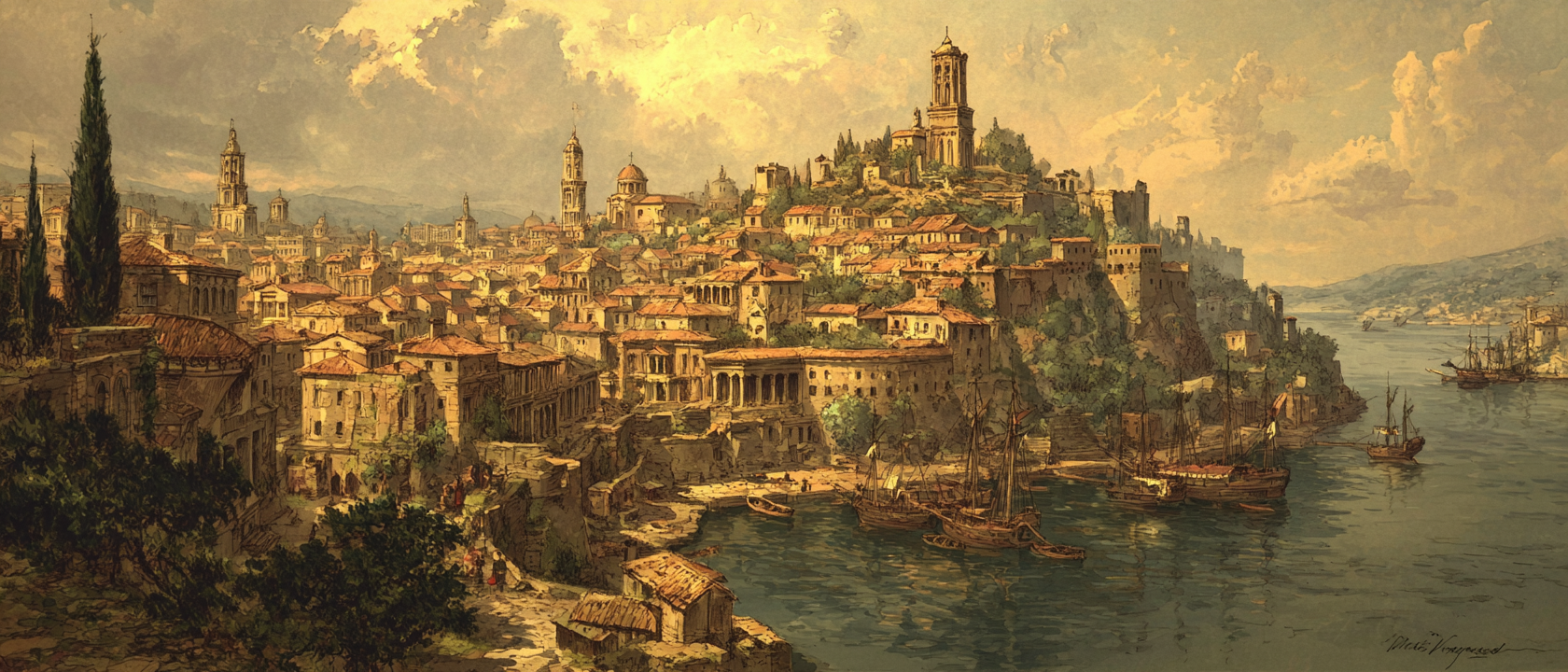
The Sinus Australis district occupies the bay's western shore from the Via Portus terminus south to the headland's base — the deep-water harbour that makes Portus Meridiani what it is. The three ocean quays here are built to a standard that accommodates fully laden ocean-going vessels; the bay's depth, the headland's shelter, and the piloted channel entrance make this the best natural harbour on the primary continent's southern coast. Everything that arrives from Brindala, everything that departs for Brindala, and everything that connects the southern ocean trade to the Roman interior comes through this shore. The district is defined by departure and arrival — people and goods in constant transit, the bay itself the constant background presence, the sound of rigging and water and the specific purposeful noise of a working deep-water harbour.
Demographics
The bay shore's permanent population of approximately eight thousand is the most internationally constituted in Portus Meridiani — the halfling crew and pilot community attached to the scheduled service, Roman dockworkers and crane operators, the warehouse staff and their families, the factors who oversee cargo handling, and the floating population of sailors in port between voyages who constitute a significant fraction of the district's daily population without appearing in any census. The halfling presence here is distinct from the halfling Quarter to the south: this is the working community of the crossing, not the settled residential community, and its members move between Portus Meridiani and Brindala on schedules that make permanent residence in either place a loose concept.
Government
The Praefectura Portus Meridiani's harbour authority administers the bay quays — berth allocation, cargo inspection, the customs process for arriving and departing vessels. The harbour master, appointed by Sura and currently a Roman of fifty-two named Marcus Vitellius Rufus, manages daily operations with the resigned authority of a man who knows that his nominal control of the bay's activity is substantially modified by the Merchant Council's scheduling protocols and the halfling pilots' absolute discretion over which vessels they agree to bring through the channel. Rufus and the senior halfling pilot, a woman called Delia Sandyfoot who has been piloting the channel for twenty-three years, maintain a working relationship of mutual professional respect that both parties would characterise as functional and neither would characterise as warm.
Defences
The bay shore's primary defensive infrastructure is the Chain Tower at the headland, which controls the channel entrance. The Southern Quay's military berths are within sight of the Chain Tower and are used by the occasional Legio IV Australis vessel whose function is not discussed openly. The quay areas have no permanent military garrison; the Praefectura's harbour inspectors carry side-arms and have the authority to detain vessels and personnel pending customs resolution, which is the practical limit of official force on the bay shore. For anything more serious, the Castra Borealis is thirty minutes' march north.
Industry & Trade
The bay shore is where the southern trade physically exists — the cargo, the vessels, the people who move both. The halfling scheduled service's Central Quay berth is the most commercially significant piece of real estate in Portus Meridiani: every ten days, a halfling vessel arrives from Brindala carrying southern goods, and a vessel departs carrying Roman goods, and the difference in value between what arrives and what departs, multiplied by fifty departures per year and two hundred years of operation, is the foundation of the thirty families' wealth. The customs process on the Central Quay is the most carefully monitored in the city. It is also the process in which the discrepancy in the manifests has been occurring.
Infrastructure
The deep-water channel through the sandbar entrance is maintained by a dredging operation that the Pilot's Guild manages under a perpetual contract with the Praefectura — the same arrangement, essentially, that has been in place since the bay's second century of operation. The crane mechanisms at the quay ends are replaced on a rotation that keeps at least two operational at all times; the current replacement schedule was established after a crane failure in 1087 A.P. that damaged a halfling vessel and produced a diplomatic exchange between the Praefectura and the Merchant Council that neither party wants to repeat. The Pilot's Station's observation equipment — lenses, wind instruments, the specific tide-gauges that the halfling weather-readers use for their departure assessments — is maintained by the halfling community at its own expense and is not subject to Praefectura inspection.
Guilds and Factions
The Pilot's Guild controls access to the Sinus Australis — without a guild pilot, no vessel of significant size can enter or exit the bay through the sandbar channel. This authority, which the Guild has held since the bay's second century of operation, makes it the single most practically powerful institution in the district, outranking the Praefectura's harbour authority in the specific question of whether any given vessel can leave. The Guild's membership is mixed — Roman pilots for the northern quay traffic, halfling pilots who handle the scheduled service and most deep-water arrivals. The senior pilot is Delia Sandyfoot, whose read of the channel conditions is, by general agreement, definitive.
The halfling seacrew community associated with the scheduled service constitutes a second distinct faction — not the settled halfling Quarter residents but the working sailors, whose lives are organised around the ten-day crossing cycle and whose primary loyalty is to the Merchant Council and to Merry Burrowfoot's fleet rather than to any land-based institution. They are in Portus Meridiani for forty-eight to seventy-two hours between crossings. In that time they are an economic force in the bay shore's eating houses and inns, a source of information about conditions in Brindala and on the crossing route, and entirely unreachable by the Praefectura if they choose to be.
History
The Sinus Australis bay was first used for ocean-capable vessels in the second century, when Roman shipbuilders constructed the first vessels designed for southern coast rather than river operation. The deep-water quays were built in the third century. The halfling scheduled service has operated from the Central Quay since 1008 A.P., eight years after the halflings' arrival, which is the most precise illustration available of how quickly the Merchant Council identified and secured the commercial infrastructure it needed. The piracy crisis of the 1080s involved two attacks on vessels at the bay quays; the chain was raised once during this period. The attackers were not conclusively identified.
For full chronological detail, see: Annales Mundi.
Points of interest
The Central Quay on departure day — every tenth day, morning, the scheduled service preparing to leave — is the most distinctive regular spectacle in Portus Meridiani. The halfling vessel, its crew handling the departure in a manner that Romans who sail describe as impressively efficient and Romans who do not sail describe as somehow too fast for something that large, the weather-reader on the bow making the final observations that determine whether the departure proceeds or is delayed by a day. Transit passengers on the quay in various states of departure anxiety. The Ara Transeuntium offerings left the evening before, now cleared by the Hearth-Keepers. The specific quality of the light on the bay at that hour. Varro has described this scene three times in different documents and has not repeated himself.
The Pilot's Station upper floor is technically restricted to Guild members and authorised harbour authority personnel. In practice, persons who have been brought by a Guild member and who conduct themselves appropriately are not asked to leave. The view from the upper floor — the full Sinus Australis visible, the channel entrance clear, and beyond it the Mare Australe extending to a horizon that is simply ocean — is the most affecting view in the city. The harbour master goes up there on his lunch break most days. He considers this professionally justified.
The Northern Quay's harbourmaster office handles the documentation for non-scheduled vessels — Roman merchants, private charters, the occasional vessel of uncertain origin that produces adequate paperwork and departs without creating incidents. The harbourmaster's log for the past year contains three entries for vessels in this category whose cargo weights do not match their manifests by a consistent small margin. The harbourmaster has flagged this in his weekly report to Rufus. Rufus has passed it upward to Sura. Sura has not yet acted on it.
Tourism
The bay shore is publicly accessible and constitutes the primary visitor experience of Portus Meridiani's working port character — the ocean vessels at the quays, the activity of cargo handling, the halfling crew community visible and audible in the bay shore's eating houses and on the quayside. Visitors intending to make the Brindala crossing spend time here waiting for their departure date, which produces a particular atmosphere on the Central Quay's shore: people in various states of anticipation, some of them having waited for the crossing for months and now finding that the actual moment of commitment is arriving faster than expected.
Architecture
The quay infrastructure itself is the district's defining architecture — the stone quay faces, the mooring rings of iron that have been set into the stonework since the bay's original construction, the crane mechanisms at each quay's end that have been maintained, upgraded, and replaced continuously for twelve centuries. The warehouses behind the quays are functional in the way of all warehousing: built to contain things rather than to be looked at, their interest entirely internal. The Pilot's Station at the Southern Quay's shore end is the exception — a two-storey building of considerable solidity, its upper floor providing the observation platform from which the bay pilots track arriving vessels and where the weather-readers among the halfling pilot community conduct the observations that make the scheduled service's departure timing reliable.
Geography
The bay shore curves gently from the Via Portus's end southward along the Sinus Australis's western edge, the water immediately accessible from the quay faces at all states of tide. The three ocean quays project into the bay at intervals — the Northern Quay closest to the Via Portus and used primarily by Roman merchant vessels, the Central Quay designated for the halfling scheduled service, the Southern Quay nearest the headland and used for military vessels, supply ships, and those arrivals that benefit from proximity to the Chain Tower without actually being at it. Between and behind the quays, the warehouse district extends two or three blocks inland — stone buildings four storeys, their doors wide enough for the wagons that move cargo to and from the Via Portus.
Access
Quayside publicly accessible. Quay berths — harbour authority permission. Pilot's Station upper floor — Guild members and authorised guests.

Comments