
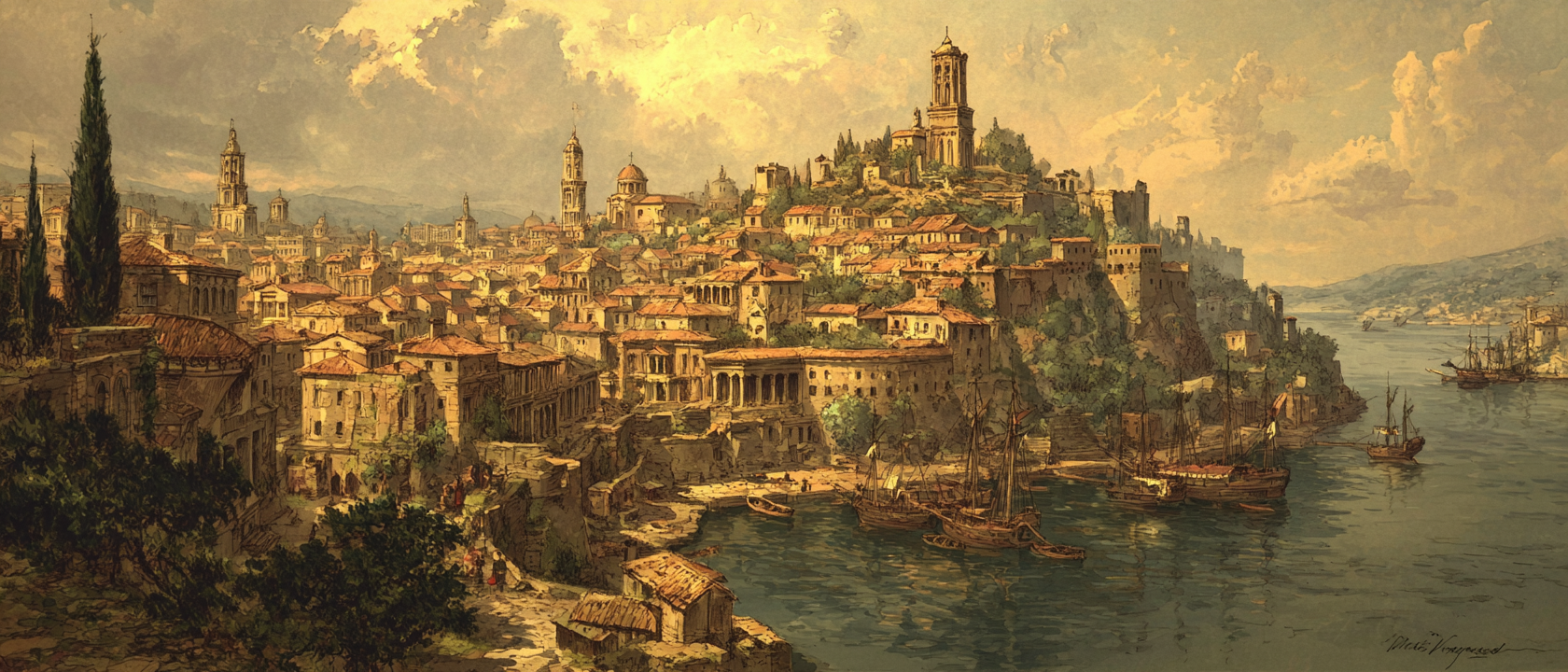
VIA PORTUS
The Commercial Spine · District · Portus Meridiani
"Four hundred metres of road between two harbours. Every significant transaction in Portus Meridiani has, at some point, involved something or someone moving along this road. It is not an impressive street. It is the most commercially important street in the southern Empire, and these two facts coexist without difficulty."
The Via Portus is simultaneously a street, a district, and an institution. As a street it runs four hundred metres from the Forum Meridiani's southern gate to the ocean quays at the Sinus Australis shore, connecting the river mouth economy to the bay economy in the most direct line the promontory's geography allows. As a district it encompasses the buildings on both sides of that street — the Porticus Meridiani, the Taberna Meridiana, the counting houses, the insurers' offices, the notaries and factors whose functions constitute the administrative layer of the southern trade. As an institution it is the place where the money of the known world is arranged, which is different from where it is stored, which is different again from where it moves, and only one of those three functions is visible from the street.
Demographics
The Via Portus district has a small permanent population — perhaps two thousand, mostly the staff of the commercial premises and the families who live above the offices they work in. Its daily population is several times that: the factors, agents, captains, and Merchant Council representatives who conduct business in the Porticus, the passengers and merchants who move between the forum and the quays, the Praefectura's customs inspectors who follow cargo from the quays to the warehouses along the adjacent streets, and the various persons of unclear affiliation whose presence in the Taberna Meridiana is noted by people who note such things.
Government
The Via Portus is civic territory under the Praefectura's jurisdiction and is maintained as such — the street surface is the Aedilitas's responsibility, the Porticus's fire-safety compliance is inspected annually, the Taberna's license is renewed each year. None of this governance touches what actually happens on the street, which is regulated by the Porticus's own membership rules, the Merchant Council's commercial protocols, and the accumulated social contracts of people who have been doing business with each other for generations and understand, without needing it written down, what the rules are.
Defences
No garrison. The Praefectura's constables pass through periodically. The Porticus employs two guards who are present during trading hours and who are, by general understanding, there to manage access to the building rather than to prevent crime in the street. The street's security is largely informal — the commercial community has a strong collective interest in the Via Portus being a place where business can be conducted without incident, and this interest has historically proved a more effective deterrent than any official arrangement.
Industry & Trade
The Via Portus is where the southern trade is arranged, not where it physically moves. The goods themselves move through the quays, the warehouses, and the river mouth wharves. What moves along the Via Portus is information, commitment, and paper: the contracts that commit cargo to vessels, the insurance agreements that price the risk of the ocean crossing, the letters of credit that allow a merchant in Nova Romae to pay for a cargo that hasn't left Brindala yet, the futures contracts that determine what the spices landing next month are worth before anyone has tasted them. These instruments are the real product of the Via Portus, and they are worth considerably more than the physical goods they represent.
The Porticus's membership — the thirty families — does not conduct all of its business here. Significant negotiations happen in the upper rooms of the Taberna, in the families' private residences in the Collis Mercatorum district, and occasionally on vessels in the bay whose privacy is absolute. What happens in the Porticus itself is the formalisation of decisions already made elsewhere, and the record-keeping that makes those decisions legally enforceable.
Infrastructure
The Via Portus is the best-maintained street in Portus Meridiani. This is not a coincidence. The Porticus's members have a standing arrangement with the Aedilitas — the details of which are not publicly documented — under which the street's paving is inspected monthly and repaired within a week of any defect being noted. The drainage channels on both sides are cleared after every significant rainfall. The oil lamps at twenty-metre intervals are maintained by a lamplighter who has held the contract for thirty years and whose family has held it before him. The street is lit all night. Most streets in the city are not.
Guilds and Factions
The Porticus Meridiani is the dominant institution on its own street — its membership constitutes the commercial authority that the Praefectura formally administers and practically defers to on most questions of consequence. The Merchant Council's presence, through Pip Goodbarrel, is the Via Portus's second faction — not a formal membership but a functional participant whose access to the Porticus represents the halfling trade network's integration into the southern trade's formal structure. The relationship between the families and the Council is commercially symbiotic and politically complex, and in 1200 A.P. it is under strain from the railway negotiation in ways that neither party has yet addressed directly.
History
The Via Portus was laid out in the second century, when the city's development had progressed far enough that the promontory's southern end and the bay's western shore needed a formal connection. It has been the city's commercial heart since. The Porticus was founded in the fourth century; the building that preceded the current one was on the same site. The Taberna Meridiana has been on the eastern side since the sixth century, six generations of the same family's management producing a continuity that the commercial community finds reassuring and that Valeria Prisca finds occasionally suffocating.
For full chronological detail, see: Annales Mundi.
Points of interest
The Porticus Meridiani is where the thirty families conduct formal commercial business — a covered colonnade open to members and their authorised agents, its floor worn smooth by two centuries of the same transactions in the same space. Non-members do not enter. The rule has two exceptions: the Praefectus Sura has standing access by long-established courtesy, and Pip Goodbarrel has standing access because the Porticus found, approximately a decade ago, that refusing the Merchant Council's agent entry was more commercially inconvenient than permitting it. Neither exception is written in the Porticus's membership charter.
The Taberna Meridiana occupies the street's eastern side and has been the informal venue for commercial arrangements that the Porticus cannot accommodate since its founding. Valeria Prisca, the current proprietor, manages a dining room that serves the best food in Portus Meridiani at prices that are not low, a set of upper rooms whose discretion is absolute, and a knowledge of the city's commercial life that has made her the most informed private individual in Provincia Urbis. She knows where the uncustomed cargo went. She has not decided what to do with this knowledge.
The document vault in the Porticus basement holds the commercial archive of two centuries of southern trade — the contracts, manifests, and correspondence that constitute the legal record of how the Empire's luxury import economy was built. Several scholars have applied for access to this archive for historical research. All have been declined. The most recent application was from an Academy researcher whose stated purpose was comparative commercial history. The Porticus's response, after six months, was that the archive was under review and access was suspended pending completion of that review. The review has been ongoing for three years.
Tourism
The Via Portus is accessible to anyone, and the experience of walking it — the Porticus's colonnade on one side, the bay glimpsed at the far end, the smell of the Taberna's kitchen at midday — is one of the standard Portus Meridiani experiences for visitors who understand what they are looking at. Those who do not understand what they are looking at see a moderately interesting commercial street. Varro has noted that this distinction is the most reliable indicator of whether a visitor to the city has any meaningful understanding of how the southern trade actually functions.
Architecture
The Porticus Meridiani occupies the western side of the street's northern half — a covered colonnade whose current building is one hundred and sixty years old and whose predecessor burned down in circumstances that have not been established. The colonnade's proportions are deliberate: wide enough to accommodate twenty people conducting business simultaneously without overhearing each other, its paving worn smooth by two centuries of the same shuffling commercial dance. The building's interior, visible through the colonnade's arches, contains the members' archive, a private meeting room, and a locked document vault whose key the Porticus's secretary holds and whose combination the secretary's predecessor held and took with him when he retired to a farm on the coast that nobody can quite locate on a map.
The Taberna Meridiana, on the eastern side three-quarters of the way toward the quays, has no impressive architecture whatsoever — a three-storey building of plain limestone, its ground floor given over to the eating and drinking that is its official function, its upper floors containing private rooms whose rental history, if documented, would constitute an alternative commercial record of the southern trade. The building is old, comfortable, and has the specific quality of places where important things happen in apparently unremarkable surroundings.
Geography
The Via Portus follows the promontory's spine south from the forum to the point where the ground drops toward the bay shore, at which point it becomes the approach road to the ocean quays. The street is wide by the city's standards — wide enough for two laden wagons to pass — and follows a slight curve that conforms to the promontory's natural ridge line. The buildings on its western side are older and larger, backing onto the slope toward the river mouth; those on its eastern side are newer and face the bay, their upper floors offering, on the better-maintained premises, a view across the Sinus Australis that the owners consider compensation for the sea air's effect on their stonework.
Access
Street publicly accessible. Porticus — members and authorised agents only. Taberna — public eating house; upper rooms by arrangement.

Comments