
FLUMINIS TERMINUS
The River Mouth District · District · Portus Meridiani
"The barge families who work the Fluminis Magnus between Portus Meridiani and Nova Romae have been doing so for eight centuries. The same river, the same route, the same goods in the same direction at the same time of year. They have opinions about the railway negotiation that are not being sought by anyone in Nova Romae, which is an oversight that I note without expecting it to be corrected."
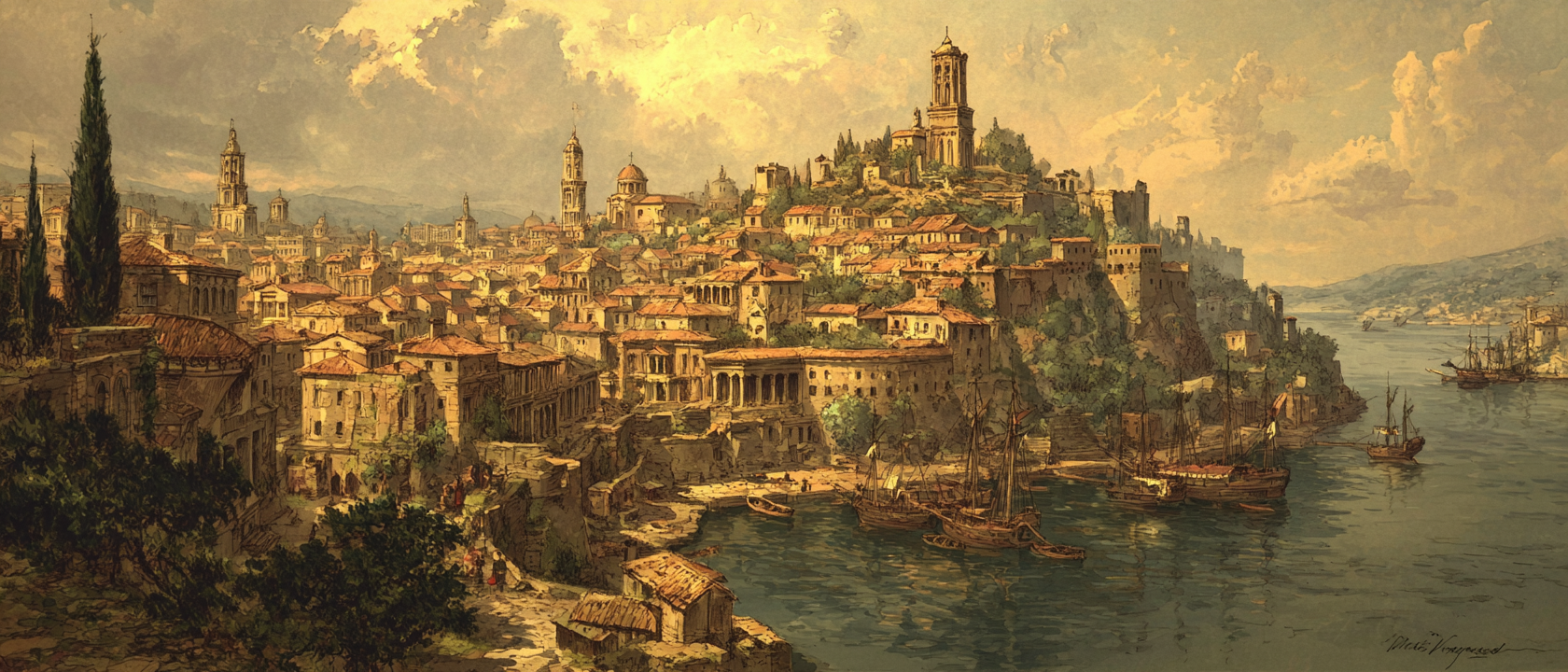
The Fluminis Terminus district occupies the delta embankment west of the promontory — the reclaimed marshland where the Fluminis Magnus spreads into its coastal delta and where eight river wharves handle the barge traffic that connects Portus Meridiani to Nova Romae. It is the oldest commercial waterfront in the city, predating the ocean quays by a century, and it has a character that reflects this: older buildings, older families, older ways of doing things, a relationship with the river that eight centuries of daily proximity has made intimate in the way that very long familiarity produces. The barge families consider the bay shore district an upstart and the ocean trade a speculation. They have been moving goods reliably for eight hundred years and they consider this sufficient.
Demographics
The Fluminis Terminus's permanent population of approximately twelve thousand is the most homogeneous in the city — almost entirely Roman, almost entirely connected to the river trade, several family names traceable to the district's first century of settlement. The barge families are the core: the principals who own the vessels, the experienced crew whose knowledge of the river is the trade's primary asset, the boat-builders and maintenance workers whose workshops occupy the district's inland streets. The warehouse district employs another population of loaders, accountants, and factors whose connection to specific barges is professional rather than familial but whose working lives are equally organised around the river's rhythms.
Government
The district falls under the Praefectura's jurisdiction and is administered through the harbour authority's river division — a smaller office than the bay harbour authority, reflecting the lower administrative complexity of river as opposed to ocean traffic. The Barge Masters' Association, the oldest continuously operating commercial organisation in Portus Meridiani, handles the internal governance of the river trade with an authority that the harbour authority formally exceeds and practically defers to on questions about the river. The Association's current master, Gaius Pontius Fluvius, is sixty-seven, in his twelfth year, and has been preparing the Association's formal objection to the railway negotiation for six months.
Defences
No military garrison; the Praefectura's river harbour inspectors handle the routine security of a working river wharf. The district is not a target for the kind of threat that requires military response — the goods moving through it are bulk agricultural and manufactured products, not the luxury cargo of the ocean trade, and the barge families have maintained their operations through twelve centuries of political change without accumulating the kind of enemies that require walls. The Association's informal security, expressed through eight centuries of knowing who is and is not part of the river trade community, is more effective than any formal arrangement at managing unauthorised activity on the wharves.
Industry & Trade
The river trade is Portus Meridiani's oldest commerce and its least glamorous. What moves on the barges is not luxury goods — that moves through the bay quays. What moves on the barges is grain, manufactured goods, correspondence, military supply, the administrative traffic of an empire. Two days downstream from Nova Romae, two days upstream: reliable, relatively cheap, the backbone of the supply chain that keeps both cities functioning. The barge families have been moving this traffic for eight centuries and have built lives of solid, unglamorous prosperity on the margin between the cost of moving a ton of grain and what the Nova Romae granary pays to receive it.
The Association is watching the railway negotiation with the specific attention of people who understand exactly what a faster overland route between Nova Romae and the Iron Spine means for the goods that currently travel by river. Some of those goods would still move by water — grain is cheaper by barge than by rail at sufficient volume. Some of those goods would not. The Association's economists — they have economists, which is not widely appreciated outside the district — have modelled the impact. The model is not optimistic.
Infrastructure
The delta embankment is the district's most critical infrastructure and its most persistent maintenance challenge. Built up over centuries from reclaimed marsh, it requires continuous work to hold its elevation against the river's seasonal flooding and the slow subsidence of the delta ground. The Praefectura allocates a significant fraction of the city's maintenance budget to embankment work, which the Association considers insufficient and which Sura considers the maximum politically achievable given the competition from other infrastructure priorities. The river channel through the delta has been dredged and maintained by the Barge Masters' Association under a Praefectura contract since the third century — a contract whose terms have been renegotiated seventeen times and whose fundamental structure has not changed once.
Guilds and Factions
The Barge Masters' Association is the district's governing institution in every sense that matters. Its formal authority over the river trade — vessel registration, cargo rates, the maintenance contract with the Praefectura — is matched by its informal authority over the district's social life, employment practices, and political positions. The Association's position on the railway negotiation is being communicated to Nova Romae through the Praefectura's reporting chain and through the Association's own contacts in the Senate, several of whom represent constituencies where the barge trade's economic significance is too large to ignore. Whether this communication is being heard at the relevant level of the negotiation is a question the Association cannot answer and that Pontius Fluvius finds the most irritating aspect of his current administrative situation.
History
The river wharves predate the bay quays by approximately a century — the first Roman settlers at Portus Meridiani were using the river before they were using the ocean, which is the natural order of things for a people who arrived from the north along a river valley. The embankment was built in stages over the first three centuries, each stage extending the usable waterfront and adding another family's permanent presence. The Barge Masters' Association was formally founded in 412 A.P., formalising arrangements that had been operating informally for four centuries before that.
For full chronological detail, see: Annales Mundi.
Points of interest
The Barge Masters' Association hall, on the embankment road at the central wharf, is the oldest active institutional building in Portus Meridiani — the current structure is fifth-century, replacing an earlier building on the same site, and houses eight hundred years of the river trade's records in an archive that scholars have been requesting access to for decades. The Association has not refused these requests. It has responded to them slowly, on a timescale that several applicants have identified as functionally equivalent to refusal. Varro's request, submitted sixteen years ago, has been acknowledged twice.
The delta view from the embankment road at dawn — the river spreading into the sea, the light coming up over the bay to the east, the first barges of the day beginning their upstream movement — is, in Varro's estimation, the most quietly affecting view in Portus Meridiani. Not dramatic, not grand, but ancient in the way that working waterways that have been working for twelve centuries become ancient, the accumulated history of the same movement repeated across eight hundred years visible in the embankment itself, in the wharf stones, in the way the barge families move around the wharves without watching where they step because they have never needed to watch.
Tourism
The river wharves predate the bay quays by approximately a century — the first Roman settlers at Portus Meridiani were using the river before they were using the ocean, which is the natural order of things for a people who arrived from the north along a river valley. The embankment was built in stages over the first three centuries, each stage extending the usable waterfront and adding another family's permanent presence. The Barge Masters' Association was formally founded in 412 A.P., formalising arrangements that had been operating informally for four centuries before that.
For full chronological detail, see: Annales Mundi.
Architecture
The Fluminis Terminus is the most utilitarian district in Portus Meridiani. The wharves are functional infrastructure in the most direct sense — timber and stone, maintained and repaired but not embellished. The warehouses behind them are the same: stone, four storeys, their primary virtue being that they do not leak and do not burn easily, lessons learned from incidents in the district's earlier centuries. The barge families' residential buildings, occupying the streets behind the warehouses, are old and solid and built for people who have been doing the same work for generations — narrow frontages, deep plans, workshops on the ground floor and living quarters above, the houses of people who have never separated their domestic and working lives very cleanly.
Geography
The delta embankment runs west and north from the promontory's base along the river's final approach to the sea. The terrain is flat — this is reclaimed marsh, built up over centuries of engineering work that the Praefectura maintains and the barge families have always considered inadequately maintained. The eight wharves project into the river at intervals along the embankment, their spacing calibrated to the turning radius of the standard river barge and adjusted twice in eight centuries as barge design evolved. The river itself is at its broadest here, spreading across the delta, the current slower than upstream, the water colour different from the upper river in a way that experienced bargemen read as a navigation guide.
Access
Embankment road and public wharves accessible. Association hall — members and authorised visitors.

Comments