
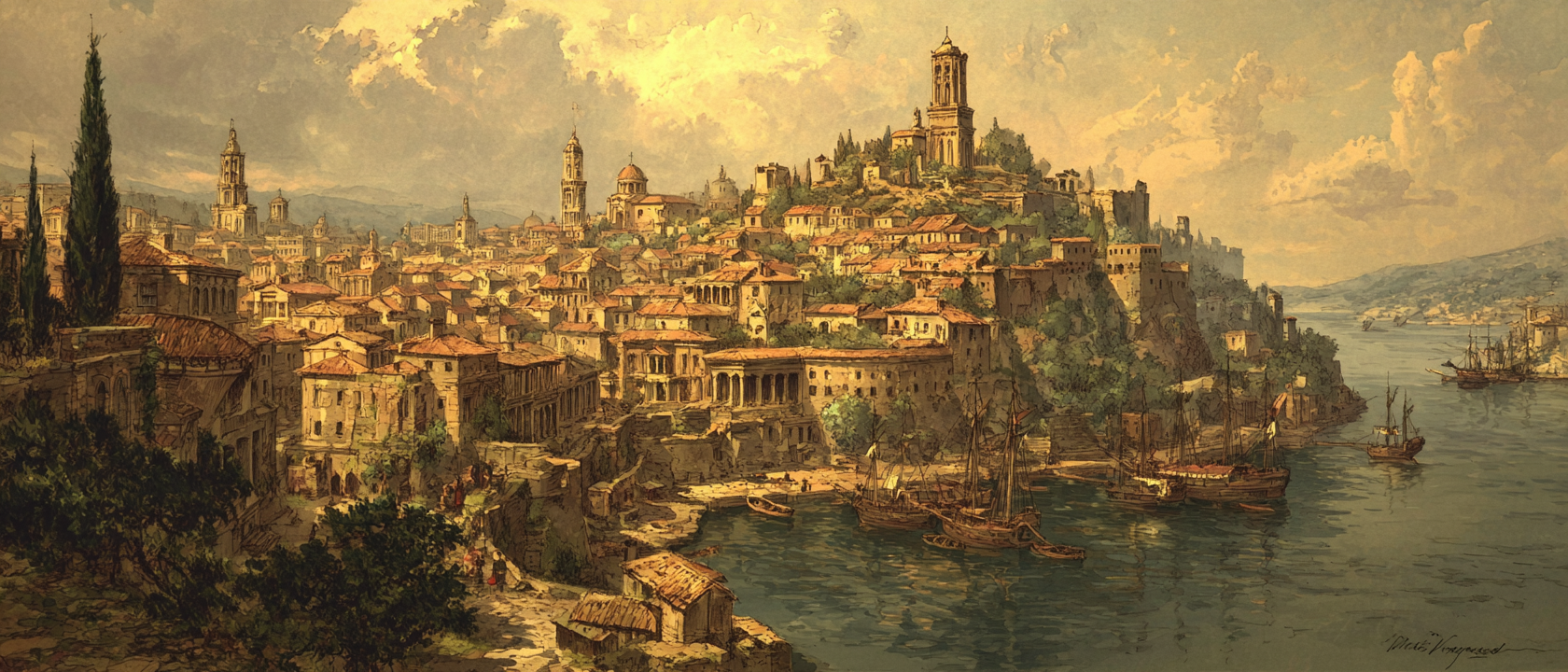
COLLIS MERCATORUM
The Merchant Hill · District · Portus Meridiani
"The merchant families of Portus Meridiani have been accumulating wealth for eight or nine generations, and their residences reflect this in the way that old money always reflects it: not through display, but through the specific quality of restraint that is only available to people who have stopped needing to demonstrate anything. The hill is quiet. The walls are high. The views are exceptional. The gates are very well maintained."
The Collis Mercatorum occupies the coastal ridge east of the promontory — the high ground that runs between the forum district and the headland, its crest offering the views across the Sinus Australis that have made it the residential address of choice for Portus Meridiani's merchant families since the fifth century. Thirty families, by current count, maintain their primary residences here, supplemented by the households of senior legal professionals, the families of retired Legion officers, and the occasional scholar whose institutional affiliation carries sufficient status to obtain one of the ridge's less spectacular sites. It is not a large district — the ridge is only a few hundred metres long — but it is, per square metre, the most expensive residential land in Provincia Urbis after the Palatine Hill itself.
Demographics
The Collis Mercatorum's permanent population of approximately three thousand is the smallest of any district in Portus Meridiani and the wealthiest by an extraordinary margin. The thirty family principals, their households, the domestic staff who maintain the properties — perhaps fifty people per major residence, including staff — constitute the district's core. The district is not a place of commerce or administration; it is where the people who conduct that commerce and administration sleep, eat, and raise their children. The children of the Collis grow up knowing the bay from its most advantageous perspective and understanding the southern trade at a level of abstraction — futures, contracts, relationships — that distinguishes their education from anything available in Roman schools.
Government
The Collis is governed by the Praefectura's civic authority in the most formal sense and by the families' collective preferences in every practical one. The Aedilitas maintains the ridge road and the public path at the crest; everything else is the families' private concern. The neighbourhood has no formal association and no collective governance structure — the families coordinate through the Porticus and through the social relationships of eight or nine generations of shared residential proximity, which is a more effective coordination mechanism than any formal institution.
Defences
The families maintain private security — guards at the gates, household staff who are not only household staff — calibrated to protect against individual threat rather than organised assault. The ridge's elevation provides a natural observation advantage; it is not possible to approach the Collis Mercatorum from the bay side without being visible from the upper-tier residences for several minutes before arrival. The families have been aware of who is coming toward their gates for eight centuries, which they consider sufficient preparation.
Industry & Trade
The Collis does not trade. The people who live here conduct trade elsewhere — in the Porticus, on vessels in the bay, in the private meeting rooms of the Taberna Meridiana. The district's only commercial activity is the service economy that supports the families' domestic life: the deliveries of food and goods from the city below, the maintenance contracts for the properties, the tutors and physicians and legal advisers whose professional relationships with the families bring them to the ridge regularly.
Infrastructure
The ridge road is the district's primary infrastructure — a well-maintained private-standard road running the crest's length, its surface better than the Via Portus and considerably better than most streets in the working districts. The water supply is a dedicated branch of the promontory's aqueduct, extended to the ridge in the sixth century at collective family expense. The families have their own arrangements for correspondence — a private messenger service connecting the Collis to the Porticus, the bay quays, and the Via Australis postal system — that operates on schedules the Praefectura's postal service does not set.
Guilds and Factions
The thirty families constitute an informal collective whose internal politics are conducted through the Porticus, through social relationship, and through the long memory of people who have been dealing with each other for generations. They are not unified — the families compete, disagree, and occasionally act against each other's interests — but they present a consistent face to the Praefectura and to external parties, which is a coordination achievement that their Nova Romae counterparts in the Mercatorum faction have been trying to replicate for three centuries without full success. Tertia Calida Maxima's opinion carries more weight in this informal collective than any formal authority could provide. She has opinions on the railway negotiation. She has not shared them publicly. Several family principals have been trying to determine what those opinions are for approximately eight months.
History
The ridge was first occupied residentially in the fifth century, when the early merchant families had accumulated enough from the growing southern trade to build permanent residences on the best available ground. The families whose names appear in the Porticus's oldest records — the Calida, the Rufus, the Aquileia — still have residences here, their original fifth-century buildings now cores around which seven more centuries of expansion have accumulated. The ridge filled completely in the seventh century; the last new residence was built in 1003 A.P., three years after the halfling arrival, by a family that had correctly anticipated the trade expansion that would follow. They are now one of the wealthiest of the thirty.
For full chronological detail, see: Annales Mundi.
Points of interest
The crest path — the public right of way along the ridge's top, maintained by the Aedilitas — provides the finest view of the Sinus Australis available from land in Portus Meridiani: the full bay visible, the channel entrance, the ocean beyond, and on clear days the smudge on the southern horizon that experienced eyes identify as the first indication that the world extends further than the Roman interior. The path is public and is used by visitors who have learned about it. The families find this acceptable. None of them live directly adjacent to the path.
The Domus Calida, the oldest of the family residences and the seat of the Calidus family from whom the Praefectus takes his name — though the Praefectus is a younger branch, the main line considerably wealthier — is the most historically significant private building in the city. Its oldest wing dates to the fifth century. Its current occupant, the family matriarch Tertia Calida Maxima, is eighty-one years old, has not left the Collis in thirty years, and is the most politically experienced person in Portus Meridiani by several decades. She receives visitors on Tuesdays. The list of people who have asked for appointments and not received them is a significant social document.
Tourism
The Collis Mercatorum is accessible to the public only via the crest path, which is a right of way the families have never been able to close despite several attempts. Visitors who walk the crest path and have the view explained to them by someone who understands what they are looking at — both harbours visible, the ocean beyond, the understanding of why this ground is worth what it costs — receive an education in Portus Meridiani's commercial geography that no document provides. Visitors who walk the crest path without such an explanation find it a pleasant walk with good views and no indication that anything of significance is happening in the walls below them, which is precisely what the families intend.
Architecture
The Collis Mercatorum's architecture is the architecture of very old money in a maritime climate — substantial private residences built in local limestone, their seaward facades carefully maintained against the salt air's persistent attention, their landward walls higher and plainer than their position would suggest is necessary. The gardens are walled. The gates are iron, well-oiled, opened from the inside. The buildings themselves are not ostentatious — the families that have been here for eight generations have learned that the ocean, not the architecture, provides the spectacle, and have positioned their dining rooms accordingly.
The oldest residences date to the fifth century and are the most modest in footprint — the families who arrived first built what the ridge had room for. The newer buildings, mostly sixth and seventh century, are larger, their proportions reflecting generations of accumulated resource rather than the cautious investment of new wealth. Several families have extended their properties over the centuries in ways that the neighbouring families' silence has implicitly permitted. The ridge has not had a new residence built on it in two hundred years; there is nowhere left to build.
Geography
The Collis Mercatorum occupies the coastal ridge east of the promontory — the high ground that runs between the forum district and the headland, its crest offering the views across the Sinus Australis that have made it the residential address of choice for Portus Meridiani's merchant families since the fifth century. Thirty families, by current count, maintain their primary residences here, supplemented by the households of senior legal professionals, the families of retired Legion officers, and the occasional scholar whose institutional affiliation carries sufficient status to obtain one of the ridge's less spectacular sites. It is not a large district — the ridge is only a few hundred metres long — but it is, per square metre, the most expensive residential land in Provincia Urbis after the Palatine Hill itself.
Access
Crest path publicly accessible. All residences private

Comments