
FORUM MERIDIANI
The Civic Promontory · District · Portus Meridiani
"The Forum Meridiani is the oldest part of the city and the highest — which is not saying much, the promontory being perhaps forty feet above the delta at its crest, but in a city built largely on reclaimed marsh it is enough to be the place from which everything else is surveyed. The Legion surveyor who chose this ground in the first decade after the Permutatio was thinking about flood lines, not aesthetics. He was correct on the flood lines. The aesthetics followed."
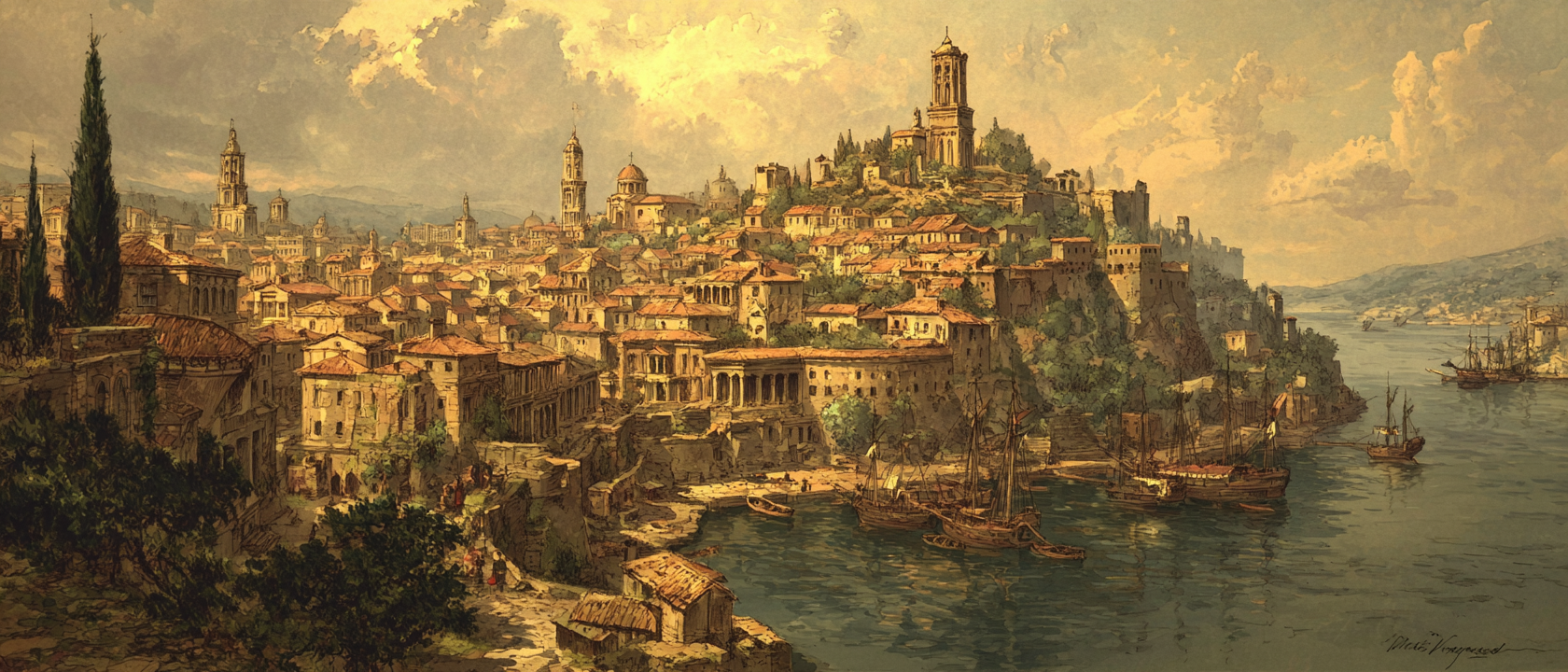
The Forum Meridiani district occupies the low promontory that was the site of the original Legion waystation and has been the civic heart of Portus Meridiani ever since. It is the oldest ground in the city, the highest ground, and the ground from which both harbours are simultaneously visible — the river mouth to the west and the Sinus Australis to the east. Everything the city has built in twelve centuries of expansion has been built outward from this point, and the forum at its centre still functions as the axis around which the rest of the city organises itself. It is also, because Portus Meridiani is not a city that performs its civic identity with great enthusiasm, considerably more modest than its counterpart in Nova Romae.
Demographics
The promontory's permanent population of approximately six thousand is the city's administrative and priestly class — the Praefectura's staff, the temple hierarchies, the legal professionals who conduct the forum's public cases, and the households that support all of these. It is the most Roman district in the city in character: the streets are planned, the buildings are maintained to civic standard, the population is literate and largely citizen. It is also the district least connected to the sea, in the sense that the people who live here administer the port rather than work it.
Government
The Praefectura Portus Meridiani operates from the administrative building at the promontory's summit — the converted garrison tower and its later additions. Praefectus Sura's offices occupy the tower's upper floors. The forum's daily administration is handled by the Aedilitas Meridiani, a sub-office with five staff members who manage the market, the road surfaces, and the temple maintenance schedule. This is a small establishment for a city of sixty thousand, which reflects both the city's compact civic structure and the fact that most of what matters in Portus Meridiani happens in the Porticus or on the quays rather than in the forum.
Defences
The promontory has no military garrison — the Castra Borealis to the north provides that function — but the Praefectura maintains a watch of twelve constables who patrol the civic district, manage the forum market on trading days, and serve as the formal security presence at official ceremonies. The promontory's height provides a natural observation advantage: the watchtower at its summit is used by the Praefectura for harbour traffic observation and by the Legio's intelligence section for whatever the Legio's intelligence section does, which is not discussed officially.
Industry & Trade
The forum hosts a twice-weekly market for local produce — vegetables, fish, coastal goods — that serves the residential population of the city's non-commercial districts. This is distinct from the Porticus's financial trading and the quayside commercial activity; the forum market is where people buy their food, not where they move the empire's luxury imports. The legal professionals' offices along the eastern colonnade constitute the city's judicial and notarial economy, handling the contracts, disputes, and documentation that sixty thousand people and their commercial activities generate. Several of these offices have been in the same family for four or five generations.
Infrastructure
The forum hosts a twice-weekly market for local produce — vegetables, fish, coastal goods — that serves the residential population of the city's non-commercial districts. This is distinct from the Porticus's financial trading and the quayside commercial activity; the forum market is where people buy their food, not where they move the empire's luxury imports. The legal professionals' offices along the eastern colonnade constitute the city's judicial and notarial economy, handling the contracts, disputes, and documentation that sixty thousand people and their commercial activities generate. Several of these offices have been in the same family for four or five generations.
Guilds and Factions
The Praefectura is the district's dominant institution, and under Sura it operates with the efficiency of a man who has calibrated exactly how much authority he has and applies it precisely to that extent. The temple hierarchy, under the Pontifex Localis, manages the four temples with the autonomy that distance from Nova Romae and the College's inability to override the Neptuni appointment custom have produced. The legal profession's informal association — no formal charter, a dining club that meets monthly — constitutes a political voice in the district's affairs whose influence is expressed primarily through which cases get argued energetically and which do not.
History
The promontory was the site of the first Roman structure south of the delta — a Legion waystation in the city's third or fourth year, the garrison tower built in the decade following. The forum was laid out in the first century, the temple district established in the second. The Templum Neptuni was first built in the third century and has been on the same site since, the seventh-century rebuilding being essentially a replacement on the original foundations. The promontory has never flooded. This has been noted, in the administrative records, approximately once per century since the city was founded.
For full chronological detail, see: Annales Mundi.
Points of interest
The Praefectura tower — the original Legion garrison structure at the promontory's summit — is the oldest building in continuous occupation in Portus Meridiani. The watchtower at its top provides the only simultaneous view of both the river mouth and the Sinus Australis available from within the city. Sura has a habit of going up there at dawn, alone, before the day begins. Nobody has asked him what he thinks about. The tower's lower courses contain inscribed stones from the first decade of settlement, the names of Legion engineers who built the waystation in the world's third year.
The Templum Neptuni on the promontory's southern face is the finest building in Portus Meridiani and the spiritual centre of a city that has a more practical relationship with the sea than most Roman towns. The merchant families funded its rebuilding in the seventh century and have maintained it since; the priests who serve it are, by long-established custom, nominated by the families rather than the College of Pontiffs, an arrangement the College finds irregular and has been unable to change for five hundred years.
The forum itself — a rectangle of weathered limestone, its colonnades keeping shade through the afternoon, the golden milestone copy at its centre marking the southern terminus of the Via Australis measurement system — is where the city performs its civic identity on the occasions it chooses to perform it. Senate proclamations arrive here by post-horse from Nova Romae, are read from the steps of the Praefectura, and are then discussed in the Taberna Meridiana with varying degrees of compliance.
Tourism
The Forum Meridiani is the first part of the city that travellers from Nova Romae encounter after the Via Australis descent to the coast — the terminus of the road, the first smell of sea air, the first visible proof that they are no longer in the interior. Most transit passengers spend one night in the mansio and move on. Visitors who stay longer find the promontory's vantage point — both harbours visible, the ocean beyond the bay, the river channel to the north — the most geographically illuminating position in Provincia Urbis. The Praefectura does not charge for the view. It has been suggested that it should.
Architecture
The forum itself is Roman in the standard sense — a rectangular paved space with colonnades on the long sides, the principal temple at the northern end, the administrative offices along the eastern colonnade — but built in local limestone rather than marble, weathered to a pale grey that makes the whole ensemble look older than it is, which is already old. The oldest structure still standing is the original garrison tower at the promontory's summit, now the base of the Praefectura's administrative building, its first-decade stonework still visible in the tower's lower courses where later construction hasn't encased it. Twelve centuries of Portus Meridiani's history are readable in the layering of that one building.
The temple district on the promontory's southern face is compact — four temples, smaller than their Nova Romae equivalents, their proportions correct but their scale reflecting a city that has always spent its money on ships and warehouses rather than on sacred architecture. The exception is the Templum Neptuni, the temple to Neptune, which the merchant families rebuilt in the seventh century at considerable personal expense and which is, by some margin, the most impressive building in Portus Meridiani. The families have a closer relationship with the sea than with any political institution, and the temple reflects this.
Geography
The promontory rises from the surrounding delta terrain to approximately forty feet above sea level — enough to be above the historic flood line, enough to have commanding views in all directions, not enough to be described as a hill by anyone from an inland province. It is roughly oval, perhaps six hundred metres at its longest, with its eastern face dropping toward the bay shore and its western face sloping more gradually toward the river mouth embankment. The Via Australis enters the city from the north and terminates at the forum's northern gate. The Via Portus runs east from the forum's southern end toward the bay quays.
Access
Fully publicly accessible. Praefectura interior — official business. Watchtower — restricted.

Comments