
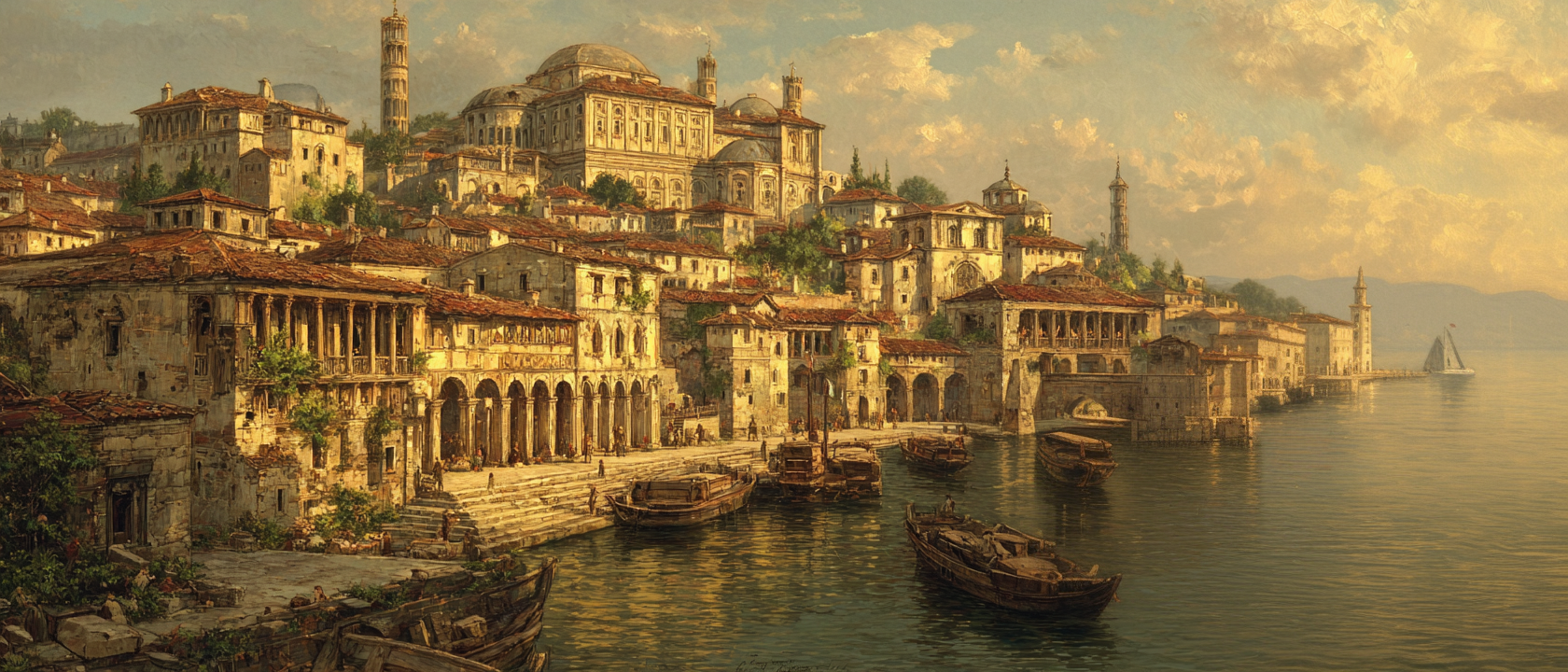
VETUS PORTUS
Old Port · Town · Provincia Fluminis Magni
Vetus Portus is two hundred kilometres north of Nova Romae and twelve hundred years old and carries both facts with the specific ease of a place that has stopped needing to explain itself. It was a waystation within the first decade after the Rift. Its oldest streets are first-century. Its oldest field boundaries predate the town itself, because the farms came before the settlement, and the farms came because the river was there and the soil was good and the people who had just been transposed into an unknown world needed to eat. Twelve centuries later the fields are still being farmed and the river is still running and the town between them has developed, in the space between these two continuities, certain commercial practices that the Imperial administration in Nova Romae has not found the time to examine closely. I note this without drawing conclusions that are not mine to draw.
Vetus Portus is the empire's second-oldest continuously inhabited settlement and the most instructive example of what happens when a location's historical significance outlasts its strategic one. The town was the primary river waystation for the first four centuries — the essential stopping point between Nova Romae and the northern settlements, its wharves the most heavily used on the Fluminis Magnus, its inns the largest in the province. When Confluentes grew large enough to dominate northern river traffic and the Inland Sea ports assumed the volume that Vetus Portus had once handled, the town's commercial significance declined without its historical significance diminishing. What remained was an imperial settlement with first-century infrastructure, third-century buildings, a modest but functional river harbour, and an administrative apparatus whose staffing levels were set in the fifth century and have not been adjusted since, because the town's historical status has protected it from the bureaucratic rationalisations that have reorganised newer settlements.
The Aquila family has been in Vetus Portus for three generations. They arrived as the town's commercial significance was completing its decline and understood, with the specific clarity of people who had been looking for exactly this kind of opportunity, that a town with deep historical roots, minimal Imperial oversight, a functional river harbour, and administrative staff whose positions are sinecures rather than working roles offered something that no more prominent location could: the combination of legitimate institutional standing and practical invisibility. They established a legal practice specialising in ancient property rights and historical title disputes. They have been doing this for seventy years. The legal practice is genuine, respected, and profitable. The other practice is considerably more profitable and is not described in any document that the firm has ever filed with any authority.
I have been to Vetus Portus four times and have found it, each time, a more layered place than its quiet presentation suggests. The first-century street paving is real. The third-century warehouses along the river are real. The inn at the market square has been feeding travellers since the second century and the food is good in the way that food is good when it has been made the same way for generations. None of this is performance. And the Aquila firm's office on the square's northern edge is a genuinely distinguished legal practice whose senior partner is among the most knowledgeable property lawyers in the empire. None of that is performance either. Both things are true simultaneously, which is what makes Vetus Portus what it is.
Demographics
Approximately twelve thousand permanent residents — a population that has been roughly stable for four centuries, the town having reached the equilibrium between its limited legitimate commerce and the specific economic niche that the Aquila operation provides. The residential character is the specific combination of old-established families and carefully selected newcomers that the Aquila operation produces: the old families whose presence provides the historical legitimacy, the newcomers whose skills or commercial needs have been assessed and found compatible with the town's operational requirements. The assessment is informal, conducted through the social mechanisms that small towns use to absorb strangers, and has the accuracy of a process that has been refined over three generations.
Government
The town prefect, appointed by the governor's office, manages the administrative functions that the town's Imperial status requires — the tax collection that the Quaestor's office conducts annually, the property records that the Tabularium keeps in a state of professional adequacy, the harbour authority whose staff of three have held their positions for between eight and twenty-two years and have developed the specific professional practice of recording what the traffic log should contain. The prefect, Sextus Antiquus Celer, fifty-eight, in his eleventh year, is not corrupt in the sense of taking active payments. He is accommodated — his position is comfortable, his administrative requirements are manageable, the town functions without requiring him to look at anything he would find professionally challenging, and the Aquila family's annual gift to the civic restoration fund covers the maintenance costs that the governor's budget allocation does not. He considers himself a competent administrator. By his own definition, which excludes the things he has chosen not to look at, he is correct.
The town prefect, appointed by the governor's office, manages the administrative functions that the town's Imperial status requires — the tax collection that the Quaestor's office conducts annually, the property records maintained in the Officium Praefecti Veteris, the civic infrastructure that the town's first-century character requires ongoing maintenance for. The prefects who have been most effective in this role have held their positions for between eight and twenty-two years and have developed the specific professional practice of recording what the traffic log should contain. The prefect, Sextus Antiquus Celer, fifty-eight, in his eleventh year, is not corrupt in the sense of taking active payments. He is accommodated — his position is comfortable, his administrative requirements are manageable, the town functions without requiring him to look at anything he would find professionally challenging, and the Aquila family's annual gift to the civic restoration fund covers the maintenance costs that the governor's budget allocation does not. He considers himself a competent administrator. By his own definition, which excludes the things he has chosen not to look at, he is correct.
Defences
A watch of twelve, adequate for a town of twelve thousand with a stable population and no history of public disorder. The Aquila operation's own security — three individuals whose employment the firm describes as document couriers and whose actual function is the physical management of situations that the town watch should not know about — is the more operationally significant force. The guild's tolerance of the Vetus Portus operation rests on an understanding, maintained through the Aquila firm's careful management of what touches Guild-licensed cargo and what does not, that the guild's protection officers have no reason to take an interest in what happens at the fourth docking point. This understanding has held for forty years. Its maintenance requires continuous active attention from the Aquila family's current senior partner.
Industry & Trade
The legitimate commercial activity — the river traffic that stops here as a waystation, the agricultural trade from the surrounding farms, the legal services the Aquila firm provides to clients throughout the province — is sufficient to maintain the town's appearance as a functioning if modest commercial settlement. The legal practice is genuinely the most significant legitimate business in the town: the Aquila firm's expertise in ancient property rights is the best available in the province, and clients travel from Nova Romae and Confluentes to consult them. The firm's archive of historical property documents — accumulated over seventy years of specialised practice — is the most complete collection of pre-fourth-century title records outside the Tabularium Urbis, and several of the documents it contains have not been reported to the Tabularium because the Aquila family's assessment is that their existence is information rather than a filing obligation.
The other practice moves goods, people, and information through the fourth docking point on schedules that the harbour authority does not record. The goods category is the largest by volume: items whose manifests in the legitimate trade system would trigger inspection or seizure, moving between parties who need discretion at both ends. The people category is smaller but more sensitive: individuals whose movements through the empire's official travel system would create records that someone — the individual, or a third party — has paid to prevent. The information category is the most profitable: documents, intelligence, testimony, and the specific category of ancient title records whose existence gives a party leverage in a dispute that has not yet become official. The Aquila family does not create the leverage. They hold it. There is a distinction, which the current senior partner, Servilia Aquila Venusta, sixty-three, considers important, and which her clients consider irrelevant.
DM ONLYDistricts
The Market Square is the town's civic centre — the original waystation facilities, the inn, the Aquila firm's office, the prefect's administrative rooms. The Wharf District is the river frontage from the active docking points south to the decommissioned fourth point. The Old Fields District is the residential and agricultural zone east of the town where the pre-town field boundaries are most visible. The Via Quarter is the section along the old river road where the waystation-era infrastructure is most concentrated and where the buildings are oldest.
Guilds and Factions
The Aquila firm is the town's dominant institutional fact, its authority not formal but complete within the commercial domain that the town's other institutions have learned to leave alone. The firm is not a faction in the Roman sense — it does not seek political influence, does not cultivate senatorial relationships, and does not participate in the provincial commercial network in any way that leaves a traceable pattern. Its influence is the influence of an institution that holds information other institutions need and has demonstrated, across three generations, the specific reliability of an organisation that uses what it holds only when it has to and treats discretion as a commercial product rather than a personal virtue.
The Bargemasters' Guild has a presence in Vetus Portus in the form of a license office and a single guild inspector whose primary function is ensuring that the river traffic stopping here maintains its manifests correctly. The guild inspector and the Aquila firm have a relationship whose specific character — not hostile, not cooperative, operating within a defined mutual understanding of what each party notices and what each party records — is the product of forty years of careful management by successive Aquila partners. The current inspector has been in post for three years and has understood the arrangement since his second month.
History
Vetus Portus was established as a river waystation within the first decade after the Rift — its oldest field boundaries predate even this, the farms having been worked before the waystation infrastructure made the location a settlement rather than a stopping point. The town reached its commercial peak in the third and fourth centuries. Its decline in commercial significance was complete by the seventh century. The Aquila family arrived in the ninth century, three generations ago. The fourth docking point's informal operation began approximately sixty years ago, in the first generation of Aquila presence.
For full chronological detail, see: Annales Mundi.
Points of interest
The Aquila Firm's Office, Market Square (accessible during business hours for legitimate consultations) — Servilia Aquila Venusta sees clients in person for significant matters and has a waiting list of three months for new consultations, which is the waiting list of a legal practice that is in genuine demand. The other access — the building's rear courtyard, the basement that is not on any property record — operates on a different appointment system whose existence the firm does not acknowledge and whose reliability the firm's reputation depends on maintaining absolutely. An appointment missed on the Aquila firm's informal side has consequences that the formal legal practice would describe as breach of contract and that the informal practice describes as the end of the relationship and whatever follows from that.
The Fourth Docking Point, Wharf District (southern end, officially decommissioned) — indistinguishable from the decommissioned infrastructure that surrounds it except on the nights when it is in use, when it is distinguishable by the presence of a vessel without running lights moored at a structure that is officially not capable of mooring vessels. The town residents who live close enough to observe this have developed the same professional practice as the harbour authority's staff — they have seen nothing that needs reporting, which is a conclusion they have reached through the same assessment process that Prefect Celer employs and that produces the same outcome.
The Aedificium Primum, Via Quarter (public access, scholarly interest) — the oldest continuously occupied building in the empire outside Nova Romae, a first-century waystation structure that has been in continuous use since the Rift. Its current function is storage for the town's surplus administrative records. The architectural scholars who visit to study its construction are received with the specific hospitality of a town that has learned, over twelve centuries, to be genuinely welcoming to visitors whose attention is directed at the past.
The Old Fields, Old Fields District (public, agricultural) — the field boundaries that predate the town itself, running at angles to the street grid, the farms fitted around the town rather than the town fitted around the farms. Visible from the eastern edge of any district. The families who work these fields have been working the same ground since before the settlement existed, which is either the most Roman thing in Vetus Portus or the least Roman thing, depending on how you define Roman.
Tourism
Vetus Portus receives commercial visitors — traders, cargo brokers, legal clients — in numbers that make it one of the more visited towns of its size in the province, given the Aquila firm's reputation drawing clients from as far as Nova Romae and Confluentes. Leisure visitors are fewer: the town's historical depth attracts architectural scholars and historians who come specifically for the layered construction record and the Aedificium Primum. Varro's recommendation to visitors is to arrive at the confluence of legitimate and historical interest that the town provides — the first-century street paving, the inn that has been feeding travellers since the second century, the legal practice that is as distinguished as it appears — and to note that the town's presentation is accurate in everything it presents and silent about the rest. This, he observes, is a form of honesty that deserves more credit than it receives.
Architecture
Vetus Portus is the most completely layered architectural environment in the empire outside Nova Romae — first-century street paving under third-century buildings with fifth-century modifications and ninth-century repairs, the whole producing a texture that architectural scholars visit specifically to study and that the town's residents navigate without registering as anything other than the normal condition of a place. The Aquila firm's office on the market square's northern edge is a third-century building with original ground-floor stonework — two thousand square feet of the empire's oldest continuously occupied commercial premises, used for legal practice by the Aquila family for seventy years and for other purposes for the same period. The building's basement, accessible from the rear courtyard, is not on any civic property record. This is not an oversight.
The wharves are smaller than their first-century dimensions and have been progressively simplified as the volume of legitimate commerce has declined. The current wharf infrastructure — three functional docking points, adequate for the modest river traffic that uses Vetus Portus as a stopping point rather than a destination — is maintained to the minimum standard that the harbour authority's staffing level can manage, which is the minimum standard. The fourth docking point, at the southern end of the wharf, was officially decommissioned in the eighth century. Its infrastructure was not removed. It handles, on an irregular schedule that does not appear in the harbour authority's traffic log, the arrivals that the other three docking points are not asked to process.
Geography
The town sits on the Fluminis Magnus's western bank two hundred kilometres north of Nova Romae, its position originally chosen for the river crossing that served the Via Lacensus's northward extension in the first century. The town's layout reflects its waystation origin — the river road running north-south, the market square where the waystation facilities clustered, the residential streets extending east into the agricultural land behind. The fields that predate the town are still visibly older than the buildings beside them — the field boundaries running at angles to the street grid, the farms fitted around the town rather than the town fitted around the farms.
Climate
The river valley's temperate climate, identical to Confluentes further north — the Fluminis Magnus moderating the temperature extremes, the spring flooding cycle managed by the wharf infrastructure in the same way it has been managed since the first century. The town's agricultural surrounding means the seasonal rhythms are more legible here than in Confluentes — the planting and harvest schedules visible in the field patterns east of town, the smell of the fields in the seasonal transitions perceptible from the market square.
Natural Resources
The river and the agricultural land are the town's natural resource base — the Fluminis Magnus providing the waystation traffic that sustains the legitimate river economy, the surrounding farmland producing the grain, livestock, and market garden produce that feeds the town and generates a modest surplus for the provincial market. The town's most significant resource is institutional rather than natural: the Aquila firm's archive of historical property documents is, in practical terms, a resource whose value exceeds the town's entire agricultural output, though it does not appear on any provincial assessment.
Military
Watch of twelve. No garrison. Guild's wharf security (three individuals) operates at the fourth docking point under separate informal arrangement.
Economy
River waystation traffic and services. Agricultural trade from surrounding farms. Aquila firm legal services (ancient property rights, historical title disputes). Fourth docking point operations (undeclared).

Comments