
CONFLUENCE QUARTER
Where the Rivers Meet · District · Confluentes
Rivers Meet · District · Confluentes "The Confluence Quarter has the character of all border territories — it belongs to everyone and no one, which means it serves purposes that clearly defined territories cannot accommodate. The Guild's jurisdiction ends at the wharf edge. The governor's jurisdiction covers the public streets. The space between these two clear boundaries is the Confluence Quarter, and in twelve centuries that space has attracted precisely the kinds of activity that benefit from jurisdictional ambiguity. I am not suggesting that the quarter is disreputable. I am suggesting that it is useful to people who need things done that do not fit cleanly within existing institutional categories, which is a condition that commercial cities generate in considerable quantity."
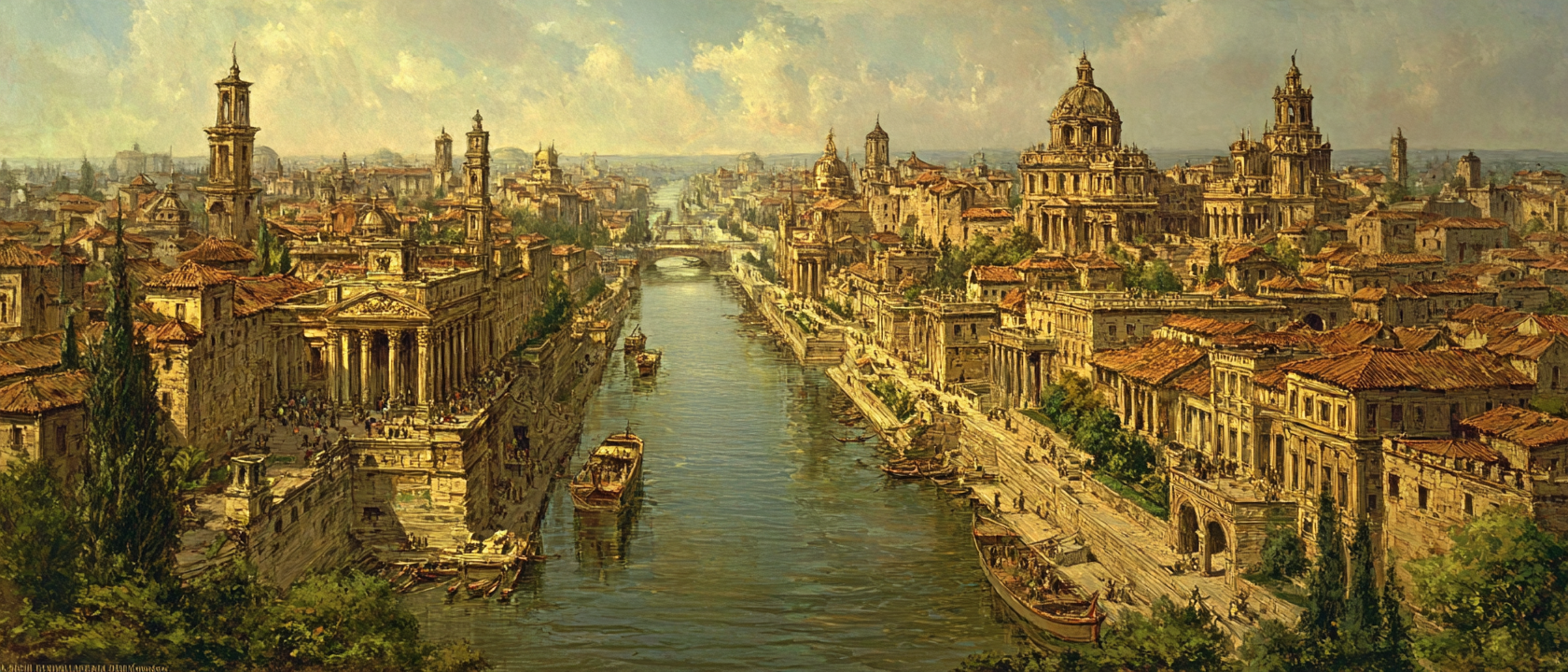
The Confluence Quarter occupies the ground immediately south of where the Rivus Orientalis meets the Fluminis Magnus — the most commercially active district in the city and the one with the least clear jurisdictional ownership. Both the Guild and the governor's office have theoretical authority here; neither has established operational dominance, and the result is the specific commercial culture that jurisdictional ambiguity produces: adaptive, pragmatic, comfortable with complexity, and more useful to people who need things done without excessive documentation than any formally administered district could be. The quarter is not lawless — the city watch patrols it, the Guild's protection officers maintain a presence, and the River Authority has an inspection post on the southern edge. It is, rather, a district where the gap between what is formally prohibited and what is practically accepted is wider than elsewhere, and where the people who operate in that gap are the quarter's most commercially productive residents.
Demographics
Approximately fifteen thousand permanent residents with the highest proportion of non-Roman inhabitants in the city — the eastern trade goods bring eastern traders, and a portion of them have settled in the quarter permanently. The halfling commercial presence is significant; three of the Banca Brindala's Confluentes agents maintain their offices here rather than in the more formally administered eastern bank, a locational choice that reflects the same preference for jurisdictional flexibility that characterises the quarter generally.
Points of interest
The Eastern Trade Goods District
The Rivus Orientalis delivers the eastern provinces' commercial output to the confluence, and the quarter's eastern edge is where those goods first enter the Fluminis Magnus trade network. The cargo brokers who work this interface — handling the transfer of eastern goods onto northbound and southbound barges — are the city's most commercially informed private operators and the source of the commercial intelligence that the Via Obscura's Confluentes network trades in. The forest-adjacent goods arriving from Provincia Orientalis enter the mainstream river trade here, processed by the manifest clerks' informal categorisation practice and absorbed into the barge traffic with the minimum institutional attention that the clerks' professional judgment considers appropriate.
Access
Fully publicly accessible.
No restricted areas by institutional designation, though certain establishments operate on the understood basis that questions are not asked.

Comments