
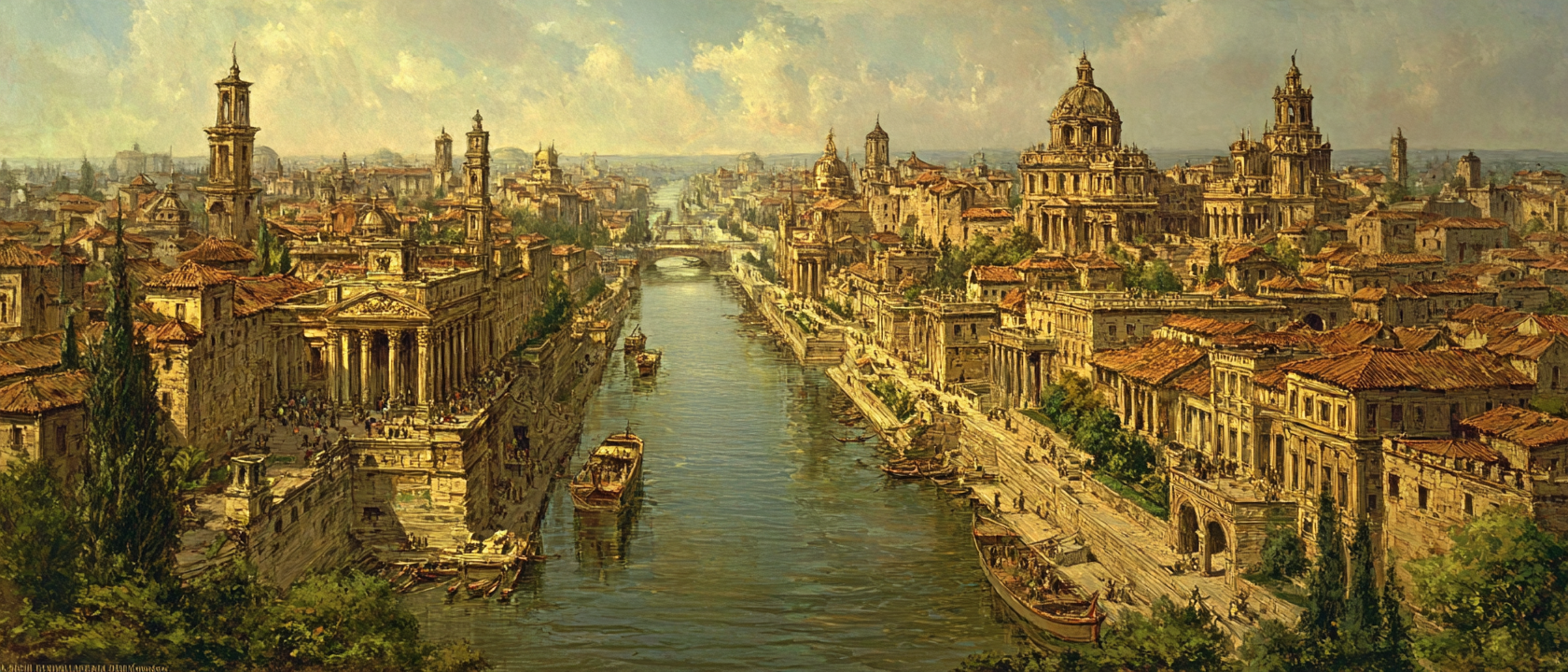
CONFLUENTES
The River City · City · Provincia Fluminis Magni
Confluentes is the oldest inhabited town in the empire outside Nova Romae and it knows this about itself in the way that very old things sometimes do — not proudly, exactly, but with the settled assurance of something that has outlasted every argument about whether it matters. The Bargemasters' Guild has its headquarters here. The Fluminis Magnus River Authority has its headquarters here. The provincial governor has his headquarters here. Of those three institutions, the governor's office is the one that most frequently needs the other two's cooperation, which is a power arrangement everyone in Confluentes understands without needing to discuss it.
Confluentes sits where the Fluminis Magnus exits the Inland Sea, at a confluence that has been commercially significant since the first century and has become, over twelve hundred years, the administrative and logistical heart of the empire's most important river corridor. The city's population of approximately eighty thousand is organised primarily around the river — the barges that dock here, the cargoes that transfer here, the licenses that are issued here, and the disputes that are adjudicated here by the Bargemasters' Guild's own courts, which have been operating since the fourth century and which the Senate has attempted to subordinate to the Imperial court system on seven occasions, each time unsuccessfully.
The Bargemasters' Guild is the city's dominant institution in the way that the Forum Novum is Nova Romae's dominant institution — not merely present but generative, the body around which everything else in Confluentes is organised. The Guild's headquarters on the western bank, the River Authority's offices on the eastern bank, and the provincial governor's residence between them form the civic triangle that makes Confluentes function. The current Guildmaster, Flavia Nauta Riparia, fifty-four, in her sixth year, comes from a barge family whose river licenses predate the Guild's formal charter by three generations. Her assertiveness on questions of river policy is the assertiveness of someone who considers the river her institution's primary function and the governor's office a useful administrative partner rather than a superior authority. Governor Publius Alveus Magnus, sixty-two, in his third year, is a competent administrator who has understood since his first month that competence in Confluentes means understanding where his authority actually ends.
The Bargemasters' Guild has been operating since the third century and has survived fourteen Senate attempts to reduce its fee structure. It has outlasted every senator who tried. I first visited Confluentes at thirty-four and spent a week at the Guild headquarters with the then-Guildmaster's permission, examining the charter records. The charter is a masterwork of legal precision — every clause has been tested, every ambiguity has been resolved through case law, and the result is an institution whose independence from Senate oversight is not a loophole but a deliberately constructed architectural feature. The current Guildmaster knows this better than anyone alive. I have spoken with her twice and found her, both times, to be exactly as formidable as her reputation suggests and considerably more charming.
Demographics
Eighty thousand residents with the demographic character of a city whose primary industry is the movement and administration of other people's goods. The barge families are the city's oldest population — the hereditary guild members whose river licenses have passed through generations and whose residential patterns reflect the same stability. The commercial service community is the city's largest population — the warehouse operators, the cargo brokers, the document handlers, the food suppliers, the equipment maintainers whose businesses exist to serve the barge traffic. The administrative community — the River Authority staff, the governor's household, the guild's own administrative operations — is the smallest of the three but the most institutionally visible. The eastern provinces' trade goods pass through Confluentes in volume, and the city's commercial character has absorbed influences from every province east of the river that sends cargo down toward Nova Romae.
Government
Governor Publius Alveus Magnus administers the province with the specific diplomatic competence that Confluentes requires: he governs what is actually his to govern — public order, road maintenance, the Quaestor's tax administration, the civic infrastructure — and he negotiates with the Guild on everything that touches the river, which is most of what matters. The relationship between Alveus and Guildmaster Riparia is formally cooperative and privately competitive in the sense that two institutions with overlapping interests and different mandates develop a productive working tension when both sides are competent. Alveus has been pushing that boundary downward, toward greater gubernatorial authority over river policy. Since her election, Riparia has been holding it, with the specific resistance of a person who knows that every concession she makes becomes a precedent that her successors will be unable to reverse. Both are right about the stakes. Neither has yet forced a confrontation that would require the Senate to adjudicate.
The city's Quaestor, Gaius Ratio Pontis, fifty-one, in his fourth year, manages the Senate's tax interests with the particular care of someone operating inside the Guild's jurisdictional territory. The customs revenue that passes through Confluentes is the highest of any inland city in the empire, and the gap between what the Guild's manifest records show and what actually moves through the wharves is a calculation the Quaestor's office has been attempting to close for forty years.
DM ONLYDefences
A garrison of eight hundred soldiers — a full cohort plus auxiliary support — under Centurion Primus Gaius Riparius Fortis, forty-eight, who has no relation to the Guildmaster despite the suggestive surname and who finds questions about this both tedious and understandable. The garrison's primary function in a city with no external military threat is the maintenance of public order along wharves that handle enormous commercial value daily, a function that requires more diplomatic skill than military capacity and that Fortis has developed across twelve years at the posting. The guild's own wharf security — formally described in the guild charter as 'cargo protection officers' and understood by everyone as the most effective private security force in the interior provinces — operates in parallel with the garrison with the carefully maintained jurisdictional clarity that eight centuries of occasional friction has produced.
Industry & Trade
Everything passes through Confluentes. This is not a figure of speech — every barge operating on the Fluminis Magnus north of Nova Romae requires a license issued from the Guild headquarters here, every cargo manifest must be filed with the River Authority here, and every dispute about river traffic is adjudicated by the Guild's courts here before it can proceed to the Imperial court system. The fee schedule for these services was last successfully renegotiated by Senate action in 642 A.P. and has been adjusted upward by the Guild in every decade since. The Senate's fiscal committee produces an annual report noting the fee increases. The Guild's response to each report is the same: the fees are set by the Guild council under the authority of the charter, and the charter is not subject to Senate revision on operational matters. This exchange has occurred forty-seven times. The outcome has not varied.
The eastern trade goods arriving via the Inland Sea represent the city's most commercially dynamic element — the goods from Provincia Orientalis and the eastern agricultural provinces moving west and south toward Nova Romae and Portus Meridiani. Since the Porta Silvae settlement's cultural connections to Sylvanmere have begun, intermittently and without official acknowledgment, producing small quantities of forest-adjacent goods — materials and craft items whose provenance the cargo manifests describe with careful vagueness — Confluentes has become the first point at which these goods enter the mainstream river trade. The River Authority's manifest clerks have developed a professional habit of recording such cargoes in the category that creates the least administrative complexity. The Guild's cargo protection officers have a different category for them in their own records.
DM ONLYDistricts
The Western Bank is the older settlement and the Guild's territory — the headquarters, the wharves, the barge families' residential streets, the cargo brokers' district. The Eastern Bank is the administrative quarter — the River Authority, the governor's residence, the provincial Senate chamber, the commercial service community. The Confluence Quarter occupies the ground immediately south of where the two rivers meet, its position making it the most commercially active district in the city and the one with the least clear jurisdictional ownership between the Guild and the governor's office, a condition that both institutions have found it more useful to maintain than to resolve. The Bridge Quarter spans both banks at the city's oldest crossing, its mixed residential and commercial character the product of being the point where eastern and western Confluentes have been meeting for twelve centuries.
Assets
Confluentes was established in the first century at the confluence of the two rivers, the location's commercial logic immediately apparent to the Legion's surveyors who pushed north from Nova Romae along the river valley. The Bargemasters' Guild was formally chartered in the third century, though barge family river licenses predate the charter by two generations. The Guild headquarters has been on its current site since the charter. The River Authority was established in the fifth century as a Senate attempt to create a counterweight to the Guild's river dominance; it has functioned as a productive institutional tension rather than an effective counterweight, which the Senate considers a partial success. For full chronological detail, see: Annales Mundi.
Guilds and Factions
The Bargemasters' Guild under Riparia and the Fluminis Magnus River Authority under its Director, Marcus Flumen Rector, fifty-nine, are the city's two dominant institutional factions, with the governor's office as the formal authority that both institutions work around rather than through. Rector and Riparia have a relationship that is functionally collegial and strategically adversarial — the River Authority's mandate is to regulate river use in the public interest, and the Guild's mandate is to administer river commerce in the Guild's interest, and the overlap between these two mandates is the permanent source of friction that makes Confluentes' institutional politics the most complex in the interior provinces. Rector is the more politically exposed of the two — his appointment is gubernatorial and his budget is Senate-dependent, where Riparia's position is elected by the Guild's senior masters and her institution funds itself. This asymmetry is the source of the current competition's specific character: Rector needs the governor's support to hold his position; Riparia needs nothing from anyone outside the Guild, and they both know it.
The Via Obscura operates in Confluentes with a specific focus: the river intelligence trade. The information about what is being shipped, when, by whom, and to where is the most commercially valuable intelligence in the interior empire, and the Via Obscura's Confluentes operation has built itself around the gap between what the Guild's manifest records officially contain and what the barge crews actually know. The Guild's intelligence network and the Via Obscura's network overlap sufficiently that each is aware of the other's existence and has developed the kind of professional non-interference that two intelligence operations sharing a city maintain when direct competition would be more expensive than coexistence.
History
Confluentes was established in the first century at the confluence of the two rivers — the Fluminis Magnus and the channel that exits the Inland Sea — the location's commercial logic immediately apparent to the Legion's surveyors who pushed north from Nova Romae along the river valley. The Bargemasters' Guild was formally chartered in the third century, though barge family river licenses predate the charter by two generations. The Guild headquarters has been on its current site since the charter. The River Authority was established in the fifth century as a Senate attempt to create a counterweight to the Guild's river dominance; it has functioned as a productive institutional tension rather than an effective counterweight, which the Senate considers a partial success.
For full chronological detail, see: Annales Mundi.
Points of interest
The Guild Headquarters Charter Room (accessible by appointment) — the Guild grants access more readily than its reputation for institutional privacy would suggest; Riparia's view is that the charter's strength is best demonstrated by showing it to people who might challenge it, because the challenge will fail and the failure is instructive. Varro has been in the charter room three times. He describes the founding documents as the most carefully drafted legal instruments he has read in sixty years of encountering legal documents. The charter room itself — first-century stonework with sixth-century reinforcement — feels to anyone sensitive to such things like being inside an argument that has been going on for eight hundred years and has not yet been resolved.
The Confluence Itself (public, Bridge Quarter) — viewed from the Bridge Quarter's central span at dawn, when the river traffic has not yet reached its daytime density and the two waters' different colours are most visible in the morning light. The confluence is not dramatic — it is a gradual, unhurried merging over a hundred metres of water — but it has the quality that slow, inevitable processes have when you watch them with sufficient attention. Bargemen who have made this crossing ten thousand times still look at it.
The Mensae Antiquae (public market, Western Bank) — the oldest continuously operating market in Confluentes, its current stalls occupying ground where goods have been traded since the first century. The stall assignments have passed through families for as many generations as the barge licenses, and the informal hierarchy of stall position encodes twelve centuries of commercial precedence that the Guild's records document and the market itself enforces without any formal mechanism.
The Pons Confluentis (public infrastructure) — the city's primary bridge, rebuilt four times in twelve centuries, always to the same layout. The barge families have resisted every attempt to improve it on the grounds that improvement means change and change means learning new patterns that the river does not care about. The current structure is third-century stonework with twelfth-century maintenance. It is sound. The River Authority's engineers consider it adequate. The barge families consider it correct.
Tourism
Confluentes receives commercial visitors — traders, cargo brokers, license applicants, dispute parties — in numbers that make it one of the most transient cities in the interior empire. Leisure visitors are fewer but not absent: the river's visual quality, the city's historical depth, and the specific atmosphere of a place that has been doing the same thing very well for twelve centuries attract people who appreciate that kind of continuity. The Guild headquarters' public gallery, where the charter rooms documents can be viewed from behind a barrier during scheduled hours, draws scholars from across the empire. Varro's recommendation to visitors is to arrive at the confluence in the early morning, watch the rivers meet, and then present themselves at the Guild headquarters' public desk and ask the duty clerk a question about the charter. The quality of the answer, he notes, is the best available introduction to what Confluentes actually is.
Architecture
The city is built in the pale river limestone that the Fluminis Magnus valley produces, its colour lighter than Lacusum's coastal stone and warmer than the northern province's harder material. The Guild headquarters on the western bank is the city's most significant structure — eight centuries of accumulated construction on the same site, the oldest sections third-century and the most recent additions distinguishable only by the slightly different weathering of their stone, the whole building carrying the specific quality of an institution that has been adding to itself for so long that the additions have become indistinguishable from the original. The charter room at the building's core, where the Guild's founding documents are kept and where the Guildmaster conducts her most significant negotiations, is first-century stonework with sixth-century reinforcement, and the combination produces a room that feels, to anyone sensitive to such things, like being inside an argument that has been going on for eight hundred years and has not yet been resolved.
The river wharves are the city's most continuously active infrastructure — twelve major docking points on the western bank handling the northbound and southbound barge traffic simultaneously, the loading and unloading operations running in the overlapping shifts that a river that never stops requires. The wharf infrastructure has been rebuilt four times in twelve centuries, always to the same layout, because the layout is correct and the barge families who use it have resisted every attempt to improve it on the grounds that improvement means change and change means learning new patterns that the river does not care about.
Geography
The city occupies both banks of the Fluminis Magnus at the point where the river exits the Inland Sea, the confluence of river and sea creating a natural harbour of unusual depth and commercial utility. The western bank is the older settlement, its street pattern first-century below the surface modifications of twelve centuries of improvement. The eastern bank, developed later, is the more formally planned — the River Authority's district, the administrative quarter, the residential streets of the commercial families who service the river trade without being part of it. The confluence itself — the visible meeting of river water and sea water, the slightly different colours of their water merging over the first hundred metres south of the junction — is the city's defining visual feature and the image that appears on its civic seal, its public buildings, and the guild's own documents.
Climate
The river valley's temperate climate — the Fluminis Magnus moderates the temperature extremes that the agricultural interior experiences, keeping the city warmer than the northern provinces in winter and cooler than the southern coast in summer. The spring flooding cycle, when the Iron Spine snowmelt arrives down the river's northern tributaries, is the city's primary annual challenge — the wharves are built for it, the barge schedules accommodate it, and the River Authority's flood management protocols are the most thoroughly tested emergency procedures in the interior empire. The Guild's barge families read the spring flood's timing from water temperature and upstream reports with an accuracy that the River Authority's monitoring stations have not matched.
Natural Resources
The river itself is the city's primary resource — the navigable waterway that connects the Inland Sea to the southern ocean via Nova Romae and Portus Meridiani, and that carries more goods by volume than any other route in the known world. The Guild's administrative control of river access is, in practical terms, control of the most significant transport infrastructure in the empire. The surrounding agricultural land provides the city's food supply; the limestone quarries in the eastern uplands supply building stone. The city's primary export is institutional: the accumulated commercial law, river management protocol, and navigational knowledge that the Guild has been developing and defending for eight centuries and that underlies every commercial transaction that moves cargo on the Fluminis Magnus.
Military
Garrison of 800 (full cohort plus auxiliary support) under Centurion Primus Gaius Riparius Fortis. Guild's own wharf security operates in parallel under separate jurisdictional charter.
Economy
River trade licensing and administration (all Fluminis Magnus barge traffic).
Guild fees and commercial courts.
Eastern provinces trade goods transit. Bargemasters' Guild operational revenue.
River Authority administrative fees.

Comments