
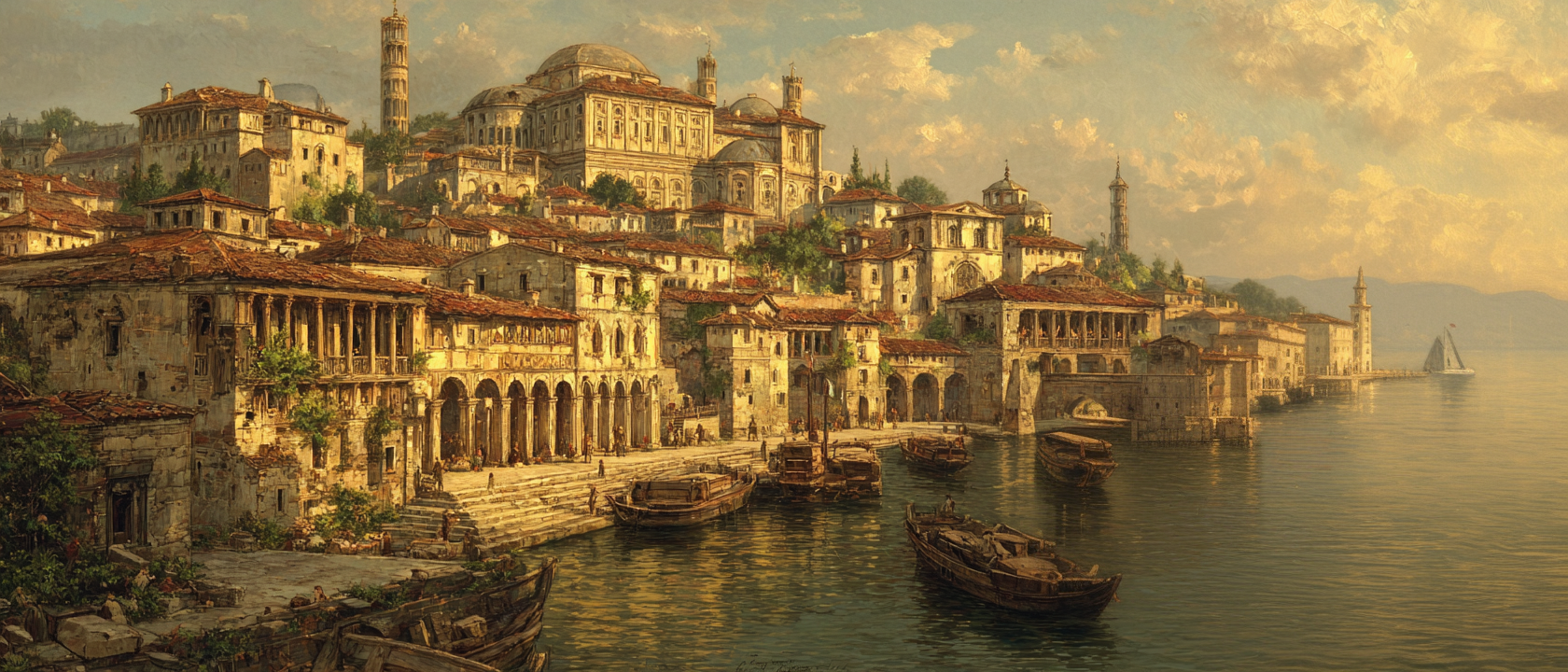
VIA QUARTER
The Oldest Road · District · Vetus Portus
"The Via Quarter is where the first-century town is most legible — the old river road running north to south as the district's spine, the buildings along it repurposed so many times that their original functions are archaeological questions rather than living memory. The inn that is now a cooper's workshop was a cavalry remount station in the second century and a grain store before that. The building that currently houses three residential families and a dyer's operation was the waystation's original administrative post, the first Imperial building north of Nova Romae. I find this accumulation of repurposed purpose clarifying rather than confusing. A building that has served seven functions in twelve hundred years is not confused about what it is. It is simply very old and still standing, which is its own form of clarity."
The Via Quarter is the section of Vetus Portus along the original river road — the Via Lacensis's first-century northward extension, which ran from Nova Romae along the Fluminis Magnus's eastern bank and made Vetus Portus a waystation rather than simply a collection of farms beside a river. The road is still there, its original stone paving under twelve centuries of repair and overlay, its course unchanged because the road went where it needed to go and subsequent generations found no reason to disagree. The buildings along it are the town's oldest above-ground structures, their first-century bones visible in the ground-floor stonework even where the upper floors have been rebuilt entirely. The district has two thousand permanent residents and the specific quality of a place whose buildings have outlived every purpose they were built for and have accommodated whatever purpose arrived next with the indifference of very old stone.
The Via Quarter's relationship with the Aquila operation is different from the other districts' — not the farming families' social integration or the wharf district's operational infrastructure, but the specific usefulness of buildings whose ownership histories are so complex that the Aquila firm's title archive contains more complete records of them than the Tabularium does. Several of the quarter's buildings have ownership chains going back to the first century that have never been formally consolidated in the official record — the original waystation buildings were Imperial property, transferred to private ownership at various points under circumstances that the official record describes with the vagueness of administrative processes that were not carefully documented at the time. The Aquila firm's archive contains the original transfer documents for four of these buildings. Their current owners do not know this. Their current owners' title is secure. The question of whether it would remain secure if someone examined the transfer chain carefully is a question that Servilia Aquila has assessed and filed under information rather than obligation.
"The building that was the first Imperial administrative post north of Nova Romae is currently occupied on the ground floor by a dyer named Titus whose output is the best quality indigo work in the province, and on the upper floors by three families who share a landing and a water arrangement that has apparently been a source of negotiated compromise since the seventh century. I spent an afternoon with Titus, ostensibly examining his dyeing process and in practice trying to establish whether he was aware that the floor he works on is the oldest continuously occupied administrative space in the empire outside Nova Romae itself. He was not. He was aware that the stone was very good quality and had given him no drainage problems in twenty years of operation, which he considered the more relevant fact. He is correct."
Demographics
Approximately two thousand permanent residents — the artisans and small traders whose businesses occupy the repurposed waystation buildings, the residential families on the upper floors of those buildings, and the service workers whose functions serve the market square's commercial activity without being part of it. The district has more non-Roman residents proportionally than the Old Fields — the waystation's first-century function as the empire's primary northern stopping point brought travellers from everywhere, and a small proportion of every generation of travellers has remained, their descendants now as much a part of the Via Quarter's fabric as the families who have been here since the first century. The dyer Titus is the fourth generation of a family whose original member arrived from the eastern provinces in the seventh century and has not left.
The district's artisan community — the dyer, the cooper who works in the old remount station, the potter whose kiln occupies the ground floor of a building whose second-century use was a Legion equipment repair depot — has the specific character of craftspeople working in spaces not designed for their crafts and finding, over generations of adaptation, that the spaces have become exactly right for the work. The old Legion repair depot's stone floor, designed to handle heavy equipment, handles a potter's kiln and its thermal stresses without difficulty. The remount station's high ceilings and wide doorways, designed for horses, accommodate barrel storage and the barrel-making equipment with room to spare. The first-century engineers built for purposes that subsequent centuries have repurposed, and built well enough that the repurposing has worked.
History
The Via Quarter's existence begins with the road — the Via Lacensis's first-century northward extension that made Vetus Portus a waystation and the waystation buildings that followed. The district's buildings are the empire's oldest provincial construction outside Nova Romae, their first-century ground floors the physical evidence of what the empire looked like when it was new to this world and building everything it needed from the beginning. For full chronological detail, see: Annales Mundi.
Points of interest
The first Imperial administrative building north of Nova Romae — currently the ground-floor dye works of Titus the dyer, his operation occupying the space where the empire's first northern prefect processed the waystation's official business in the first century. Titus is aware that the building is old. He is not aware of its specific significance, which is a condition he shares with most of the Via Quarter's residents regarding most of the buildings they live and work in. The building's ground floor stonework is the best-preserved first-century administrative construction outside Nova Romae's Old City, and the drainage channel in the north-east corner that Titus uses to manage his dyeing process runoff was designed to drain the administrative archive's water supply and has been redirected to its current purpose without any modification because it drains in exactly the right direction for both functions.
The third-century milestone at the district's southern end — maintained in position on Aquila advice, its Nova Romae distance carved in the old numeral style, worn but legible. The milestone is the district's most photographically visited feature and its most institutionally complex, its position a reference point in surveys that the town's civic administration does not know exist. Visitors who examine it closely will notice that someone has recently cleaned the carved numerals with more care than the town's maintenance budget would typically allocate to a roadside stone. The cleaning was done three weeks ago by Decimus Aquila Novi, who checks the milestone's position against the internal survey every six months and considers the maintenance a professional responsibility.
The Road Itself
The Via Lacensis in the Via Quarter is the most completely preserved section of first-century road paving in the province — the subsequent repairs visible as patches of slightly different stone rather than replacements of the original, the original paving surviving because it was laid correctly the first time and the repairs have been confined to what genuinely needed replacing. The road authority in Confluentes has a standing request to examine the paving for inclusion in the empire's infrastructure survey. The town watch has a standing practice of directing road authority surveyors to the market square for the prefect's attention, where they are received courteously and offered refreshment and eventually advised that the road is under standard maintenance and does not require special survey attention. The road authority has submitted the examination request eleven times in forty years. The outcome has not varied. This is not the Aquila operation's management — it is simply the town's general preference for not having officials examine things closely, applied consistently across categories.
Architecture
The oldest above-ground buildings in the town — first-century ground floors with varying upper stories, the construction quality of the original waystation infrastructure visible in the ground-floor stonework's precision, which is better than anything built in the province since the third century and which has kept the buildings standing through twelve centuries of repairs to the floors above. The road itself is the district's most significant architectural element: original first-century paving under the overlay of subsequent repairs, the stone worn smooth by twelve centuries of foot and wheel traffic, its camber and drainage channels designed by engineers who had been building roads in the old world for three centuries and who applied that experience to a new world that happened to have exactly the terrain the technique required.
The milestone at the district's southern end — third-century, the distance to Nova Romae carved in the original Imperial numeral style that was replaced by the current standard in the fifth century — is the most visited historical object in the town by the small number of historically interested visitors who come to Vetus Portus specifically for its age. Varro has noted it in three separate documents. The Aquila firm's advice sixty years ago that it should remain in place was accurate on its stated grounds and also, incidentally, correct on the unstated grounds that the milestone's position is a reference point in the firm's internal survey of the pre-town field boundaries, and moving it would have required updating a set of measurements that the firm preferred to leave undisturbed.
Geography
The Via Quarter runs north to south along the river road, its width the depth of the buildings on either side of the road — roughly two streets east of the road and one street west before the ground drops to the wharf district's river frontage. The district is narrow and long, its shape determined by the road that is its reason for existing. The northern end of the quarter is where the road approaches the market square; the southern end is where the road continues out of town toward Nova Romae, the town's edge marked by a milestone that is third-century and that the town has maintained in its original position because the Aquila firm advised, sixty years ago, that moving it would create a boundary question that was more expensive to resolve than leaving the stone in place.
Access
Road and streets — fully public. Buildings — private commercial and residential.
First administrative building's dye works — Titus's commercial premises, accessible during business.
Key NPC
Titus the Dyer
Decimus Aquila Novi

Comments