
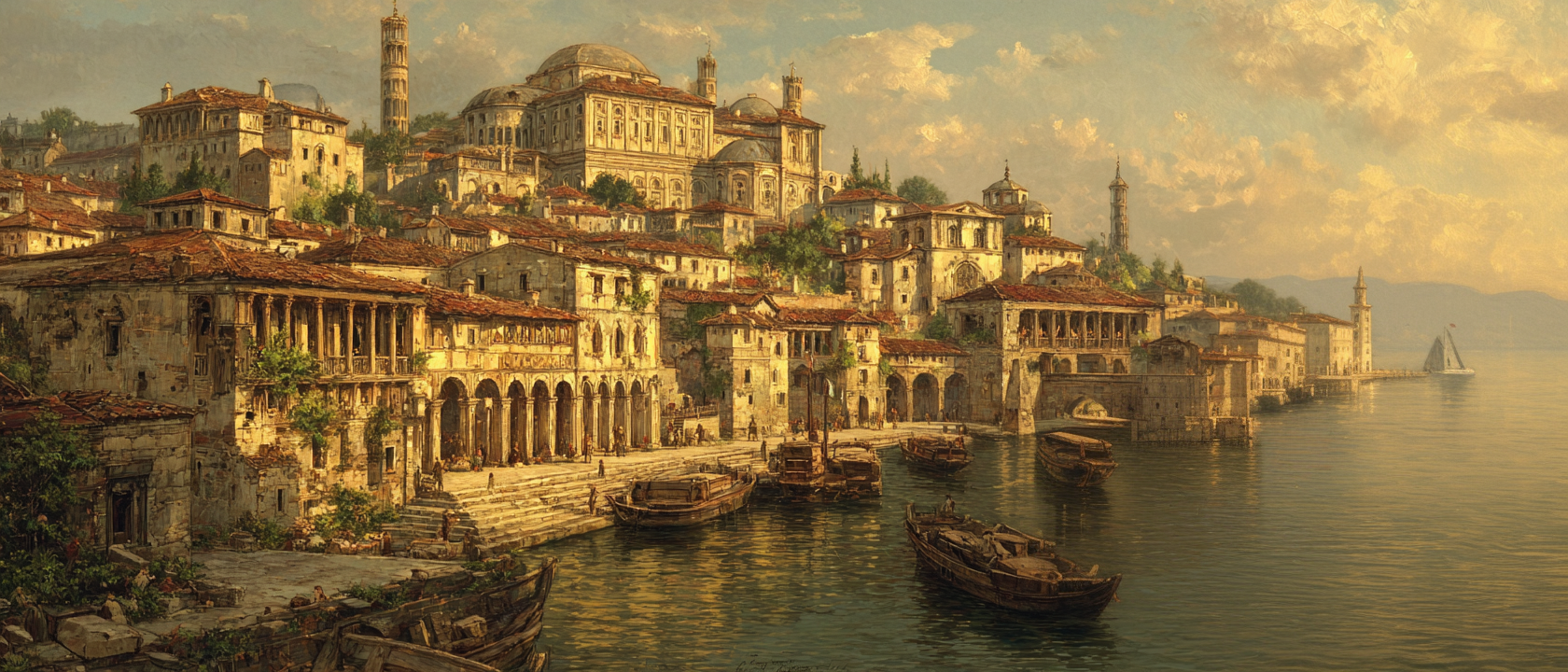
AEDIFICIUM PRIMUM
The First Administrative Building · Historic Structure / Working Premises · Via Quarter, Vetus Portus
"I spent an afternoon with Titus, ostensibly examining his dyeing process and in practice trying to establish whether he was aware that the floor he works on is the oldest continuously occupied administrative space in the empire outside Nova Romae itself. He was not. He was aware that the stone was very good quality and had given him no drainage problems in twenty years of operation, which he considered the more relevant fact. He is correct."
The Aedificium Primum is the oldest continuously occupied administrative structure in the empire outside Nova Romae’s Old City: the first Imperial administrative post north of the capital, built in the first century to process the waystation’s official business, now occupied on its ground floor by Titus the dyer’s indigo operation and on its upper floors by three residential families. Titus, forty-six, the fourth generation of a family whose original member arrived from the eastern provinces in the seventh century, is aware the building is old. He is not aware of its specific significance, which he shares with most of the Via Quarter’s residents regarding most of the buildings they work in.
The building’s ground floor stonework is the best-preserved first-century administrative construction in the province: the precision of the original imperial engineering visible in the dressed limestone’s quality, the drainage channel in the north-east corner that Titus uses for his dyeing process’ water management designed for an archive’s water supply and redirected without modification because the drainage angle works identically for both purposes. The building has been repurposed seven times in twelve centuries. The stone has not changed.
Design
Two storeys on the Via Lacensis’s eastern side: the ground floor a single large space whose original administrative layout is visible in the column positions that divided the space into the processing areas the first-century prefect required, now serving as the natural divisions of Titus’s dye works. The upper floor two residential apartments whose tenants are the third, fifth, and seventh families to occupy the building since its administrative function ended. The north-east corner’s drainage channel runs to a sump outside the building’s eastern wall that has been receiving water in one form or another since the first century.
History
First century A.P.: the first Imperial administrative post north of Nova Romae, the first prefect of the first northern waystation processing the empire’s northward expansion from this room. Subsequent uses: grain storage (second and third centuries), Legion equipment depot (fourth century), private residence (fifth through seventh centuries), weaving workshop (seventh and eighth centuries), current residential and commercial use from the ninth century. Seven documented functions in twelve hundred years. The stone has been here for all of them. For full chronological detail, see: Annales Mundi.
Access
Ground floor dye works: commercial premises, accessible during business.
Upper floor: private residential.

Comments