
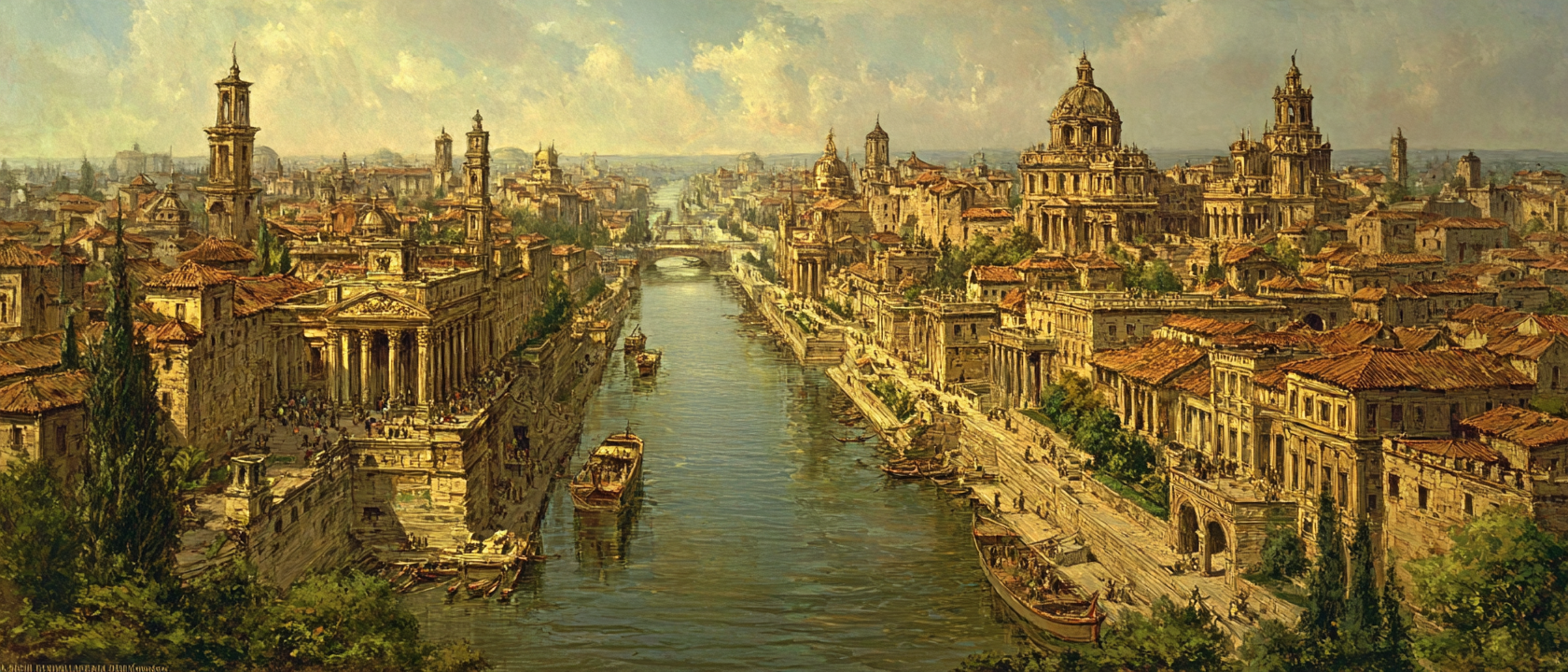
BRIDGE QUARTER
Where the Banks Meet · District · Confluentes
"The Bridge Quarter is the only part of Confluentes that belongs equally to both banks, which means it belongs completely to neither, which means it has developed the character of all genuinely neutral ground: everyone uses it, everyone is comfortable there, and the comfort comes precisely from the fact that no institution has successfully claimed it. The Guild's jurisdiction is strongest on the western bank and diminishes as you cross. The governor's jurisdiction is strongest on the eastern bank and diminishes as you cross in the other direction. The bridge itself is the point at which both jurisdictions are at their weakest simultaneously, and in twelve centuries the space on and around that bridge has filled, as such spaces always do, with the commercial and social activity that finds the absence of strong institutional oversight congenial."
The Bridge Quarter spans both banks of the Fluminis Magnus at the city's oldest crossing point, its mixed residential and commercial character the product of twelve centuries of being the place where the western bank's barge families and the eastern bank's administrative community meet on ground that neither side can entirely call its own. The district is Confluentes's most socially integrated — the hereditary guild members from the western bank residential streets, the administrative staff from the eastern bank's institutional district, the commercial service workers who service both, and the transient population of traders, travelers, and river professionals passing through the city all mix here in the specific combination that crossing points produce when they have been crossing points for long enough. The bridge itself is the oldest continuous piece of civic infrastructure in the province, its foundation piers third-century stone reinforced four times since and its roadway rebuilt entirely in the seventh century and partially in the eleventh, the whole structure carrying a weight of daily use that the original engineers would have considered gratifying and that the River Authority's bridge maintenance team considers professionally challenging on an ongoing basis.
The Bridge Quarter's commercial character is the city's most diverse — the market that has operated on the bridge's western approach since the fifth century, the eating houses along the eastern approach that serve the mixed clientele that the crossing produces, the small traders whose stalls occupy the bridge's pedestrian margins on the days when river traffic is light enough that the bridge master permits commercial use of the margins. The district is where information moves most freely in Confluentes, because information moves most freely in places where people from different institutional worlds meet regularly on neutral ground, and the Bridge Quarter is the only place in the city where the Guild's hereditary barge families and the River Authority's inspection officers eat at the same establishments without the encounter being a professional event requiring careful management. Off the clock, in the Bridge Quarter's eating houses, conversations happen that do not happen anywhere else in the city, and the Via Obscura's most productive Confluentes operators have known this for two centuries.
"I have eaten in the Bridge Quarter on every visit to Confluentes and consider it, without qualification, the best place to eat in the interior provinces. This is not because the cooking is extraordinary — it is good, solidly good, the product of establishments that have been feeding hungry working people for generations — but because the clientele is the most interesting cross-section of the city available at a single table. On my most recent visit I sat adjacent to a senior barge family master who was explaining the spring flood's upstream timing to a River Authority inspection officer who was explaining the legal basis for cargo manifest amendments to the barge master. Both were off duty. Both were entirely frank. Both were, I concluded, more useful to each other than their institutional roles permitted them to acknowledge professionally. I paid for their food and asked no questions."
Demographics
Approximately ten thousand permanent residents — the mixed population that the crossing point's neutral character produces over centuries. The western side of the district has a higher proportion of barge family members and Guild-affiliated residents; the eastern side has more administrative and commercial service workers. The bridge itself and the streets immediately adjacent are the most socially mixed zone in the city, the crossing point producing daily contact between populations that live in the same city but in institutional worlds that rarely otherwise intersect. The proportion of non-Roman residents is higher here than in the western or eastern bank districts — traders from the eastern provinces passing through Confluentes find the Bridge Quarter's neutral character and mixed clientele more comfortable than the Guild's territory or the administrative district, and a portion of every generation of such traders has remained.
The district's eating house community — eleven establishments ranging from the thousand-year-old institution on the eastern approach to the three relatively recent operations that opened in the past thirty years — employs approximately two hundred people and feeds several times that daily. The proprietors of the older establishments have accumulated, across generations of feeding the city's institutional population in an off-duty context, a social knowledge of Confluentes that is in some respects more complete than the Via Obscura's operational intelligence, in the sense that people eating in a comfortable establishment say things they would not say in any context where they believed they were being observed. None of the proprietors are Via Obscura operators. Two of them are on cordial terms with Via Obscura operators who eat regularly at their establishments, which is a different relationship and one that the proprietors understand perfectly well.
Guilds and Factions
The Bridge Quarter is the one district in Confluentes where the Guild's dominance is genuinely attenuated — the bridge master's appointment is Guild-confirmed but the position's practical authority is civic, the market's Guild management is resented by the market community on historical grounds, and the eating houses' social function as neutral ground has been maintained precisely because the Guild's protection officers and the River Authority's inspection staff both use them and both need the neutral character to persist. The Via Obscura's Bridge Quarter operation is the network's most socially embedded in Confluentes — not an intelligence network operating in the quarter so much as a set of operators who are part of the quarter's fabric, whose information comes from being genuinely present in a place where information flows freely, and whose most productive asset is the bridge master's private memorandum, which they do not yet know exists.
History
The crossing at this point is older than the bridge — the river was forded here in the first century before the bridge's construction, the location chosen for the same reason the city chose its confluence position: the river is narrowest here and the approach ground on both banks is firm. The bridge's foundation piers are third-century, contemporary with the Guild's formal charter, and the two constructions — the bridge and the charter — are the third century's twin contributions to Confluentes's permanent institutional structure. Both have been maintained, modified, and argued over ever since. Neither has been replaced. For full chronological detail, see: Annales Mundi.
Points of interest
The Bridge Market
The market on the western bridge approach has been operating since the fifth century — a daily market in the warmer months, a reduced three-day-per-week operation in the winter — selling the mixed goods that a market serving a mixed population produces: food from the surrounding agricultural province, goods from the eastern trade arriving via the Confluence Quarter, river-related equipment and supplies for the barge community, and the category of miscellaneous traded goods that all long-established markets develop when they have been running long enough to attract sellers of everything that anyone might want to buy. The market master, a Guild-appointed position since the eighth century, manages the stall licensing and the daily setup with the institutional authority of someone whose appointment comes from the Guild and whose practical management requires the cooperation of a market community that predates the Guild's involvement in it by three centuries. The current market master, Livia Mercata Pontis, forty-nine, in her seventh year, has resolved this authority question in the practical direction — she manages what the market needs managing and leaves the historical question of whose market it is to the lawyers.
Show SpoilerGnaeus Pons Veteris has been watching the city cross his bridge for twenty-three years. He knows the regular patterns — which barge families cross at which times, which administrative staff take which routes, which of the city's less institutionally visible residents use the bridge margins at what hours. He also knows the irregular patterns — the crossings that happen outside the regular schedules, the traffic that uses the bridge at hours when its use is technically permitted but practically unusual, and the three specific individuals who have been crossing at irregular hours over the past eight months in a pattern that he cannot account for by any commercial or administrative logic he can construct. He has noted all of this in his private memorandum, which has grown from its original eleven-year scope into something that now contains material he is not certain he should be holding in a private document. He has not shown it to anyone. He is not certain who the correct person to show it to would be, because the three individuals' crossing pattern suggests involvement with one or more of the city's institutional powers in a way that makes every obvious recipient of the information a potentially interested party rather than a neutral one.
Architecture
The Bridge Quarter has the architectural character of a district that has been built, rebuilt, and infilled across twelve centuries without any single period's aesthetic dominating — the third-century bridge piers visible at the waterline, the seventh-century roadway above them, the fifth-century market buildings on the western approach in their ninth-century modified form, the eating houses on the eastern approach ranging from a second-century building that has been continuously operated as a food establishment for over a thousand years to a structure rebuilt entirely after a flood in the tenth century whose owner chose a design that was fashionable in Nova Romae at the time and that now looks slightly incongruous amid its older neighbours in the specific way that buildings from the wrong century always do. The district does not look old in the way that the Via Quarter in Vetus Portus looks old — it looks used, which is a different quality, the quality of a place that has never stopped functioning long enough to develop a historical patina.
The bridge master's house, on the western bridge head, is the district's most institutionally interesting building — a fifth-century construction that has been the bridge master's official residence since the position was created, its occupant responsible for the bridge's maintenance schedule, the traffic management on days of heavy river barge movement when bridge crossings are timed to avoid the swing-weight interference that heavy pedestrian loads create on the crossing structure, and the commercial licensing of the bridge margin stalls. The current bridge master, Gnaeus Pons Veteris, sixty-six, in his twenty-third year, has more practical knowledge of the city's daily movement patterns than anyone else in Confluentes and has never been asked to share it systematically by any institution, which he considers a significant administrative oversight and about which he has been writing a private memorandum for eleven years that he has not yet completed.
Geography
The district occupies both banks at the crossing point, its extent defined by the bridge's gravitational pull on commercial and residential activity rather than by any administrative boundary. On the western side, the Bridge Quarter begins where the barge families' residential streets end and the mixed-use zone around the bridge approach starts — approximately three streets back from the bridge head. On the eastern side, it begins where the administrative district's formal institutional buildings give way to the more commercially varied streets of the bridge approach. The bridge itself — wide enough for two loaded carts to pass in opposite directions, which was the design requirement when it was built and remains the traffic requirement today — is the district's physical centre and social spine.
Access
Bridge and streets — fully public.
Bridge margin stalls — licensed commercial, seasonal.
Eating houses — public.
Bridge master's house — official business only.
Key NPCs
Gnaeus Pons Veteris
Livia Mercata Pontis
Fausta Mensae Antiquae

Comments