
FONS FLUMINIS
The Sacred Spring · Town · Provincia Septentrionalis
Fons Fluminis is older than it looks, which is itself a strange thing to say about a place, since most places look approximately as old as they are. What I mean is that the settlement is modest — eight thousand people, a College shrine, an Academy monitoring post, the pilgrim facilities that the shrine requires — and that the spring from which the Fluminis Magnus begins is, by every natural measure, simply a spring emerging from limestone karst in the foothills. A large spring, geologically active, reliably flowing. A source. And yet I have been here four times now and each time I have stayed longer than I planned and left feeling that I had not quite resolved something I had not quite managed to articulate. I note this as a personal observation rather than a scholarly one. I am aware that the distinction is not always as clean as I would prefer.
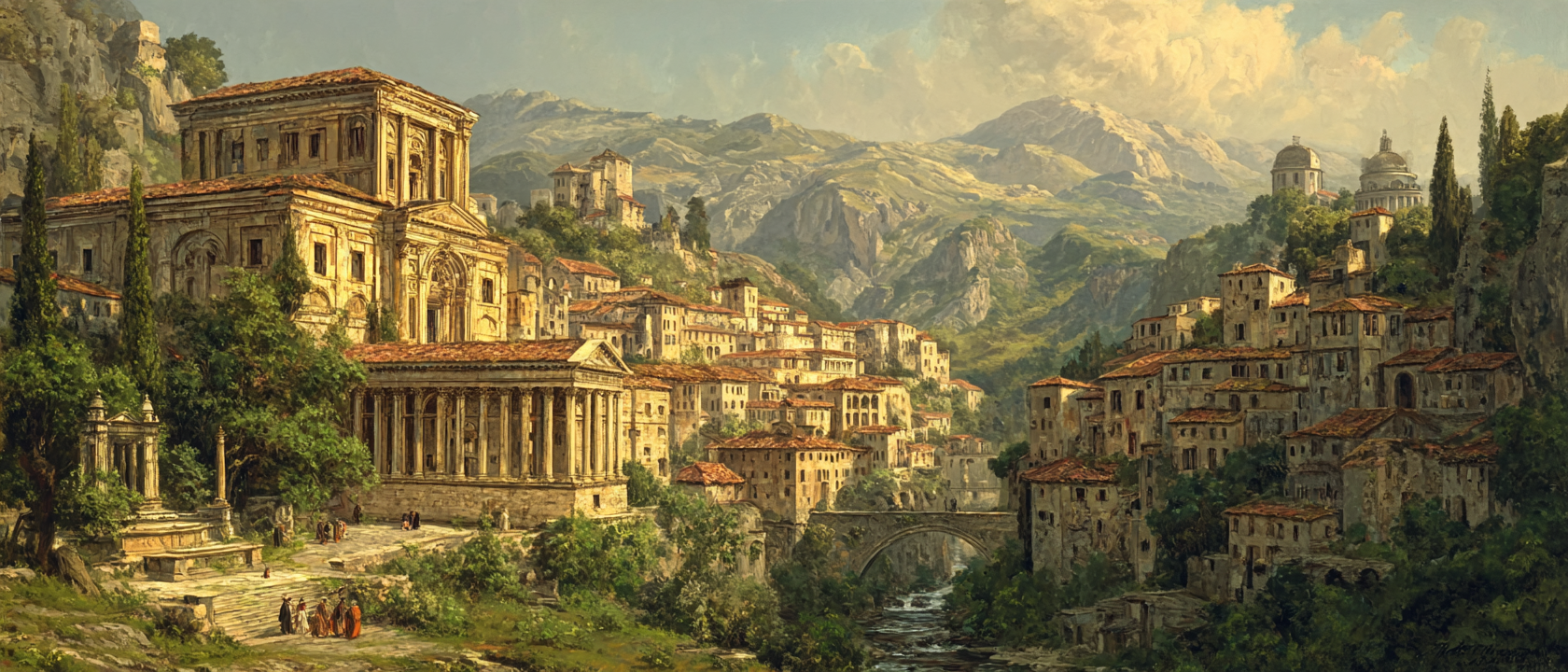
Fons Fluminis is a small town of approximately eight thousand permanent residents at the edge of the Inland Sea plain and the Iron Spine foothills, in the transitional limestone karst zone where the Fluminis Magnus begins. It exists because the sacred spring is here and because the sacred spring requires tending, which requires people, which requires a town. The College of Pontiffs maintains a substantial shrine at the spring — the Fons is officially sacred to Jupiter in his capacity as the source of the Empire's foundational river — and the pilgrimage traffic this attracts supports the town's economy. The Academy's monitoring station is a smaller institutional presence but a significant one. The town is otherwise quiet, modest, and has the character of a place that has been important for longer than it looks.
What nobody has satisfactorily explained — not the College's priests, not the Academy's scholars, not the natural philosophers who have visited specifically to investigate — is why Fons Fluminis is what it is. The spring's flow is consistent in ways that limestone karst springs are not supposed to be consistent. The water's temperature does not vary seasonally in the way that water at this depth and latitude should. The light in the clearing where the spring emerges behaves, at certain times of day and in certain weather conditions, in ways that several careful observers have documented and none have explained. The College has an official position on all of these anomalies. Several of its own priests find that position insufficient.
Demographics
Eight thousand permanent residents, divided between the College's priestly community, the Academy's small research staff, and the service population that sustains both institutions and the pilgrim traffic. The permanent population has been approximately this size for several centuries, growing and contracting with the pilgrim traffic's fluctuations but never reaching the density that would classify it as a city. The pilgrim population is harder to count: a steady flow of visitors, peaking at festival periods, whose time in the town ranges from an afternoon to several weeks depending on their purpose and resources.
The town's permanent residents have the specific quality of people who live next to something that visitors travel far to experience and that the residents have largely stopped experiencing in the heightened way visitors do. They maintain the shrine, serve the pilgrims, study the spring, and conduct the ordinary commerce of a small provincial town. The spring is background. The anomalies are weather, in the sense of being noticed and noted and not particularly alarming. Several of the long-term residents find it difficult to explain to visitors why the spring's peculiarities are not more disturbing. The honest answer is that familiarity is a more powerful force than strangeness.
Government
Fons Fluminis is administered by a town prefect appointed by the Governor's office — a modest posting, currently held by Marcia Fonta Rivalis, in her second year. Rivalis manages the pilgrim facilities, the road maintenance, and the civic infrastructure with the competence of someone who understands her role is primarily facilitation rather than governance. The College shrine's senior priest — Pontifex Fluvius, twenty years in the posting — manages the shrine's affairs with the authority that a senior College appointment carries, and his relationship with Rivalis is cordial and appropriately bounded. The Academy station's director manages the research facility independently. The three institutions have learned to coexist without competing, because the town is not large enough for institutional competition to be sustainable.
Defences
No garrison. The town watch — six constables — manages the pilgrim population and the occasional disputes that a steady flow of strangers through a small community produces. The College shrine has its own internal security in the form of two temple guards whose function is ceremonial and practical simultaneously. The location's isolation — a day and a half from Agropolis, at the edge of the foothills — provides a natural defence against organised threat that the town has not faced in its recorded history. What the town has faced, periodically, is the specific category of visitor who comes not as a pilgrim or a scholar but with an interest in the spring that Pontifex Fluvius describes as inappropriate and that requires the temple guards' non-ceremonial function.
Industry & Trade
The pilgrim economy — the inns, eating houses, votive shops, and services that pilgrims require — is the town's primary commercial activity, supplemented by the modest farming and pastoral activity of the valley's permanent residents. The College's shrine generates significant votive offering income that funds the shrine's operation and contributes to the College's central accounts. The Academy station's budget comes from the Academy in Nova Romae and has no local commercial dimension. The town produces one export of note: the spring water itself, bottled and sealed, sold through the votive shops and carried by pilgrims to their homes throughout the Empire. The water's properties when bottled are the same as any clean spring water. The pilgrims believe otherwise. Pontifex Fluvius does not correct them, which the Academy's station director finds theologically uncomfortable and practically understandable.
Infrastructure
The road from Agropolis — a branch of the Via Segetalis that turns northwest at the plain's edge — is maintained as a pilgrim road, its surface adequate for the foot and cart traffic it carries. The spring's water management infrastructure, the channels that direct overflow from the spring-basin into the stream that becomes the Fluminis Magnus, is the most carefully maintained engineering in the town, its condition monitored continuously by the Academy station and maintained by the College's own engineering staff. The two institutions disagree about the maintenance protocols, the monitoring methodology, and the interpretation of what the monitoring shows, while agreeing that the spring's water management is the town's most critical infrastructure and that neither institution should be solely responsible for it.
DM ONLYGuilds and Factions
The College's shrine community and the Academy's monitoring station are the town's institutional powers, their relationship characterised by the polite professional tension of two institutions that need the same site for different purposes and that have developed different explanations for what the site is. Pontifex Fluvius's explanation is theological: the spring is sacred to Jupiter, its unusual properties are divine manifestations, and the appropriate response is worship and maintenance. The Academy station director Caelestis's explanation is empirical: the spring has unusual properties that require documentation, and the appropriate response is observation and recording. Both explanations are incomplete. Both men are aware that the other's explanation catches something theirs does not. They have discussed this twice, briefly, and returned to their respective positions.
DM ONLYHistory
Fons Fluminis is older than the Roman settlement. The Processional Way's ancient paving establishes presence before the Permutatio; whatever community used this site before the Romans arrived left no other documented trace. The first Roman settlement here was in the second century. The College shrine was built in the fourth century, on foundations whose age Caelestis's team has not published. The Academy monitoring station was established in the eighth century, originally for agricultural watershed research. The ongoing anomaly documentation began in 1030 A.P. when a scholar followed the Fluminis Magnus to its source and spent three days making notes that the Academy later identified as the first systematic record of the spring's unusual properties. For full chronological detail, see: Annales Mundi.
Points of interest
The spring itself (in the clearing behind the shrine's formal basin, accessible through the College's precinct) — the experience that pilgrims come for and that the College manages carefully. The formal access is through the shrine's offering ritual, which provides a structured encounter with the spring that the College controls and that produces the experience the College intends. Informal access, going around the shrine to the clearing's edge, which is technically outside the College's precinct, is not prohibited and provides a different experience: the spring visible from a slight distance, the sound of the water, and the specific quality of the clearing's light, which is consistently, slightly, wrong in a way that rewards careful observation without explaining itself.
The Academy monitoring station's observation logbook (station front desk, accessible to any visitor who asks) — twenty years of daily spring observations recorded in the dry language of scientific documentation. Read consecutively, the entries constitute the most complete record of the spring's anomalous behaviour available outside the College's internal reports. Several entries are annotated in a different hand with question marks. The annotations are in Caelestis's handwriting. He has not responded to questions about what he is questioning.
The Processional Way (formal pilgrim route from the town entrance to the shrine) — the oldest path in Fons Fluminis, worn smooth by twelve centuries of foot traffic. Its stones are not all the same age. The section nearest the shrine contains paving that the Academy's geological assessors date to significantly before the first Roman settlement. How significantly before is a number that Caelestis has told Pontifex Fluvius and that neither of them has told anyone else. The College's position is that the site has always been sacred. This is, on the evidence, correct.
Tourism
Fons Fluminis is a pilgrim destination and has been for twelve centuries. The College's shrine is the primary draw: the formal pilgrim experience, the offering ritual, the opportunity to see the spring through the shrine's managed access. The town's facilities are adequate for the pilgrim traffic and occasionally strained at festival periods. Visitors who come for scholarly rather than religious purposes find the Academy station's logbook, the Processional Way's ancient paving, and the clearing's observable anomalies collectively more interesting than the shrine's formal experience, a preference that Pontifex Fluvius notes without comment and that Caelestis enables by keeping the logbook accessible.
Architecture
The College shrine is the town's most substantial building: built in the pale marble that the College uses for its significant installations regardless of local material availability, its proportions deliberately larger than the town would seem to warrant. The College has been aware since the shrine's construction in the fourth century that Fons Fluminis is a location whose significance exceeds its size, and the architecture is its institutional statement about that significance. The shrine's interior contains the spring-basin, the formal access point where pilgrims make offerings, and the priests' residential quarters, which are larger than they need to be for the current staff and which have been that size since a period in the sixth century when considerably more priests were stationed here than are now.
The Academy monitoring station is a single building of modest scale at the clearing's northern edge: a research facility rather than a statement, built in the local limestone and maintained with functional rather than aesthetic priority. The pilgrim facilities — the inns, the eating houses, the votive shops — are scattered through the valley in the organic arrangement of buildings that have grown to serve a visiting population rather than been planned for it.
Geography
The town sits at the base of the first significant limestone ridge of the Iron Spine foothills, approximately a day and a half north of Agropolis by road and an hour's walk above the plain's edge. The spring emerges from the ridge's base in a natural clearing: the bedrock here is fractured in a pattern that the Academy's geologists have mapped carefully and that does not conform to the fracture patterns of the surrounding karst. The Fluminis Magnus begins here as a fast-moving stream that widens gradually as it descends to the plain, and the town has grown up around the spring's clearing, the shrine on the clearing's western edge, the Academy station on the clearing's northern edge, and the pilgrim facilities spreading through the valley between the ridge and the plain below.
Climate
The foothills location is cooler than the plain below, noticeably so in winter, when the Iron Spine's weather comes down the valleys and the town experiences conditions that the agricultural plain does not. The spring's clearing is warmer than the surrounding terrain at all times of year, by an amount that the Academy's thermometric instruments can measure and that the College's priests attribute to divine presence and that Caelestis attributes to the spring's thermal properties. Both attributions are accurate in different senses of the word accurate.
Natural Resources
The spring is the resource: the source of the Fluminis Magnus, which is the water supply for the entire river province downstream. The karst geology of the foothills above the town contains cave systems that feed the spring from underground, and the integrity of those systems is an imperial-level strategic concern that neither the College nor the Academy discusses publicly for fear of provoking anxiety about the capital's water supply. The spring has been flowing consistently for twelve centuries of Roman observation. It was flowing before the Romans arrived. There is no documented reason to believe it will stop. There is no documented explanation for why it has not varied more than it has.
College shrine votive income.
Spring water bottled and sold through votive trade.
Modest local farming and pastoral activity.

Comments