
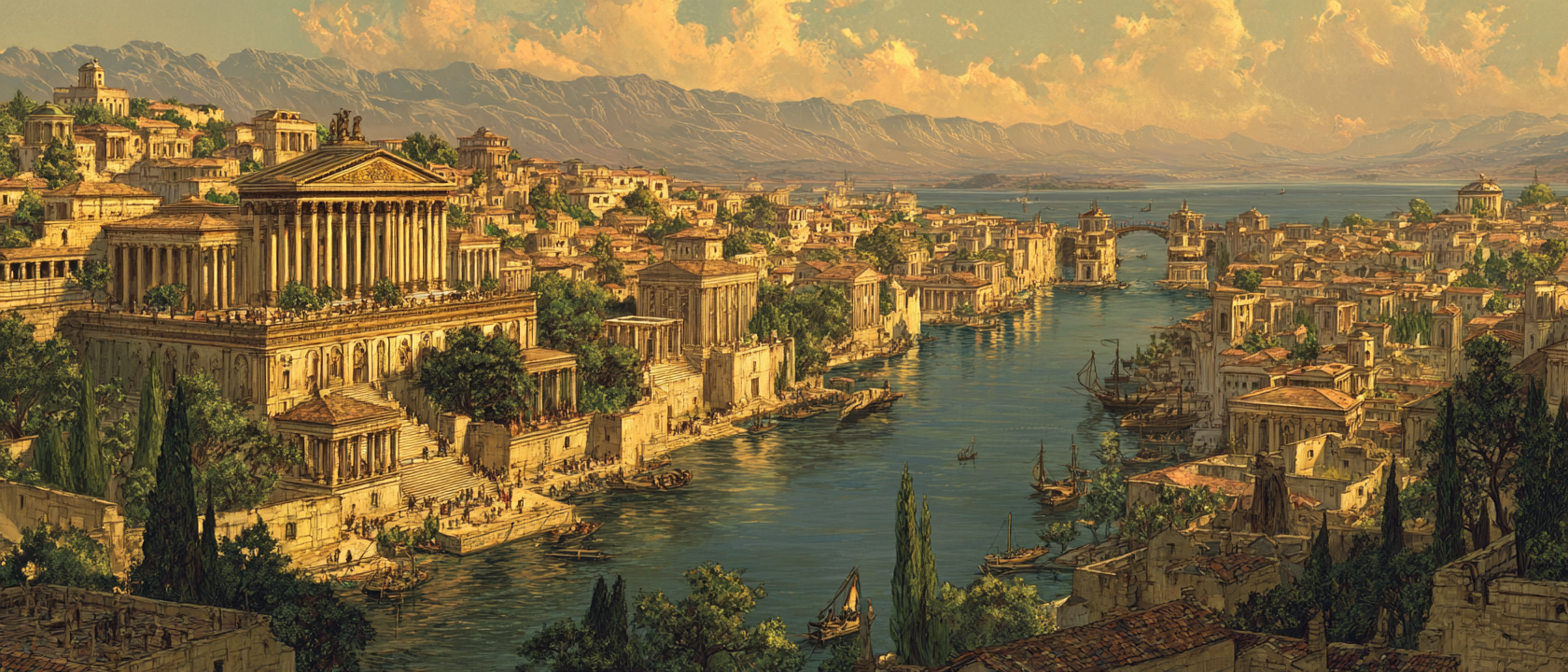
SCHOLARS' RESIDENCE
The Academy Station · District · Agropolis
"The Scholars' Residence is small enough that calling it a district is a courtesy and large enough that ignoring it would be an error. The Academy's agricultural monitoring station has been here since the eighth century, its records of three hundred years of provincial harvest data constituting the most precise long-term agricultural dataset in the Empire. The natural philosophers who work here are the least politically significant scholars in the Academy's network and, on certain questions of agricultural science and northern geology, the most practically knowledgeable. Fons Fluminis is their primary field site. They go there regularly. Several of them have been going there for twenty years and have noticed things they find difficult to account for."
The Scholars' Residence is the city's smallest district — a compact cluster of Academy-affiliated buildings at the eastern bank's northern edge, between the Wharves district and the city's outer wall, housing the agricultural monitoring station and the small community of natural philosophers who study the province's farming practices, geology, and the karst systems of the northern foothills. It has a population of approximately five hundred, a library of considerable specialist depth, and a connection to Fons Fluminis that is the district's most significant and least publicised characteristic.
Demographics
Approximately five hundred people — the senior scholars, their research assistants, the library staff, and the support personnel. The community turns over more slowly than its equivalents at the Academy in Nova Romae; the agricultural monitoring work requires multi-decade data series that benefit from researcher continuity, and several of the station's current scholars have been here for fifteen or twenty years. The result is a community with unusually deep local knowledge and an institutional memory that the Academy's central office in Nova Romae periodically attempts to access through formal data requests and the station's director periodically declines to provide in the form requested.
Government
The station reports to the Academy in Nova Romae and has no formal relationship with the Governor's administration, which Arvum finds occasionally irritating when the scholars' field research produces observations with administrative implications that they share with the Academy before sharing with the province. The station director, a natural philosopher of sixty-four named Aulus Seges Caelestis, has been in the role for eighteen years and navigates the Academy-Governor relationship with the practiced neutrality of someone who needs both institutions' goodwill and neither institution's interference.
Industry & Trade
Research and monitoring. The station's primary outputs are the annual harvest assessment data series that the Academy publishes and the Annona's regional office uses as an independent check on the estate families' self-reported yields. Caelestis's assessment data has diverged from the official exchange assessments on three occasions in his tenure — twice in ways that indicated the official assessment was too optimistic, once in ways that indicated it was too pessimistic. All three divergences were eventually validated by the weigh-houses' actual receipts. The Annona's office has been using the station's data as a backstop check for eleven years and has told neither the estate families nor the Governor's office that it does so.
The secondary research focus — the karst geology of the northern foothills and the cave systems that connect to the Fons Fluminis spring — is less commercially relevant and more scientifically interesting. The scholars who work on this research go to Fons Fluminis regularly. Several have been going for years. Their field notes, which are deposited in the station library and copied to the Academy, contain careful descriptions of observations at the spring that the scholars describe as anomalous and that Caelestis describes, in his covering letters to the Academy, as requiring further investigation. The Academy has acknowledged these covering letters. It has not funded the further investigation.
History
The monitoring station was established in 890 A.P. as part of the same Academy expansion that established the Castellum Magnum frontier academy. Its original mandate was purely agricultural — documenting harvest yields for the Empire's food supply planning. The geological research began in 1030 A.P. when a scholar investigating irrigation systems followed a water source northward and reached the Fons Fluminis spring, where she spent three days making notes that the Academy's Comparative Cultural faculty later identified as the first systematic documentation of the spring's anomalous properties. For full chronological detail, see: Annales Mundi.
Points of interest
The station library's Fons Fluminis file — the accumulated field notes, sketches, and anomaly reports from twenty years of regular scholarly visits to the sacred spring — is the most complete documentation of the spring's unusual properties available outside the College of Pontiffs' restricted archive. It is accessible to Academy-affiliated researchers. It is not accessible to the College, which has requested a copy twice and been told that the data is preliminary and not ready for external distribution. Caelestis has been saying this for six years. The data is not preliminary. He is waiting for something, and he is not certain what.
Tourism
Not a visitor destination. The station does not receive casual visitors and the district has nothing to offer a general audience. Scholars with Academy credentials and a documented research purpose can apply to use the library, which the station accepts for approximately half of all applications and declines, without explanation, for the remainder. The criterion for the distinction is not publicly available.
Architecture
Academic institutional architecture in the pale limestone that the Academy uses consistently across its provincial outposts — the same deliberate contrast with local building materials that the Castellum Magnum Academy employs, though here the contrast is with warm yellow sandstone rather than dark reddish-grey. The monitoring station building is the largest, its ground floor the observation and recording facility, its upper floor the library and senior scholars' offices. The residential buildings behind it are modest and functional, built for people whose primary activity is fieldwork rather than urban life.
Geography
The district occupies the eastern bank's northernmost ground, outside the Wharves district and technically beyond the city's main administrative boundary — a location that reflects its establishment as an Academy outpost rather than an organic part of the city's growth. The buildings face north, toward the agricultural plain and the Iron Spine foothills on the horizon, their orientation reflecting the direction of the research rather than the direction of the city's commercial activity. The Academy road connecting the district to the Via Segetalis is the scholars' primary route to their field sites in the north.
Access
Station grounds — restricted to Academy-affiliated researchers.
Library — by application.

Comments