
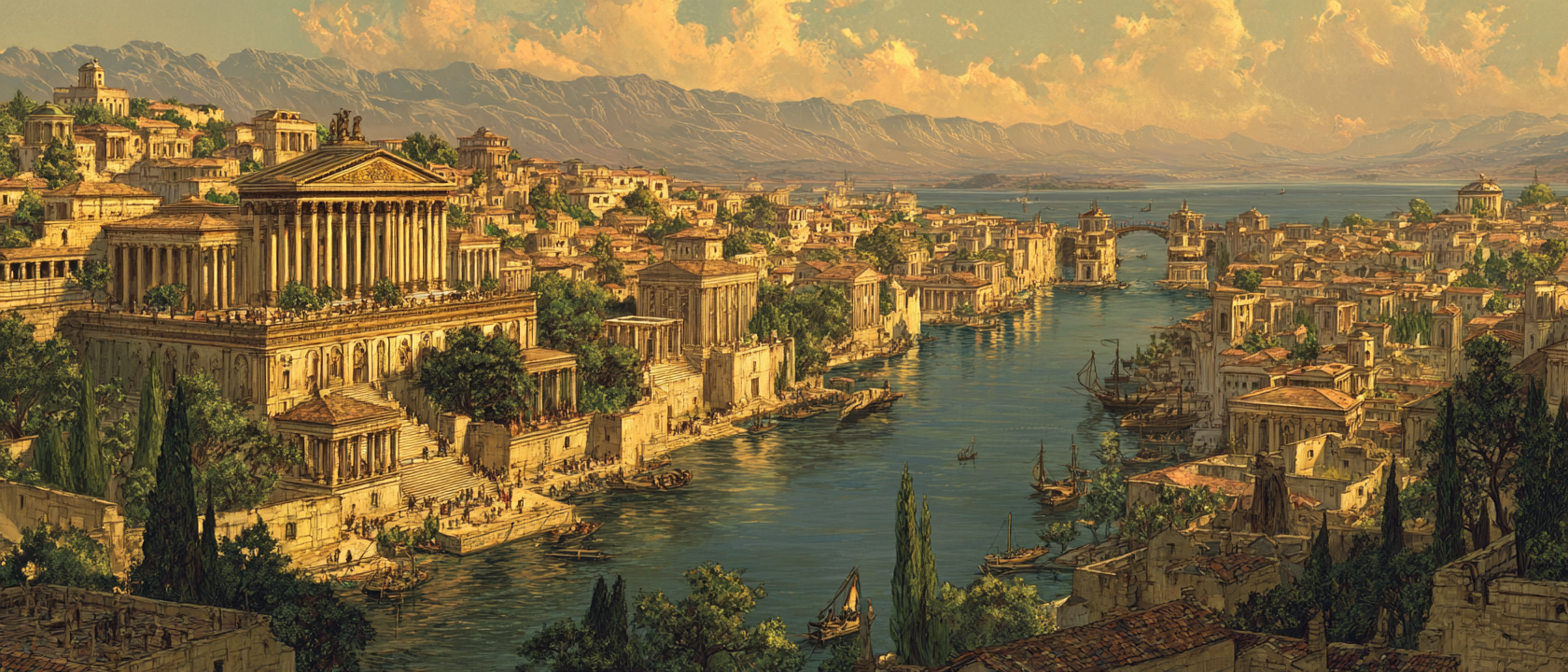
ARVINA
The Estate Families’ Club · Private Social Club and Archive · Estate District, Agropolis
"The Arvina has been in continuous operation since the third century. Its archive goes back to its founding. Its membership has been the twenty significant estate families and it has never been anything else. The city watch has never entered. No external research request has received an affirmative response. The membership secretary, who has held the role for thirty years, processes access requests with the efficiency of someone who has been declining them for the same period and has refined the decline to its minimum required form. I find the building more interesting for not having been inside it than I would if I had."
The Arvina is the most politically significant building in Agropolis that the city watch has never entered: the estate families’ private club on the Estate District’s central street, its ground floor the dining and meeting space where the province’s largest landowners discuss matters they are not prepared to discuss at the exchange or the Governor’s office, its upper floor the archive whose records go back to 243 A.P. and whose access policy has never produced an affirmative response to an external request. The current membership secretary, Tertia Arvina Minor — not her birth name, a title the secretaryship confers — sixty-seven, thirty years in the role, is the most effective gatekeeper of institutional memory in the province and the person who communicated to Arvum’s office that the pending petitions’ subject matter required careful consideration.
Purpose / Function
Social club, meeting space, and private institutional archive. The ground floor’s dining and meeting function is where the families coordinate their positions before the exchange session, discuss the Annona’s contract terms, and manage the specific category of collective decision that requires the families’ unanimous front and cannot be achieved through any more formal mechanism. The archive’s function is institutional memory: nine centuries of the families’ commercial history, maintained by the secretaryship as the province’s most complete private record of agricultural economic activity.
Design
A fourth-century building on the Estate District’s central street, its exterior in the same sandstone as the surrounding residences, its only distinguishing feature the quality of its maintenance rather than any architectural distinction. The ground floor’s meeting and dining rooms are the most carefully maintained interior in the district: the furniture eight-century construction maintained to working condition, the wall panels carrying the families’ heraldic devices in the order they were admitted to membership. The upper floor archive is arranged by family and by period, its organisation the secretaryship’s primary professional responsibility.
Sensory & Appearance
The building’s exterior is indistinguishable from the surrounding residences except for the quality of its maintenance and the absence of any signage. The main entrance on the central street is unmarked; members know where it is and non-members are not expected to need to. Inside the main dining room: the polished wood, the controlled quality of a room maintained to a consistent standard for eight centuries, the specific quiet that comes from walls designed to contain sound rather than transmit it.
Denizens
Tertia Arvina Minor , sixty-seven, thirty years as membership secretary: the province’s most effective institutional gatekeeper and, in the archive’s context, the person with the most complete knowledge of what the families’ records contain. Has communicated to Arvum’s office that the pending petitions require careful consideration. Has not communicated to Arvum’s office what the petitions would reveal if processed. Is not legally obligated to do so. Is also not certain that her current position — blocking petitions that would expose the northern interest arrangement — is sustainable if the arrangement becomes relevant to something larger than a records access dispute.
Marcus Falco Agrestis , seventy-eight, patriarch of the Falco family: the oldest significant estate family patriarch, rarely leaves the Domus Falconis, consulted by every family principal on questions requiring the longest possible perspective. Has shared his Fons Fluminis opinions with one person — the College’s local pontifex — who found them unsettling. Has opinions about Farro’s alternative procurement that he has shared with no one. Will speak with parties who demonstrate they understand the difference between the current dispute’s surface and its foundation, which he has been watching develop for longer than most of its participants have been alive.
History
The Arvina was founded in 243 A.P. by the estate families who had consolidated their holdings and determined that their collective interests required a formal social institution. The archive began simultaneously. The 400–450 A.P. records document the ‘northern interest’ arrangement in the period immediately following the consolidation’s completion. The building’s current structure dates to 341 A.P. The secretaryship was formalised as a named institutional role in the sixth century, 572 A.P. See Annales Mundi for full chronological detail.
Access
Members only. No exception in recorded history.
City watch: never entered.

Comments