
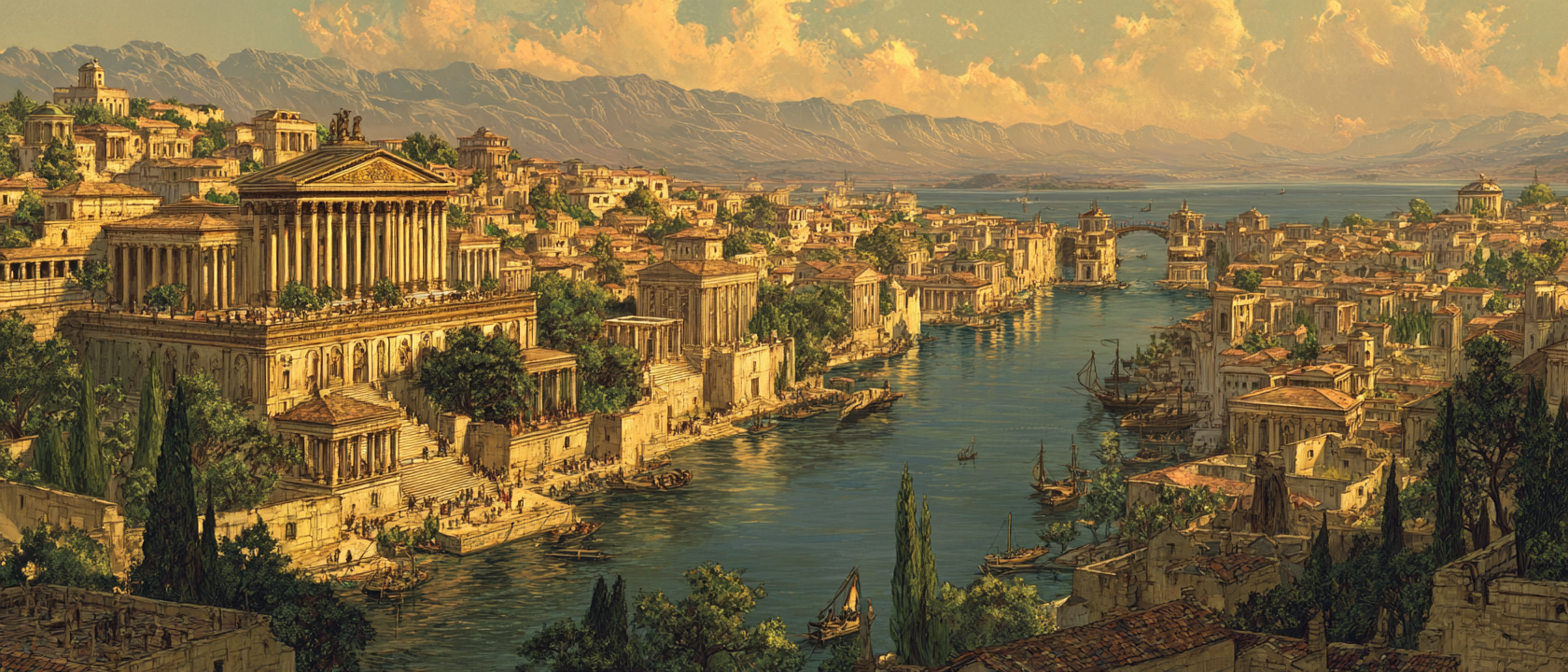
ANNONA QUARTER
The Grain Administration District · District · Agropolis
"The Annona Quarter is where the Empire's food supply is managed at the provincial level, and it has the character of that function: purposeful, large-scale, and somewhat intimidating if you understand what the buildings contain. The granaries hold enough grain to feed the capital for several months. The regional office's files contain the contractual basis for the Empire's most critical supply chain. The weigh-houses' records document twelve centuries of harvest yields with the accuracy of people who know that inaccuracy in their specific field has historically preceded political instability. I find this quarter the most sobering in Agropolis, which is a city that takes its function seriously throughout."
The Annona Quarter occupies the eastern bank's northern section — the upriver end of the city, where the barge traffic from the agricultural plain arrives first and where the granaries that receive the harvest were built as close to the unloading point as the city's layout allowed. It is the most functionally dense district in Agropolis: the four great granaries, the Annona's regional administrative offices, the weigh-houses where incoming grain is assessed and recorded, the inspection facilities where yield quality is verified, and the logistics infrastructure that connects all of these to the harbour downstream. It is not a district that welcomes casual exploration — access to the granaries and the Annona offices is controlled — but it is the district that makes everything else in the city possible.
Demographics
The Annona Quarter's working population is primarily the Annona's regional staff — assessors, inspectors, logistics managers, record-keepers, and the administrative support for all of them. This is a population of approximately eight hundred people during normal operations and considerably more during harvest assessment season, when the regional office draws in temporary staff from the Annona's other offices and from the specialist contractors who handle the increased volume. The permanent residential population is small — most Annona staff live in the Forum District or the residential areas of the eastern bank — but the district has a constant working population that gives it an active character year-round.
Government
The Annona Quarter is under the regional Prefect's direct authority — Satura's domain in the most complete sense. The Governor's administration has no formal presence in the quarter and requires the Prefect's cooperation to access its records. This arrangement, which reflects the Annona's institutional independence from provincial governance, is the structural foundation of the Arvum-Satura tension. Arvum's position is that the granaries are in his province and their security is his responsibility. Satura's position is that the granaries are Annona property, their contents are Annona contracts, and their management is none of the Governor's business. Both positions are defensible under the current legal framework, which is why the dispute has been ongoing for seven years without resolution.
Defences
The granaries are the most heavily secured civilian structures in Provincia Septentrionalis. The Legion cohort's primary posting is here — two hundred soldiers maintaining continuous watch on the granary perimeter, the weigh-houses, and the granary wharves. Access to the granary interiors requires Annona authorisation; the inspection facilities and administrative offices require lower-level authorisation but are still controlled. The security is not against military attack — the province has no military frontier — but against the specific threats that an enormous concentration of the Empire's most strategically important commodity attracts: theft at scale, sabotage, falsification of records, and the category of sophisticated commercial fraud that can move significant value without physically touching the grain.
Industry & Trade
The Annona Quarter's commercial function is grain procurement and storage — receiving the harvest from the province's estates under the contracts the Annona sets at the exchange, storing it in the granaries, and managing its despatch south by sea to the capital and the frontier legions. The weigh-houses' records, which document every grain delivery against its contracted quantity and quality, are the primary instrument by which the Annona verifies that the estate families are delivering what they contracted to deliver. Discrepancies between the exchange's yield assessments and the weigh-houses' actual receipts are the most politically sensitive documents the Annona's regional office produces, and they are produced every harvest season without exception.
Guilds and Factions
The Annona's regional staff under Satura constitute the district's sole institutional power. The estate families interact with the quarter through the contract and inspection processes and have learned, over generations, that the Annona's assessors are not susceptible to the social influence that works elsewhere in Agropolis. This is not because the Annona's staff are incorruptible — they are not, uniformly — but because the assessment system's redundancies make individual corruption difficult to conceal, and because the consequences of being caught are sufficiently severe that the risk calculation discourages all but the most carefully planned attempts. Three such attempts have succeeded in the past century. Two were eventually discovered. One has not been.
History
The first granaries were built in the second century, when the province's output had grown large enough to require systematic storage. The Annona's regional office was established in the fifth century. The current granary buildings are seventh-century construction. The weigh-house system, which was originally informal and became formalised after a major yield discrepancy scandal in the sixth century, has been the province's primary grain accountability mechanism for six hundred years. For full chronological detail, see: Annales Mundi.
Points of interest
The Annona's regional archive — maintained in the administrative building's fireproof lower floor — contains the provincial grain contract records from the Annona office's establishment in the fifth century to the present. These records document every significant harvest, every contract dispute, every yield discrepancy, and every occasion on which the Annona's assessment of the harvest differed from the estate families' self-reported figures. The archive is not accessible to the public. It is not accessible to the Governor's office without a formal Senate order. Satura has read it in full. It contains, among other things, the complete record of Farro's alternative procurement channels, documented in terms that are accurate about the transactions and silent about their purpose.
The granary wharves during harvest season — the six-week period when the barges arrive daily from the agricultural plain, the weigh-house teams work extended hours, and the granary loading operations run from dawn to dusk — is the most concentrated expression of what Agropolis is for. The scale of the operation, the precision of the documentation, and the specific competence of the people doing it have impressed every scholar who has observed it, including Varro, who describes it as the most efficiently managed large-scale logistics operation he has witnessed in the Empire and who has visited the capital's Annona operations for comparison.
Tourism
The Annona Quarter is not a tourist destination and the Annona's regional office does not encourage visits. The granary wharves during harvest season are visible from the river and from the opposite bank and constitute an impressive spectacle from those vantage points. Inside access requires Annona authorisation, which is available to credentialled scholars with a documented research purpose and a letter of introduction from either the Governor's office or the Academy. Varro obtained access through the Academy on his third attempt. His account of the granary interiors is the most complete description available in any published document.
Architecture
The granaries are the most impressive structures in Agropolis and among the most impressive functional buildings in the Empire. Each is approximately sixty metres long, fifteen metres high, built in coursed stone with the specific ventilation architecture that grain storage requires — the raised floors, the thick walls, the carefully positioned apertures that maintain the interior temperature and airflow that prevents spoilage. They have been rebuilt twice in twelve centuries, each rebuild incorporating improvements in grain storage technique while maintaining the fundamental design that has worked since the second century. The current buildings are seventh-century construction. They will outlast everyone currently alive in the city.
Geography
The district runs along the eastern bank's northern section, its river face given over to the granary wharves — dedicated unloading points for the grain barges, separate from the general harbour downstream, their infrastructure calibrated specifically for the bulk grain transfer that happens in concentrated bursts during the harvest months. Behind the granary wharves, the four granary buildings occupy a roughly rectangular area of approximately six hundred by three hundred metres, their scale dominating the district's northern skyline. The Annona's administrative building is adjacent to the granaries' southern end, connected to them by a covered corridor whose purpose is to allow the inspection staff to move between the offices and the storage without going outside, which matters during the harvest season when both facilities are running at capacity.
Access
Granary wharves — Annona authorisation.
Granary interiors — senior Annona authorisation.
Archive — Prefect's personal authorisation only.

Comments