
HARBOURFRONT
The Sea Terminal and Exchange · District · Agropolis
"The harbourfront is where the province ends and the Empire begins. The grain that has been grown in Septentrionalis, assessed in the Annona Quarter, and priced in the exchange is loaded here onto sea vessels that will carry it to Lacusum and then to the capital. The moment of loading is the moment at which the province's product becomes part of the supply chain that feeds eight hundred thousand people in a city two hundred kilometres away. I have watched this loading operation and tried to feel its significance in the right proportions. I have not fully succeeded. The scale resists adequate apprehension."
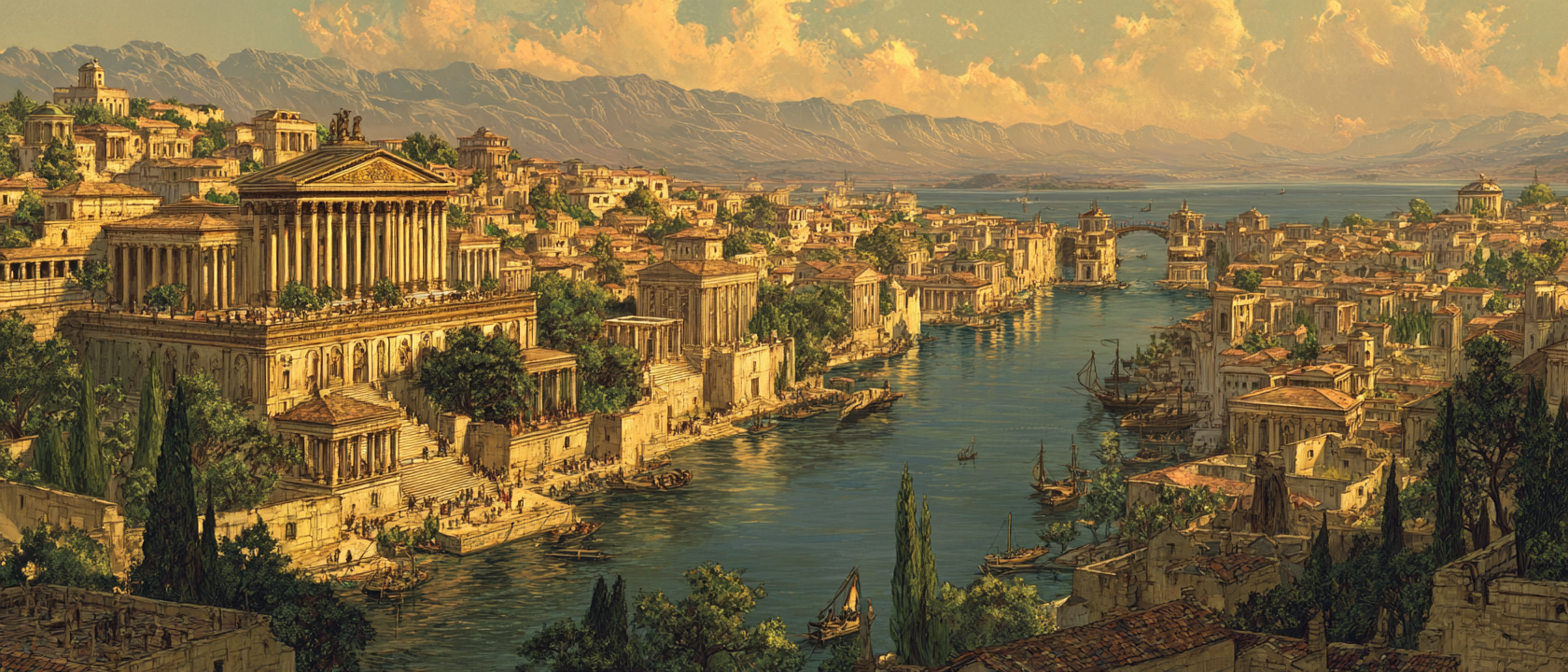
The Harbourfront district occupies the eastern bank's southern section where the Flumen Segetis meets the Inland Sea — the point at which the river economy connects to the sea economy and the provincial supply chain connects to the imperial one. The grain exchange is here, the sea terminal wharves, the factors' offices for the Lacusum trading houses, the customs facilities, and the maritime services infrastructure that the sea trade requires. It is the city's most commercially varied district, its population the most mixed, its daily activity the most visible from outside the city — the sea vessels loading at the terminal are visible from the Inland Sea's shipping lanes, the exchange's trading sessions draw commercial representatives from across the Empire.
Demographics
The Harbourfront's permanent population of approximately eight thousand is the city's most commercially mixed — the sea merchants and factors based here year-round, the exchange's staff, the harbour services workers, the maritime crews in port between voyages, and the population of commercial travellers whose business at the exchange or the terminal brings them to Agropolis seasonally. The Lacusum banking houses have representative offices here, their staff maintaining the connection between the provincial pricing in Agropolis and the futures trading downstream. The halfling commercial community maintains a small factor's office at the exchange's northern end — not the scale of their Portus Meridiani or Lacusum presence, but a consistent commercial presence reflecting the Merchant Council's interest in knowing what the grain price is before it leaves the province.
Government
The harbourfront falls under the Governor's customs authority for the sea terminal and under the exchange's own governance rules for the trading floor. The Annona's authority extends to the grain loading operations at the terminal wharves — the point at which grain leaves Annona custody — but not to the exchange itself, which is governed by a membership board that includes the estate families, the Lacusum factors, and the Annona's regional office in carefully negotiated proportions. The board's composition and voting rules have been renegotiated four times in the past century, each renegotiation producing a document that all parties consider unsatisfactory and that all parties find preferable to the alternative.
Industry & Trade
The grain exchange is the district's commercial heart — its twice-yearly pricing sessions setting the provincial harvest price and the inter-season adjustment price that responds to changed supply or demand conditions. The session that sets the harvest price is the more significant, attended by the full commercial community and followed closely by the Lacusum trading houses whose futures contracts depend on the provincial price as their underlying asset. The halfling factor's office sends its assessment of the session to Brindala within hours of the price being set, through a communication channel whose speed the exchange's other members find interesting and have not been able to replicate.
Guilds and Factions
The exchange's membership board, the Lacusum factors' informal association, and the sea merchants' cooperative constitute the district's commercial powers. The Lacusum banking houses' representatives are the most financially sophisticated participants in the district's commercial life and the most carefully watched by the estate families, who understand that Lacusum's futures trading amplifies the provincial price's effects in ways that benefit the capital's financial community more than the province's farmers. This tension has been documented in the exchange's governance disputes for six centuries without producing a resolution that satisfies either side.
History
The harbourfront has been the city's sea terminal since the first century. The grain exchange was built in the fourth century on the site of an earlier informal trading post. The Lacusum banking houses established offices here in the sixth century, when the futures trading in the capital had grown large enough to justify a permanent presence at the source of the underlying commodity. The halfling factor's office dates to 1095 A.P., five years after the Merchant Council identified the Agropolis exchange as a commercial intelligence asset worth investing in. For full chronological detail, see: Annales Mundi.
Points of interest
The grain exchange floor during the harvest pricing session is the most commercially significant space in Provincia Septentrionalis. The public gallery holds fifty observers. During the first day of the session it holds more than fifty, which the exchange's rules technically prohibit and which the session chair technically enforces by looking at the back wall. On the second day, the gallery empties to approximately a third capacity, and the actual pricing occurs in the subdued atmosphere of professionals who have agreed, in advance, that the range is known and the question is where within the range the final number falls. Visitors who attend only the first day receive theatre. Visitors who attend both days receive education.
The halfling factor's office at the exchange's northern end is the smallest commercial premises in the district and the one whose function is most consistently underestimated by other exchange members. The factor — a halfling of sixty-one named Calla Goodseed, who has been in this posting for twenty-two years and who knows every significant estate family's historical yield pattern from memory — sends assessments to the Merchant Council that are more accurate than the official Annona yield assessments, because Calla talks to more people than the Annona's assessors do and asks different questions.
Tourism
The harbourfront is fully accessible and is the district most visitors spend their time in — the exchange is visible, the sea terminal active, and the commercial life of a major grain port observable from the public areas. The exchange's gallery is open to visitors during sessions. The sea terminal's public observation areas provide views of the Inland Sea that are, in good weather, among the most pleasant vantage points in the city. The halfling factor's office does not receive tourists.
Architecture
The grain exchange's pale limestone colonnade is the district's architectural statement and the building that visitors from outside the province identify as the city's landmark. Behind it, the factors' offices and maritime services buildings are more various — a mix of periods and styles reflecting twelve centuries of commercial construction, each building replaced when the previous one became inadequate, the replacements reflecting the commercial priorities of their construction date rather than any unified civic aesthetic. The sea terminal wharves are functional infrastructure built to the Annona's engineering specification, their quality reflecting the same institutional priorities as the granary wharves upstream.
Geography
The district runs along the river's southern section and curves around the river mouth to face the Inland Sea directly. The grain exchange occupies the prime position at the river mouth's eastern corner — the building from which both the river traffic and the sea terminal are visible simultaneously, a position that is commercially symbolic and practically convenient. The sea terminal wharves extend south from the river mouth along the bay's eastern shore, their depth calibrated for the sea vessels that the Inland Sea's grain trade uses. The factors' offices and maritime services cluster between the exchange and the terminal, their addresses constituting the most commercially significant street in the city.
Access
Exchange gallery — open during sessions.
Terminal wharves — commercial access.
Exchange floor — members and authorised agents.

Comments