
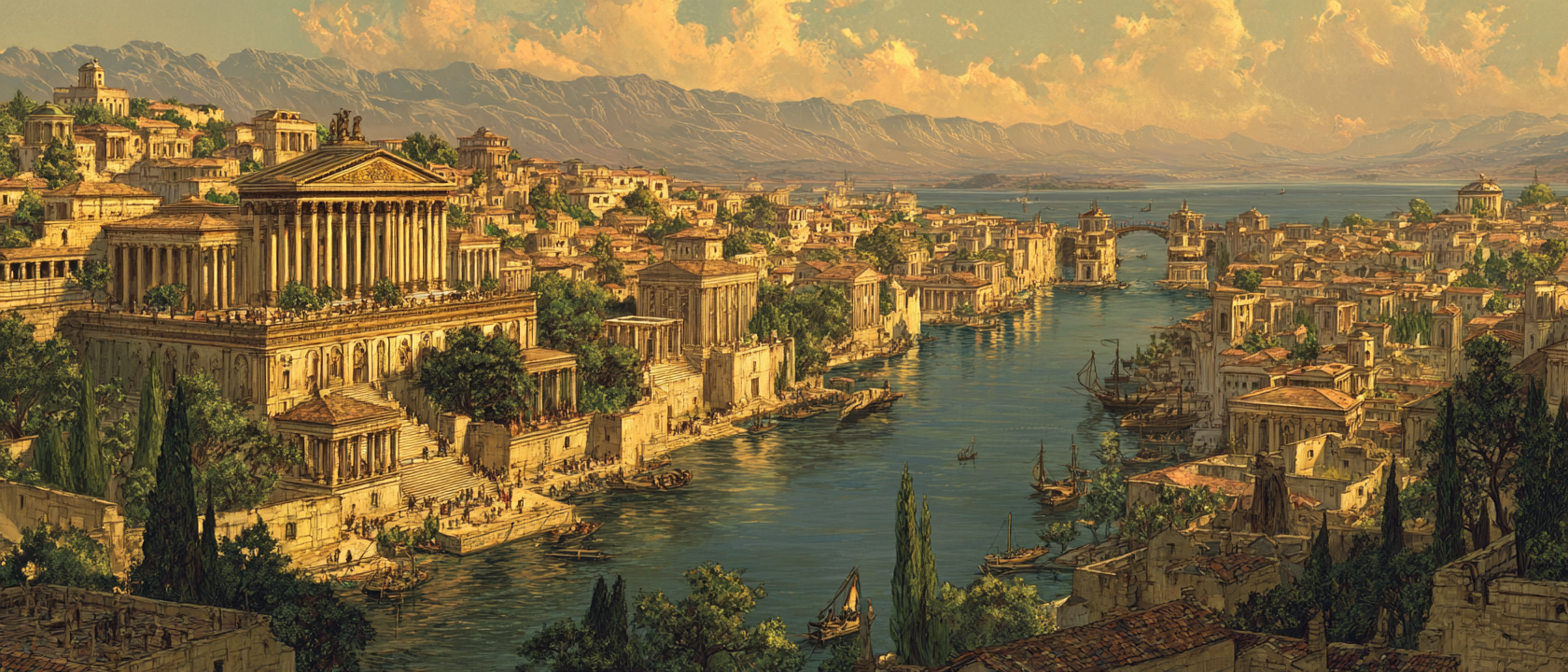
FORUM DISTRICT
The Civic Core · District · Agropolis
"The Forum Agropolense is a pleasant civic space that has never needed to be anything more than a pleasant civic space, and it shows. No battle was decided here, no crisis resolved in the forum's porticoes, no famous speech delivered from its steps. The province was built in the fields, administered in the granaries, and priced on the exchange floor. The forum administers the record of all this with the quiet competence that good administrative spaces develop when they have been doing the same work for a very long time."
The Forum District occupies the eastern bank's central ground — the original settlement core, the administrative heart of a city that has been administering the same essential function for twelve centuries. It contains the Governor's offices, the provincial senate house, the principal temples, the legal courts, and the public records office whose archives constitute the most complete agricultural administration record in the Empire. It is quieter than its equivalents in Nova Romae or Castellum Magnum, less politically charged, more purely functional. The people who work here are managing a province that knows what it is for, and the administrative buildings reflect this: correct, well-maintained, undemonstrative.
Demographics
The Forum District's permanent population of approximately five thousand is the city's administrative and professional class — the Governor's staff, the legal profession, the temple hierarchies, the records office personnel. The district has the specific demographic character of an administrative centre in a prosperous but unflashy province: educated, moderately comfortable, professionally defined, and largely uninterested in the kind of social display that the estate families in the Estate District across the river indulge. The lawyers who work the forum's courts are among the most technically proficient agricultural law specialists in the Empire; several have written the authoritative commentaries on grain contract law that the Annona itself uses as reference.
Government
The Governor's administration operates from the forum's northern building, its authority covering the province's civic functions — roads, courts, public buildings, the military cohort, the provincial tax collection. Arvum's administration is well-regarded by the Senate as efficient and stable. It is less well-regarded by the estate families, who find Arvum's approach to the Annona tension insufficiently robust, and by the Annona's staff, who find his approach insufficiently deferential. He navigates both assessments with the equanimity of someone who has been doing so for seven years and expects to continue.
Defences
The Governor's administration operates from the forum's northern building, its authority covering the province's civic functions — roads, courts, public buildings, the military cohort, the provincial tax collection. Arvum's administration is well-regarded by the Senate as efficient and stable. It is less well-regarded by the estate families, who find Arvum's approach to the Annona tension insufficiently robust, and by the Annona's staff, who find his approach insufficiently deferential. He navigates both assessments with the equanimity of someone who has been doing so for seven years and expects to continue.
Industry & Trade
The forum hosts a daily legal market — the courts sit every morning, the legal offices conduct consultations through the afternoon, and the commercial documentation that sixty thousand people and an enormous agricultural economy generates flows through the records office continuously. Agricultural contract law is the district's primary commercial product, practised by specialists whose expertise is unmatched in the Empire outside the Annona's own legal team. The tension between the independent legal profession and the Annona's in-house counsel is one of the forum district's defining professional relationships.
Guilds and Factions
The Governor's administration and the legal profession are the district's institutional powers. The estate families have no formal presence in the forum district but their interests are the most common subject of the legal profession's work, and the families' relationships with specific legal practitioners constitute a form of institutional presence that operates through representation rather than occupancy. The College of Pontiffs' local representative manages the Templum Cereris and two smaller temples, and navigates the specific theological complexity of a province where the harvest goddess is also, in functional terms, the province's economic foundation — a relationship that produces more philosophically interesting sermons than the College typically expects from a provincial posting.
History
The forum was laid out in the city's second century, its current buildings replacing first-century predecessors that were demolished as the city grew confident enough to rebuild rather than maintain. The Public Records Office has been on the same site since the third century. The Templum Cereris was built in the first century, the province's earliest generation expressing in stone what they understood the new world to require of them. For full chronological detail, see: Annales Mundi.
Points of interest
The Public Records Office maintains twelve centuries of provincial agricultural records — yield assessments, grain contracts, estate ownership documents, water rights allocations, road maintenance obligations. The archive is the most complete record of twelve centuries of Roman agricultural practice available anywhere in the Empire. Access is public for records older than fifty years. Records less than fifty years old require a formal petition to the Governor's office, which Arvum reviews personally for any request that involves the estate families' historical holdings. Several of those petitions are currently pending review. They have been pending for two years.
The Templum Cereris — the Temple of Ceres, the grain goddess — is the most visited religious site in the city, its connection to the province's identity so direct that it functions less as a theological institution than as the city's primary expression of what it values. The harvest festival held here each year is the largest public event in Agropolis and the one occasion when the estate families, the Annona staff, the barge workers, and the city's ordinary residents occupy the same public space for the same purpose without the commercial and institutional distinctions that separate them the rest of the year. Arvum attends every year. Satura attends every year. They sit in adjacent seats of honour and behave with complete formal cordiality.
Tourism
The Forum District is fully accessible and is the standard starting point for visitors who want to understand Agropolis's administrative character before moving to the commercial harbourfront. The Templum Cereris is worth visiting for its harvest festival iconography alone — twelve centuries of agricultural imagery accumulated on its walls and in its collection constitutes an unintentional visual history of Roman farming practice in Aethermarch. The Public Records Office's public archive section, available without petition, contains accessible records that agricultural historians find invaluable and that most other visitors find impressive in the aggregate and impenetrable in the specific.
Architecture
Good provincial Roman architecture in the local pale sandstone — not the pale limestone of the grain exchange, not the dark stone of the frontier, but a warm yellowish local material that weathers pleasantly and that gives the district a cohesive visual character that the mixed styles of the harbourfront do not have. The Governor's building is the largest, its ground floor the public offices, its upper floor Arvum's private administration. The public records office is the most heavily used building in the district and, by the standards of the other civic buildings, the least impressive to look at — a long, low structure whose architectural interest is entirely in its organisation of archive space rather than its facade.
Geography
The district occupies the elevated ground at the eastern bank's centre, above the flood line that the river reaches in wet years, with the Annona Quarter to its north and the Harbourfront to its south. The forum square is the district's centre — a standard Roman rectangular space, its proportions correct, its paving maintained to a standard the Aedilitas takes seriously. The Governor's building occupies the forum's northern side. The provincial senate house is on the eastern side. The temples are clustered at the forum's southern end, their backs to the slope toward the harbourfront.
Access
Access Fully publicly accessible. Governor's building — official business. Records Office — public archive open; recent records by petition.

Comments