
AGROPOLIS
The Grain City · City · Provincia Septentrionalis
"Agropolis knows exactly what it is. This sounds like a modest quality and it is in fact an exceptional one. Most cities accumulate purposes over the centuries until their identity becomes complicated and contested. Agropolis has had one purpose for twelve centuries and has organised every institution, every building, every commercial relationship around that purpose with a clarity that I find, as someone who has spent his career trying to understand what cities are for, genuinely impressive. It is for grain. Everything else follows from this."
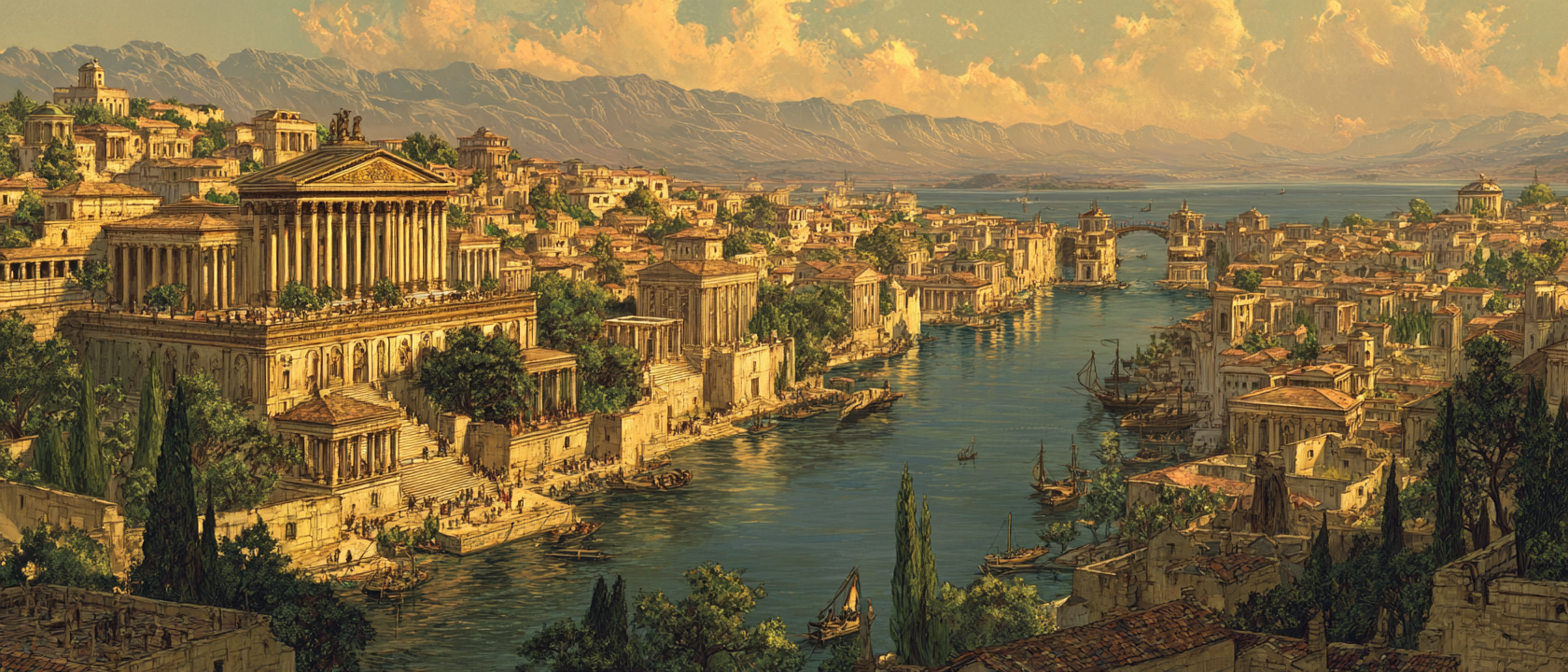
Agropolis is the provincial capital of Provincia Septentrionalis and the commercial and administrative centre of the Empire's most important agricultural province. It sits at the mouth of the Flumen Segetis — the Grain River — where the province's primary waterway meets the Inland Sea's northern shore, the city receiving the barge traffic that carries the harvest south from the agricultural plain and despatching it onto the sea route to Lacusum and the capital beyond. The Annona's regional office administers the grain contracts from here. The grain exchange on the harbourfront is where provincial harvest prices are set each season, before the futures contracts that Lacusum then trades downstream. Fifty-five thousand people live in a city that understands, with unusual clarity, that its function is the management of something the Empire cannot do without.
The city's character is defined by this function in ways that take a day or two to see clearly. It is not a military city — there is no frontier here, no wall, no Legion headquarters whose shadow falls across everything else. It is not a commercial entrepôt in the Lacusum sense — the goods that move through Agropolis are mostly one thing, moving mostly in one direction, on a schedule that the harvest imposes rather than the market. It is an agricultural city, which is a category that the Empire's urban hierarchy does not quite have the vocabulary for, and it has the specific confidence of a place that has been quietly essential for twelve centuries without receiving the credit that more dramatic forms of essentialness attract.
I arrived in Agropolis during the harvest assessment season — the six weeks in late summer when the Annona's regional office receives the estate managers' yield reports and the grain exchange's futures prices shift accordingly. The city was not frantic in the way of a financial centre at a critical moment. It was purposeful. Everyone knew what they were doing, why they were doing it, and what the consequences of doing it wrong would be. I have been in the Senate during significant debates. I have been in Lacusum during major market movements. Neither produced in me the specific sensation of watching something important being handled correctly that six days in Agropolis during assessment season produced.
Demographics
Fifty-five thousand people in a city whose economic base is agricultural rather than manufacturing or trade produces a specific demographic character: a very large service population, a significant administrative class, and the estate families whose ownership of the surrounding farmland constitutes the province's primary wealth. The estate families — approximately twenty significant ones, with perhaps forty smaller ones whose holdings are less consequential — are the city's dominant social presence. They have been here as long as the province has been settled, and several can document continuous family tenure on specific land parcels going back eight or nine centuries. They are not the frontier families' equivalent — there is no wall here, no shared danger — but they have the particular confidence of people whose relationship with the land beneath them is multigenerational and whose understanding of what they own predates most institutions.
The Annona's regional staff — several hundred administrators, assessors, and contract managers — constitute the city's second significant social grouping, distinct from the estate families by origin (most are appointed from Nova Romae or transferred from other Annona offices), by temperament (they are administrators rather than landowners), and by the specific quality of their relationship with the estate families: one of mutual dependence conducted with the formal courtesy of people who need each other and do not entirely trust each other.
Government
Agropolis is governed by the provincial administration under Governor Quintus Servilius Arvum, in his seventh year — one of the longer-serving governors in the current Empire, his tenure a reflection of both his competence and the Senate's appreciation of stability in a province whose function is too important to disturb with frequent administrative transitions. Arvum governs with the particular skill of a man who has spent seven years learning exactly where the line is between the Governor's authority and the Annona regional office's authority, and who has developed the practice of not approaching that line unless he has a specific reason.
The Annona's Regional Prefect, Lucia Grania Satura, in her fourth year, is Arvum's institutional counterpart and occasional adversary. Satura was appointed by the Annona's central office in Nova Romae, reports to Publius Farro rather than to the Governor, and controls the grain contracts on which the province's entire economy depends. Her formal authority is narrowly defined — grain procurement and supply management — and her practical authority is considerably broader, because in a province where the grain contracts define almost every other commercial relationship, the person who controls those contracts has leverage that extends well beyond their formal remit. Satura is aware of this. Arvum is aware that she is aware. The relationship is formally correct and substantively watchful.
DM ONLYDefences
A Legion cohort of five hundred soldiers garrisons the city: not a full Legion, which Agropolis has never required, but sufficient for the security of the granaries and the harbour, which are the two facilities whose loss would constitute a strategic emergency. The granary garrison is the cohort's primary posting; the harbour watch is secondary. The city's walls are maintained but not militarised — Agropolis has not faced an organised military threat in eight centuries and its defences reflect this history. The cohort commander's primary operational concern is not external attack but internal grain security: the specific category of crime involving the falsification of yield assessments, the diversion of contracted grain, or the manipulation of exchange prices that a city built around a single enormously valuable commodity attracts.
Industry & Trade
Grain is the economy. Everything else is either support for the grain trade — the barge industry, the harbour services, the granary operations — or the consumer economy of fifty-five thousand people who need to eat, clothe themselves, and maintain their buildings. The one commercial activity in Agropolis not directly grain-derived is the estate families' private wealth management, which is substantial and which they conduct through the grain exchange's secondary financial services and through their own relationships with Lacusum's banking houses. Several of the estate families are, individually, among the wealthiest landowners in the Empire. None of them are as visible about this as their equivalents in Nova Romae, which is a choice rather than a circumstance.
The grain exchange sets the provincial harvest price each season through a formal trading session attended by the estate managers, the Annona's assessors, and the independent factors who represent Lacusum's grain trading houses. What happens in the session is real price discovery — the yield assessments, the demand projections, the transport costs, all combined into a price that becomes the basis for every contract in the province that year. What happens before the session, in the estate families' private dinners and the Annona office's internal briefings, is the pre-negotiation that determines the range within which the public discovery will occur. I attended one session and found it the most politely contested three hours I have spent in Aethermarch.
Infrastructure
The river barge infrastructure is the city's most critical physical asset: the wharves on both banks, the crane mechanisms for grain loading, the weigh-houses where yield assessments are verified, the barge maintenance yards where the vessels that carry the harvest are kept in working condition year-round. The Annona maintains this infrastructure directly rather than contracting it to the city's Aedilitas, which is one of several points of institutional friction between the Annona office and the Governor's administration. The two river bridges are the Governor's responsibility and are the subject of a maintenance dispute that has been ongoing for three years and that both parties use as a proxy for the larger question of who controls what in Agropolis.
The Via Segetalis — the Grain Road — runs north from Agropolis through the agricultural plain to the province's interior market towns, connecting the farms to the city and supplementing the river route for estates whose distance from the river makes water transport impractical. It is the best-maintained road in Provincia Septentrionalis and the third most-used road in the Empire by cargo weight, after the Via Militaris and the Via Australis.
Districts
Agropolis divides naturally along the river. The eastern bank holds the original settlement: the Forum District with its civic and administrative core, the Annona Quarter where the regional office and granaries are concentrated, and the Harbourfront where the grain exchange and sea terminal operate. The western bank expansion holds the Estate District where the major landowning families maintain their city residences, the River Market where the province's weekly grain market operates, and the Wharves where the barge industry lives. A seventh district — the Scholars' Residence — is a small but noted community at the city's northern edge, where the Academy's agricultural monitoring station and a small community of natural philosophers who study the province's farming practices operate.
Guilds and Factions
The estate families, organised informally through the Arvina and formally through the Grain Exchange's membership structure, constitute the province's dominant commercial and social power. The Annona's regional office under Satura is the Imperial authority whose mandate and the estate families' commercial interests are most directly in tension: the Annona needs to procure grain at prices that work for the capital's budget, and the estate families need to sell grain at prices that justify the investment in their land. The grain exchange is where this tension is managed annually, publicly, and with considerable professional courtesy that conceals the structural conflict beneath it.
The Barge Masters' Association operates the river transport infrastructure and has interests in both the Annona contracts and the estate families' shipping arrangements. Its position in Agropolis is more comfortable than its counterpart in Portus Meridiani because the railway, if built, will connect the Iron Spine to the capital but will not replace the river barge route from the province's interior. The river is wider, cheaper, and more appropriate for grain at the volumes the province produces than any rail alternative that has been proposed. The local Barge Masters know this. They are watching the Mercatus Viridis negotiation anyway.
History
Agropolis was established in the first century of expansion, when the Legion's surveyors reached the Inland Sea's northern shore and identified the Flumen Segetis mouth as the natural terminus for the agricultural plain's produce. The first granaries were built in the second century, the grain exchange in the fourth century. The Annona established its regional office here in the fifth century, when the province's output had grown large enough that a dedicated administrative presence was warranted. The estate families' consolidation of land holdings occurred primarily in the third and fourth centuries; the twenty significant families of 1200 A.P. are the descendants of the families who held the best ground when consolidation was occurring.
For full chronological detail, see: Annales Mundi.
Points of interest
The Grain Exchange (harbourfront, eastern bank, fourth century construction) — the city's most commercially significant building and the only one where the Empire's food supply is priced in public. The exchange floor's sessions during harvest assessment season are open to any credentialled commercial party, a definition that has been expanded and contracted several times in the past century as the estate families and the Annona have disagreed about who should be present when the price is set. The current rules allow Lacusum's factors, the Annona's assessors, the estate managers, and a small public gallery. The gallery is always full during the first day of the assessment session. The actual pricing happens on the second day, when the gallery is less attentive.
The Annona Granaries (eastern bank, northern section, restricted access) — four enormous stone structures, each capable of storing several months' grain supply for the capital, and the most strategically important buildings in the province. They are not accessible to the public and are not intended to be impressive from the outside, but their scale — each building approximately sixty metres long and fifteen metres high — is visible from the opposite bank and from the sea approaches. The Rift XIII preparation budget's diversion of granary expansion funds has left two of the four buildings operating below designed capacity. This is not publicly known.
The Two Bridges (Pons Orientalis, sixth century; Pons Occidentalis, fourth century) — the city's civic landmarks in the way that genuinely functional infrastructure becomes landmark when it is old enough. Both have been repaired and partially rebuilt sufficiently that no original material survives, but both occupy the positions their predecessors occupied and both carry the daily commerce of a city of fifty-five thousand. The maintenance dispute between the Governor's office and the Annona about which institution is responsible for which bridge has been sufficiently prolonged that several people in the city can recite its history from memory.
The Arvina (Forum District's northern edge, not publicly accessible, continuous operation since the third century) — the estate families' private social club, whose membership is the twenty significant families and whose records, maintained since the founding, constitute the most complete private commercial history of the province's agricultural economy available anywhere. Several scholars have requested access. None have received it. The request process involves a formal application to the membership secretary, a waiting period of unspecified duration, and a response that has never, in recorded history, been affirmative.
DM ONLYTourism
Agropolis receives two categories of visitor: commercial travellers with business at the exchange or the Annona office, and the occasional scholar interested in agricultural practice, river engineering, or the province's natural history. Neither category constitutes tourism in the way that Nova Romae or the frontier attracts visitors for non-commercial purposes. The city is fully accessible and has adequate accommodation for both visitor types. It does not have the infrastructure of a destination, and its residents find the concept of visiting Agropolis for its own sake mildly puzzling — not unwelcoming, but genuinely uncertain what the appeal would be for someone with no grain contracts to negotiate. The answer is that watching something enormously important be handled with complete competence is its own category of experience, and that Agropolis during harvest assessment season is one of the few places in the Empire where this experience is reliably available.
Architecture
Agropolis is a prosperous provincial city built to last and not built to impress, which produces a specific architectural character: well-maintained, correctly proportioned, modest in ornamental ambition, and structurally excellent. The granaries along the river's eastern bank are the city's most impressive buildings in terms of engineering — enormous stone structures built to the Annona's specification, their ventilation, drainage, and structural integrity maintained to a standard that reflects what they contain. They are also, by several measures, the most beautiful buildings in the city, which says something about what the city considers worthy of care.
The grain exchange on the harbourfront is the architectural exception — commissioned in the fourth century by the estate families who fund most of the city's civic infrastructure, built in the pale limestone that had to be shipped from the coast because the local stone was not considered adequate, its colonnaded facade the clearest signal available that the people who built it understood the difference between a building that functions and a building that announces. It is the most visited building in the city for commercial purposes and the one that visitors from the capital find most familiar, because it is the only building in Agropolis built to impress people from the capital.
Geography
The Flumen Segetis enters the Inland Sea at the centre of a wide, shallow bay whose eastern and western arms provide partial shelter for the river mouth harbour. The city occupies both banks of the river's final three kilometres before the sea — the eastern bank being the older settlement, the administrative and commercial core, and the western bank being the newer expansion of the past four centuries, connected to the east by two bridges whose maintenance is the Aedilitas's most significant ongoing responsibility. The agricultural plain extends northward from both banks, flat and enormously productive, its field boundaries visible from the city's upper floors extending toward the Iron Spine foothills on the northern horizon.
The river itself is the city's organising spine. The barge traffic arriving from the north — laden with grain in the harvest months, returning empty or with manufactured goods in the winter — defines the city's rhythm more precisely than any administrative calendar. The harbour at the river mouth handles the transfer from river barges to sea vessels: the point at which the grain becomes part of the larger imperial supply chain rather than a provincial commodity, and the site around which the city's most important institutions have arranged themselves.
Climate
The Inland Sea moderates the province's southern edge, keeping Agropolis warmer in winter and cooler in summer than the inland agricultural plain experiences. The plain itself has the continental climate of open agricultural land: cold winters, hot summers, the specific weather patterns that large flat terrain produces when there is nothing to interrupt the wind. The harvest season is late summer, the assessment season early autumn, and the city's annual cycle is organised around these fixed points more precisely than around any religious or civic calendar. The Iron Spine foothills to the north produce specific weather effects in late autumn — cold fronts that come down the mountain valleys faster than the plain's farmers expect, and that have damaged harvests sufficiently often that the province's agricultural practices include specific preparations for early cold.
Natural Resources
The province's agricultural plain is the resource: the deep, well-drained alluvial soil that the river system has been depositing and the farming families have been cultivating for twelve centuries. The soil quality is extraordinary by any measure available to Roman agricultural science, and it produces yields that the Annona's assessors document annually with the satisfaction of people measuring something that continues to exceed expectations. The river itself is a resource — the barge route, the irrigation capacity for the estates nearest the water, and the fish population that supplements the city's food supply. The limestone karst at the province's northern edge, approaching the Iron Spine foothills, contains cave systems that the province's natural philosophers have been studying for three decades, connected hydrologically to the river sources that feed the plain's watercourses.
- AEDIFICIUM PRAEFECTURAE · TABULARIUM PUBLICUM
- ANNONA QUARTER
- ARVINA
- AULA FRUMENTARIA
- ESTATE DISTRICT
- FORUM DISTRICT
- FORUM HEBDOMADARIUM
- HARBOURFRONT
- HORREA QUATTUOR
- OFFICIUM ANNONAE REGIONALIS
- RIVER MARKET
- SCHOLARS' RESIDENCE
- STATIO ACADEMIAE AGROPOLENSIS
- TABERNA AGROPOLENSIS
- TABERNA PORTUS
- TEMPLUM CERERIS
- THE WHARVES
River barge trade.
Grain exchange financial services.
Estate family wealth management through Lacusum banking houses.

Comments