Available to the Master subscription tier and above. Upgrade here.
Manuscripts is World Anvil’s writing software, designed for novels, serial fiction, and short story collections. It integrates directly with your world bible, and saves you time and energy by cutting down on context shifting. You can use it to:
- plot, write and edit
- publish directly on World Anvil (either for free, or as a paid product)
- export your manuscript (to self-publish elsewhere or submit to traditional publishers)
This guide takes you through the Manuscripts software, from first idea through to publishing your work.
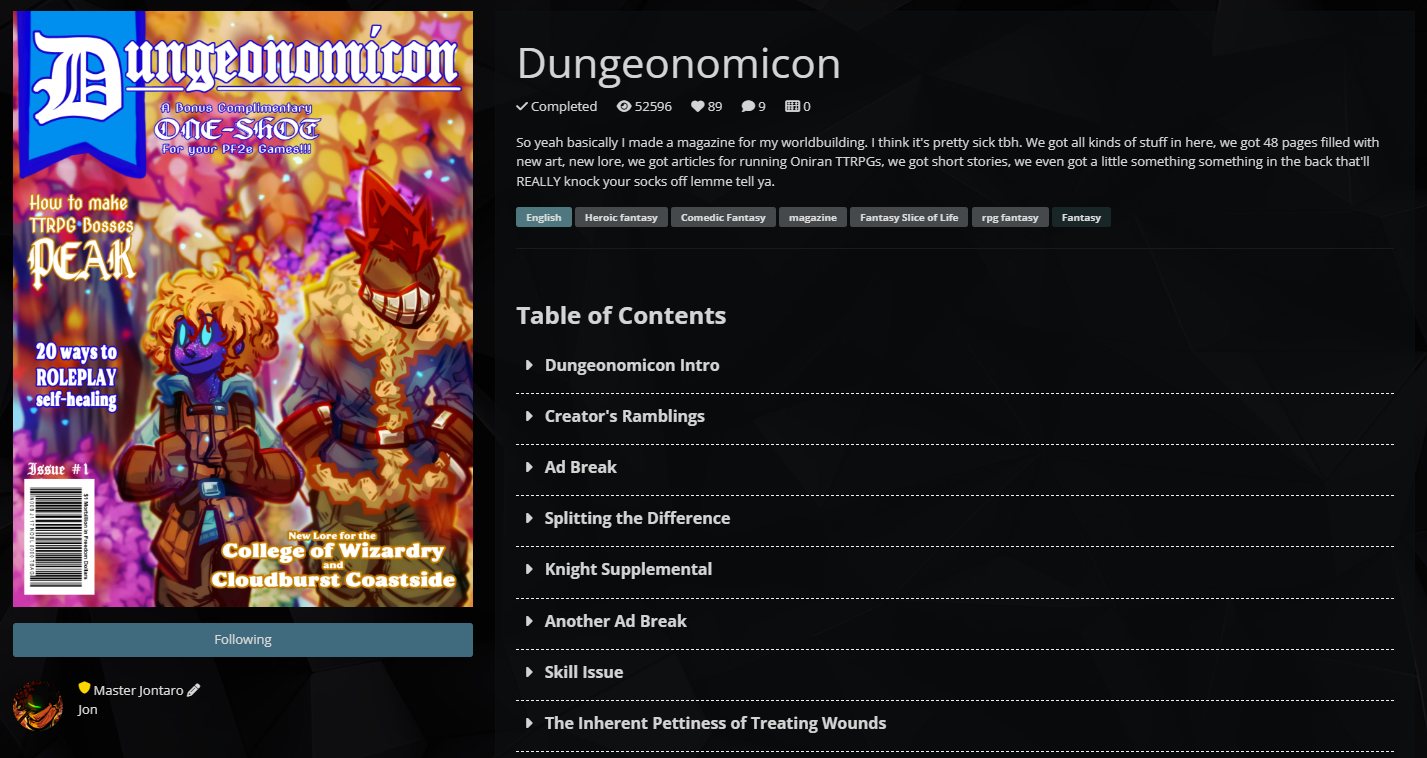
Dungeonomicon by Jon
Contents
- Create your manuscript
- The Manuscripts interface at a glance
- Customize your settings for writing
- Creating and managing scenes and chapters
- Writing in manuscripts
- Plotting on World Anvil
- Creating synopses and outlines
- Editing in Manuscripts
- Extra touches before publishing on World Anvil!
- How to publish your Manuscripts
- Exporting your Manuscript from World Anvil
Create your manuscript
To create your Manuscript on World Anvil:
- Ensure you have activated the correct world.
- Click on Manuscripts in the left sidebar.
- Press the Create Manuscript button
- In the creation pop-up on the right, give a title to the manuscript.
- Click the submit button or Shift + Enter.
After creating it, you'll be redirected to the manuscript interface.
Don’t see Manuscripts on your side bar? Make sure you have the writing features enabled on your Features page. Here’s how to enable account features!
The Manuscripts interface at a glance
The manuscripts interface has three main areas: the left, central and right panels.

- The left panel is the content of your manuscript—your chapters and scenes. Click on a chapter or scene to select it, or drag and drop them into order.
- The central part of the manuscripts interface is where you’ll be doing your writing! When you select anything on the left panel, its content will appear in the middle.
- On the right side, you can see additional notes and settings for the scene or chapter you’ve selected.
Collapse or expand these side panels by clicking the gray layers button at the top left. You can achieve a “focus mode” by collapsing both of them.
The structure of a Manuscript
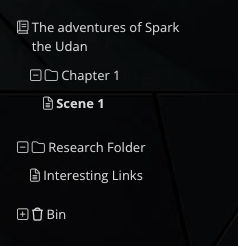
There are three basic levels of structure in a Manuscript: the Manuscript itself, chapters, and pages (which can be Text or Image). In general...
- Folders are chapters: They don't contain any text directly, and instead contain pages.
- Pages are scenes: In other words, if you have five pages in a folder, they will appear one after the other in the same chapter when viewing the Manuscript.
You can also put folders inside folders, or even place folders outside of the Manuscript's section (for example, as a research folder, an outline, etc). This gives you a ton of flexibility to decide exactly how you want to structure your writing space.
Manuscript modes
At the top right of the interface you can toggle between Write, Review and Read modes.

- Write mode allows you to write content in your scenes, see chapter stats (such as word count, view count, and likes), and edit your Manuscript settings (by clicking on your Manuscript’s title).
- Review mode allows you to review the synopses, labels and details of scenes contained within a chapter, or of chapters contained within a Manuscript. It’s useful for outlining, or getting an overview of all your chapters.
- Read mode allows you to read WITHOUT being able to edit your text, either scene-by-scene or chapter-by-chapter. You can make notes on the right hand side in the notes section. This is very useful for developmental editing passes, as it stops you being able to make line edits!
The View button at the top right opens the public View Mode of the manuscript. If your manuscript is unpublished or private, no one will be able to see it except you.
You can also change which parts of the Manuscripts UI are visible so you can focus on your writing. Check How to change your Manuscript's layout for more information.
Customize your manuscript settings for writing
Before you start writing, customize the writing software to your liking! By default, all new manuscripts are titled “The Name of the Manuscript”. Click on your manuscript’s name to reveal the Manuscript Basic Settings.
From Manuscript Basic Settings, you can change the title. You can also add book covers, a “back cover blurb” and genre tags—these are used when you publish on World Anvil to help readers find your work.
Everything in Manuscripts autosaves—you’ll see the little “saved” tag flag at the top of the screen when this happens.
As always on World Anvil, make sure you don’t have your content open in multiple tabs at the same time, or you could lose parts of your progress!
On the right hand panel of your Manusript’s Basic Settings, you can customize background color, fonts, and paragraph settings. You’ll need to refresh your browser page for your changes to take effect on your scenes.
Creating and managing chapters and scenes in Manuscripts
By default, your new manuscript will contain a chapter and a scene (i.e. a folder and a page) located under the name of the manuscript, as well as a Research Folder and a Bin folder.
Click on a scene in the left panel to view the contents in the center. You can also change the title on the right hand panel:

Click on a chapter on the left panel to see an overview of the scenes inside it. You can also change the title on the right hand panel, and add more information.
Your book or serial is made of chapters and scenes, but you can also use them for plotting, ideas, or additional resources. Make sure these aren't nested directly under your Manuscript title so they don’t show up when you export your book.
Creating new scenes and chapters
To create a new scene, click the green plus button at the top left. It will spawn on the left panel beneath the chapter or scene you have selected. Drag it into place, and add a title on the right hand panel.
To create a new chapter, click the little arrow beside the green plus button at the top left, and select “folder.” Like the scene, it will spawn beneath the chapter or scene you have selected. Drag it into place, and add a title on the right hand panel.
You can also quickly create chapters and scenes in Review mode:
- In the top right, click "Review".
- Select a chapter (or the manuscript as a whole) and use the create buttons:
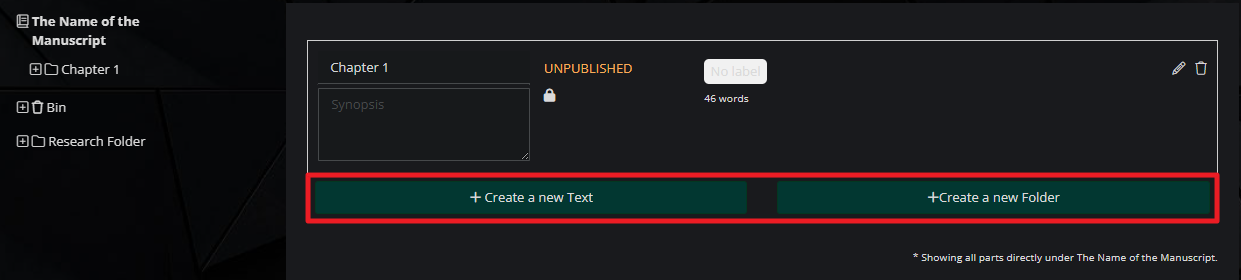
- When you're happy with the structure you've created, switch to Write mode again!
Remember you can always drag and drop your scenes and chapters to reorganize them after creating them. If you need to create a second version of the same scene, you can duplicate an existing scene so you don't start from scratch.
Deleting a scene or chapter is as easy as dragging them into the Bin folder at the bottom. You can always recover them later!
Writing in Manuscripts
Let’s explore a few more workflows that can help you write your novel faster in Manuscripts!
The power of search
You can search both your manuscript and your world from the search bar at the top:
- Type the search term in the search bar at the top left.
- The search results will appear on the right hand panel.
- See each result's context by clicking on it to open either the scene or the article.
- Within each scene or article, press Ctrl+F on your keyboard to find the exact instance of the search term.
Then, depending on the type of result, you have additional options:
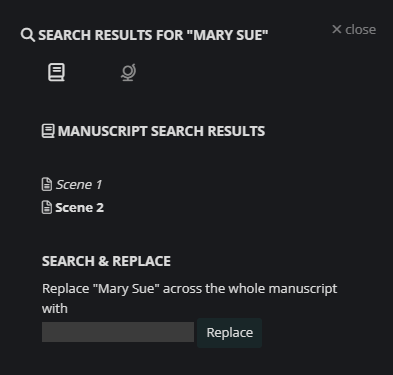
Manuscript results
For Manuscript results, you have a Search & Replace function that works all across the Manuscript. This is useful to fix repeat typos or if you decide to change a character's name later on.
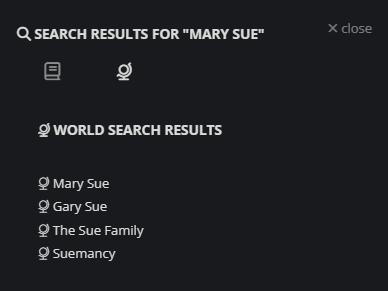
World results
Click the globe icon to see world results. When you click on a result, you'll be able to read the article right there, without leaving the page, and even edit it (for example, if you change a character name, you might want to immediately update it across your world too).
Check How to search and edit your world from Manuscripts for more details.
Other useful tools
To create new articles directly in the Manuscripts interface, use the Quick Article Creation button.
Manuscripts works with the spell checker and grammar checker from your browser. Google Chrome has a good one (it’s the browser we recommend for World Anvil). Browser-based grammar tools (like the ProWritingAid and Grammarly free Chrome plugins) also work with Manuscripts and are simple to use.
Finally, if you like keeping track, you can also see your daily word count within Manuscripts.
Editing in Manuscripts
Novels don’t always come out perfectly the first time—or the second or third! Manuscripts has various features that let you version the drafts of your novel, make editorial notes for your new draft, and use customisable labels to track the stages of your process.
Using labels
To customize your labels, click on the title of your Manuscript (make sure you’re in Write mode at the top right), and select the third tab, Labels. From here, you can rename your labels (e.g. outlined, written, edited, beta read, etc) and select your preferred colors.
Apply labels to each chapter or scene using the right panel. For more check out How to use labels in Manuscripts.
Versioning
Manuscripts allows you to manually version your drafts by copying scenes. You can do this on the right hand panel, under the settings cog. Here’s a guide on how to version your drafts.
Notes
The Notes section on both Scenes and Chapters (right panel) is very useful for the editing process! When you start an edit pass, read through your Manuscript on Read Mode (top right), and use the notes section to write down any major changes you want to make to each chapter or scene. You won’t be able to edit the main text in this mode, so it’s a good way not to get sucked into the details like line edits!
Extra touches before you publish your Manuscript on World Anvil!
Once you’ve written (and perhaps rewritten) your novel, you’re ready to publish! If you want to publish your writing on the World Anvil platform, here are a few extra finishing touches you can add!
If you don’t want to publish your novel—either free for everyone or for your paying customers—on World Anvil, skip to Exporting your Manuscript.
Add a cover
Adding a cover to your Manuscript is a great way to get it noticed. The suggested ratio is 5:7 (e.g. 500x700px) and webp or JPEG are the best file types. To add a cover to your manuscript:
- Upload your cover as an image to World Anvil (learn how here)
- Start typing the name of your image in the image field
- Select your cover from the image options that show up
Add metadata
Adding genres and language helps readers find your manuscript more easily! Type your genres in the search bar: if it’s in our database, it’ll autocomplete. You can also add genres not in our list.
Prepare the Manuscript's marketing
To customize your Manuscript’s public marketing panel:
- Go to basic settings
- On the right panel, click the third tab (a chequered flag)
- Add your Patreon and Kofi username, and a custom marketing message (which appears on left side of your public manuscript page and right above the comments section of its parts).
If you’re releasing exclusively to certain people (like paying customers), you might choose to add a custom access denied page. Readers will see this if you haven’t given them permission to view your chapters—for example, if you’ve released chapters exclusively for your Patreon or Ko-fi backers.
Multimedia options
If you’re going for a multimedia experience, rather than just classic prose, you can also:
- Add images to your Manuscript
- Add audio recordings to your Manuscript
- How to publish your Manuscript exclusively for your Patreon supporters
How to publish your Manuscript on World Anvil
World Anvil’s publishing platform is easy to read, accessible, and doesn’t require downloading anything for your readers. You have flexibility to publish to everyone, or only to your paying supporters. And your writing will be discoverable directly by searching our library of manuscripts!
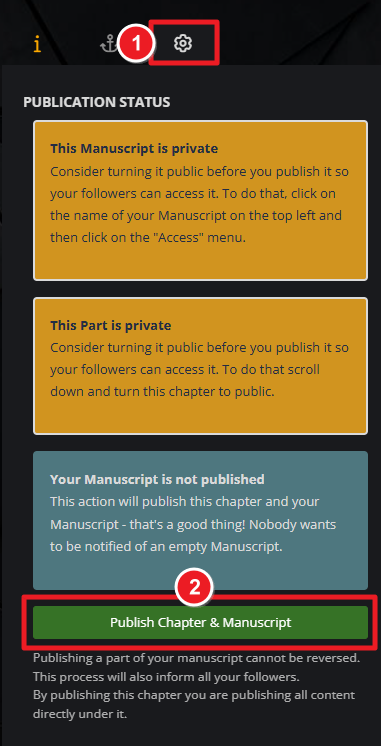
Manuscripts are published chapter by chapter. To publish a chapter:
- Select the chapter you want to publish
- On the right panel, click the settings tab
- There, click the green button “Publish Chapter”.
Note: the first time you publish a chapter, the button will read “Publish Chapter & Manuscript”.
A published chapter simply means that it will be appear for you in the View mode of Manuscripts. But by default, all Manuscripts are private, so only you will see it.
How to make the entire Manuscript public
Follow these steps to publish your Manuscripts so that everyone can read it in its entirety:
- Click the title of your manuscript to go to Basic Settings
- In the Access Tab (in the centre) change Privacy status to Public
- Publish chapters as above, and they’ll be visible to everyone
Publishing with limited access
You can also release your Manuscript to certain people only (for example, your editor, beta readers, or Patreons!)
- Set up a Subscriber group (click here to learn how).
- In the Access Tab (in the centre) change Privacy status to Public.
- Publish chapters as above, and they’ll be visible exclusively to your subscriber group.
You can also make some chapters public and others private (which is great to encourage readers to become supporters!). Check this how-to for more details.
Take a look at how to embed your manuscript into your world to learn how to link the Manuscript from any page of your world.
Exporting your Manuscript from World Anvil
If you want to publish elsewhere, on other platforms, you can export your manuscript:
- First, make sure that only the chapters and scenes you want to export are nested under your Manuscript title (or you’ll export old drafts and notes too!)
- Click your Manuscript title to go to Manuscript Basic Settings. On the right panel, click the Export tab, and click the “Export in HMTL” button.
- A new tab will open, containing your Manuscript!
Once you have your Manuscript in HTML, you can:
- Export as PDF from your browser: right click, click print, then select “save as PDF”
- Export as Doc or Docx format: simply paste your novel into a word processor like Microsoft Word or Libre Office and save as doc or docx, or Google Docs and export as any format you like (PDF, doc, docx, etc.)
- Export as epub or mobi: paste your story into an epub or mobi creator like Jutoh or Vellum (macOS-only).