

Storm Giant
Storm giants, known as uvarjotunen in their own language,11 were one of the most intelligent and respected races of giants.
Basic Information
Anatomy
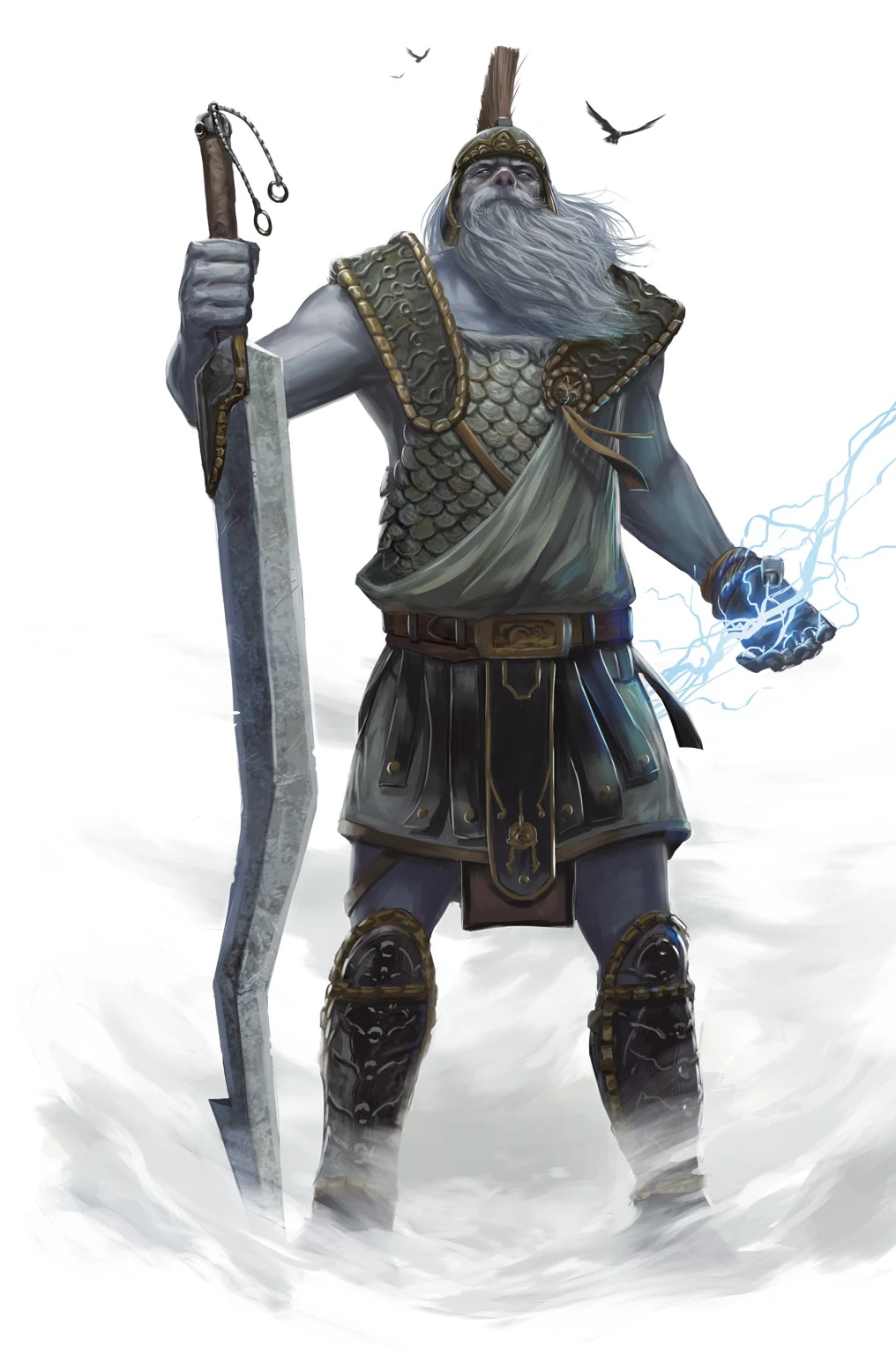
Storm giants were the tallest of the true giants to remain on the Material Plane, standing a full 26 feet in height and massing out at around 15,000 pounds.
There were two ethnicities of storm giants; most had pale, light green skin and dark green hair and eyes, but a small number had violet skin, dark blue hair, and silver eyes.5
They tended to wear fine tunics and belted sandals.5 When it came to armor, they often favored the use of scale mail.
Biological Traits
Storm giants had vision that was well adapted to underwater conditions, where they saw equally as well as they did in the air.12 Likewise, their lungs were adapted to surviving in underwater conditions.
Their bodies were impervious to harm from lightning and thunder, even that discharged by a blue dragon. They were even capable of generating and throwing bolts of lightning themselves,6 at distances of up to 500 feet (150 meters).1 Because of this they were often responsible for sightings of lightning bolts streaking across mountain peaks.14
Some storm giants held the ability to mark and claim a mortal humanoid as a sea spawn, either by cursing them or making a pact with them.
Ecology and Habitats
Storm giants live in isolated refuges so far above the surface of the world or below the sea that they are beyond the reach of most other creatures. Some make their abodes in cloud-top castles so high that flying dragons appear as specks below. Others live atop mountain peaks that pierce the clouds. Some occupy palaces covered with algae and coral at the bottom of the ocean, or grim fortresses in undersea rifts. One kind of location that invariably draws their attention is an elemental crossing — where the Material Plane and the Elemental Planes intersect and interact. Elemental influence pervades the architecture of storm giants and lends a tempestuous, unearthly quality to their homes.
Storm giants use elemental crossings for their own transplanar wandering, especially into the Elemental Plane of Air and the Elemental Plane of Water. The frequent whirlpools, tornadoes, and lashing rainstorms that buffet the passages to those two planes help to safeguard the giants’ homes and ensure their privacy.
Dietary Needs and Habits
Many storm giants dwell in coastal or underwater regions, so their diet likely includes giant-sized portions of fish, whales, squid, and other deep-sea delicacies. Those who live in warm mountain regions may hunt large terrestrial beasts like dire elk or griffons. They may consume rare fruits, herbs, and plants found in high-altitude or magical environments—especially those imbued with elemental energy.
Storm giants are likely to have gardens near their homes as well as livestock pens to help provide a stable source of food since they do not raid like other giants do.
Additional Information
Social Structure
Once they’re old enough to fend for themselves, storm giants spend most of their lives in contemplative isolation. Athough a storm giant prefers to live outside the company of other giants, it isn’t necessarily alone in its stronghold. Storm giants share their abodes with other creatures that are comfortable in the environment: a sea-dwelling storm giant, for example, might have a few merfolk, water weirds, or even a dragon turtle for companions, while a storm giant living on a mountain peak would extend a friendly hand to any pegasus that happened by, and might even welcome yetis into its home for a time if it believed they could be trusted. The giant’s guests are expected to be respectful, to make themselves useful, and to provide interesting conversation or other entertainment when the giant feels like being sociable.
Ordning
Each storm giant knows its status in the ordning by the signals the universe sends them. Omens might be seen in the wheeling flight of a flock of birds, the patterns in sand left by a receding tide, the shapes of clouds, or any number of other natural phenomena. Storm giants that receive the greatest number of such messages generally rank highest, but the significance of individual signs can also affect one’s status. On the rare occasions when storm giants meet, omens and signs accompany each individual, making it plain to all present who ranks where. Arguments about ranking within the ordning are rare, but all the giants in the group studiously examine every sign for evidence that one among them might be the greatest yet, since the revelation of that fact would herald Annam’s return.
Without an emperor to serve as their political and spiritual head, the storm giants are adrift on an uncertain sea. Every possibility encapsulated in every sign is exhaustively examined. Debates over the meaning and validity of this or that omen are conducted across human kingdoms and spanning human lifetimes.
Civilization and Culture
Naming Traditions
Common given names among storm giants included the following:24
Males
Gautarr, Harrdiir, Ilknarr, Kuruth, Ogmoth, Ogmund, Ormmur, Torune, and Ulvulk.
Females
Geironal, Helgyra, Hornarra, Mistfast, Relsif, Silkarra, Sparraxe, Talnut, Wynd, and Yimmra.
Major Language Groups and Dialects
Common Myths and Legends
Storm giants pay homage to Stronmaus, the eldest of Annam’s children, who is also the most joyful and the most prone to laughter and enjoying fellowship with his siblings. That image of Stronmaus is in sharp contrast to how storm giants are perceived in the world: aloof and dour. Nonetheless, it is an accurate one.
In the giants’ legends, Stronmaus is subject to gray moods and deep brooding that are just as intense as his moments of good humor. It is also true that storm giants aren’t as humorless as popular notions paint them to be. They’re quiet and reserved when they’re by themselves, which is how they spend most of their time. But when they get together with others of their kind, they enjoy mirth, song, and drink as much as Stronmaus does. For the sake of their privacy and for the safety of smaller beings in the vicinity, these rare gatherings occur far from the presence of other creatures, thus perpetuating the giants’ reputation for always being gloomy and grim.
Interspecies Relations and Assumptions
In the absence of both Annam and a worldly emperor, storm giants recognize no higher authority. Human, elf, and dwarf kings, liches, grand sorcerers and wizards — all might amass what they consider great power, but they have no influence over the storm giants. Any who try extending their reach in that direction are guaranteed to come to grief.
But as long as the world leaves the storm giants alone, the giants will leave the world alone. They wish neither good nor ill on the realms of humanity; they simply don’t give much thought to the matter, except on the rare occasions when humans crop up in a prophecy or are hinted at by an omen.
When storm giants do interact with non-giants, those on the receiving end of their attention might question the notion that storm giants are “good” creatures. They respect the principle of the sanctity of life, but even the calmest of storm giants has a tremendous temper. When one is roused to anger, principle gives way to fury, and an offense committed by one person against a giant can bring furious retribution down on an entire community.
A storm giant that destroys a town and kills innocents in a fit of rage is likely to regret it afterward and might offer payment to make amends, though a sack of gold is likely little comfort to those who lost loved ones, homes, and livelihoods. It’s always wise to tread softly, speak deferentially, and act respectfully in the presence of a giant, but this is especially true of storm giants.

Comments