

Fire Giant
Fire giants, called ildjotunen in their own language, were master craftsmen giants that lived in volcanic and mountainous environments. They were the officers, engineers, and crafters of ancient Ostoria. Their position and unparalleled skill, along with their domineering outlook, make them haughty and arrogant.
Basic Information
Anatomy
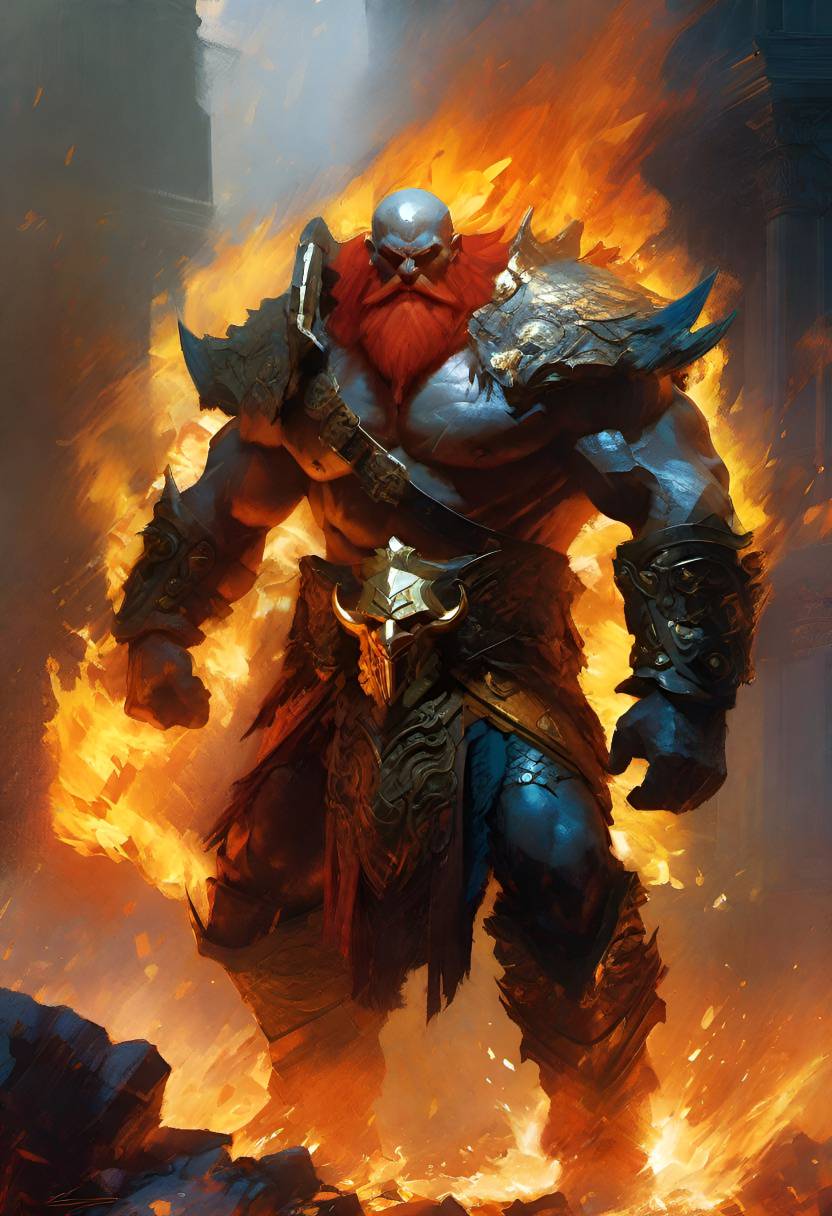
Fire giants had very broad bodies, making them sort of dwarf-like in appearance, and bulky. They stood roughly 18 feet tall, but they weighed over 7,000 pounds, much heavier than a human of that height would weigh. Their skin was very dark, reminiscent of coal, and the color of their hair tended towards a spectrum of flaming orange or red, with similarly colored red eyes.
Their clothing was usually flame-colored or black and singed. They also tended to wear armor that was forged from steel or dragonscales.
Biological Traits
Although their bodies were impervious to harm from fire, even that exhaled by a red dragon, some fire giants were particularly vulnerable to cold.
Ecology and Habitats
They preferred to dwell in hot environments like volcanic areas, either in caverns or castles.
Fire giants shun cold as much as their cousins the frost giants hate heat. They can adapt to cold environments with effort, though, keeping their hearth fires burning bright and wearing heavy woolen clothing and furs to stay warm.
Dietary Needs and Habits
Fire giants are carnivorous and favor heavily roasted or charred meat, often cooked over lava flows or massive forges. Their prey includes large mountain-dwelling creatures like dire goats, cave bears, and even dragons if they can overpower one.
Behaviour
When fire giants aren’t honing their crafting skills, they’re drilling with weapons or exercising to keep themselves fit for battle. The typical fire giant has a mastery of combat tactics that few other warriors can match, but the giants’ understanding of strategy is rudimentary.
This deficiency isn’t born from a lack of ability, but has its roots in tradition. In ages past, when the giants worked together to dominate the world, strategy was determined by the cloud giants and the storm giants. Ever since the clans went their separate ways after Ostoria’s wars against the dragons, the fire giants have not mounted a grand, strategic effort to extend their sway, but they have fought countless skirmishes and other tactical engagements, mainly to solidify their hold on territory they have already claimed. If an ambitious fire giant ever became a master of strategic planning (or captured and enslaved a cooperative general), little could stop a tribe of fire giants that enjoyed this additional advantage over their neighbors.
Fire giants raise and train hell hounds as war dogs, and they sometimes persuade human wizards (free or enslaved) to harness fire elementals as guardians for their strongholds. Some allow trolls to roam free in rarely used parts of their fortresses, serving as perimeter guards of a sort. Trolls require little maintenance, able to survive on the fire giants’ scraps and on dead or diseased slaves; they’re tough enough to deter most intruders; and their susceptibility to fire makes them little threat to a fire giant.
Fire giants often considered bravery as being one of the highest virtues anyone could and should have.16 They relished opportunities in which they could test their fortitude against formidable opponents.
Magic
Fire giants possessed an average affinity for runecasting as well as traditional sorcery. This affinity was superior to many of their kin, but paled in comparison to that of cloud and storm giants.18 They typically preferred to memorize spells that would help them in detecting and thwarting intruders.19
Combat
Fire giants were known to attack their enemies with rocks heated in fire or lava, thereby softening the targets before engaging in close quarters combat.6 When it came to close quarters, fire giants favored the use of large swords,8 typically enchanted with flames.6
Having had caltrops used against them one too many times, innovative fire giants developed boots made of either iron or dragonskin to protect their feet. These were typically covered in either fur or leather in order to conceal the material from any crafty magic user that might think to use spells of cold or heat. It was rumored that some giants had become specialists in fighting with these boots.
Additional Information
Social Structure
Fire giants lived in small family groups, called huslyder and existed in societies often led by a king or a queen.
Ordning
A fire giant’s prowess in the occupations of crafting determines its place in the ordning. Although fire giants put stock in combat skill, they recognize that success in battle or on the hunt derives mainly from the quality of one’s weapons and armor, and those that can fashion the finest gear enjoy the highest status in the clan. Master artisans, architects, and engineers select the best disciples to pass their knowledge on to, along with their standing. Often pupils are children or siblings of their teachers, but that’s not always so. Leaders are chosen by general recognition from among the best crafters in the clan.
Perception and Sensory Capabilities
Civilization and Culture
Naming Traditions
Common given names among fire giants included the following:
Males: Fforl, Ffuldr, Fulluk, Hauk, Hulbro, Ilkurt, Snarr, Zund, and Zundr.
Females: Edrelle, Emba, Ffaelane, Ghenjra, Hulda, Lukue, Marra, and Vrolka.
Major Language Groups and Dialects
Fire giants were known to speak the general giant language Jotun, their own specialized version of it known as Jotunild, as well as common. However, they were often largely illiterate due to education being undervalued in their culture.
Culture and Cultural Heritage
Fire giants don’t spend a lot of time crafting works of art, although they would maintain that all of their feats of metalworking and engineering are themselves forms of artistic expression. Beyond such accomplishments, true artwork is scarce among fire giants, and most of what exists is jewelry, made from gems and ore that they mine and then refine. A unique form of art that some fire giants produce involves manipulating magma as it cools, forming it into fantastical, one-of-a-kind shapes. The most striking of these works are collected and displayed inside the stronghold, not unlike how other cultures create topiary gardens.
Common Myths and Legends
Surtur, the chief deity of fire giants, is believed to have been born alongside Thrym. Each twin then tried to be the first to cry out, the first to walk, and the first to talk, and they have competed with one another ever since. Often in legends these contests are bloody battles, but some tales have the brothers acting side by side on grand adventures. Surtur is seen as the more clever of the two, and fire giants emulate his unsurpassed skill at creating and building things.
In the fire giants’ world, fire is strength. It burns away impurities and leaves behind only what is strong enough to withstand the heat, such as the best steel from the forge. When fire is controlled, it is the giants’ most powerful tool; when it rages unchecked, it can bring down forests and lay waste to cities.
Because of the destructive power of fire, the worship of Surtur is tinged with an apocalyptic air. Some observers suspect that priests of Surtur maintain clandestine workshops and armories where they manufacture and stockpile battle gear in preparation for a final, all-encompassing battle that will decide the fate of the world. If the suspicions are true, these sites are expertly hidden and kept secret even from most fire giants.
Interspecies Relations and Assumptions
Many fire giants, at least in the Ice Spires region, were known to enslave fomorians and verbeegs, as well as dwarves and gnomes. They aren’t overly cruel masters, but neither are they particularly kind — they are uncaring about their slaves, because slaves aren’t giants, and there are always more to be had if the supply runs low.
Most creatures that fire giants capture are put to work in the giants’ mines or on surface farms the giants claim as part of their domain. Even master crafters of other races are consigned to unskilled labor, because so few of them have talents the fire giants consider “skilled.” Only creatures that have skills the fire giants need but don’t practice (because they aren’t valued in the ordning), such as accounting, brewing, and medicine, are allowed to continue plying their trades.
Skilled slaves receive better treatment, at least in the sense that an owner uses less force with a delicate tool, but as a rule fire giants view humans in much the same way that humans view horses: they have utility if properly directed, and some might be prized for rare qualities, but even the smartest, best trained horse isn’t a person. That said, it’s not unheard of for a fire giant to “consult with” a slave physician when it falls ill, or with a slave engineer right before beginning a difficult stage of tunnel excavation. (Such a consultation would only be to ensure that the right tools and materials are on hand for the excavation, not to solicit a second opinion on the giant’s personal assessment of the structure’s integrity.)
Fire giants were often hostage takers and took payments from less powerful creatures in their surrounding area in exchange for not attacking them.6
They were known to occasionally forge alliances with, and even serve, red dragons.32 They were also known to domesticate hell hounds, keeping them as pets or guards.

Comments