

Stone Giant
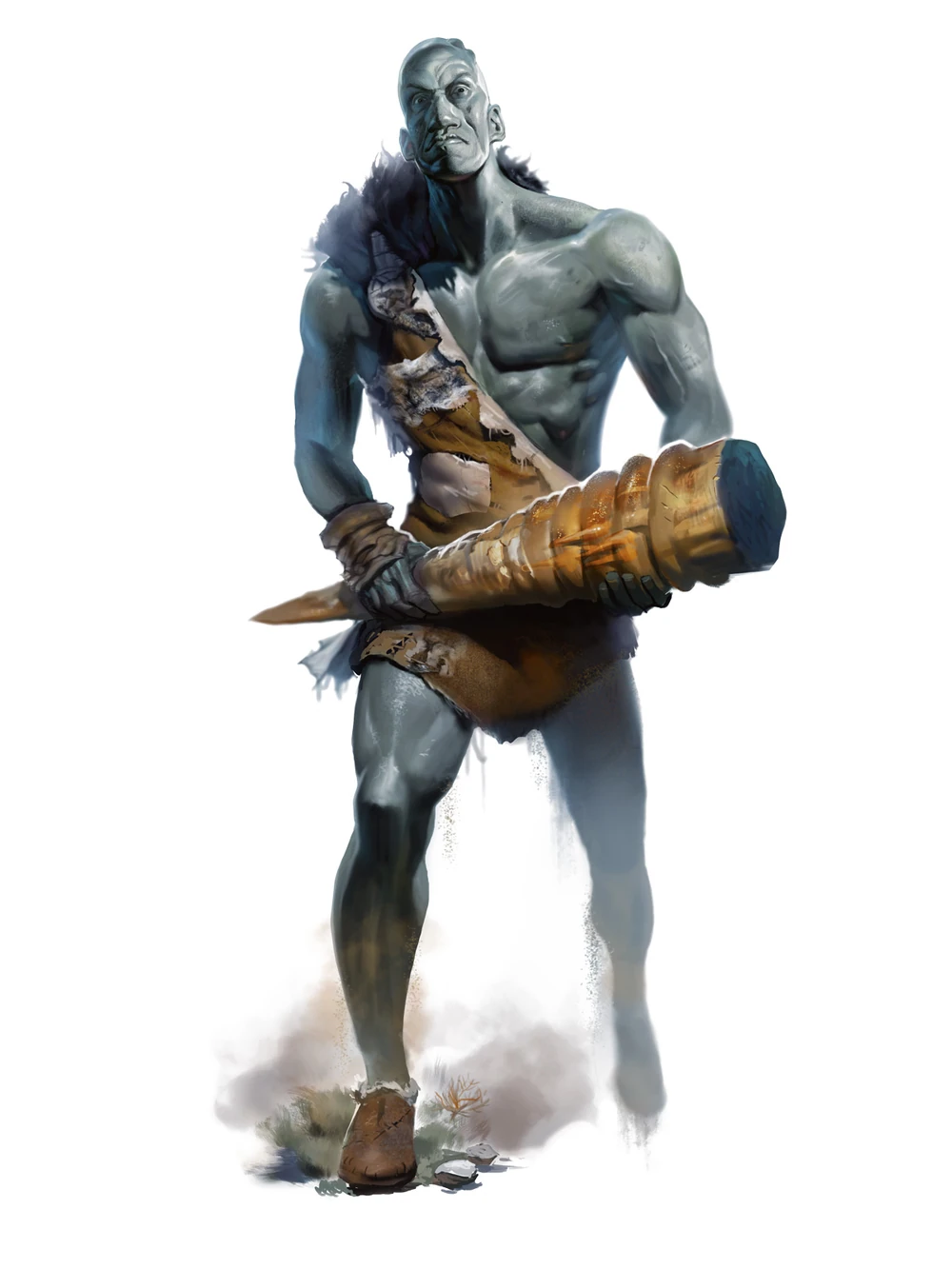
Stone giants, called steinjotunen in their own language,, were a reclusive and artistic race of giants that lived in underground and mountainous environments.
Basic Information
Anatomy
The bodies of stone giants had a gray to grayish-brown skin tone, hair that ranged in a spectrum of dark grays and bluish-grays, and eyes of a silver or steel hue. They also tended to wear clothing that was of a similar color to nearby rocks, which altogether made it easy for their race to blend in with their environment when needed.
Adults averaged about 18 feet in height, although fossilized stone giants from the era of Ostoria show that in the past their race was capable of reaching heights of up to 24 feet. Though thinner and less bulky than fire giants, who were about the same height on average, a stone giant's thicker, heavier flesh made them weigh significantly more, at about 9,000 pounds.
Ecology and Habitats
Secluded caves are the homes of the stone giants. Cavern networks are their towns, rocky tunnels their roads, and underground streams their waterways. Isolated mountain ranges are their continents, with the vast spans of land between seen as oceans that the stone giants only rarely cross.
Dietary Needs and Habits
The diet of stone giants is primarily omnivorous, although they are known to prefer fresh food. They often consume wild game and vegetation during warm seasons.
Behaviour
In their dark, quiet caves, stone giants wordlessly chip away at elaborate carvings, measuring time in the echoing drip of water into cavern pools. In the deepest chambers of a stone giant settlement, far from the chittering of bats or the patrols paced out by the giants’ cave bear companions, are holy places where silence and darkness are complete. Stone takes on its most sacred quality in these cavern cathedrals, their buttresses and columns carved with a beauty that shames the legendary stonecraft of the dwarves.
Additional Information
Social Structure
Stone giant family bonds were less important than the bonds between a master and his pupil. The ordering of stone giant society was based upon an individual's artistry and ability to throw rocks.
The strongest stone giant nation was Cairnheim in the Underdark. It was a village located in the western part of the Darklands in the Upperdark inside the Giant's Run Mountains under the rule of the stone giant lich Dodkong.
Ordning
Skilled rock throwers are granted positions of high rank in the giants’ ordning, testing and demonstrating their ability to hurl and catch enormous boulders. Such giants take the front ranks when a tribe has cause to defend its home or attack its enemies. However, even in combat, artistry is key. A stone giant hurling a rock performs not just a feat of brute strength but also one of stunning athleticism and poise.
Geographic Origin and Distribution
Stone giants were powerful enough to survive and make a living in the Underdark in the face of competition. They had a tendency to gather in larger individual groups the deeper the given group was located, but were primarily denizens of the Upperdark, though their numbers were small even there.
Perception and Sensory Capabilities
Stone giants had an excellent sense of smell and had infravision sight of up to 200 feet
Civilization and Culture
Naming Traditions
Common given names among stone giants included the following:
Males
Falkh, Hundar, Korlgar, Kuljarn, Sulfulkh, Valgusk, Vorold, and Yulhamur.
Females
Beldra, Gillauga, Gurdis, Moada, Oskra, Ragnara, Rakra, Skarla, Woave, and Zarka.
Major Language Groups and Dialects
Stone giants were known to speak the general giant language Jotun and their own dialect known as Jotunstein, which was derived from both Jotun and Auld Dwarvish. The written form of this language was known as "Metamorpherie".
Culture and Cultural Heritage
Among stone giants, artistry ranks as the greatest virtue. They create intricate murals, paint sprawling murals across cavern walls, and indulge in a wide variety of other artistic disciplines. They esteem stone carving as the greatest of skills.
Stone giants strive to draw shapes out of raw stone, which they believe reveal meaning inspired by their god, Skoraeus Stonebones. The giants appoint the tribe’s best carvers as their leaders, shamans, and prophets. The holy hands of such giants become the hands of the god as they work.
Common Myths and Legends
Like all true giants, stone giants worshiped Annam All-Father as their chief deity, but unlike the other races they envisioned him as being an artist whose skills were perfection. Their patron deity among Annam's children was Skoraeus Stonebones, though lesser deities Hiatea and Iallanis were also known to have a significant following among the stone giants.
Priests of Skoraeus felt that their duty was to oversee their society's affairs and ensure that the stone giants as a whole continued to progress towards greater achievements in art and intellectual thought. But in order to accomplish this goal, they believed that their race needed to isolate itself from others, with the exception of individuals who might help expand upon their mastery of craftsmanship.
Interspecies Relations and Assumptions
Stone giants view the world outside their underground homes as a realm of dreams where nothing is entirely true or real. They behave in the surface world the way humanoids might behave in their own dreams, making little account for their actions and never fully trusting what they see or hear. A promise made above ground need not be kept. Insults can be made without apology. Killing prey or sentient beings is no cause for guilt in the dreaming world beneath the sky.

Comments