

Hill Giant
Hill giants, called haugjotunen in their own language, were voracious, primitive giants defined by their gluttony. They were the least of the commonly recognized "true giants", the shortest in stature, weakest in mind, and lowest in rank according to the Ordning. Granted domain over the rolling hills by Annam All-Father millennia ago, they were masters of its slopes and deeply connected to the land itself.
Basic Information
Anatomy
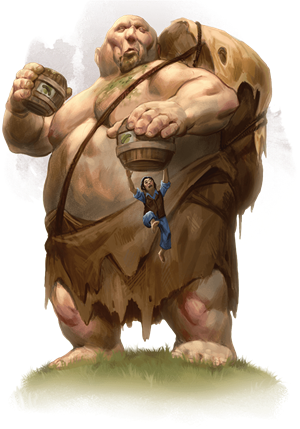
Hill giants normally stood around 16 feet tall, but males could reach about 17 feet in height. Females tended to be a bit shorter, at 15 to 16 feet. Their reported weight was around 4,500 pounds, but morbidly obese (and immobile) individuals were known to weigh over 10 tons. Their skin was a deep, ruddy brown, but they could also be light tan in coloration as a result of a life spent under the sun. Their hair ranged from brown to black, and their eyes shared that color in addition to having red rims.
Hill giants were basically humanoid in shape, but had an oddly simian in appearance, with low foreheads, stooped shoulders, thick limbs, and elongated arms shared by both genders. Despite being the shortest of giants, they had larger and more muscular appendages than other giant breeds. They had a rugged, barbaric look, and if not for the lack of two heads could be mistaken for the relatively uncivilized ettins at a glance.
Genetics and Reproduction
Most giants bore young in the same fashion as humans, with gestation periods for hill giants specifically being nine months.
Growth Rate & Stages
Hill giant infants were completely incapable, but about as tough as a normal gnoll, while older children were about as capable as ogres.
Hill Giants reach adolescence by 20, and reach maturity by 40. Giants typically reach mating age by 50, and can produce offspring as late as 125 years old.
Peaceful deaths were rare among hill giants, but they could live to be 200 years old.
Ecology and Habitats
Hill giants lived in the hills and mountain valleys across the world. Though they preferred temperate regions, some lived in colder climates, and they could be found in any location where inclines in the land were abundant. They lumbered up and down the slopes and blundered through the hills and forests where they lived, often in search of food. Badlands, canyons, deserts, rocky barrens, mountain passes, caves, and similar underground environments could also house hill giants, and their lairs were often made in forsaken areas.
As with all giant breeds assigned a terrain to rule by Annam, hill giants had developed a natural mastery of their environment so absolute that it could be mistaken for (and sometimes was) magic. In their case, hill giants were invariably aware of the various secret passes and hidden crossways that dotted the areas surrounding their steadings.
Dietary Needs and Habits
On average, hill giants required more than ten times as much food as humans to survive, an even greater amount than both the larger stone and fire giants required. The reason for this disproportionate level of consumption in comparison to their size was that, over the years, hill giants had developed an excessively high metabolism.
Hill giants would eat almost anything, and with little else to occupy their time they ate as much as possible. Although smart enough to avoid eating anything obviously deadly (such as poisonous creatures) they were willing to consume such disgusting things as rotten meat, decaying plants, and even mud. They gleefully gorged themselves on spoiled and diseased foods as if eating dessert, oblivious to the danger, and it was only their vulture-like constitution that fended off illness. They were hated and feared by farmers for their ceaseless voracity, devouring live cattle before moving on to sheep, goats, chickens, fruits, vegetables grain, and perhaps the farmers somewhere along the line.
Hill giants mainly consumed meat, which could include that of bears, griffons, ogres, humans, and demihumans among other kinds, and was normally obtained through hunting. Young green dragon flesh was considered a delicacy, and hill giants whose homes were covered by forests sometimes organized hunting parties to search for their lairs. In response, green dragons sometimes hunted and enslaved hill giants, who they considered to be their greatest enemy.
Behaviour
Hill giants were selfish and brutish bullies that often forced weaker creatures to do their bidding. They lived as uncivilized savages, surviving by foraging, hunting, and raiding for food when not coercing other, smaller beings into doing the work and feeding them.
Although prone to evil behaviors, a hill giant's acts of cruelty were normally more along the lines of angry reactions than deliberate decisions. They were short-tempered creatures whose form of chaotic evil was known to be defined by violent mood swings and losses of patience. They were likely to go on a violent rampage if they felt deceived, mocked, or otherwise humiliated, and in their tantrums would rage against the guilty and innocent alike until they calmed down, grew hungry, or were otherwise distracted. Their memories were also normally too short to hold grudges, with some reported to forget those they recently met after waking up (which conversely could mean that any previously built rapport could be forgotten).
Intelligence
Hill giants equated size with strength, functioning based on a "bigger is better" mentality. Smaller creatures, sentient or not, were prey to hunt with impunity, while larger creatures, like dragons and bigger giants, were dangerous adversaries. Following this logic, a hill giant of average intelligence might think to consume food in attempt to grow immense (not understanding biological limitations) and therefore superior. The idea that giants were stupid was perhaps the most commonly stated misconception surrounding them, but few kinds embodied the fallacious belief more than hill giants.
Hill giants were reckless, sluggish, and notoriously moronic, such that they would died out long ago if their great size and formidable power did not compensate for their dull wits and lazy disposition. Ironically, their mental weakness was partially perpetuated by their brute strength. Having never faced adversity that required adaptation and improvement, hill giants had managed to survive for millennia with their lacking ambition, living unchanged as barbarians with simple minds and underdeveloped emotions.
The least intelligent hill giants were mentally closer to beasts than civilized beings, while the brightest were above average compared to most humanoids. Hill giants were blunt and direct in conversation, and though reasoning with them was useless, they could be manipulated into taking certain actions by more clever creatures. They had little concept of deception, to the point where villagers standing on each other's shoulders could cover themselves in blankets and hold a large, circular object above themselves to fool a hill giant into fleeing from the opposing giant.
Hill giants were much like ogres in terms of mental prowess, being as intelligent, if not stupider, than the smaller giant-kin. Both had a tendency to be overly literal due to not thinking about their directions, misinterpreting even the simplest instructions due to their lacking consideration. However, though potentially less intelligent than ogres, hill giants shared with them an exceptional cunning, even outmatching them in craftiness. Though they themselves were easily susceptible to the schemes of others, both were capable of surprising feats of cleverness, albeit in pursuit of limited desires.
Combat
Despite lacking brainpower and being infamously clumsy, hill giants were capable combatants. Some of the already physically formidable beings even trained to become barbarians. When they went looking for food, hill giants did so alone or with an animal companion, such as a dire wolf, to avoid having to split their spoils with other tribe mates.
A hill giant's preferred combat strategy was to utilize the time-honored giant tactic of throwing rocks at their enemies. They pelted their enemies with boulders from high, rocky outcroppings, allowing them to injure their foes while limiting the risk of personal injury. Assuming they could not pull rocks from the bags most giants carried around, they could simply pull rocks up from the ground. Normally the boulders they used were around 3 feet in diameter and 325 pounds (147 kilograms) in weight. Their reported maximum throwing ranges varied, with the longest claimed distance being 600 feet. They could also catch similarly-sized rocks (and other proportionate missiles) with an approximate success rate of about three in ten.
Once an opponent got into melee range, hill giants stopped hurling stones and began fighting in close quarters. They favored the use of oversized clubs, and could uproot trees to use as weapons if needed. Some hill giant hunters were known to use javelins, but they still carried throwing rocks with them.
Hill giants had various favorite melee tactics. They loved overrunning smaller enemies at the start of a battle, trampling them underfoot before standing fast and swinging with their clubs. When faced with more than one target, they made sweeping motions in an attempt to knock their enemies to the ground. Some liked to hurl their whole, considerable mass at smaller foes, crushing their opposition beneath their formidable bulk.
Even hill giants, as dim-witted as they were, recognized that smaller foes would attack their lower body parts. As such, when they knew they were going to face human-sized enemies, they took certain precautions. They were known to peel thick strips of bark from trees and strap them to their legs as make-shift greaves, and to tie logs and stones to their belts so that foes trying to move under them would have to beware the dangling obstacles. Hill giants were also wise enough to know that a hopeless situation was one to escape from, rather than continue fighting to the death. When faced with the prospect of death, they might even fall into incoherent blubbering and sobbing.
Additional Information
Social Structure
As with most giant breeds, hill giants were loosely organized into huslyder, a giantish word roughly meaning "families", that were responsible for taking care of children. For hill giants, huslyder were large and communal, and could be relatively unregimented compared to other giant societies, even if each giant still had specific assigned roles.
Normally a hill giant lair housed an extended family, sometimes including lone hill giants who were accepted into the family, which totaled around 9-16 hill giants. Of these, around half were male, a quarter female, and the remainder juveniles. Raiding and hunting parties of around 6-9 members were known to form, as were bands of similar numbers with the addition of 2-3 non-combatant members.
On occasions where a hill giant of average human intelligence emerged, there was the capacity of hill giants to be rallied by the superior intellect, creating groups of hill giants anywhere from 2-4 times the ordinary number. Such self-titled "giant kings" often raided human towns, and might even go so far as to attack other bands of giants. A hill giant tribe normally had about 21-30 members in addition to about 7-11 non-combatants.
Among hill giants, the most maug (the equivalent of evil for giants) act a giant could commit was the betrayal of one's tribe. If a member of a tribe aided outsiders against that tribe, even for a morally good reason, all his peers, even those of good alignment themselves, would brand him as maug, and therefore worthy of shunning or punishment. On the other hand, even despicable hill giants could be convinced to stop a rampaging hill giant if he once betrayed his breed
Like other breeds, hill giants had developed their own value system over the millennia, and their unique culture was centered around one thing — food. According to the hill giant belief system, the one true meaning of life was to satisfy one's appetites, and over the years the dull creatures had managed to take this simple philosophy of hedonism to surprisingly deep extremes. Unusually learned hill giants were known to write elaborate poems using food and consumption in complex metaphors regarding the many trials of life.
Given the hill giant tendency to put all sorts of repulsive and rotting things in their mouths with little hesitation, some theorized that the species had no sense of taste or were so hungry at all times that taste was irrelevant. In truth, hill giants had, over the course of their long history, consumed almost anything one could imagine (including various sentient beings) and enjoyed almost everything they tried. The kind of food that humans and elves would find appealing were appallingly dull to hill giants, who preferred more exotic dishes, and since most recovered from getting sick, they rarely learned to avoid anything.
Despite their general ignorance and ineptitude, hill giants had unnatural gifts for both hunting and cooking, and had actually developed some of the most sophisticated food preservation methods in all the Realms. Long had they known the benefits of smoking, salting, and freezing different foodstuffs, although despite these advancements about a fourth of their inventory was accidentally ruined or spoiled before it could be used. They also had knowledge of certain properties of different foods, namely which were more fattening.
Ordning
A hill giant's position in the Ordning (the social ranking system among giant breeds and giants as a whole) was based around an odd combination of physical strength and gustatory prowess. Though the latter skill might seem like a strange factor to use for determining the chain of command, among hill giants, it was a trait synonymous with virtue. Because hill giants believed the purpose of life was self-gratification, it only made sense that the development of skills that helped them to accomplish that goal were the most worthy of being pursued, and thus that the giant who had best mastered such skills was obviously the most fit to lead.
Size was the same thing as strength to hill giants, and consuming food was not only satisfying, but made them even bigger. As such, the tallest, widest, and heaviest member of a hill giant tribe (normally but not always still able to move) was considered the most successful and admirable. On the other hand, the lazy creatures also realized that overexerting themselves often made them thinner; as one might expect, girth was perhaps the one area where hill giants excelled compared to other giant breeds.
The qualities that other beings expected or required of their leaders — including intelligence, decisiveness, and charisma — were not rewarded or recognized as important beyond their capacity to aid a giant in obtaining more food. Some hill giants did not even consciously realize they followed an Ordning, simply operating on the belief that the larger and stronger giant was to be obeyed. Only on rare occasions were relatively smart hill giants able to subvert their social order through cunning, such as by deceiving or intimidating others into giving them food or by gaining the favor of their superiors.
For hill giants, Ordning challenges to rise in rank took the form of epic eating competitions where two opposing parties would devour huge piles of food. After the massive meals were prepared, (hill giants involved would try to obtain lots of their favorite foods for such battles) the contestants would emerge, consume, and return every three hours until one side couldn't continue. In "duels" between the most gluttonous (and likely among the highest ranking) hill giants, these competitions could go on for weeks, with neither side allowed sleep. Unbelievable portions were consumed by the end of such matches, which ended with both participants often feeling utterly sick and nearly immobile.
At the top of a hill giant Ordning was the chief known as the storkokk, meaning "master eater" in their own giantish dialect. Because of the nature of the selection process they had to endure simply to obtain their positions in the first place, storkokks were almost always the most massive and rapacious hill giant in their steading. They also had among the greatest responsibility, for not only were they tasked with handling matters of state (which given hill giant attitudes would often sounded like discussions at an eatery), they were looked to by their kin for political leadership, spiritual guidance, and gastronomical inspiration.
Below the master eater were the gluttons, the highest ranking of hill giants. They were tasked with supervising labor, law enforcement, and the creation of new rules, but their most important duties were, supervising the obtainment of foodstuffs, hunting, and the creation of new recipes. A glutton that failed in these duties (such as if their food stores gradually dwindled down to nothing) was severely dishonored, and the pressure to succeed was so dire for some that they resorted to dishonest methods (including stealing from other gluttons) to keep up appearances.
The best and brightest hill giants were assigned the role of fetcher, a position meant to groom them for later greatness. Each was the assistant to a specific glutton and most master gluttons called upon their most trusted fetchers to handle minor details related to their positions, such as stocking the vegetables or non-exotic livestock. Hoarders meanwhile were those hill giants responsible for performing inventory, storing the perishables and cooking supplies, and reporting food levels to the relevant higher ups.
ill giant hunters stalked game and brought it back home (dead or alive), and were known to form hunting parties to do so. Certain limits, such as not hunting humans, were sometimes placed upon them depending on a tribe's diplomatic position. Conversely there were also gatherers, who obtained foods that could not be hunted or, ironically, gathered, by buying from merchants. Since hill giants had no use for treasure, they would often gladly pay above standard price for their purchases. Lowest in the Ordning were herders, who killed and butchered the tribal herd (or managed the slaves that did so) and were usually trained in various livestock fattening techniques (livestock sometimes including sentient humanoids).
Geographic Origin and Distribution
Most of Toril's giants had gathered in the regions just south of the Endless Ice Sea and west of the desert of Anauroch. They were known to prowl the foothills of the Spine of the World and could be found in the Ice Spires mountain range. In interior Faerûn, hill giants could be found in the Cloven Mountains. Beyond Faerûn, hill giants could be found on the continent of Zakhara.
Civilization and Culture
Naming Traditions
Males
Dagg, Gulk, Hogl, Hond, Hund, Kuld, Lodd, Teldo, Vruk, and Usgut.
Females
Ardis, Bora, Dis, Gulkra, Gylla, Laha, Nelmyr, Telda, Teldra, Tora, and Vaere
Beauty Ideals
The traits that other races often saw as attractive were known to be considered strange and worthy of scorn to hill giants. Straight teeth, neat hair, unblemished skin, clear speech, and a lack of drool when eating were abnormal, if not repulsive traits. Their own sweat mixed with the reeking stench of the crude, rough animal hides they wore. Animal skins worn by hill giants were poorly stitched with hair and leather thongs, not stripped of fur, and rarely cleaned or repaired, since hill giants normally opted to simply add more skins on
Major Language Groups and Dialects
Hill giants were known to speak the standard giant language of Jotun, but like most giant breeds, they had their own specialized dialect of the tongue, in their case Jotunhaug (which was closely interrelated to the frost giant dialect of Jotunise). Although capable of speaking it, hill giants were among the giant types that were particularly prone to illiteracy due to the low value their culture placed on education and knowledge. Seldom did they have the intelligence to learn to read, instead telling their stories through pictograms etched into earth.
About half spoke the language of ogres, but most spoke a little bit of Ogre and Gnoll, and the smarter ones could learn languages such as Common, Draconic, Elven, Goblin and Orc.
Culture and Cultural Heritage
On occasion, hill giants were known to amuse themselves with inane games, normally involving food or eating in some way. One such game, known as "stuff-stuff" had the hill giants see how many small creatures (such as halflings, gnomes, or goblins) that they could fit into their mouths and once without swallowing. Hill giants were also known to take amusement from wading in pools of water (which doubled as drinking water sources), even in regions with extremely low temperatures, and sometimes created such pools by damming rivers. The idea of wives and husbands was present among hill giants, although polyamory was noted to occur. Even if both subjects would miss each other if separated, daily spousal abuse was not unheard of.
If a hill giant glutton discovered that his food stores were particularly well-stocked, they might decide to call a grand feast. A grand feast was a huge celebration infamous for total revelry and lack or restraint, and often ended with most of the tribe heavily drunk and fast asleep. During such feasts, an important guest from outside the tribe was often asked to part. This might be another giant chieftain or a diplomatic partner of another race, but since so few guests (including some higher-ranking giant breeds) could match a hill giant's sheer overindulgent gluttony, most would politely excuse themselves long before the end of the feast.
In lieu of engaging in their own lacking and myopic culture, hill giants were known to ape the traditions of other creatures instead, copying their methods without proper consideration. For example, a tribe might copy elves only to topple forests trying to live in trees, while those that tried to take humanoid villages as their own often only got as far as the door before accidentally demolishing the walls and roof. One such imitation took the form of a hill giant declaring itself king and demanding tribute of livestock and produce from nearby humanoids, a tyrannical reign of terror defined by the giant's shifting mood, with the constant threat of it forgetting its own title and eating its subjects on a whim.
Interspecies Relations and Assumptions
Hill giants often lived in fear of their larger giant cousins. Although they did not consider it maug behavior (since for hill giants it was an inherent part of their ways) storm giants still considered the raiding practices of their lesser kin distasteful. Hill giants served cloud giants, and might fight as brutes, act as fodder, battle for their amusement, or sometimes steal from humanoid lands (or "collect fair tax" as the cloud giants saw it) on their behalf. Frost giants often enjoyed opportunities to mingle with other tribes so that they could show off their bravery and prowess, and particularly enjoyed their infrequent visits to hill giants since drink was so plentiful.
Although ettins also worshiped the same god as hill giants, albeit a two-headed aspect of him, that did not necessarily mean that the two species had friendly relations or any special affinity for each other. They merely paid him homage as a powerful ettin, and so were not granted spells (though they could still cast spells on their faith alone) while the hill giants truly worshiped him as a deity. Ettins (alongside fomorians, who were known to be enslaved for the purpose) were sometimes used as the caretakers of a tribal herd.
Ogres were known to work for hill giants when impressed by their size or adamant ambition; around half of hill giant lairs had guards, and a fifth of the time those guards consisted of 2-8 ogres. Verbeeg sometimes maintained symbiotic relationships with both hill giants and ogres, and the three giant types sometimes shared so many similarities that the more ignorant members of smaller races could get them all mixed up. The verbeeg provided greater intelligence and direction while the other types protected them. Watching them attempt to coordinate could be humorous to watch (if not their intended victim) as the infuriated verbeeg struggled to communicate with their stronger kin, who were routinely befuddled by their most basic commands.
Individuals and bands of hill giants had a tendency to be aggressively direct in their interactions, taking rather than trading. However, hill giant tribes (and some bands), often traded with other giants, including bands of ogres and other hill giants, to obtain foodstuffs, trinkets, and servants.
Non-Giants
Many non-giant races could end up serving hill giants. Survivors of a defeated orc tribe, given their culturally ingrained bowing before superior strength, could come under the sway of a creature like a hill giant even despite its dim wits. Both hill giants and frost giants sometimes kidnapped and enslaved goliaths to force them to do menial labor, and particularly evil ones captured them specifically for the purpose of eating or sacrificing them. Many hill giant tribes had discovered that dwarves were more valuable as workers than as meals, and sought to capture them for the former purpose. Galeb duhrs, creatures of living stone said by some to have once been dwarves, often served hill giants.
Despite their barbaric ways, hill giants still maintained a basically humanoid shape that made it easy for them to relate with more commonly civilized beings. They were never truly accepted into most civilizations, but could do well on the edges of society, forging strong and profitable lives on its frontiers. They were known to serve in the military of other nations, such as in the armies of Thay. In Zakhara, where they tended to be more civilized than their western brethren, many hill giants could be found living in cities alongside other races.
Hill giants were also known to associate with fiends. Hezrous on the Material Plane, often used their above-average intelligence and great size to recruit less intelligent giants, hill giants included. Hill giants were also known to work for some of the rakshasa nobles of Tirumala

Comments