

Frost Giant
Frost giants, called isejotunen in their own language, were large giants that could be found in most cold environments of Faerûn.
Basic Information
Anatomy
Among the tallest of true giants, frost giants could tower higher than 21 feet. They weighed about 8,000 pounds.
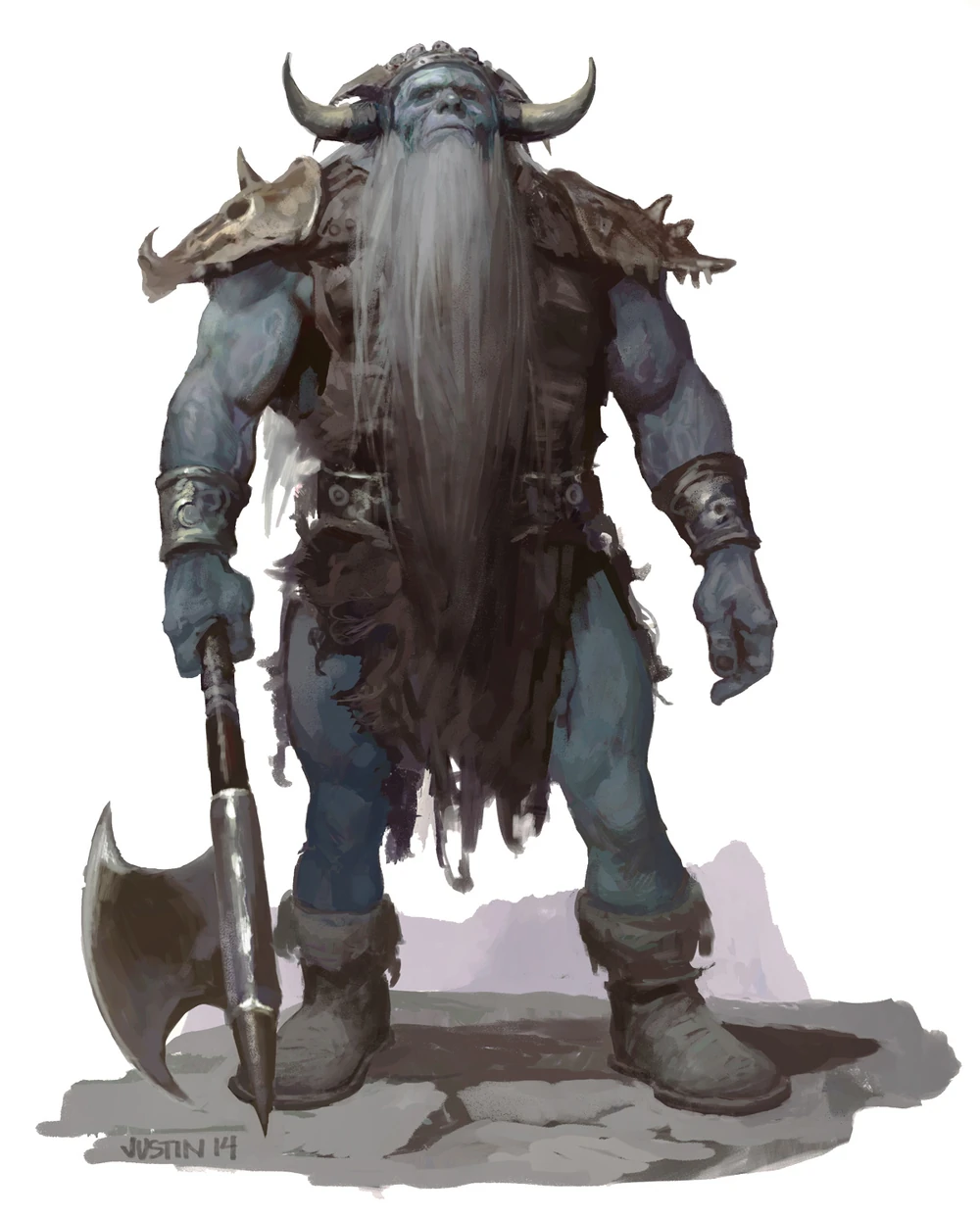
The bodies of these giants had skin and hair whose colors ranged a wide spectrum of blue and white shades, though some were known to have dirty yellow hair. Likewise, their eyes were generally shades of blue or yellow. Men often grew beards, which would become matted with frost and icicles.
Frost giants typically wore the skins or pelts of animals, along with any jewelry they owned. In terms of armor they tended to favor chainmail and helmets that were adorned with horns or feathers.
Ecology and Habitats
Frost giants dwell in high peaks and glacial rifts where the sun hides its golden head by winter.
Dietary Needs and Habits
Due to the environments in which they typically lived, frost giants had a largely carnivorous diet. Crops don’t grow in their frozen homelands, and they keep little livestock beyond what they capture in their raids. Frost giants typically obtained their food by means of hunting or raiding the settlements of humans and demihumans, although they were not above trading if the need arose. When hunting in their native tundras, it was not uncommon for a frost giant to forgoe cooking a fresh kill, as it would taste sufficiently hot to their tastes.
Additional Information
Social Structure
Frost giants respect brute strength above all else, and a frost giant’s place in the ordning depends on evidence of physical might, such as superior musculature, scars from battles of renown, or trophies fashioned from the bodies of slain enemies. Tasks such as hunting, childrearing, and crafting are given to giants based on their physical strength and hardiness.
In their societies, the most important bond (besides that of the ordning) was that of family. So much so that the recitation of ancestral lineage was an important aspect of the sagas crafted by their skalds, with each new character being introduced with a full recitation accompanied by appropriate music.
Geographic Origin and Distribution
On Faerun, most Frost Giants would be found in the northern regions, such as the Spine of the World, <DATA NEEDED>
Beyond the Prime Material plane, large communities of frost giants lived on the Para-Elemental Plane of Ice and small tribes of them could be found in Stygia.
Civilization and Culture
Naming Traditions
Common given names among frost giants included the following:
Males: Fulvragg, Helmskag, Oraldr, Oskorri, Skane, Svolm, Ulfur, Uttir, and Valkurl.
Females: Folka, Gauthild, Geira, Grymra, Haelgra, Helmra, Hrimma, Imbra, Magra, and Vulkara.
Gender Ideals
The ordning is determined by strength and strength alone, and there is no difference in physical prowess between the genders of frost giants. (Most child-rearing duties are handled by the elderly of both sexes, not solely by females.) It is considered highly maug to attack or challenge a pregnant female, even to improve one’s standing, just as it would be to attack a frost giant as it slept.
Major Language Groups and Dialects
Frost giants were known to speak the general giant language Jotun, their own specialized version of it known as Jotunise, as well as common. However, they were often largely illiterate due to education being undervalued in their culture.
Culture and Cultural Heritage
Though frost giants consider the menial crafting of goods beneath them, carving and leatherwork are valued skills. They make their clothing from the skins and bones of beasts, and carve bone or ivory into jewelry and the handles of weapons and tools. They reuse the weapons and armor of their smaller foes, stringing shields into scale armor and lashing sword blades to wooden hafts to make giant-sized spears. The greatest battle trophies come from conquered dragons, and the greatest frost giant jarls wear armor of dragon scales or wield picks and mauls made of a dragon’s teeth or claws.
Skalds were an imprtant part of Frost Giant culture as well. These are essentially the bards and storytellers of a clan. Part of a skald's life was spent adventuring, though not as much as true warriors. The majority of their time was spent writing epic poems, known as "sagas," which honored the adventures of their tribe's leaders. Skalds often described sagas as being the "mead of Annam," thus some were known to start with the phrase, "I pour mead to the All-Father." Sagas were passed down through generations in a tribe, allowing frost giants to maintain the history of their people and earning skalds respect equal to that of a warrior.
Common Customs, Traditions and Rituals
Doubt or disagreement between frost giants over which is strongest is settled by a trial of strength. Such a contest typically involves wrestling but can also be a rock-throwing competition, a hunt, or one-on-one combat.
Interspecies Relations and Assumptions
Because strength is their only standard of measurement, frost giants are more likely than other giants to welcome a non-giant into their group. The might of a human who hunts polar bears bare-handed as frost giants do, or who wrestles a frost giant into submission, can’t be denied. Such a human could never become the chieftain of a tribe but could earn a place of honor as one blessed by Thrym.

Comments