

Red Dragon
The largest and most powerful of the chromatic dragons, and just the worst not counting Tiamat, red dragons were also the most fearsome and cruel. These dragons delighted in ruin, death and destruction. They breathed a cone of fire. In countless lands, they were considered the archetypal villainous dragon of legend and fable, exemplars of all their most notorious traits, and the red dragons thought so too
Basic Information
Anatomy
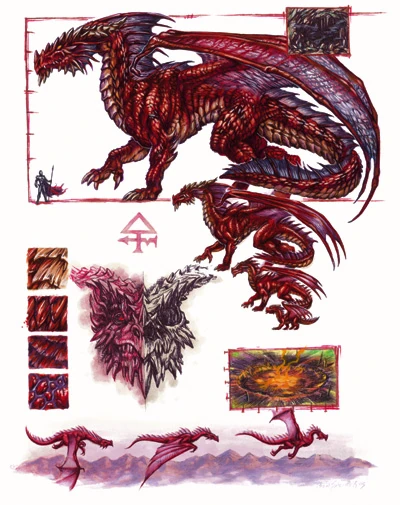
Red dragons were physically distinguished by their enormous size and wingspan, which was the widest of all dragons, both in absolute size and relative to body length. The outermost alar phalanx was extremely long and made the wing appear to taper, while the trailing edge was the longest section. The trailing edge joined the body behind the rear legs and partway along the tail.
And of course they were recognized by their scarlet and crimson scaled hides. A wyrmling had small, bright, and glossy scarlet scales (becoming pink on its belly), which turned dull and a deeper red by the time they were young dragons. In older dragons, the scales grew thicker and larger, and as tough as metal. In contrast to their red hide, their wings and neck frills turned a purple-gray, ash-blue, or blue-black toward the edges, similar to metal scorched in a fire, which darkened as they aged. The pupils of their eyes faded with age, such that especially old red dragons had eyes that seemed to be orbs of molten lava.
A red dragon had two large horns upon their head, which pointed backward toward their wings. These horns, which were big enough to be noticeable from below, could be either straight or twisted and any color from white as bone to black as night. They had smaller horns on their chin, cheeks, lower jaw, and in rows over their brow, as well as on their beak-like snout. They also had frills around their ears that often combined with their cheek horns as they got older and a backward-sweeping frill running down their necks and spine, from just behind the head to the end of the tail. The frills around the dragon's internal ears assisted its hearing, by collecting sounds and ascertaining directions.3 A red wyrmling had the two main horns, but the others were only stubs.
They smelled of smoke, sulfur, and pumice. Their bodies were so warm that the air around them occasionally shimmered as in a heat mirage3 while their blood was, when outside its body, hot enough to produce steam.16 Smoke blew from their nostrils constantly. When a red dragon was enraged, flames flickered in its eyes and nostrils.
The vanity of red dragons was often revealed in their prideful postures and the looks of disdain with which they regarded all others.
Genetics and Reproduction
Mating was initiated by the female every century or so when she felt the urge to have children. She looked for the nearest red dragon male with the most wealth and power. As such, males never denied their advances, as it was a sign of prestige among other males to be requested to mate. Avoiding inbreeding, they knew one another's genealogies via their reputations. Nevertheless, red dragon courtship was a risky matter, as the majority of potential suitors were still considered also as dangerous rivals. Females conducted much of the courting, though it was not unknown for males to try as well, and it typically saw the younger, though still high-status, usually female dragon carefully approaching the elder, usually male dragon. Rarely did two red dragons fight over a potential mate; such a battle would inevitably be deadly, and when a superior suitor pressed their case, all but the most unwise lesser would give up. Females tended to be the aggressors in mating.
After mating, the male would leave the female and not return, or else the elder then left the younger to protect the eggs. A typical red dragon female produced two to four eggs, and could control the number of eggs to limit the number of offspring, primarily to reduce the number of potential competitors in future. They had an incubation time of 270 days to 660 days or 22 months, and they were laid after approximately 165 days or 5.5 months. All were viable if laid under ideal conditions, namely deep underground and close to a natural heat source, for example, in a volcano's empty lava tubes. It should be kept within an open flame or at a temperature of no less than 140 ℉ (60 ℃) but it could even be immersed in a pool of lava.
The female jealously guarded the clutch, occasionally with the assistance of an old or infertile female. She rarely laid down her own life for her hatchlings, but would fight harder to protect them.
However, once hatched, even the wyrmlings were left to take care of themselves. Often, within the first few months, they would fight and kill one another until only one remained; otherwise, they would remain cooperative until they came of age. They remained close to the hatchery for a few years before spreading out to find more food and their own lairs. Hence, a full surviving clutch typically included two to five offspring from several matings, ranging in age from wyrmlings to young adults. Once her young reached the young adult stage of development, or sometimes earlier, the mother's natural instincts overruled her maternal ones and she forced all of her young from her territory, as she saw them as competitors. In fact, on occasion, after the young left the nest, the mother entered a temporary state of insanity in which she would attack, slay, and devour her former mate, if present, and any young that dared returned. There was never any familial or generational loyalty
Ecology and Habitats
Red dragons typically dwelled in warm mountainous regions, hills, desert mesas, and badlands,135789113536 though these were not necessities. The main factors in them choosing a place to live were primarily a high elevation and secondarily a high temperature; while cold did not especially hamper them, they did not like it, but would put up with it for the sake of elevation.3 Many preferred to dwell within volcanoes—even within the caldera itself—or sulfurous geysers or other areas of geothermal activity, where the intense heat and dangerous gases kept others at bay and comforted a sleeping dragon.3571136 They liked to sleep near a source of heat.10 However, they could make their lairs almost anywhere, from ice-capped mountains to hills to deserted dwarf mines and holds.35935
They particularly loved to make their lairs in large caverns or cave systems that reached deep underground and received geothermal activity. These places were warm with the heat of their bodies and smelled of smoke and sulfur. Despite this, almost all red dragons required a high perch somewhere close by from which they could look over their domain—the higher the better, as they believed that their domain encompassed all that they could see.1357891136 They were just as likely to be found up here as they were in their lairs.5 Otherwise, for security, they preferred to sleep and store their treasure deep underground, below masses of stone.3 Hence, noted dragon-slayer Smerdiuk Dragonbane mistakenly reported in The Compleat Dragon-Hunter that their lairs were often at the highest point in the region, as it gave them a sense of power and the ability to watch approaches.37
Red dragons that dwelled within dungeons or the like would make their lairs in heated or fire-filled locations. In lieu of a high place with a panoramic view of the area, they keep watch in large open spaces or down long corridors, wherever they could get a wide view.
As it was rare for a natural cave system to have all the features a red dragon desired, they would claim spaces already excavated or constructed by others where possible, or else enslave other creatures to build or modify them. Hence, they would seize such places as dwarf holds and drow access tunnels. Furthermore, a red dragon ordered its minions to attend them as servants, keep the lair clean, keep watch for trespassers, and build monuments to it and place these around its lair. These praised the dragon's power and told of its life, deeds, and victories.
While within its volcanic lair, to defend itself and its hoard, a legendary red dragon could cause earth tremors, clouds of toxic gases, and geysers of magma or even clouds of noxious smoke or areas of intense heat. The lair of a legendary red dragon could alter the land around it, causing minor earthquakes up to 6 miles (9.7 kilometers) away, heating and tainting water sources within 1 mile (1.6 kilometers), and even opening portals to the Elemental Plane of Fire within rocky fissures, through which beings of elemental fire could cross over. They could also cause droughts and desertification up to 6 miles (9,700 meters) away or cause all open flames in that range to turn dark red and to constantly hiss, crackle, and spark in any circumstance. Alternatively, the dragon might use any open flame up to 1 mile (1.6 kilometers) away to listen through to a range of 30 feet (9.1 meters). (Such effects faded within a tenday if the dragon was slain.) For more conventional defenses, many reds enjoyed a well-camouflaged pit trap that would summon a fiendish megaraptor in with the victim.
Dietary Needs and Habits
They were carnivorous by choice, with a particular taste for young humans and elves, especially young women, an appetite for which they were notorious. They insisted that it just tasted better. It was not unknown for a red dragon to intimidate or charm the people of a local village into periodically sacrificing their young folk to them or else to kidnap young humanoids for later consumption. Otherwise, they made do with other humanoids, animals, and other dragons, again with a predilection for younger, tender flesh. Some dined on herds of domesticated livestock, appreciating the convenience, but preferred humanoids do the actual work. In any case, they preferred meat charred by flame, both liking the taste and finding it easier to digest.
Behaviour
Out of all dragon kind, reds were the most avaricious and were constantly looking to expand their hoards with treasure, no matter whose it already was,13589101114 and they were the most obsessive collectors.911 They valued material wealth more than anything else—if it was worth something, they wanted it.511 They adored gold more than any other precious metal, loving its look and sound, and gathered gold pieces and treasures to make up much of their hoard. They also collected gems of red and fiery hues, like rubies and fire opals. They did prefer things made of metal or stone that would withstand the heat of their lairs and flame and last through the ages; flammable goods of cloth, leather, or paper were less desirable.19 Females had a greater preference for treasures with reflective surfaces and they generally had little interest in art.10 Other than that, they were so greedy they generally didn't care what they collected, and while individual red dragons could have certain preferences, there were no common trends across the species.3 They accumulated amazing hoards and showed them off in pride as a show of their own superiority, with a particular love for anything taken from a slain rival.519 Treasure placement, however, was practical and tactical: coins comprised its bed, gems and shiny things were placed in very visible locations but they didn't surround themselves with mirrored surfaces, and humanoid-usable things like armors were stored well back, so as to lure thieves deeper in. Valued trophies were stored and displayed and gloated over separately. Massive stones could be used to seal particular treasures in hollows.10 They knew the value, origin, and precise location of every piece of treasure in their hoards, and remembered well how and when they'd claimed it.591119 Losing even one coin or tiny trinket could cause a red dragon to fly into a rage and hunt down and mercilessly destroy the supposed thief. If they could not, then they would rampage across the land, slaughtering all they encountered and devastating local settlements where a thief might hide they could calm down.511
Red dragons were known for their swift and fiery tempers—if angered, they would explode into a destructive rage and become even more impulsive and vengeful.5 They never forgave even the most minor offense, theft, or infraction, and would kill the offender or, if they were unavailable, instead raise havoc to inflict their outrage on everyone else. They would kill even on a whim.314 Such rages were in part due to their fragile pride and feeling that any loss, insult, or defeat meant a loss of status if not addressed—causing chaos and destruction assuaged wounded pride and mitigated lost status.11 Their rage could only be quelled with blood and death or great tributes of riches.
Highly confident combatants, a red dragon would, on sighting a potential foe, decide in an instant whether to attack. They rarely stopped to size up a foe or make a plan, instead relying on a general strategy they'd figured out earlier, often over years and covering every imaginable situation, and picking it on the fly.38911 Usually, though, they just flew into their foes and blasted them with fire, then used their claws on whoever was left.7 If attacking small, lone, and vulnerable creatures, they preferred to land and slay them with claw and fang, rather than use their flame and risk destroying whatever valuables they might have, but not if it meant defeat or death.38911 Against large groups, they would use spells and fire breath before landing.9 Like any dragon, they could fight with their claws, teeth, wings, tail, and just sheer weight.578 They loved this chance to show off their strength, but weren't shy to use their fire breath either.3
Though they fought just as well in the air as on the ground,3 a red dragon was not agile in flight, so they usually elected to land and fight on the ground when appropriate, where they showed remarkable mobility and grasp of tactics. They would jump from point to point or fly short distances to seize an advantageous location from which to cast their magic or breathe fire.
Despite its ferociousness and unwillingness to retreat or compromise, a red dragon was not mindless nor suicidally reckless. It had enough of a sense of self-preservation to know when not to attack or to break off combat against a superior opponent, albeit reluctantly and if it could retain its pride and status in doing so; retreating hurt their pride most of all.311 Nevertheless, after first blood had been drawn, they were much less likely to retreat, even if it was an option. Their overwhelming pride led more red dragons to fight to the death than any other chromatic dragons.3 In particular, the fearless and bloodthirsty red wyrmlings lacked the sense to flee and had no clever tactics to back them up, so they usually fight and win or die trying. However, they valued their sight over other senses, and a blinded red dragon was most likely to retreat or, if trapped, try to bargain or beg for its life, but not without lashing out at every sound and smell.
Utilizing lesser creatures as messengers, informants, and spies to bring them information, paying particular interest in the deeds of fellow red dragons, with whom they always competed for status. If they believed their own achievements and possessions to be greater than these other red dragons, then they stayed in their lairs, smugly congratulating themselves. However, if they learned that the achievements or possessions of the other red dragons were greater than their own, then they would fly into a jealous rage, decimating the surrounding area until they believed that they had outdone their rivals. The dragon became much less cautious and foolish during this time and much more likely to underestimate their foes.
In turn, a red dragon would take efforts to ensure that they were seen as superior to every other red dragon in the area. They would often burn down only half a village or let a single adventurer flee from a battle so that word of their power spread throughout the region. They would also boast about their magnificent hoards. However, not only would this anger other red dragons and attract rivals looking to gain status but it was also like a shining beacon to adventurers, dragon slayers, and treasure hunters.111321
Red dragons believed that if a being was not strong enough to protect what it had, then it did not deserve to keep it. This applied not just to treasure, but to life. They despised weakness among their own kind. If one ever found out that another of their kin showed any signs of fragility, either by getting badly wounded or becoming senile or weak in old age, then local red dragons would descend on the lair, stripping it clean and usually killing the owner.
Reds were also highly territorial.591113 They were constantly on the lookout for intruders in their territory, and especially other dragons encroaching on it,911 which was cause for death.3 Entering an area a red considered its domain was just asking to be attacked, especially if it was a rival dragon.1113 If the trespasser was another red dragon, then conflict was inevitable and the fighting the most vicious, as neither would dare show weakness to the other as a point of pride. Thankfully, most other species were smart enough to flee if they realized the area belonged to a red dragon. Rarely, red dragons would adopt a protective yet patronizing manner towards creatures they saw as inferior that lived within their self-imposed borders.13 A few liked to set themselves up as rulers of communities within their territory, enjoying the feeling of power, but they reigned as tyrants, demanding obedience and using threats to gain it, and killing or destroying those that did not comply.322 In their view, humanoids were a renewable resource. Communities in or around a red dragon's territory could appease it with tributes and sacrifices.3 Some even required worship, but others preferred more covert means of control, wherein they were the secret puppet-masters pulling the strings in a network.22
Red dragons hated any authority other than their own. They never asked elders for advice or information, even if doing so would save their lives as, to them, admitting they needed something their elders had was the same as putting themselves under their authority.
Additional Information
Geographic Origin and Distribution
As they made their lairs in high hills and mountainous regions, red dragons seemed particularly populous throughout the peaks of northwestern and northern Faerûn, especially those surrounding the great desert of Anauroch. They were rumored to be particularly numerous around the snow-capped mountains of the Spine of the World. In the mid–14th century DR, they'd also been sighted further east, over the Glacier of the White Worm and Ironfang Keep in the Earthspur Mountains.35
Most likely, red dragons lived in more southerly parts of Faerûn too, but their habit of boasting of their hoards helped dragon hunters locate those who made their lairs close to civilization. Nevertheless, a couple of red dragons have been spotted over the Sunset Mountains in the Western Heartlands,35 the foothills of the Orsraun Mountains of Turmish,35 and even Tethyr.
Civilization and Culture
Historical Figures
Themberchaud, also known as "The Wyrmsmith of Gracklstugh".
Tchazzar, the "Father of Chessenta", was revered as a deity among his people well into the 15th century.
Klauth, also known as "Old Snarl", a great wyrm of the Spine of the World.
Ephelomon, the red dragon consort of the Lich Queen Vlaakith CLVII who gifted the githyanki the scepter that symbolized the pact between the two races.
Ashardalon, an ancient and fiendish red dragon who spanned the multiverse.
Interspecies Relations and Assumptions
Preferring their own company and engaging with others only when it had purpose, they were solitary creatures and cared little for news of other types of dragons, though they did look for news of other red dragons in their area3591113 and of affairs in the world in general. They used other charmed creatures as messengers, informants, and spies to bring them information.
Other Dragons
Metallics
Red dragons hated silver dragons with a passion as their familiarity with the element of cold and other natural powers often made red dragons appear weak in battle with them, which they naturally resented.1113 They also occasionally conflicted over territory, with the red's high perch often crossing into a silver's domain.89115051 Fights between them were often vicious and lethal, but silvers worked together and even enlisted human allies, so they generally got the advantage over the reds.5051
Similarly, red dragons who delved deep underground for their lairs would sometimes run into the deep dragons, also known as purple dragons, who dwelled in the Underdark.3
As copper dragons regularly dwelled in hills that would be within view of a red dragon's perch, they commonly came into conflict,59111352 though the smaller copper dragons rarely won out against the more powerful red dragons in open battle.1113 The coppers normally fled until they could find a way of improving their chances,52 like luring them into narrow winding canyons and caves where they could climb walls and outmaneuver a red dragon. Of course, coppers viewed reds as challenges to be irritated and embarrassed as much as possible without getting killed.53
Above all, though, red dragons hated gold dragons, because they were so similar to them, yet their natural moral differences were extreme,13 and because golds were, in a red dragon's view, "nearly" as powerful as reds.9 However, while red dragons might loudly proclaim that they would fight and defeat any gold dragon they came across, they often found an excuse not to fight when that time eventually came. Despite the reds' overwhelming arrogance and confidence, they weren't stupid and understood—even if they'd never admit it even to themselves nor hear it from anyone—that an equivalent gold was more powerful and victory was far from certain in any battle between them. Nevertheless, out of pride and unwillingness to back down, reds sometimes attacked wandering golds even when clearly outclassed.
Chromatics
White dragons, meanwhile, were seen as unworthy of even a red dragon's rivalry, and whites sensibly stayed out of the more powerful reds' paths. Occasionally, they came into conflict, but a red dragon was often happy to let a white dragon neighbor live nearby, provided they stayed out of the way and out of sight.51
Humanoids
If not as food, all lesser creatures were treated as nothing more than potential servants or tools for a red dragon to use, and only while they were useful and effective.22 A red dragon in need of minions would typically find some local chaotic evil humanoids and demand they pledge their service, and if they needed encouragement, killed off their leaders. Those who did survive and serve a red dragon must be constantly obsequious to it5 and were fearful of displeasing their master or even delivering bad news lest they be roasted and devoured.511 While some served willingly, others would flee given the chance.36 The red dragon displayed a patronizing manner to these minions, who served it as agents, spies, and emissaries.
Gith
A small contingent of red dragons served high-ranking githyanki as mounts and companions, following a treaty established with Tiamat during the war between the gith and the mind flayers. These red dragons served the githyanki during their young age, being dismissed as soon as they reached adulthood and keeping the wealth accumulated over their years of service. These dragons resented their time of servitude, but were eager to participate in raids thanks to the promise of treasure and of growing in power. The dragons remained loyal to their riders as long as they were treated respectfully and were given ample opportunities to pillage. While not all red dragons elected allied with the githyanki like this, few counted them as enemies.54555657 Some of the descendants of these red dragons remained with the githyanki in the Astral Sea, becoming pact dragons.

Comments