

Green Dragon
Green dragons, also known as forest dragons or D. Chlorinous Nauseous Respiratorus to scholars, were a variety of chromatic dragons known for their manipulative and self-serving nature. They were considered master conspirators that reveled in corrupting lesser creatures, taking special pleasure in subverting and corrupting the good-hearted. In the ancient forests they roam, green dragons demonstrate an aggression that is often less about territory than it is about gaining power and wealth with as little effort as possible.
Basic Information
Anatomy
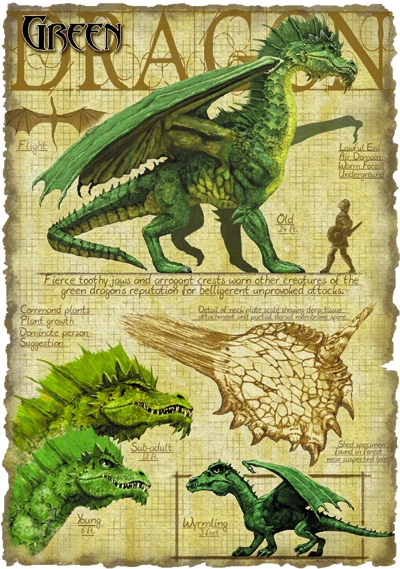
A green dragon is recognized by its curved jawline and the crest that begins near its eyes and continues down its spine, reaching full height just behind the skull. They have no external ears, but bear leathery spiked plates that run down the sides of their necks. Additionally their legs are longer in relation to the body than with any other dragon, enabling them to easily pass over underbrush and forest debris when they walks. With its equally long neck, an older green dragon can peer over the tops of trees without rearing up.
A wyrmling green dragon’s thin scales are a shade of green so dark as to appear nearly black. As a green dragon ages, its scales grow larger and lighter, turning shades of forest, emerald, and olive green to help it blend in with its wooded surroundings. Its wings have a dappled pattern, darker near the leading edges and lighter toward the trailing edges. Finally, green dragons' scales did not fully harden, granting them greater flexibility than other chromatic dragons.
These dragons were capable of expelling a cone of poisonous chlorine gas. They could use their unique breath weapon even while completely submerged underwater.
Genetics and Reproduction
Female green dragons initiated courtship with males, a process that was reflective of the females' offensive and crass behavior. After impregnation however, the relationship between mated green dragons changed, and a strong bond was formed.1210 Incubation of green dragon eggs continued for about sixteen months, with the eggs being laid at about the four-month mark.1
The mated pair developed strong ties to each other and wholly dedicated themselves to newly-hatched wyrmlings.1012 Both the mother and father typically stayed close to their eggs while they were incubating. Green dragons were the only species of chromatic dragons known to sacrifice their own lives for their brood.
Growth Rate & Stages
The green wyrmling could be easily mistaken for a black dragon, due to their nearly black scales. As the wyrmling matured, its scales became steadily lighter in color until they reached the striking green shade of an adult.3 The wyrmlings typically stayed with both parents until they reached young adulthood, at around 51 years of age. Once a green dragon set out on its own, the mated pair went their separate ways, and the bond they formed was broken.
Ecology and Habitats
These dragons were typically found to live near woodlands,8 including jungles, bayous, and forests.1316 Their domains were often easy to spot, as a heavy fog that faintly smelled of poison lingered over their domain.3
Despite the density of the trees within,17 some green dragons were known to haunt the Elven Woods and the Starwoods in Cormanthor,1819 Younger green dragons would remain within its forests until they grew to a certain age, after which they would seek out their own domain.17
Lair
The typical green dragon lair was located underground816 and was a complex of caves and tunnels, with its main entrance hidden behind a waterfall. The preferred green dragon lair was a cave high up on a cliff, but such locations were usually hard to find and thus only home to the oldest and most powerful green dragons.1 If necessary, green dragons would hide their lair behind thickets of magically-grown plant life.12
Within their lair, green dragons could command tangles of roots and vines to immobilize intruders, or compel barriers of tangled, thorny bushes to rapidly extended out as needed.3
Green dragon lairs occasionally developed what was referred to as 'chlorine haze', a buildup of residual chlorine gas. It lingered within their domain and remained ever-harmful to anyone vulnerable to its exposure.
Green dragons lair in ancient forests, often shaping stands of massive trees into compounds of interwoven branches, hollow trunks, and caverns amid mighty roots. They might also dwell amid forested ruins, particularly the former homes of those they’ve conquered.
Dietary Needs and Habits
Green dragons were omnivorous and ate just about whatever they could get ahold of,13 including a variety of plants and living animals. They especially enjoyed consuming fey creatures like elves and sprites.6
According to the sage Elminster, their appetite could be discerned by the direction of their eye movement: lateral movement meant they craved vegetation, while a straight-on stare meant they desired meat.23
Green dragons, as with some other dragon breeds, were unable to chew their food. Hence, to aid digestion, they swallowed small stones, pieces of metal, and even coins, which went into a small second stomach like a bird's gizzard. These stomach stones ground down their food and were eventually expelled in waste.
Behaviour
These dragons were known to have very bad tempers and a tendency for evil behavior. They loved intrigue and secrets. Green dragons put up a front of diplomacy and deceit when dealing with stronger foes, but they revealed their cruel and petty nature when intimidating lesser beings or when gaining the upper hand. They especially enjoyed enslaving intelligent woodland beings.
They delighted in stalking their enemies and listening in for any information they could gather before moving to attack. On occasion however, they were known to attack outright without being provoked.
When hunting, green dragons stalked their prey for extended lengths of time, continuing for days on end, until they could execute a deadly ambush. They reveled in the fear they inspired in lesser creatures, and always left at least one survivor whenever possible. Green dragons would take dominion over their victims, interrogating them for information, especially that regarding nearby treasures.
If they get into a conflict with more powerful creatures, or other dragons over territory, green dragons often feigned weakness to glean more information about their foes. Like when stalking their prey, they would wait as long as necessary―years or decades at a time―to find the right moment to strike out against an opponent.
Green dragons were mostly solitary creatures, but rarely worked together in pairs or small groups when an especially lucrative opportunity presented itself.
Green dragons valued their territory, They were extremely cunning and duplicitous foes, and loved double-crossing others.
Civilization and Culture
Common Customs, Traditions and Rituals
Like all other evil dragons, green dragons enjoyed amassing more treasure for their hoard. Among material wealth, they preferred wood carvings, instruments, sculptures, emeralds, and beryls. On occasion, they adorned their treasure with rare plants that they cultivated within their own lair, creating truly unique and priceless pieces of art.
Green dragons' true favorite possessions however, were the sentient beings they claimed as servants. Renowned personalities of the Realms―such as famous artists, adventurers, or even scholars―were considered by green dragons to be the most prized individuals to add to their collections.
Historical Figures
Claugiyliamatar, also known as "Old Gnawbones", the ancient dragon that ruled over Kryptgarden Forest in the Sword Mountains.
Buchembrallor, the "Terror of Velen" who harried ships along the coast of Cape Velen throughout the late 13th and mid–14th centuries DR.
Vorgansharax, the " Maimed Virulence" who ruled Phlan for a time
Venominhandar, the legendary wyrm of Cormanthor that lived over a millennium before Dale Reckoning.
Interspecies Relations and Assumptions
While green dragons typically exploited non-dragons with their schemes, they were not above moving against their own kind. They typically did not however scheme or plot against their own parents.
They often accepted more servile creatures as their minions. Among those known to regularly serve green dragons were kobolds, goblins, ettercaps, orcs, yuan-ti, and ettins.
Some green dragons held strong connections to the Feywild, and some were even known to serve the archfey the Queen of Air and Darkness.

Comments