

Black Dragon
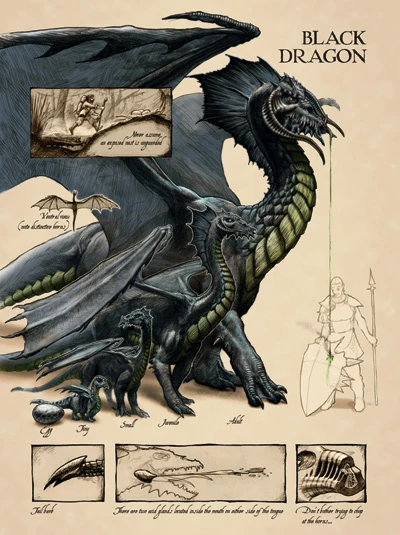
Black dragons, also known as skull dragons, are far and away the most vile tempered and cruel of all chromatic dragons. They collect the wreckage and treasures of fallen peoples. These dragons loathe seeing the weak prosper and revel in the collapse of humanoid kingdoms. They make their homes in fetid swamps and crumbling ruins where kingdoms once stood.
Basic Information
Anatomy
With deep-socketed eyes and broad nasal openings, a black dragon’s face resembles a skull. Its curving, segmented horns are bone-colored near the base and darken to dead black at the tips. As a black dragon ages, the flesh around its horns and cheekbones deteriorates as though eaten by acid, leaving thin layers of hide that enhance its skeletal appearance. A black dragon’s head is marked by spikes and horns. Its tongue is flat with a forked tip, drooling slime whose acidic scent adds to the dragon’s reek of rotting vegetation and foul water.
When it hatches, a black dragon has glossy black scale. As it ages, its scales become thicker and duller, helping it blend in to the marshes and blasted ruins that are its home.
Black dragons breathe a stream of acid.
Genetics and Reproduction
Female dragons took the lead when it came to breeding, choosing their mate largely based on the size of the hoard of prospective males. Because of this, male black dragons would often brag about their accumulated wealth to communicative creatures or others of their own kind, in the hopes that rumors of their hoard would spread to any females in the area that were looking to mate. When two or more females selected the same male as their partner, they would fight for dominance high in the air above the lair of the male, allowing him to gaze upon his future mate's victory in admiration.
Black dragons were not noted as good parents, relying more upon disguise and hiding to protect their eggs than upon guarding them personally. Black dragon eggs must be submerged in strong acid while growing, which helped protect the dragon as well. Black dragons would only protect their young so long as that responsibility didn't threaten their own life. If they had to choose between saving their own life or those of their clutch or spawn, they would most certainly choose the former; though they would assuredly seek revenge afterwards.
Ecology and Habitats
Black dragons dwell in swamps on the frayed edges of civilization. A black dragon’s lair is a dismal cave, grotto, or ruin that is at least partially flooded, providing pools where the dragon rests, and where its victims can ferment. Their lairs always have at least two entrances: one underwater through the adjacent swamp or pond, and one above-ground, disguised amidst the undergrowth. The lair is littered with the acid-pitted bones of previous victims and the fly-ridden carcasses of fresh kills, watched over by crumbling statues. Centipedes, scorpions, and snakes infest the lair, which is filled with the stench of death and decay.
Within 6 miles of a lair, plants grow thick and twisted, and the swamps are thick with reeking mud. Fog constantly obscures the air, and smells foul. Water sources within 1 mile of the lair are supernaturally fouled and corrupted.
Dietary Needs and Habits
A black dragon's diet consists of fish, mollusks, aquatic critters and some red meat from terrestrial animals. When possible, it prefers to let its food rot to better enhance the flavors.
Behaviour
All chromatic dragons are evil, but black dragons stand apart for their sadistic nature. A black dragon lives to watch its prey beg for mercy, and will often offer the illusion of respite or escape before finishing off its enemies.
A black dragon strikes at its weakest enemies first, ensuring a quick and brutal victory, which bolsters its ego as it terrifies its remaining foes. On the verge of defeat, a black dragon does anything it can to save itself, but it accepts death before allowing any other creature to claim mastery over it.
Black dragons hoard the treasures and magic items of crumbled empires and conquered kingdoms to remind themselves of their greatness. The more civilizations a dragon outlasts, the more entitled it feels to claim the wealth of current civilizations for itself.
Additional Information
Geographic Origin and Distribution
The skies over the southwestern Bay of Chessenta and southern Chondalwood have been the source of multiple sightings of black dragons. Reports from the jungles of Chult of dense, multi-layered tropical forest complete with its own ecosystem, are highlighted with tales of black dragons living within the canopy.
Civilization and Culture
Historical Figures
Chardansearavitriol, also known as "Ebondeath."
Daurgothoth, also known as “The Creeping Doom”, who embraced undeath and hunted the world as a dracolich.
Voaraghamanthar, also known as “The Black Death” and "Weszlum". He shared the title of "Wyrm of the Mere" with his twin sibling Waervaerendor.
Thauglorimorgorus, also known as "Thauglor", "Black Doom" and "King of the Forest" in Cormyr.
Sjachmalsvir, also known as "Thoss Fyurnen" and "Sun Swallower" who was the self-proclaimed Chosen of Talona.
Interspecies Relations and Assumptions
Black dragons hate and fear other dragons. They spy on draconic rivals from afar, looking for opportunities to slay weaker dragons and avoid stronger ones. If a stronger dragon threatens it, a black dragon abandons its lair and seeks out new territory.
Evil lizardfolk venerate and serve black dragons, raiding humanoid settlements for treasure and food to give as tribute and building crude draconic effigies along the borders of their dragon master’s domain.
A black dragon’s malevolent influence might also cause the spontaneous creation of evil shambling mounds that seek out and slay good creatures approaching the dragon’s lair.
Kobolds infest the lairs of many black dragons like vermin. They become as cruel as their dark masters, often torturing and weakening captives with centipede bites and scorpion stings before delivering them to sate the dragon’s hunger.

Comments