

Dragons
There are several creatures that are identified as dragons due to ancestry and classification. This article is exploring only 'true' dragons; the species that has existed mostly unchanged for millennia.
Dragons were very powerful and magical creatures. There were several types of dragons, the most common of which were chromatic and metallic, which were evil and good respectively. They were an ancient race. Few species that still exist can claim longer lineage. Dragons were the bane of the creator races of Toril; their line was so old, they had their own realm during the first recorded exploits of the elves. In recent times, the dragons of Toril were nearly all recluses or at the very least secretive as to their true nature, living among other species in polymorphed form.
Basic Information
Anatomy
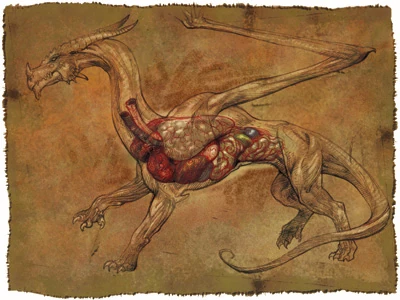
Dragons were inherently magical beings, and in no case should dragons be considered reptiles, despite obvious similarities such as a scaled epidermis and reproduction by laying eggs. In fact, they were more akin to feline creatures than reptiles, particularly in regards to their posture and movements, as well as being inherently warm-blooded and with an eye composition similar to felines, although far more complex. A good example of this was the placement of the legs: dragons also tended to place their rear foot where their front foot was previously, much like most stalking feline predators.
While each sub-type of true dragon has its own variations on morphology (unique horn, crest, coloration, wing shape, etc.), some things are common across all dragons. Specifically, dragons all have four powerful limbs ending in clawed feet, capable of grasping, climbing, and rending. They have a separate set of limbs serving as wings; massive, bat-like wings sprout from their back, and are powerful enough to allow flight (there is some argument over whether magic is also used in some way, as dragons are by no means shaped like other true flying species). These wings are often as wide as the dragon is long. They have long sinuous necks, that lead to reptilian shaped heads which bear some combination of horns, crests, and/or frills. Dragons have keen and often glowing eyes, and as mentioned above, were more akin to felines than to reptiles. Their jaws contained one row of razor sharp teeth each, and had the ability to exhale some form of elemental attack.
These creatures were covered in scales, with the coloration being the best indicator of which specific breed of dragon. The scales grow tougher with age and are almost completely unaffected by mundane weapons.
All dragons posses hearts, and dragon blood is a very rare albeit powerful magical reagent. They have lungs and breathe air, though some dragons have shown abilities to stay underwater or in realmspace for a long period of time. Likewise, all dragons posses hearty stomachs, capable of digesting even magical items.
Finally, all dragons inherently possess magical capabilities, but they varied from race to race. Metallic dragons were often able to shapechange into animal or human forms, and used this ability to secretly help or watch over humans. It is suspected that chromatic dragons also possess such abilities, but are loathe to use them due to their common superiority complexes. Most commonly, they had some innate powers upon the element they are linked to. For example a red dragon, who breathed fire, had better control over magical flame than other elements.
Genetics and Reproduction
Dragons reproduced by laying eggs. The number of eggs a female laid each brood depended on its race, but was usually low; between one and ten. Evil dragons of adult age often laid and abandoned clutches of eggs, leaving the wyrmlings to work together to raise themselves until they were old enough to go their separate ways. Good dragons of adult age, and some more intelligent evil dragons, would form families consisting of the mated pair and their offspring. The children generally left the family by the time they reached young adulthood. As dragon couples got older, they became increasingly likely to split apart as the desire for treasure began to outweigh interests in families. Older dragons would continue to mate, but would assign a single parent to the duty of raising the offspring.
Thanks to their shape-shifting, dragons could also cross-breed with virtually any other creature, creating a half-dragon. Some half-dragons appeared more draconic, similar to but distinct from the dragonborn, while others looked more like their other parent's species. The latter 'breed' would be more likely to continue the bloodline, usually with others from its humanoid parent species. This would start diluting the magical blood, but it would be prone to 'flare-ups', commonly leading to powerful wizards or dragon-blooded sorcerers. The most commonly heard of were in the humanoid races, particularly with humans and elves. Any combination was possible, however, even with devils or angels.
Most of the time when dragons of different types crossbred it resulted in no offspring. Whenever offspring did occur between different types, the offspring's biology would almost always favor one of the parent's "type" over the other and might display characteristic that varied from its norm. In very rare instances of crossbreeding yielding offspring, the resulting child's biology might favor neither parent. This might result in them being born as a new type or with albinism.
Growth Rate & Stages
True dragons went through twelve stages of growth during their enormously long life cycle. While size depended on the subspecies of dragon, great wyrms were often more than 100 feet (30 meters) in length. Unlike humanoids, age did not seem to diminish their strength, intelligence, or power, and often had the opposite effect, and so the oldest wyrms were among the most formidable and impressive creatures in all of Faerûn.
Simplified Dragon Growth Stages
| Stage | Age in Years |
|---|---|
| Hatchling | Less than 1 year |
| Wyrmling | 1 - 5 years |
| Young | 6 - 100 years |
| Adult | 101 - 800 years |
| Ancient | 801 - 1000 years |
| Wyrm | 1001 - 1200 years |
| Great Wyrm | Over 1200 years |
Dietary Needs and Habits
All dragons were omnivorous and could eat almost anything, thanks to their innate elemental nature that allowed them to consume and digest all sorts of food, including substances that wouldn't qualify as food to other living creatures. Most dragons preferred a carnivorous diet, but a few of them had developing unique dietary habits. Metallic dragons, for instance, preferred to eat primarily inorganic fare. Although they were true apex predators, dragons were not above scavenging for food if necessary.
Additional Information
Geographic Origin and Distribution
Dragons can be found across all of Toril, and even beyond. They can travel both Realmspace and Planescape with ease.
Perception and Sensory Capabilities
Dragons posses keen senses: amazing eyesight, powerful hearing and smell, and can see in darkness without any magical assistance. Adding magic into the equation means abilities such as truesight are not out of the question either.
Civilization and Culture
Major Language Groups and Dialects
All dragons spoke Draconic, and many spoke additional languages such as regional dialects (Chondathan, Illuskan), Celestial or Infernal, and Primordial. They could speak Common, but only tended to do so whilst in human form; and that was more out of maintaining their disguise than anything else. While Common serves its purpose among the 'lesser' peoples, among such long-lived creatures, it seems more like slang or pidgin and thus is not a true language to trouble themselves with.
Common Customs, Traditions and Rituals
All dragons were inherently territorial and covetous. They hoarded wealth—although "wealth" could mean different things to different dragons—and jealously protected their hoards. For most dragons, there was no such thing as enough treasure. They enjoyed collecting mountains of gold, gems, coins, and magic items. They found these treasures radiant and enticing, and would make nooks and beds for themselves in their money piles. The habit of sleeping on their wealth meant that most great wyrms had hundreds of coins and gems embedded in their hides.
Evil dragons are quick to attack anyone they perceive as a threat to their hoard, even other dragons. Good dragons are more likely to attempt diplomacy, but their desire to protect their hoard is no less intense.
History
It was not clear exactly how dragons came to inhabit Abeir-Toril, but many traditions believed their origin was related to the Tearfall. Some scholars believe this event precipitated a dramatic climatic change, which in turn sparked the rapid evolution of proto-dragons into the varied forms of dragonkind known today, while others claim that the dragon race was born from falling meteors that were actually dragon eggs.
Regardless of their true origins, in the few centuries that followed their arrival to Abeir-Toril, the dragons generally kept aloof of the world's giants and ignored them, maintaining a relative peace with their nation Ostoria. Though they regularly preyed upon the herds of animals the giants founded and tended, such as elk and rothé. This led to many minor conflicts with the giants, as they felt slaying these poachers was not only desirable, but worthy of great honor or "bragging rights." Such conflicts, however, were always personal, not tribal or regional, with most being settled by contests of might, skill, or wits rather than outright murder.
Circa -26000 DR, tensions between the two reached their peak and would erupt into a war that would last over a thousand years. It was uncertain exactly what finally set off the war between them. Despite giantkind's best efforts during this war, dragonkind ultimately drove them out of the southern portion of Ostoria. The war eventually concluded with a truce, though accounts of the event and its nature differed among the races. According to the dwarves, the dragons ceased the war due to their own civil war developing between the chromatic and the metallic dragons, known as the Dragonfall War; a conflict between the followers of Bahamut and Tiamat that subtly continues unabated even in more recent times.
Individual dragons and dragon clans came to rule large swaths of territory and battled with their rivals not only for dominion of those lands, but also over matters of religious nature as the dragons of that ancient age were devout followers of their draconic gods. This period of devastating warfare among the dragons led the race to near extinction. Eventually, draconic philosophers came to the conclusion that all of the fighting was wasteful and that gods who allowed such behavior were not worthy of their worship. This started the dragon's apathy toward their gods, which lasted for thousands of years.
Draconic rule finally came to an end when the elves created the Dracorage mythal, a powerful magical effect that incited all dragons across Faerûn to madness and mindless destruction, turning against each other and even against their offspring. This event became known as the Rage of Dragons. Dragons were unable to take control of Faerûn again, their collective power waxing and waning over the following millennia. Although exceptions were recorded throughout history, the majority of Faerûn's dragons came to occupy the niche of top predator, not ruler.
Common Myths and Legends
Dragons revere several distinct draconic gods. Most importantly is Asgorath (more commonly referred to as Io among non-dragons) as well as the Firstborn deities Bahamut and Tiamat. Other draconic gods do exist, but have essentially fallen out of favor due to dragons' history of nigh unending war.
It was prophesied among the few remaining worshipers of the draconic gods that a "Turning of the Great Cycle" would foretell the return of religious fervor among dragonkind. Recently, the dragon population of Faerûn has been greatly reduced in number; be it from wars amongst themselves, attempts to free Tiamat from her prison in the Nine Hells, and from pesky adventurers. That realization sparked the need of dragons to look for the help of their gods, marking the prophesied "turning". The dragon gods who survived the long years without worshipers received a great influx of power from their new draconic followers. However, this also threatened Faerûn with the possibility of a new Dragonfall War.
| Stage | Weight (tons) |
|---|---|
| Wyrmling | 1 |
| Young | 3 |
| Adult | 15 |
| Ancient | 40 |
| Stage | Length (ft) |
|---|---|
| Wyrmling | 8 ft |
| Young | 20 ft |
| Adult | 45 ft |
| Ancient | 80 ft |

Comments