

Blue Dragon
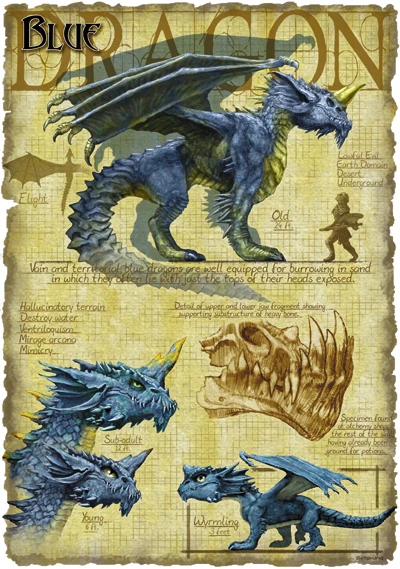
Blue dragons, referred to by sages as draco electricus1 and also known as storm dragons,9 were a breed of chromatic true dragon. Their breath weapon was a line of lightning or a large electrical discharge.
Basic Information
Anatomy
Blue dragons were physically distinguished by the single large horn protruding from their heads and also by their ears, which were rather large and frilled. Rows of spikes extend back from its nostrils to line its brow, and cluster on its jutting lower jaw. The neck was short and broad. The tail was thick and flat. A blue dragon’s scales vary in color from an iridescent azure to a deep indigo, polished to a glossy finish by the desert sands.
They smelled like electricity or sand.
Blue dragons exhaled a shocking burst of lightning at will.
Genetics and Reproduction
Despite their evil nature, blue dragons were actually excellent parents to their young, and would rarely leave their eggs unattended.
Ecology and Habitats
Blue dragons were native to arid wastelands and deserts. They made their lairs in underground caves; easily accessible to the dragons, as they could burrow through the ground. These dragons would fly above their territory, using the bleak landscape and its sparse terrain features as their best chance of spotting opponents or dramatic spires from whose tops they might see for miles.
These dragons can also be found in dry steppes, searing badlands, and rocky coasts.
Sinkholes form more frequently in the area within 1 mile of the lair. Dust devils and thunderstorms rage more often in this area too.
Dietary Needs and Habits
Though they sometimes eat cacti and other desert plants to sate their great hunger, blue dragons are carnivores. They prefer to dine on herd animals, cooking those creatures with their lightning breath before gorging themselves. Their dining habits make blue dragons an enormous threat to desert caravans and nomadic tribes, which become convenient collections of food and treasure to a dragon’s eye.
When it hunts, a blue dragon buries itself in the desert sand so that only the horn on its nose pokes above the surface, appearing to be an outcropping of stone. When prey draws near, the dragon rises up, sand pouring from its wings like an avalanche as it attacks.
Behaviour
Arrogant and imperious, blue dragons are chromatic dragons that crave control and collect followers like other dragons hoard treasure. They were orderly creatures and were unusual for chromatic dragons in that they maintained fairly well-ordered, hierarchical societies; they seek to transform their territories into empires, domains to be feared by nations. A blue dragon will not stand for any remark or insinuation that it is weak or inferior, taking great pleasure in lording its power over humanoids and other lesser creatures.
A blue dragon is a patient and methodical combatant. When fighting on its own terms, it turns combat into an extended affair of hours or even days, attacking from a distance with volleys of lightning, then flying well out of harm’s reach as it waits to attack again. They were also extremely adept at burrowing in sand, and often lie in wait just below the surface of the desert for prey. When they were so burrowed, their large horns could easily be mistaken for pointed desert rocks.
Regalia of rulership and artistic masterpieces fill blue dragons’ hoards. These dragons have no interest in treasures that are common or flawed, preferring one-of-a-kind gemstones, the crowns of fallen royals, and magic items capable of spreading the dragons’ influence.
Blue dragons also covet valuable and talented creatures whose service reinforces their sense of superiority. Bards, sages, artists, wizards, and assassins can become valuable agents for a blue dragon, which rewards loyal service handsomely.
A blue dragon keeps its lair secret and well protected, and even its most trusted servants are rarely allowed within. It encourages ankhegs, giant scorpions, and other creatures of the desert to dwell near its lair for additional security. Older blue dragons sometimes attract air elementals and other creatures to serve them as well.
Additional Information
Geographic Origin and Distribution
They seek lairs near sites of symbolic power, such as the abandoned fortresses of giants, the colossi of fallen empires, or monuments raised by their followers.
In addition, they prefer sandy areas or arid badlands for their lairs.
As such, they are most common around Anauroch, the Lands of Intrigue, the Shaar, and scattered throughout both the Cold Lands and the Unapproachable East.
Civilization and Culture
Historical Figures
Iymrith, also known as "The Doom of the Desert" in Anauroch.
Iryklathagra, also known as "Sharpfangs" who plagued the Lands of Intrigue.
Clytemorrenestrix, also known as "Nestrix" and "The Terror of the Calim."
Anaxaster and Chezzaran, offspring of Iymrith, living in ancient dwarven ruins from Delzoun; a lonely, windswept ruin on the edge of the Anauroch, near the Frozen Sea.
Abazigal, a Bhaalspawn dragon that was a member of "The Five" during the Bhaalspawn crisis.

Comments